
Summarize Content With:
What You’ll Learn
- How an AI phone answering service works beyond basic call answering
- Why after-hours and overflow calls are the biggest revenue leaks
- The difference between AI answering and traditional call handling
- How Intelligent Virtual Answering Service systems manage messages
- Why AI Answering Services for Small Business are replacing voicemail systems
- Real-world coverage model for 24/7 call handling
Why AI Phone Answering Services Have Become Essential for Modern Businesses
A modern AI phone answering service is no longer just a replacement for voicemail or a basic call-forwarding solution. It has evolved into an intelligent customer engagement layer that sits between your customers and your business operations, ensuring every inbound call receives an immediate response.
Whether a call comes in during peak business hours, after closing time, or when agents are already busy, AI-powered answering systems ensure that opportunities are not lost due to missed calls or long wait times.
Traditional reception and call-answering systems typically struggle in three critical areas:
- After-hours coverage
- Overflow call handling during peak demand
- Consistent and structured message capture
These limitations often result in missed leads, frustrated customers, and lost revenue.
This is where modern AI Answering Services create a significant operational advantage.
Instead of simply answering calls, they can understand customer intent, provide information, route callers to the right destination, capture detailed messages, schedule appointments, and document every interaction in real time. This transforms the phone system from a reactive communication channel into an active business operations tool.
The growing demand for intelligent call handling is supported by customer experience data. According to Invoca’s 2025 CX Report, 62% of inbound calls to small and medium-sized businesses occur outside business hours or during peak overflow periods. Everhelp research found that Consumer tolerance for phone wait times is exceptionally low, with industry benchmarks indicating that customers abandon phone calls if they are kept waiting for more than 1 to 3 minutes. While Salesforce reports that 79% of customers expect consistent interactions across departments. Additionally, McKinsey research indicates that AI-powered conversational agents and voice systems capture 24/7 inbound call intent, preventing leakage.
These trends explain why the best AI answering services for small businesses are rapidly becoming a core part of customer service infrastructure rather than an optional technology investment. Businesses are no longer implementing AI answering solutions simply to reduce workload they are deploying them to improve availability, protect revenue, and deliver a more consistent customer experience at scale.
What Is an AI Phone Answering Service?
An AI answering service is a conversational system that handles inbound calls using natural language processing and workflow automation.
Unlike voicemail or call queues, it actively:
- Answers incoming calls instantly
- Understands caller intent
- Captures structured messages
- Routes urgent requests
- Executes business actions
This is why modern businesses refer to it as an Intelligent Virtual Answering Service instead of a traditional answering system.
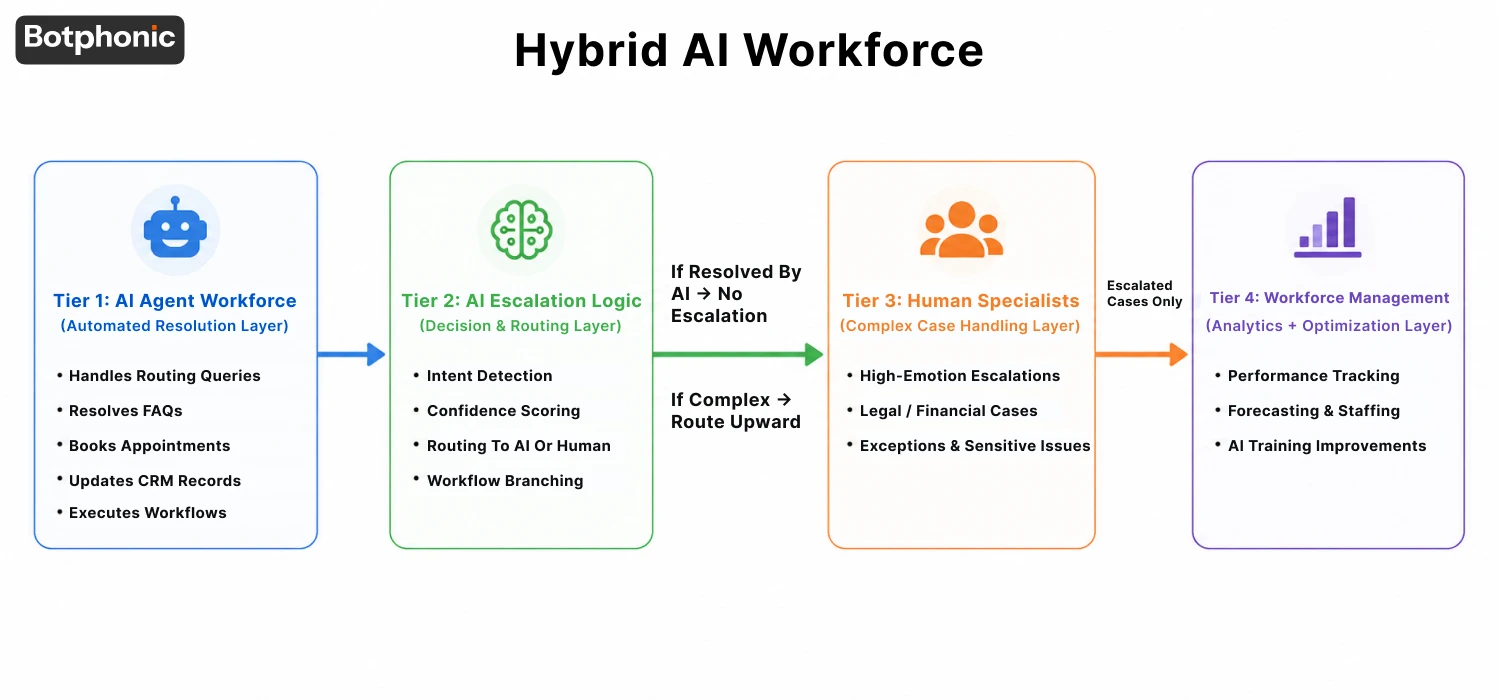
Answering-Service Coverage Model
Many businesses assume that missed calls are occasional events with minimal impact on revenue.
In reality, after-hours call abandonment is one of the most overlooked sources of lost business opportunities. Customers do not limit their needs to standard business hours. They call when a problem arises, when they are ready to make a purchase, or when they need immediate information. If no one answers, many will simply move on to a competitor that responds faster.
This is particularly true for industries where urgency plays a major role in customer decision-making.
After-hours calls frequently come from:
- High-intent buyers ready to make a purchase
- Customers seeking appointments or bookings
- Individuals requesting pricing information
- Emergency service inquiries
- Existing customers requiring immediate assistance
These callers are often much closer to making a decision than website visitors or cold leads. Losing them can directly impact revenue growth and customer acquisition efforts.
Traditional systems typically rely on voicemail, call forwarding, or delayed callbacks to handle these situations. However, voicemail rarely delivers the experience customers expect today. Many callers choose not to leave messages, and even when they do, delayed follow-up can reduce conversion opportunities significantly.
Modern AI Answering Services solve this problem by providing continuous availability without requiring additional staff or overnight coverage.
Instead of sending callers to voicemail, AI Call Assistant can answer immediately, understand the reason for the call, collect relevant information, respond to common questions, schedule appointments, and route urgent issues according to predefined business rules.
This enables businesses to:
- Answer calls 24/7 with AI
- Capture leads outside business hours
- Eliminate reliance on voicemail
- Collect structured customer information automatically
- Prioritize urgent requests
- Improve customer responsiveness
- Reduce missed revenue opportunities
Perhaps most importantly, AI Phone Call ensures that every interaction is documented and available for follow-up. Rather than receiving a vague voicemail, businesses receive organized conversation records containing customer details, intent, urgency level, and next-step recommendations.
In 2026, the advantage of AI is no longer simply answering more calls.
It is preventing revenue from slipping away when customers reach out at the moments they are most ready to engage. Businesses that provide immediate, intelligent responses after hours are increasingly outperforming competitors that still rely on voicemail and next-day callbacks.
Best AI Answering Services Landscape (2026)
The AI answering service market has evolved significantly over the past few years. What started as simple automated call handling has developed into a sophisticated ecosystem of AI-powered customer communication platforms capable of managing conversations, executing workflows, and integrating directly with business systems. However, not all solutions serve the same purpose.
Different categories of AI answering services are designed for different stages of business growth, operational complexity, and customer service requirements.
| Category | Primary Strength | Ideal Use Case |
| Best AI Answering Services | Full automation, CRM integration, workflow execution | SMBs, mid-market companies, and enterprises |
| AI Answering Services for Small Business | Cost efficiency and easy deployment | Local businesses and small teams |
| Intelligent Virtual Answering Service | Workflow automation and business process execution | Service-based industries |
| AI Answering Service | Basic call answering and message capture | Entry-level automation needs |
| Best AI Answering Services in 2026 | Advanced AI, analytics, and deep integrations | Growing and scaling businesses |
Best AI Answering Services
The leading AI answering platforms in 2026 do far more than answer incoming calls. They integrate with CRM systems, appointment scheduling tools, help desks, and business applications to create a seamless customer experience.
These platforms can qualify leads, book appointments, route calls intelligently, update customer records, and trigger automated workflows. They are particularly valuable for businesses looking to automate customer interactions while maintaining operational visibility and control.
AI Answering Services for Small Business
Small businesses often prioritize affordability, simplicity, and fast implementation. AI Answering Services for Small Business are designed to provide 24/7 call coverage without the cost of hiring additional receptionists or call center staff.
These solutions are especially popular among local service providers, medical practices, law firms, real estate agencies, contractors, and home service businesses that cannot afford to miss inbound calls but may not require enterprise-level automation.
Intelligent Virtual Answering Service
An Intelligent Virtual Answering Service focuses on workflow execution rather than simple call handling.
In addition to answering questions, these systems can schedule appointments, create support tickets, collect customer information, route urgent requests, and automate follow-up actions. They are commonly used in industries where customer interactions directly trigger operational processes.
For many service businesses, this category delivers the greatest operational value because it transforms conversations into completed business actions.
AI Answering Service
Basic AI answering services are often the first step into call automation.
Their primary role is to answer calls, capture messages, provide simple responses, and ensure customers are acknowledged even when staff members are unavailable. While they offer less functionality than advanced platforms, they still help reduce missed calls and improve customer responsiveness.
These solutions are typically suitable for businesses beginning their automation journey.
Best AI Answering Services in 2026
The most advanced AI answering services combine conversational AI, workflow automation, CRM synchronization, analytics, and business intelligence into a single platform.
These solutions not only handle customer conversations but also optimize operations through automation, reporting, and performance insights. They are increasingly being adopted by growing businesses that need scalable customer service infrastructure without proportional increases in staffing costs.
 NOTE
NOTE
How AI Phone Answering Works (Simple Flow)
- Call Comes In
A customer calls your business during business hours, after hours, or during peak call volumes.
- AI Answers Instantly
The AI phone answering service responds immediately, eliminating hold times, missed calls, and voicemail dependency.
- Intent Detection
The AI identifies why the customer is calling, whether it’s for appointment scheduling, customer support, sales inquiries, pricing information, or general questions.
- Structured Information Capture
The system collects relevant customer details such as name, phone number, service request, urgency level, and preferred follow-up information.
- Workflow Execution
Based on the customer’s request, the AI can book appointments, create support tickets, answer FAQs, capture messages, or initiate business workflows automatically.
- Urgent Call Routing
If the call requires immediate attention, the AI intelligently routes the customer to the appropriate team member or department.
- CRM Synchronization
All conversation details are automatically logged into CRM platforms such as HubSpot, Salesforce, or Zoho, ensuring accurate record keeping and follow-up.
- Conversation Summary & Follow-Up
The interaction is documented, summarized, and made available to your team for future reference and action.
This process enables businesses to provide 24/7 availability, improve customer responsiveness, and ensure that every call becomes a tracked and actionable business interaction.
Why Businesses Are Switching to AI Phone Answering Services in 2026
The adoption of AI phone answering services is accelerating in 2026 because businesses are facing a combination of operational, financial, and customer experience challenges that traditional call-handling models struggle to solve.
- Missed Calls = Lost Revenue
For many businesses, every inbound call represents a potential customer, appointment, sale, or service request. When calls go unanswered, those opportunities often disappear.
This is especially true for industries such as healthcare, legal services, home services, real estate, and professional consulting, where customers frequently contact multiple providers before making a decision.
A missed call does not simply mean a missed conversation it can mean a lost lead, a lost booking, or a lost customer relationship. AI answering services help eliminate this revenue leakage by ensuring every caller receives an immediate response, regardless of the time of day.
- Labor Cost Pressure
Providing round-the-clock phone coverage using human staff is expensive. Businesses must account for salaries, benefits, training, turnover, scheduling, and management overhead.
As labor costs continue to rise, maintaining a dedicated reception team for evenings, weekends, and overflow periods becomes increasingly difficult to justify.
AI answering services provide 24/7 coverage without requiring additional headcount. They can handle thousands of calls simultaneously, making them a cost-effective alternative for businesses that need consistent availability without continuously increasing staffing costs.
- Rising Customer Expectations
Customer expectations have changed dramatically. Consumers are accustomed to instant responses from digital services and increasingly expect the same level of responsiveness when contacting businesses.
Waiting until the next business day for a callback is no longer acceptable for many customers. They expect immediate assistance, whether they are calling during office hours, late at night, or on weekends.
AI phone answering services help businesses meet these expectations by providing instant engagement, answering common questions, capturing requests, and routing urgent issues without delay.
 PRO TIP
AI vs Traditional Answering Services: Detailed Comparison
As customer expectations shift toward instant availability and businesses look for more scalable support models, the gap between traditional answering services and AI-powered phone answering systems continues to widen.
| Feature | Traditional Answering Service | AI Phone Answering Service |
| Availability | Limited by staffing schedules, business hours, and agent availability. After-hours coverage often requires additional costs. | Available 24/7, including nights, weekends, and holidays without additional staffing requirements. |
| Cost Structure | Ongoing expenses for salaries, training, management, benefits, and staffing coverage. Costs increase as call volume grows. | Lower operational costs with predictable pricing. Can handle higher call volumes without proportional cost increases. |
| Message Accuracy | Relies on manual note-taking, which can lead to incomplete information, missed details, or transcription errors. | Captures customer information in a structured format and automatically records conversation details with high consistency. |
| Overflow Call Handling | During peak periods, callers may experience long wait times, hold queues, or missed calls. | Can answer multiple calls simultaneously and handle overflow instantly without impacting response quality. |
| Scalability | Requires hiring and training additional staff to manage increased call volume. | Scales instantly to handle seasonal spikes, marketing campaigns, or rapid business growth. |
| Response Consistency | Responses may vary depending on the individual answering the call and their training level. | Delivers consistent responses, workflows, and customer experiences across every interaction. |
| Lead Capture | Lead information is manually documented and may require follow-up data entry. | Automatically captures leads, qualifies inquiries, and logs details directly into CRM systems. |
| Appointment Scheduling | Often requires manual booking and calendar management. | Can schedule appointments automatically and sync directly with business calendars. |
| CRM Integration | Limited or dependent on manual updates by staff members. | Automatically updates platforms such as HubSpot, Salesforce, Zoho CRM, and other business systems. |
| Call Routing | Based on predefined rules or manual transfers. | Uses intent detection and AI-driven routing to direct callers to the right department or workflow. |
| Reporting & Analytics | Basic call logs and manual reporting. | Real-time analytics, conversation summaries, performance insights, and call trend reporting. |
| Business Continuity | Vulnerable to staffing shortages, absenteeism, and operational disruptions. | Provides uninterrupted service regardless of staffing levels or business hours. |
Common Mistakes Businesses Make When Handling Inbound Calls
Even businesses that invest heavily in customer service often lose leads and revenue because of weaknesses in their call-handling strategy. The problem is rarely call volume, it is usually how calls are managed when customers need help most.
- Relying on Voicemail Instead of AI-Powered Call Handling
Many businesses still depend on voicemail as their primary backup when staff are unavailable. While voicemail may capture some messages, it often creates friction for customers who expect immediate responses.
Most callers do not want to leave a message and wait for a callback. If they cannot reach someone quickly, they frequently contact a competitor instead.
Modern AI answering services provide instant engagement, answer common questions, collect customer information, and route urgent requests in real time. This significantly improves customer experience compared to voicemail-only systems.
- Having No After-Hours Coverage Strategy
Customer inquiries do not stop when business hours end. Prospective customers often call in the evenings, on weekends, or during holidays when traditional teams are unavailable.
Without a dedicated after-hours strategy, businesses risk losing:
- High-intent leads
- Appointment requests
- Emergency service inquiries
- Sales opportunities
An AI phone answering service ensures that every call is answered regardless of the time, helping businesses maintain availability without expanding staffing costs.
- Failing to Capture Structured Customer Information
Many organizations collect messages manually, resulting in incomplete notes, missing contact information, and inconsistent follow-up processes.
When important details are overlooked, teams waste time calling customers back for information that should have been captured during the first interaction.
AI systems solve this problem by collecting information in a structured format, including customer details, call intent, urgency level, and requested actions. This creates cleaner workflows and faster follow-up.
- Operating Without CRM Integration
A common mistake is treating phone conversations separately from customer records.
When call information is not automatically synced with CRM platforms, businesses often face:
- Duplicate data entry
- Lost customer context
- Delayed follow-up
- Inaccurate reporting
AI answering systems that integrate with platforms such as HubSpot, Salesforce, and Zoho automatically log conversations and update customer records, creating a more connected customer experience.
- Ignoring Overflow Traffic During Peak Periods
Many businesses prepare for average call volumes but fail to plan for spikes caused by marketing campaigns, seasonal demand, emergencies, or busy service periods.
When call volume exceeds available staff capacity, customers experience long wait times, abandoned calls, and poor service experiences.
AI answering services help absorb overflow traffic instantly by handling multiple conversations simultaneously. This ensures customers receive immediate attention even during the busiest periods.
Conclusion
The role of an AI phone answering service has evolved far beyond traditional call answering. Businesses are no longer evaluating answering solutions based solely on whether a call gets picked up. The real question is whether every incoming call is captured, understood, routed, and converted into a meaningful business outcome.
For many organizations, the biggest challenge is not handling calls during normal business hours. It is managing after-hours inquiries, overflow traffic, and missed opportunities that occur when staff are unavailable. This is where modern AI Answering Services create measurable value by ensuring customers receive immediate assistance regardless of time or call volume.
The most effective solutions do more than answer calls. They qualify leads, schedule appointments, capture structured messages, integrate with CRM systems, and trigger automated workflows. This transforms an answering service from a cost center into a revenue and customer experience asset.
As customer expectations continue to rise, businesses that rely solely on voicemail, manual message taking, or limited-hour reception coverage risk losing potential customers to faster and more responsive competitors. This is why AI Answering Services for Small Business and enterprise organizations alike are becoming a core component of modern customer communication strategies.
Ultimately, the best AI answering services in 2026 are not those that simply answer calls. They are the platforms that help businesses answer calls 24/7 with AI, maintain consistent customer experiences, and ensure that every conversation has the potential to become a booked appointment, a qualified lead, or a satisfied customer.
Stop losing customers after hours.
Upgrade to an AI phone answering service that never misses a call, never drops a lead, and never sleeps.
