
Summarize Content With:
What You’ll Learn
- Why asynchronous CRM writes are essential for eliminating dead air during AI phone calls.
- The core features agencies should look for in a white-label AI phone platform.
- How Botphonic’s multi-tenant architecture supports scalable client management.
- A practical framework for pricing, packaging, and growing recurring agency revenue.
- A proven 5-step onboarding process to reduce churn and improve client retention.
- Key compliance considerations for AI phone deployments, including consent and AI disclosure.
- How to evaluate whether Botphonic is the right platform for building a profitable AI agency.
What Is the One Technical Challenge that Kills the Majority of AI Phone Deployments for Agencies?
For the vast majority of agencies’ deployments, the technical challenge appears at the CRM integration level and not at the voice layer. Here are the reasons why one single technical choice will determine if your service will survive beyond month three.
If the AI call assistant makes a synchronous API call to a CRM to write a contact record before continuing executing the rest of the script during a live conversation – any time taken by the CRM server response breaks the call. AI models will hold on to the conversation thread until a 200 response code. Silence happens to the customer for 1.5-2 seconds on average.
This is tolerable within one single call. But when you have 300 calls per month per client and you are not aware about this technical detail in advance, the receptionist of your client will start routing callback complaints to you.
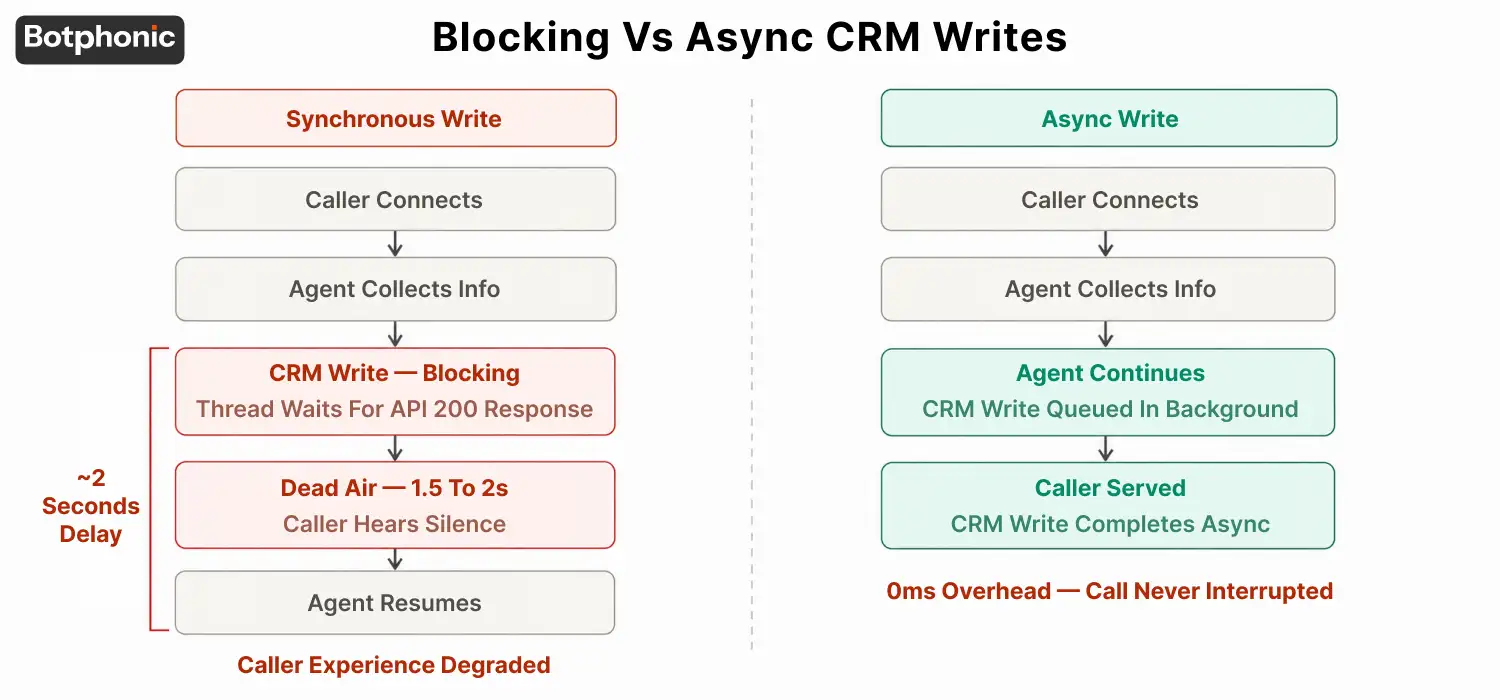
The diagram above demonstrates exactly how different blocking and non-blocking writes look like on an infrastructure level. The synchronous flow needs five actions to finish the conversation while asynchronous needs only four.
Questions to ask any vendor before buying:
“Are your CRM writes blocking or async?” The answer “it depends on the integration” means that the write is blocking. A platform designed for agency scale uses asynchronous CRM writes out-of-the-box the conversation thread does not block and wait for the API call to complete.
 PRO TIP
How Botphonic’s Architecture Solves the Dead Air Problem?
Botphonic queues all CRM writes asynchronously after the conversation thread has acknowledged the information collection. How does it impact what agencies can resell in bulk?
Agent collects information, sends an async write to the CRM queue, and continues with the conversation without waiting. The process happens in the background – usually, in the same second after the call has been completed. The caller does not feel the difference.
The CRM data is correct. The agency’s customer can see clean data in HubSpot, GoHighLevel, or Salesforce without experiencing the bad call experience that leads to one-star reviews.
This is the difference in architecture that sets Botphonic apart as an agency-grade voice platform, rather than just another SaaS solution created for a single business:
| Capability | Botphonic | Standard Single-Tenant SaaS |
| CRM writes | Async, non-blocking | Synchronous, blocks live call |
| Multi-client management | Native sub-accounts per client | Single account with manual tagging |
| White-label portal | Full branded experience per client | Logo upload on shared dashboard |
| Call handoff | Context-preserved transfer | Context dropped, caller repeats |
| AI voice customization | Per-client script and tone config | Global settings across all clients |
| Compliance toolkit | Built-in disclosure scripts + consent flags | Manual configuration per deployment |
| Agency pricing model | Wholesale markup tier | Retail pricing, no reseller margin |
| Onboarding support | Partner success program | Self-serve documentation |
The ability to perform an asynchronous CRM write is not a feature of the product. It is a requirement if the agencies wish to deploy AI calling on a large scale without receiving complaints from the customers.
What Should Agencies Look for in a White Label AI Phone Platform?
A good agency-grade white-label AI phone platform will be made for multiple client operations right from the start. Let’s examine what each of these requirements really means in practice.
Multiple tenant account management. Every client should have his or her own sub-account with unique phone numbers, ai speech scripts, and analytics. The agency administrator should be able to manage all client accounts from one place, and not log into a separate account for each one.
Custom branding and client portal. Your agency name needs to appear on every call summary, report, and login page. Platforms that just white-label the outbound caller ID will still show the vendor’s brand on the client portal. This is an indication that your agency does not position itself as the owner of the technology.
AI voice customizations for each industry. Home services clients and lawyers will need different ai speaking speed, vocabularies, and escalation paths. If the platform allows only one global voice configuration, all clients will use the same escalation path. Thus, complaints from all industries will increase.
Integration with CRM with async architecture. It has already been mentioned above, but let me repeat – the integration with HubSpot, GoHighLevel, Salesforce, or any other CRM protects you only when write requests are done in async mode.
Smart call routing and human handoff. An AI answering layer needs to be capable of transferring the customer to a human agent with the full context of the call – caller’s name, issue description, answers provided so far. When human agents do not have the full context of the call, customers are forced to repeat themselves. This is the most frequent source of complaints.
Evaluation criteria vary significantly by vendor, the best AI phone call assistants comparison breaks down how each platform handles these five requirements across different agency sizes.
What Does the Botphonic Agency Margin Framework Look Like?
Botphonic Agency Margin Framework is a markup structure where agencies pay for each call at a wholesale rate, and then the calls are bundled into a client-facing package on a monthly basis. Here is the calculation using three portfolio sizes.
The formula:
Monthly Margin = (Client Price Per Call × Calls Handled) – (Wholesale Cost Per Call × Calls Handled)
The following table uses $0.35 wholesale cost per call and $0.90 client price per call, which results in a 157% markup within the industry-standard monthly retainer pricing between $200 to $600 for local business clients.
| Portfolio Size | Calls/Month (per client) | Wholesale Cost | Client Revenue | Monthly Margin |
| 5 clients | 300 | $525 | $1,350 | $825 |
| 15 clients | 300 | $1,575 | $4,050 | $2,475 |
| 50 clients | 300 | $5,250 | $13,500 | $8,250 |
There are two factors that have a bigger impact on the result than any other: the number of average calls per client and the markup you are able to justify. If the agency bundles its Botphonic service with GoHighLevel CRM management and weekly performance reports, it can charge for the higher tiers without raising call volume cost. By reducing the markup from 157% to 130% for the 50-client portfolio, monthly profit drops from $8,250 to about $6,825 — something that should be calculated on a spreadsheet.
PRO TIP
How Do Agencies Onboard Their Client Base Without Losing Them in the First Week?
Customer turnover due to the use of artificial intelligence in phone software is generally the result of the following three failings: untested scripts, unvalidated handoff logic, and untrained clients on how to analyze their calls. Here’s the Botphonic Success Framework an onboarding process comprised of 5 steps to mitigate these risks.
Steps For Onboarding
Step 1: Conduct a call analysis of the client’s current patterns before creating any script. Get call log data from 2 – 4 weeks of call activity or have the client’s team identify 5 most common inbound call types. The call script needs to reflect the way their people answer those calls and not just follow a generic script.
Step 2: Map every call trigger before going live. What will cause the ai to escalate the call to a human?
Make sure that each of these works via a live call before you launch with the client’s number. Unoptimized handoff rules are what cause week-one issues.
Step 3: Run a 48-hour shadow period with call recording enabled. Let the AI agent take calls simultaneously with the human operator for two business days. Analyze all calls when the AI and the human took different actions. Optimize the script before you retire the human fallback option.
Step 4: Send the client a week-one performance report with three key metrics. Prove: (a) how many calls were taken vs. lost prior to deployment, (b) how many calls were handled by the AI agent in week one, (c) how many calls were escalated to a human. This sets a baseline to justify retention in month two without your needing to make your case.
Step 5: Schedule a 30-day script optimization review meeting. Patterns will change. Objections will change. Seasonal calls will arrive. Agencies that review and optimize the client’s scripts after 30 days keep accounts longer than those that do not.
If you’re deploying your first Botphonic client, use this 5-step framework as a repeatable checklist. Most agencies can complete steps 1 through 3 in under a week. The AI phone call assistant deployment roadmap for agency client follow-ups includes the script audit template agencies use in Step 1.
 NOTE
NOTE
Why Opt for Botphonic for Compliance Needs?
The compliance strategy employed by Botphonic caters to the three layers of regulation agencies are contractually responsible for with regard to resale of AI phone services. This is what they entail and the actual liabilities associated with them.
Call recording and consent. In most states, there is the requirement of one party consent meaning that only one party must be made aware that the call is being recorded and the AI agent makes that cut. Some states like California, Florida, Illinois, Maryland, and more require consent from all involved parties prior to recording. The disclosure script framework by Botphonic incorporates consent language right at the start of each call with an option of configuration in multi-state operations requiring strict consent language.
AI voice disclosure. Following the FCC ruling in 2024 about AI-generated robocalls and the emerging state requirements for AI disclosure, outbound AI calls require disclosing the non-human nature of the caller. This is done through the mandatory language incorporated in the outbound scripts offered by Botphonic.
Data handling and privacy. Transcripts from calls, contact data, and CRM records generated by the AI-powered bot are the client’s data. Data architecture of Botphonic segregates every client’s data at the sub-account level. It is essential for agencies to clarify data ownership, storage period, and data breach notifications obligations in the client’s contract, not just in the vendor agreement.
Technical reliability. Botphonic is SOC 2 Type II certified, GDPR compliant, and HIPAA compliant, independently audited standards that matter when agency clients are in healthcare, finance, or legal verticals where a vendor’s compliance posture directly affects the agency’s liability exposure.
Is Building Your Agency on Botphonic Worth It?
Building your agency on Botphonic’s platform is worth it when you have the pipeline to reach 3 to 5 clients within your first 90 days. Here’s why that number is the actual break-even threshold, and what a real white-label partner’s results look like after six months on the infrastructure.
The wholesale platform cost is relatively fixed. Client revenue scales per sub-account added. An agency with 3 clients generating $450 in monthly margin each covers the platform cost and demonstrates the model before expanding. Agencies that sign one client and wait see the math work against them while they’re waiting.
What Serenity’s White-Label Build Proves About the Timeline
Serenity AI is an e-commerce monetization platform that built its entire AI voice product on Botphonic’s white-label infrastructure rather than developing from scratch. The alternative would have taken 18 to 20 months of internal development with a dedicated engineering team and no guaranteed outcome. Serenity chose the white-label route instead, and was operational in weeks, not months.
After six months on Botphonic’s infrastructure, Serenity reduced outreach costs by 80%, tripled their cashback redemption rate, and increased cross-sell revenue by 60%. The platform handled thousands of customer conversations across multiple languages, integrated directly with Shopify, HubSpot, and Salesforce, and operated under Serenity’s own brand. Their merchant clients never saw Botphonic in the product, they saw Serenity’s AI.
The most relevant data point for agencies is this: Serenity’s merchants cancel their subscription if they don’t see results within 60 to 90 days of deployment. That’s the same window where agency AI phone clients churn. The Botphonic Success Framework in the section above exists specifically to produce visible, reportable results inside that window, so the 30-day performance report lands before a client has any reason to question the service.
Scaling Path Based on the Serenity Model
Month 1: One pilot client. Validate call quality, handoff logic, and script accuracy before selling the service broadly. Serenity’s experience shows deployment speed matters, every week without results is a week inside the 60–90 day cancellation window.
Month 3: Three to five clients. Onboarding is now templated. The first client’s performance data closes the next three conversations.
Month 6: Ten to fifteen clients. Referrals begin to supplement outbound sales. At this stage, margin typically funds a full-time account manager’s salary. Serenity’s six-month mark was where their most significant performance gains appeared, 80% cost reduction and 3X cashback redemption came from compounding call volume, not from a single deployment.
Month 12–18: Thirty to fifty clients. At 50 clients on the pricing model above, monthly margin reaches $8,250, not from any single large contract, but from a retained base of local business clients generating consistent call volume.
Churn in this model is driven by two failure points: missed handoffs that frustrate callers (prevented by Step 2 of the Botphonic Success Framework), and scripts that drift from real call patterns over time (prevented by the 30-day review in Step 5). Agencies that resolve both retain accounts past the 90-day mark. Those that resolve only one see cancellations cluster right at it.
For agencies evaluating whether this fits their current service mix, the full breakdown on why agencies are building recurring revenue with AI phone call automation covers the positioning and packaging decisions that separate agencies who retain clients from those who churn them.
Whether you’re adding AI calling to an existing agency or launching a dedicated AI automation business, Botphonic provides the infrastructure needed to scale recurring revenue without building voice technology from scratch.
Become a PartnerConclusion
The transition of agencies to Botphonic is due to white label AI phone call software that is designed with async architecture and multi-tenancy management making agency-client relationships subscription-based instead of being project-based. It is important to choose the right platform and not the right AI as the technical architecture will ensure that the dead air issues, compliance issues, and onboarding issues do not kill clients even before the service can prove itself valuable.
