
Summarize Content With:
What You’ll Learn
- Why client silence, not bad results, drives most agency churn
- What an AI phone agent for client follow-ups actually does
- How proactive voice AI customer service fits QBRs and renewal cycles
- What to check before connecting one to your CRM
- Whether the retention math justifies the switch
What Is an AI Phone Agent for Client Follow-Ups?
An AI phone call agent for client follow-ups is software that will automatically place or answer a structured check-in call with clients in-between deliverables. The tool will ask satisfaction-related questions, listen for hesitation and frustration, record the call as CRM data, and flag at-risk accounts to a human before making the renewal decision.
Why It Really Matters: Relationship Entropy, Not Worsened Service
Agencies very rarely lose their clients due to either better creative services or worse results by their competitors. In most cases, they lose them due to what we call “relationship entropy” – natural deterioration of engagement that takes place once the team can’t handle additional check-ins anymore. Nobody made a conscious decision to become less involved in the account; the calendar just ran out of space.
This changes the problem statement significantly. Instead of trying to motivate people to become more diligent with account management, one needs to set up a system of checking-in that won’t depend on people’s schedule.
The Shift: Stop thinking about follow-ups as something that an account manager should do. Think about them as automated data collection on clients’ satisfaction level.
Why Does the Agency Client Stay Silent Before Cancelling?
Client silence is always the first sign of churn, not satisfaction. The client who is not responding quickly is not busy – they are deciding.
Such an insight, once you get it, is always much more valuable than comparisons of churn rates across the industry, since it is relevant to the actual failure pattern the agency experiences – the silent client, not the loud one.
Manual Check-Ins Cannot Be Scaled Past a Certain Number of Clients
The account manager holds five clients in his or her mind. With twenty clients, some client is overlooked monthly. These clients are not typically the most vocal problem-causing clients – they are the ones that no one ever got back to.
On the ground: the founder or the account manager performs manual check-ins based on memory, not systems. The first client overlooked during a busy week is always the “quiet” client that doesn’t cause any problems.
The 60-to-120-Day Warning Period Agencies Fail to Notice
Warning signals of departure generally emerge 30 to 90 days before clients declare their intention to leave in the form of delayed responses to emails and missed meetings (Swydo, 2026). The time frame is sufficient for any actions to be taken; however, most agencies don’t experience it since no one calls just to inquire.
How the AI Assistant Actually Works: The Technical Architecture
This is the part most vendor pages skip, and it’s the part that determines whether the call sounds like a person checking in or a telemarketer reading a script. Four components matter:
| Component | What It Does | Why It Matters |
| Voice-to-text latency | Converts the client’s spoken words to text in real time, typically in the 200–500ms range for production systems | Anything slower and the pauses feel unnatural, clients notice “dead air” faster than they notice imperfect grammar |
| Sentiment analysis confidence scoring | Attaches a confidence score (not just positive/negative/neutral) to each detected sentiment shift | Low-confidence flags get held for human review instead of triggering a false escalation or a false “all clear” |
| Post-call data sanitization | Strips or redacts sensitive figures (budget numbers, PII, internal metrics) before the transcript is written to the CRM | Prevents sensitive client data from sitting in plaintext logs accessible to anyone with CRM read access |
| AI hallucination guardrails | Constrains the agent to a defined script tree and confirmed CRM facts; the agent cannot invent commitments, pricing, or promises on the client’s behalf | The single biggest fear agencies have isn’t “sounds robotic” — it’s “says something we didn’t authorize” |
Ask any vendor to walk through these four points specifically. A vendor that can’t explain their sentiment-confidence threshold or their hallucination guardrail is asking you to trust a black box with client-facing calls.
How Does an AI Phone Agent Manage Renewals and QBR Follow-ups?
AI phone agents focused on renewals make three calls on a schedule: scheduling QBRs, pre-renewal check-ins, and sentiment flags.
The 30-to-60-Day Renewal Trigger Sequence
Each contract has a renewal date. The AI phone agent contacts the client between 30 and 60 days before the date, checking for satisfaction and raising issues while there’s time to correct them. It is too late when it waits for the renewal e-mail.
 PRO TIP
Sentiment Flags: Detecting Dissatisfaction Before the Cancellation E-mail Arrives
The AI phone agent monitors tone, pauses, and certain phrases indicating dissatisfaction; it uses the exact same approach as in all AI-in-the-contact-center solutions, where voice analysis identifies risky calls and routes them to a human right away, without trying to solve them.
| Follow-Up Approach | Response Time | Scales Past 20 Clients | Captures Structured Feedback |
| Manual account manager calls | Days to weeks | No | Rarely — notes vary by person |
| Voicemail or generic IVR | Client-initiated only | Yes | No |
| AI phone agent (e.g., Botphonic) | Same day, on schedule | Yes | Yes — every call logged |
Feedback collected this way feeds directly into your customer feedback services and shapes how the next QBR gets framed.
Human-in-the-Loop Decision Criteria: Precisely When the Call Needs a Person
That’s the formula for the system feeling like it can be trusted or like it’s playing games. The decision is always made instantly if it’s something that the algorithm doesn’t have the capability to resolve.
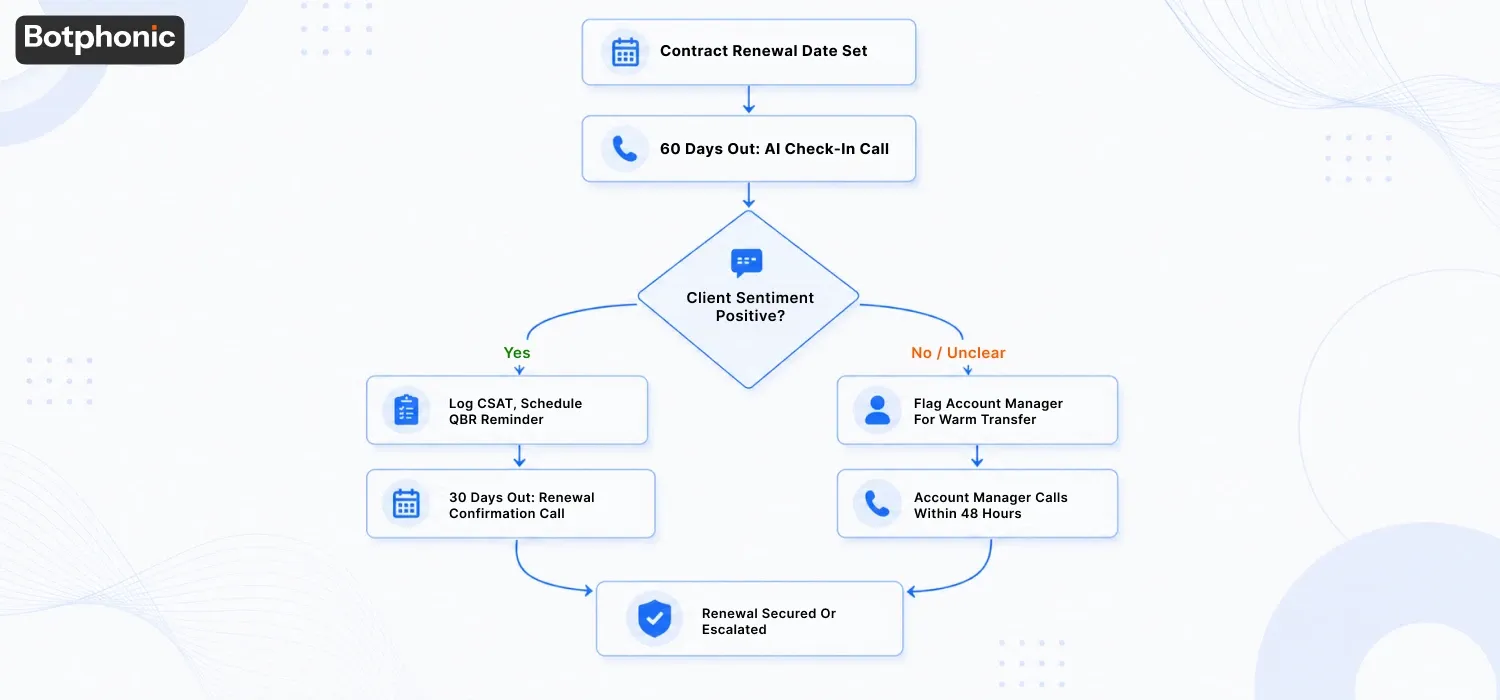
Decision flow:
- Call initiated according to set schedule (60 days before renewal date, or on set QBR schedule)
- AI initiates structured satisfaction questions and picks up sentiment
- Sentiment evaluated – Was there a positive, neutral or negative sentiment, and what was the confidence level?
- Positive/high confidence -> Record CSAT, schedule QBR call, no further human intervention necessary
- Negative/hesitant/low-confidence -> Set flag for warm transfer to account manager
- Request made by client to speak to human -> Instant warm transfer, no attempt by AI to resolve issue
- One month out from renewal -> Renewal confirmation call is made
- Flag set at any point -> Account manager makes contact within 48 hours
- Result recorded: Renewal confirmed or escalation handled by human
The principle that makes all this possible: the AI will never try to convince an agitated client that there is no need to raise an issue that the machine is not trained to deal with. It brings forward the issue, and stands down.
Why Revealing the AI’s Identity Creates Trust Instead of Skepticism
Make sure that you inform your clients whether it is the artificial intelligence they are dealing with. Knowing about the technology makes people feel more comfortable and less suspicious since everything is transparent in such a case. Otherwise, the negative consequences of discovering the deception can be much graver than the disclosure itself.
What Should Be The Features Of an Artificial Intelligence Phone Agent For Following-Up Clients?
Integration With The CRM System Is Key
Without integration with the system such as HubSpot, Salesforce, Pipedrive, the team has to do the copying of the information by hand. The live transcription and writing the information into your CRM system make a real value out of the conversation.
Important: Request a live demo of the CRM write-back from any vendor; do not accept a screenshot. Syncing a field during a sales demo and failing to do so in a production environment is quite common.
If you’re evaluating providers, compare the top AI phone call software for agencies based on CRM integrations, sentiment analysis, automation workflows, and reporting capabilities.
Data Privacy and Compliance Are Non-Negotiable for Client Outreach Calls
Agencies process sensitive client information with every follow-up call they make, including budget amounts and internal metrics. Before choosing a product, ensure it adheres to SOC 2 criteria and is compliant with GDPR or HIPAA in terms of handling the recorded calls and transcription, depending on your requirements – specifically, whether post-call sanitization (see architecture table above) occurs before or after storing in CRM.
Is an AI Phone Agent Worth It for Following Up on Clients?
If you are running fifteen or more retainers, then AI following up is beneficial for you in one saved account.
The profit gain of 25%-95% can result from a mere 5% increase in customer retention rate because it costs a lot less to retain customers than to attract new ones (Harvard Business Review / Bain & Company, 2014). Compare that to the price of one AI phone agent subscription, and the break-even point is quickly achieved in most retainer accounts. The push from executives to take action is growing as well: 91% of customer service leaders say they feel pressure from executives to use AI in 2026 (Gartner, 2026).
Monitor your customer satisfaction score as a lagging metric. When CSAT falls, it means that there was already a problem flagged by the sentiment of your AI agent weeks earlier. And most service leaders don’t plan to lay off employees due to that shift – 85% of them say that they plan to augment rather than replace their human agents (Gartner, 2026).
Relationships for the Future at Your Agencies
“A phone AI agent is not a support system; rather, it is a preventative agent detector. With voice sentiment analysis that digitizes the ‘vibe’ of the agency’s customer relationship, agencies will be able to shift from reactive fire fighting to proactive retention, converting 15 minutes on the phone to predictive CRM.”
Many agencies are also adopting AI phone call automation for marketing to improve lead qualification, campaign follow-ups, and client engagement from the very first conversation.
Customer experience initiatives are shifting towards proactive personalized follow-ups beyond quarterly check-ins. Customers now expect that companies will reach out to them without their having to ask for updates, and this expectation is only growing stronger. Begin with one high-risk cohort, see what impact it has on your renewal rates, and go from there.
See how Botphonic’s AI phone agent automates client follow-ups, identifies churn risks, and helps agencies strengthen long-term client relationships.
Try Bothphonic Demo Today!!