
Summarize Content With:
What You’ll Learn
- Why BDC and service drive phone workflows break down, and what it costs in automotive leads
- How AI phone call software for dealerships integrates with CDK, Reynolds & Reynolds, and your dealership CRM
- What real-time DMS sync means for appointment scheduling and vehicles for sale inventory
- How to measure ROI beyond call volume: show rates, RO growth, and labor savings
- A step-by-step implementation guide for auto dealership AI rollout
AI phone call software for dealerships is a voice automation layer that connects inbound calls directly to your DMS, CRM, and scheduling systems. It is built for franchised and independent auto dealerships that lose revenue when calls go unanswered across the BDC and service drive. The stakes: the average dealer misses up to 30% of inbound calls during peak hours.
Why Do Dealerships Keep Getting Missed Voicemails?
There is a structure problem rather than a staffing issue when it comes to missed calls at dealerships. Business Development Center associates take care of sales inquiries, while service advisors work on the service side. Neither works for the other, and customers don’t wait.
BDC and Service Drive Are Working Isolated from One Another
The Business Development Center is set up to manage all sales processes – taking care of internet lead responses, dealing with test-drive requests, and turning ups into appointments. The service advisors are set up to deal with the lane: meeting customers, creating repair orders, and managing technician performance.
At 5:45 p.m., the service drive closes down. The BDC representative answering the call can’t get the repair order. This results in the call being disconnected or left at voicemail.
This structure has been there forever. But what is new is the consumer expectation of always getting a response.
What Dealerships Really See
On the flip side, when you have a 20-line dealership with 6 people in your BDC, you know that you are going to get hit with an influx of call volume around lunchtime, Saturdays, and Mondays. If you have just 1 person off because he’s sick and 1 person tied up on a call, you have a chain reaction where calls get kicked into voicemail and those voicemails don’t get picked up that day. Leads become cold leads.
Your service drive experience is slightly different: You have a customer calling in to check whether his car is ready. The advisor is already busy with a customer. The call gets routed to the general phone line. No one picks up. This customer then calls your competitor to make an appointment for the next time around.
 PRO TIP
What Is the Difference Between a BDC AI and a Service Drive AI?
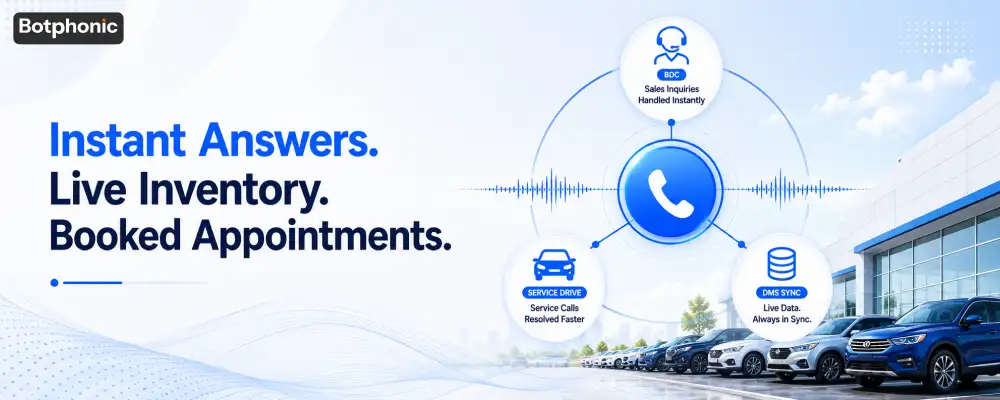
There isn’t a generic solution for dealerships when it comes to AI for phone calls. BDC AI call assistant manages inbound sales inquiries, qualifies leads, and schedules test drives, while service drive AI manages status calls, recalls, appointment reminders, and pickup scheduling.
BDC AI: From Message-Taking to Lead Conversion
Traditionally, if the BDC was busy, then leaving a message meant that the representative would eventually call the customer back. AI-powered BDC call handling changes the objective: qualifying the lead during the first interaction.
If someone calls about a particular used truck, they should get real-time inventory verification, not “let me give you a call back so I can verify the availability.” Botphonic’s AI phone call assistant for automotive sales teams are developed with live inventory lookup functionality in mind.
The BDC “ups” mentality, every visitor, every phone call, every “up” is an up that has to be converted, is easily translated into AI technology: every phone call gets captured, qualified, and either routed or booked.
Service Drive AI: Status Calls With No Advisor Distraction
Status update calls take up to 30% of the time a service advisor spends working in the shop per day (NADA).
The AI does this all on its own: retrieving RO status information from CDK or Reynolds & Reynolds and delivering the same information to the caller. The advisor remains on the showroom floor. The customer gets their question answered.
How Does AI Phone Call Software Integrate with CDK and Reynolds & Reynolds?
True DMS integration is two-way: both read and write, not just screen scrape or look up. It is through this type of true DMS integration that AI phone call software can revolutionize operations at the dealership.
How API Depth Drives What AI Can Achieve
A shallow integration can verify that an appointment is set. A deep API integration can verify bay availability, part availability, and even create a new appointment, all during one call.
Both CDK’s Drive platform and Reynolds & Reynolds’ ERA-IGNITE offer developers an API layer to integrate with. Those with access to this feature can read service schedules, get RO status information, vehicle histories, and even make appointments in real-time.
Without this capability, all an AI can do is take messages. With this feature, an entire category of inbound calls can be automated with AI technology.
The Double-Booking Situation That Bi-Directional Sync Fixes
Scenario #1 – The AI books an oil change at 10 AM Tuesday. Meanwhile, the service coordinator books the same bay at 10 AM via DealerSocket. The client arrives and there is no available bay.
Bi-Directional sync means that the AI writes to the same system the coordinators use to book appointments. This means that when CDK says that the bay is busy at 10 AM, the AI offers 11 AM instead. No double-booking, no dissatisfied customers.
 NOTE
NOTE
What Criteria Dealers Should Consider When Choosing AI Phone Call Software?
Integration, Quality of Conversation, and Escalation Strategy – these are the only factors that matter when choosing AI software for dealers. This is how the different solutions stack up against each other.
Comparing AI Phone Call Approaches for Auto Dealerships
| Feature | Basic IVR / Phone Tree | CRM-Connected AI (e.g., VinSolutions + chatbot) | Full DMS-Integrated AI (e.g., Botphonic) |
| Answers after-hours calls | Yes | Yes | Yes |
| Qualifies leads in real time | No | Partial | Yes |
| Reads RO status from DMS | No | No | Yes |
| Books appointments into DMS | No | No | Yes |
| Handles objections conversationally | No | Partial | Yes |
| Escalates to live agent seamlessly | Manual | Manual | Rule-based, automatic |
| Works with CDK / Reynolds | No | Partial | Yes (certified API) |
| Tracks lead source attribution | No | Yes | Yes |
Basic IVR navigates callers into menus. CRM-powered solutions such as VinSolutions’ chatbots work with web leads but not with voice. DMS-integrated AI systems are the only category that closes the loop with the call and ROR or the appointment.
How LLM-Powered Agents Handle Objections
Old call bots had problems with anything outside script. For example, “I was quoted $89 for the oil change last time,” meant dead end for the caller.
Large language models (LLMs) handle objections by understanding context. They could recognize the previous quote, confirm the price from the DMS, and confirm it (if within the dealer parameters) or escalate the call to a service advisor, but without making a caller feel stuck in a loop.
It’s not about replacing the advisor at all. This is just additional coverage for those 80% of calls which don’t need a professional.
How Do AI Calls Improve Automotive Lead Conversion?
The use of AI phone call software for dealerships allows improving the process of lead conversion by eliminating the lag between inquiry and response. The speed of lead is the most influential factor in automotive sales.
The Need for Speed: What the Numbers Tell Us
Dealers responding to a lead within 5 minutes have a 21x better chance of qualifying that lead compared to dealers responding to leads within 30 minutes (Research by Harvard Business Review/InsideSales.com as per Lead Response Management Study).
Most dealerships have an average first response time of 30 to 90 minutes from a human representative at their BDC centers – and 0 minutes outside office hours.
AI answers the call right away, qualifies the prospect, verifies the availability of vehicles, and books the test drive even before the prospect thinks about moving on to the next dealership.
Lead Qualification: Sorting Out Hot Leads
All leads are not created equal. “What year model truck do you have?” indicates a preliminary stage of prospecting. “Do you have the F-150 available for a Saturday morning test drive?” indicates a buying stage.
Hot leads qualified by AI are routed directly to a sales manager or the BDC representative through a text message alert – including the call summary.
Dealerships using Botphonic’s AI phone call assistant tools report that human agents spend more time on conversion conversations and less time on intake screening.
What Change Happens in Dealerships When Using AI Phone Software?
First of all, after implementation, the first change is after-hours coverage. Second, it is response consistency. Third, and most valuable, is the increase in appointment show rates.
Metrics That Actually Matter for Dealership ROI
| Metric | What to Measure | Why It Matters |
| After-hours capture rate | Calls answered vs. total after-hours volume | Reveals previously invisible revenue |
| Appointment show rate | AI-booked vs. human-booked show comparison | Validates AI scheduling quality |
| Service RO growth | Fixed ops revenue before/after AI | Ties AI to fixed ops P&L |
| BDC labor cost per lead | Cost per qualified lead, AI vs. human | Makes the staffing ROI case |
| Lead response time | Minutes to first meaningful contact | The single highest-leverage sales metric |
Staffing Cost Comparison
Annual turnover of the BDC is 60-70% at franchised dealerships (NADA Workforce Study, 2023). Hiring, training, and replacing each employee cost $10,000-$15,000.
An AI system does not take sick leave, will not quit after 90 days, and does not require paying for overtime work on Saturday. The cost comparison is not “AI vs. one BDC representative.” The cost comparison is “AI vs. constant turnover and staffing cost cycle.”
How Do You Implement AI Phone Call Software at a Dealership?
The implementation of AI phone call software at a dealership is made in three phases: configuration, piloting, and scaling. Haste in any of those phases results in missing escalations logic which frustrates the customer.
Phase 1: Define the Escalation Playbook
Before launch, establish criteria for the AI handing off to live agents. When does the transition occur? Examples are when the caller expresses frustration after two interactions, calls related to a lemon law case, the caller asks for a named manager, or all calls related to an automobile accident.
These criteria are unique to each dealership. A used car dealer that deals with high traffic will have more specific escalation criteria compared to a luxury franchise.
There are privacy and compliance considerations here too. TCPA compliance controls automated dialing of mobile phone numbers. Ensure that your AI provider is compliant for outbound follow-ups.
Phase 2: Start With After-Hours and Overflow
The least-risk path forward starts with after-hours and overflow handling. There is no displacement of human employees. The AI handles calls that were missed before anyway. Phase 2 allows you to gather clear data about the types of calls, objections, and bookings – before adding live-hour coverage.
Phase 3: Integrate Your CRM and DMS Tech Stack
For full value, you need integration within your crm for car dealerships. Your VinSolutions, DealerSocket, and CDK have to be linked, not just for read but for write-back capability on appointments, lead, and follow-up tasks.
Reynolds & Reynolds dealers will check API access from ERA-IGNITE with their DR. CDK dealers will validate Drive API access credentials before vendor onboarding process starts.
Without doing that, you have only the answering machine service. But with the step, you have the business process.
Discover how Botphonic’s AI call assistant captures every lead, updates your DMS in real time, and keeps your dealership available 24/7.
See Botphonic in actionThe Hybrid Intelligence Model: What Dealerships Need
Dealerships that have advanced further are not substituting human agents with artificial intelligence. They utilize AI as the first tier, gathering information, qualification, and scheduling so human agents deal with conversion, building relations, and complex cases.
Service advisor that does not receive status call from customers uses this time for selling more expensive brake flush services and tire rotations. BDC representative who gets pre-qualified hot leads will sell more per hour. It’s simple mathematics.
Dealers who incorporate the software into their DMS and CRM systems by design will see more conversions, reduced per-lead cost, and better customer experiences than competitors who still use phone trees and callbacks.
This is not a theoretical question; the calls are coming now. The only question is whether your technology is ready for them.
