
Summarize Content With:
What You’ll Learn:
- The exact cost of one misrouted call in terms of dollars, broken down by industry.
- What AI call routing is, what it entails, and who is it intended for?
- What is the logic of intelligent call routing, step by step?
- How intent analysis, CRM integration, and contextual intelligence change the results.
- The future of contact center artificial intelligence based on research from 2026-2027.
- What Botphonic customers know that benchmark studies don’t reveal.
- Which performance indicators to monitor before and after implementing an AI-based solution.
AI call routing is an advanced technological solution that uses natural language processing, machine learning algorithms, and live customer data to route calls to the correct destination – be it an agent, queue, or a self-service option – using voice commands only, and without any menu prompts or key presses.
How Much Does One Misrouted Call Really Cost You?
One misrouted call is actually much more expensive than you think.
The average cost of handling an inbound call ranges anywhere between $2 and $15 based on industry and complexity as cited by Teneo.ai’s 2025 Cost of the Contact Center Study. It is not enough that one call goes wrong; two or even three more will be added into that toll because research by Customer Care Measurement & Consulting reports that unresolved issues usually generate between 1.5 and 2.5 more contact attempts, each of which adds another layer onto the original call handling fee.
In a mission-critical vertical, that translates to:
Healthcare example:
A patient calls for help in getting a prescription renew. The IVR system forwards her to the general line instead of directing her straight to the pharmacy line. The rep cannot process the request and transfers her call to the right representative. This time, the patient needs to start over. The pharmacist must manually retrieve the record from his computer and spend extra time trying to help the flustered patient. The simple, 90-second phone call now lasts 12 minutes, makes the patient upset and raises HIPPA red flags if he gets the details wrong. That single mistake costs anywhere from $20-30.
Example in financial services:
Customer calls to report a suspicious charge. Instead of forwarding the caller to the fraud team, the IVR puts them in account services. The transaction proceeds while the customer waits 4 minutes for the transfer. Customer exposure to liability has changed. Bank exposure has changed. Phone voice calling is specifically used in healthcare, banking, and insurance exactly because of the sensitive nature of the information — making mistakes when connecting customers can result in more than a disconnected call.
This same process scaled up to a contact center dealing with 4,000 calls per day and a 15% error rate translates to 600 calls routed wrongly per day. At an estimated $8 per customer interaction, the cost of misrouting calls is around $4,800 per day, or almost $1.7 million annually, without considering customer churn.
The Difference Between Possessing and Utilizing AI
Why does this matter? According to 2026 contact center statistics, only 25% of companies use AI effectively in their contact centers. These statistics are from a survey by AmplifAI as reported by CMSWire in 2026.
The remaining 75% purchase AI applications which they have yet to operationalize. In America, firms continue to lose approximately $75 billion each year due to bad customer service; this figure has remained unchanged even as AI budgets rose.
Purchasing AI call routing software is one thing; implementing it so that it produces tangible results is another. This is the critical difference between companies which achieve ROI using their AI applications and those which say “we tried AI.”
Why is Traditional Call Routing the Norm, and Why Does That Matter?
IVR routing remains standard because it is familiar technology, inexpensive to keep running, and native to older telephony infrastructures. However, customer patience for traditional IVR routing has waned considerably, despite increased call complexity.
How a Badly Routed IVR Call Works
Here’s how this happens: The caller selects “2 for billing,” though they have questions about potential fraud. After a 90-second wait, they talk to a billing agent who tells them he can’t solve their problem and transfers them. After explaining themselves again to the fraud team, total elapsed time amounts to 7-9 minutes. First-call resolution rate: 0%.
According to Salesforce’s report of 2024, 88% of customers indicate that the experience provided by a company is just as valuable as their product or services. A bad routing system is a terrible experience. It is one of the key reasons why people churn from their provider.
Contact Centers Are Dealing with More Complexity with the Same Solutions
Omnichannel customer support, hybrid contact center employees, and increasing complexity of services all mean that static routing trees are no longer able to keep up. Volume surges put pressure on queue logic built for average volume. Human agents are limited resources. Poorly designed routing makes every problem further downstream even worse.
 PRO TIP
AI Call Routing vs. Interactive Voice Response (IVR): What’s the Difference?
The difference from traditional IVR is not just technical. It is architectural. IVR asks the customer to classify their own call. AI call assistant classifies it for them.
| Feature | Traditional IVR | AI Call Routing |
| Input method | Keypad or basic voice command | Natural language speech |
| Routing logic | Menu-based, static | Intent-based, dynamic |
| Personalization | None | Context-aware (CRM, history, tier) |
| Transfer rate | Higher | Lower |
| CRM integration | Basic or none | Deep and real-time |
| Self-improvement | No | Yes, learns from call outcomes |
| Customer effort | High | Low |
AI Routing Process; How It Works Step by Step?
Routing occurs within just two seconds. Below is an outline of the logic sequence starting when the call begins and ending at its intended destination.
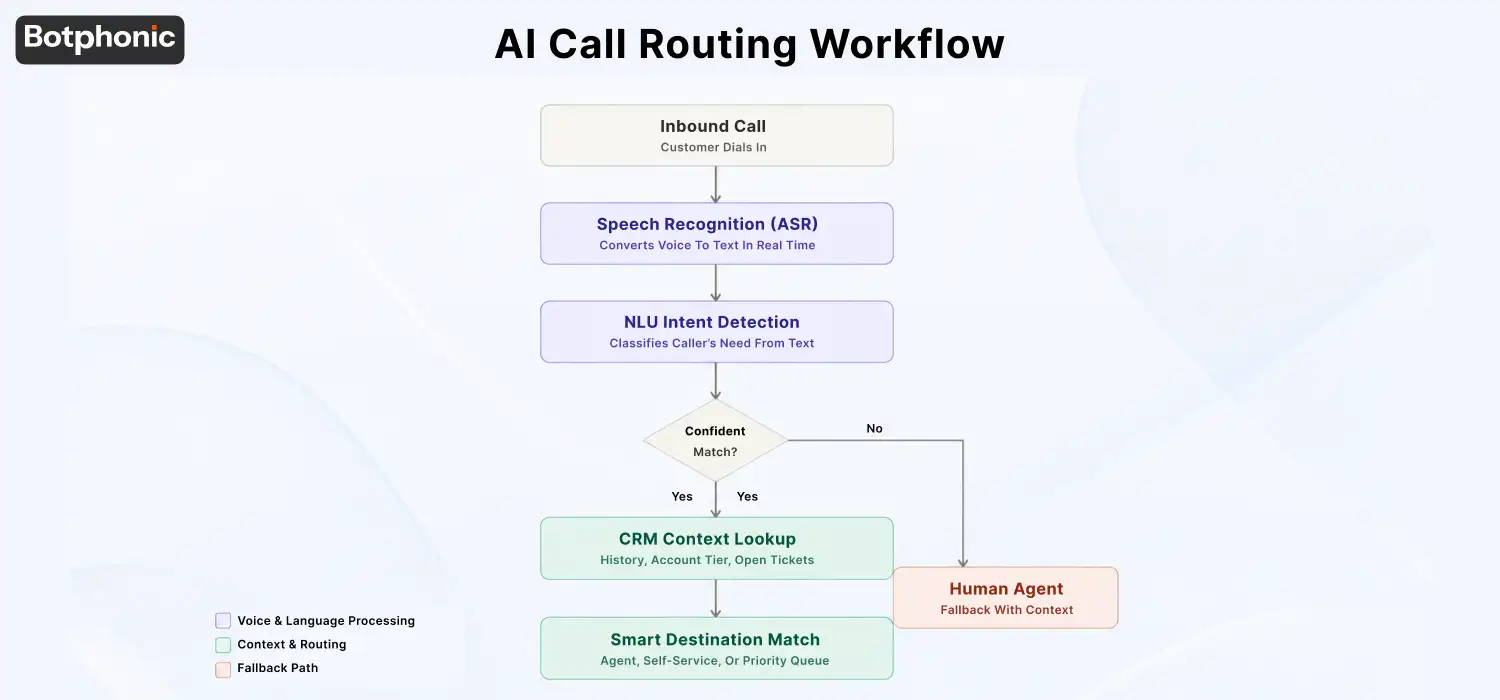
Step 1: Incoming Call
Call established connections. The AI customer service automatically goes into action – there is no need for menu selection, music on hold, and “press 1 for English.”
Step 2: Speech-to-text Conversion
The system uses automatic speech recognition to convert the caller’s voice into text. The latest ASR technology is very robust when it comes to accent, environmental interference, and broken speech. This step is critical as all subsequent operations depend on converting the caller’s speech to text accurately.
Step 3: Intention Identification
This understanding model will take the transcription and recognize what it is the caller really wants, regardless of their use of keyword terms. “My package hasn’t arrived yet” and “my delivery is behind schedule” both lead to the same department. “I need to dispute a transaction” and “there’s an error in my bill” go to the same place.
According to 2025 industry benchmarks, AI triage models can achieve around 89% accuracy at determining the appropriate classification of the interaction for live routing.
If the system does not have high enough confidence to classify with certainty, due to confusing wording, strange accent, or lack of clear context, it will route the interaction to a human with partial information regarding intent.
Stage 4: CRM Context Lookup
Having determined the customer’s intent, the CRM record of the customer is then accessed live. In this stage, personalization kicks in, and the customer will be routed differently based on the customer’s tier or their account status, their support history, the recently purchased product, or pending tickets. All these data can be extracted within two seconds.
Connecting with Botphonic AI Call Assistant happens live through integration with the CRM platforms of Salesforce, HubSpot, or Zendesk. The relevant CRM data is accessible before any agent even says a word.
Stage 5: Smart Destination Matching
The decision process comes to an end with matching the identified intention and context with the most relevant destination:
- An expert who is skilled and ready to handle the issue
- Self-service that takes care of routine issues such as balance checking, appointment scheduling, and order tracking
- Priority handling if the call is highly urgent and/or highly valuable
- Callback opportunity for customers with long waiting times
What Are the Business Outcomes of AI-Driven Call Routing?
Business impact is defined through seven measurable outcomes all linked to existing contact center metrics.
Is AI-Assisted Routing Effective in First-Call Resolution?
Absolutely. Once the caller reaches the relevant department on the very first try, they get their problem resolved. Companies utilizing AI-driven routing managed to deliver 30% faster average response time than companies with manual routing methods. Fast routing leads to less re-contact, which in turn leads to decreased queue length throughout the contact center.
What Are the Savings?
Very significant. According to industry projections for 2025, implementation of AI technology into customer support resulted in lowering the average cost per interaction by 68% from $4.60 down to $1.45. AI chatbots used in customer service lowered the cost of handling calls by 50% while improving CSAT performance by 125%, reports Contact Center Crossroads of McKinsey & Co.
What about Call Abandonments?
Lowered to 2%. Top-notch performance of AI-assisted contact centers results in moving away from high call abandonment rates toward the benchmark number of 2% of abandoned calls, which is considered a low-end of the healthy call abandonment rate from 2% to 5%.
 NOTE
NOTE
How Does It Impact the Effectiveness of Human Agents?
By using AI to sort and route customer service requests, it is possible to increase the productivity of an average human agent by 1.2 hours each working day. As a result, a 50-agent service desk can achieve a productivity gain equal to 60 human hours each day, with no headcount growth required.
Is It Possible to Scale Without Proportionally Growing the Team?
Certainly, and this is what makes the predictions made for 2026 and 2027 so meaningful. According to Gartner, by 2027, bots and other AI phone answering services will be the customer service channel for 25% of companies. However, this can only happen if the organization’s routing solution directs the calls to effective self-service channels. Inefficient routing means sending customers to self-service channels that cannot help them, thus sending them right back to call queues.
What Do Botphonic Deployments Reveal?
Benchmark numbers published tend to average results. The average fails to capture the patterns of operations that matter.
What Botphonic’s AI customer service deployments reveal across contact center clients:
First pattern: The most significant source of misrouting is not IVR menu design. It is misrouting caused by a wrong call type match when there is a spike of 40% in incoming calls. Agents will take calls from outside their specialty to help manage call volume, thus creating misroutings even when they start correctly. Routing algorithms used at Botphonic take into account the skill weighting and real-time agent availability.
Second pattern: Self-service abandonments and/or calls transferred from self-service to an agent are indicative of routing inefficiency. The reason for this is that both actions indicate a failure to match a particular problem with a resource. If a customer reaches a process which can not solve their problem through self-service, they would either hang up (self-service abandonment) or press zero. Both outcomes are failures because callers have been routed incorrectly.
Third pattern: improvements to FCR are most significant in the first two months after deployment, after which point improvements plateau. The plateau represents a data quality issue, not an inherent limitation of the system itself. Centers that supply improved CRM data, new intent modeling information, and new classifications for call types will see improvement beyond 90 days.
What happens at contact centers in month one: the largest change is not more accurate routing; it is agent behavior. As soon as it is known that the center is tracking misrouted calls, agents no longer route out-of-scope calls “informally.” The ability to track the informal handling of misrouted calls brings to light a whole new category of traffic: the calls made by callers to the incorrect agent and “handled,” without ever showing up in the call routing metrics.
What Does 2026 and 2027 Research Say About Where This Is Heading?
The future is clear, and sooner than most contact centers expect.
What makes the 2027 prediction on the workforce different from others: Gartner research from 2026 says that by 2027, half of companies that cut staff because of AI will hire back people to fill in roles identical in content but assigned other job titles. It means that although fully agentless contact centers seem unlikely to appear soon, hybrid systems with routing and triage being performed by the machine while people deal with complicated tasks have good chances to emerge soon.
The key 2029 moment for agentic AI: By 2029, according to Gartner, an agentic AI system will be able to solve 80% of typical customer problems on its own, which will result in a 30% cost decrease. But here’s the catch: such results are completely contingent on successful routing since an AI agent cannot solve something that hasn’t been routed correctly.
The gap to 2026 operationalization: 76% of contact center leaders in 2026 will be formalizing a system where the artificial intelligence performs routing and availability, while the humans focus on handling the more complicated, emotional and critical engagements. This is where most implementations fall behind; the organizations that bridge the gap from a model to reality have been laying down the groundwork through building accuracy at the base level of their routing systems – not tacking it on top.
Gartner’s investment prediction: According to Gartner, contact center technology investment will increase to $38.9 billion by 2027 due to AI-driven customer services solutions. The investments are coming. The question each contact center must ask themselves is whether they are ready for these changes.
Which Sectors Are Reaping the Benefits of AI-Based Call Routing the Most at the Moment?
Healthcare
In healthcare settings, there are many different areas where routing is essential, such as patient appointment scheduling, triaging, insurance verification, and prescription requests. In healthcare, there can be no mistake made when it comes to routing since this could lead to HIPPA compliance problems. And these are few essential reasons why AI answering service is getting actively optimized.
Financial Services
Calls related to fraud warnings, disputes regarding accounts, and loan servicing have to be quick and precise from a regulatory perspective. Three minutes spent waiting in an incorrect queue during which an action is performed means a loss that is not a performance measure.
E-Commerce
Order statuses, deliveries, and return procedures need to be routed to specific departments. Seasonal increases are expected yet hard to provide staffing for. AI routing copes with these peaks without the need for equal staffing increase.
SaaS and Technology
Technical support is based on the product line, subscription plan, and the importance of the problem that customers are reporting. A business client experiencing downtime in its production will not receive the same response as a user testing a tool. The telecommunications industry leads in the use of AI workflow automation with 95% while banking lags behind with 92%.
What Needs to Be Considered When Implementing AI for Call Routing?
Data Integrity Trumps Everything
The better the quality of information provided to the routing engine, the better the decision-making process that the system provides. Poor CRM data, fragmented customer support histories, and lack of call intent data can hinder effective routing. Prior to implementation, check which CRM solutions will feed the routing engine – Sales Force, HubSpot, or Zendesk – and ensure there is no poor-quality routing logic even when it’s powered by AI technology.
Start With The Three Most Frequent Types of Calls
Implementation should be done gradually. Choose the first two or three call categories that are performed on the largest volume and have well-known routing paths. These include billing-related calls, appointment scheduling, or order statuses.
Compliance Is Required Prior to Implementation
The deployment of routing software in healthcare requires it to be HIPAA compliant. Similarly, payment-related routing should meet PCI DSS requirements. For enterprise-level deployments, a vendor’s compliance with SOC 2 is often a must.
Monitor These Metrics Starting Day One
Improvement measurement requires a pre-implementation baseline:
- First Call Resolution (FCR): Is the issue being addressed on the first contact?
- Transfer Rate: What is the transfer ratio of calls?
- Average Handle Time (AHT): How long is each call taking?
- Call Abandonment Rate: How many people are abandoning the line?
- Customer Satisfaction (CSAT): Are satisfaction rates increasing over time?
Conclusion
The impact of doing nothing about AI call routing is not only theoretical but amounts to $4,800 per day with a misrouting rate of 15% for 4,000 daily contacts. It includes the fraud case that passes through during the transfer process and the medical patient calling twice regarding the same prescription.
AI investments in contact centers are estimated at $12 billion currently but are rising to $47 billion in less than ten years’ time. This is the case even though 75% of those centers have implemented AI software but fail to use it.
AI call routing is all about making the connection on the first try.
Route every conversation correctly in real time using AI, CRM data, and intent detection.
Start improving resolution speed and reducing transfers from day one.
Schedule Your Demo!