
Summarize Content With:
What do you think? What’s the real problem – the volume. No, it’s that wait between a lead call and when the employee picks up.
Every enterprise that depends upon the phone call outreaching has silent challenges, which employees can feel but cannot determine with precision. A high-intent buyer submits the form, lead captures in the marketing platform. It creates a support ticket. And, the delay between actual interaction and expressed prospect interest creates a big mess.
The human agent attends another call, a manager does n’t delegate the tasks now, the prospect loses interest. Your business loses a potential lead. This article explains clearly why automated phone call technology is not only a business advancement but the definitive solution to a specific issue that manual procedure built to resolve at large scale.
We are not here to provide you a surface-level solution, delivering the operational-level workflows : why traditional calling fails, how automated calling through AI phone call assistant helps to reduce delay, and how businesses shift from human dependency to the system flows.
The Unseen Friction Behind The Manual Calling Process
Many of the businesses don’t know what’s the real issue: they think they have a staffing issue not a calling problem. Sometimes, they anticipate it is a timing problem. But the reality is a bit different, these symptoms point out the one problem that is manual calling, executing in today’s world where there are high client expectations.
Here’s what the real process looks in the customer support or sales department :
Traditional Calling System – Where Delay Occurs
| Manual Approach | What happens with automation |
| Fill out form or capture leads on CRM | Make calls within a couple of seconds |
| Managers delegate duties to the available human agent. | Due to call logic, it is easy to manage routing. |
| Agents check their pending tasks, whether they have time for another call or not. | Attended multiple leads at a time |
| Human agents dials & entered in system manually | Tracking calls & outcomes automatically |
| Takes manual follow-up | Automates the follow-up process , updating the results. |
Each step of the traditional calling system creates a delay, it compounds after every phase. When the agent replies to a lead, the prospects have already filled out the competitor form. In the normal scenarios, might you observe that immediate calling is more effective than the delay response. One of the studies found that conversion rate is reduced when follow-up takes more than 5 minutes.
Your traditional calling system does not just slow down the speed, it affects the entire structure. Make calls and take follow-up inconsistently. Different human agents manage the same case with different approaches. They are not working systematically, they work under pressure with varied human habits.
 NOTE
NOTE
Breaking Down The Delay : See How Automated Calling Makes It Possible
The automated calling system replaces the manual duties from human processes that eradicate the communication hurdle. We are not here to discuss only the features and benefits but also help you understand how automated calling systems eliminate delays that exist in the traditional calling process and help in precise workflows.
Delay 1: Recognize Which Client Is This
During the traditional process, the customer recognition takes a few minutes to hours. Suppose when the lead fills the form, it checks on the marketing, analyzes the previous mails, and then only they decide whether to dial call or not. With the automated calling system, this challenge is eliminated completely.
When the lead fills out the form or calls, then the AI phone call replies within seconds and remembers the conversation context. It eliminates the recognition step as the system works faster than humans and it already feeds into their memory.
Delay 2: The Human Availability Roadblock
The employee has the limited capacity to work, it does not take more than one call at a time. They are not always available to take up the calls – sometimes they are busy in meetings, having calls with other clients, and a lunch break. These issues indicate the staffing issues but it’s a structural mismatch.
Automated calling systems don’t face this challenge. A call is made at 11:40 PM on Saturday without human intervention. Based on the call center automation research, human agents who leverage the automated workflows manage 35-40% conversation per shift – not because it executes faster but the platform has the entire details that are required to complete the conversation.
Delay 3: The Decision-Making Layer
Only noticing a lead is not enough, a manual calling procedure still needs to make a decision regarding who dial a call, which is the best time, and what are the priorities. This is where the coordination lacks the most. In many business teams – these decisions are not even being noticed, it creates more delays than expected.
Like the manager, first go through the employer experience and its background qualification to attend the call, and also check whether they are available or not. These delays can’t even be traced. The automated calling system removes this layer entirely. It does not need to take any assignment decision as the added logic knows whom to connect and under what circumstances, recorded once in a platform without much discussion.
Delay 4: The Follow-up Issues
The manual follow-up procedure needs the human memory. It takes place on the 3rd day when someone recalls it. Due to increasing workload, many prospects never get the attention they require as it is hard to maintain follow-up consistency. Automated calling system resolves through pre-determined scheduling. The follow-up does not depend upon the memory as it was built before the lead came.
Where Manual Calling Systems Fails : The Three Communication Failure
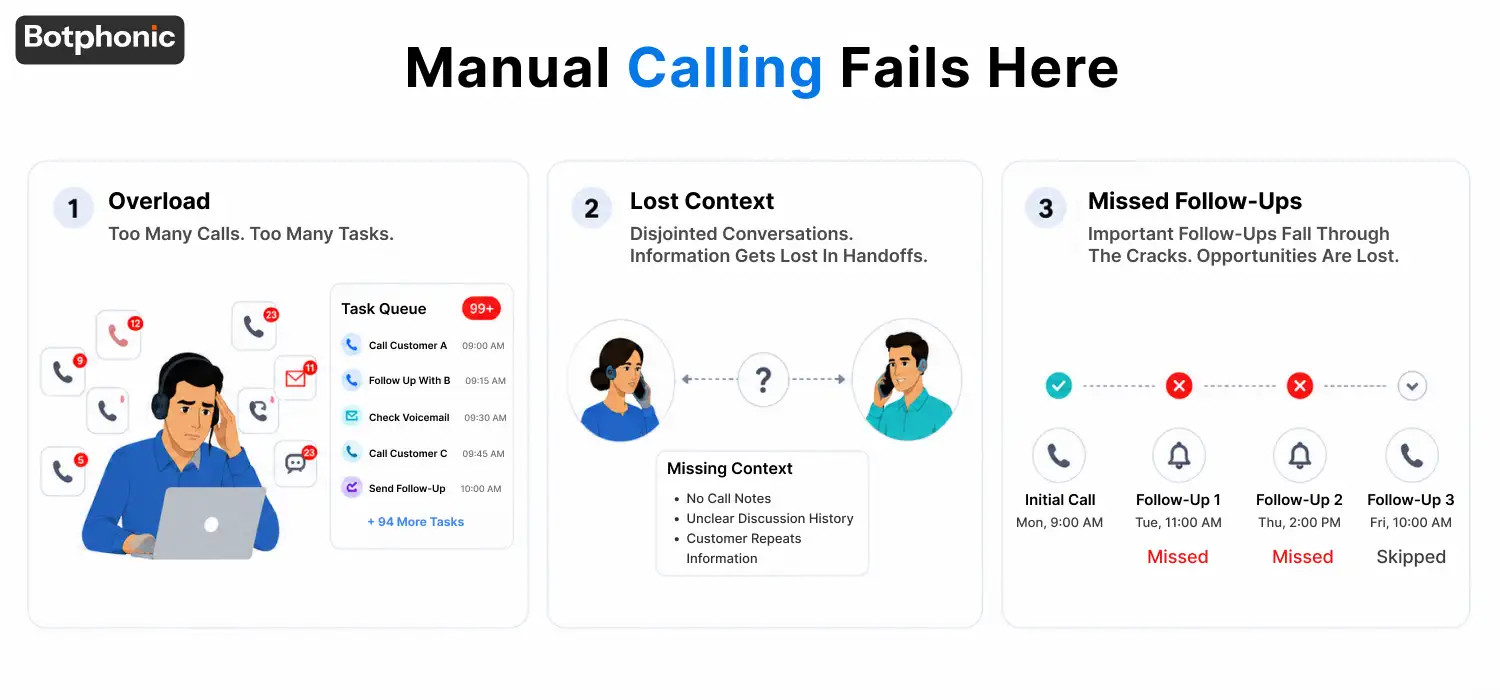
Efficiency is no longer the objective of automated phone call technology. Structural reliability is the one. It comes naturally when the workflow becomes reliable. This is actually needed as it helps you comprehend what’s breaking in the traditional calling process. It fails due to three specific reasons, each of them points out to the coordination issues that automation is built to protect :
Failure Mode 1: When Agent Have Overwork
A traditional calling system works well when the workforce is not too busy, they have enough time to handle the volume of calls. When more volume comes, exactly when you run the campaigns and launch a product, your marketing efforts also go wasted if you can’t respond on time. Some prospects get instant responses and others wait for days.
There is a structural inconsistency, not the random one. Prioritizing work is hard when the workload increases, even harder to manage the large queues. Automated calling systems carry out the similar action for every lead, irrespective of volume. Whether 20 or 200 leads come in, the triggering procedure is the same. Each prospect enters in the same process and gets instant response without having human capability limitations.
Failure Mode 2: Loss Information During Handoff
There are multiple outreaching steps in case of manual process. Suppose you get a lead from inbound or outbound sales, it’s checked by the manager, transfers to a SDRs, and eventually coordinated by an agent. Every phase of workflow has a handoff point.
Whenever the tasks move to another agent, it creates more delays and the critical context can be ignored, and the one who handles the leads doesn’t have a clear understanding of the client case. They even don’t know when the prospect information is recorded, what’s the previous conversation with the client, or if the lead previously communicated in-person or not.
The handoff is directly proportional to losing client information.
The automated calling system captures every conversation, records engagement history, and handles follow-ups. The information remains the same when the data moves person to person, it reduces the communication hurdle and minimizes delays.
Failure Mode 3: Difficult To Maintain Sequential Follow-up
If you want to maintain a single conversation, then one can easily manage it. But when the lead needs five outreaching touches, it is difficult to maintain it. Dialing calls on 1 day, takes follow-up on third day, second follow-up on 10 days, and re-engagement on 17 days – that’s where the traditional manual process no longer works. Each touch-point needs a person to prioritize and remember when to act.
As the time passes, the new leads come up so the continuous sequence is breaking down – follow-ups missed and they forget completely. The outcome is the mechanism that begins with the good intention but is difficult to maintain consistency after 1-2 touch points.
The automated calling system carries out the outreaching plan as it was built. Every call and follow-up has advanced booking, delivering reminders at the right time. The procedure does not rely on human memory and daily tasks. Thus, every lead has ful-filling outreaching procedures, maintaining consistency from initial to last conversation.
 PRO TIP
From Human Dependency To System Flows : The New Era of Communication
The traditional calling system is dependent upon the human agent and their availability. Call fires when the client is ready, with whoever is available not the one who is needed. The automated calling system is an independent, always available platform. Make calls when conditions are satisfied with the in-built communication framework, it is not dependent upon the staff.
Here’s why it is not considered as the productivity platform. It’s a structural infrastructure of communication.
See how it’s working on two diverse business models
A traditional calling system is like a restaurant, where they handle the walk-in guests. Services rely on the current demand, how much staff is available, and the client queue. When the restaurant is full of people, it increases the waiting time and reduces service consistency.
The automated calling operation resembles the airline boarding system. Each of the phases is pre-defined, well-communicated, and easily manages numerous client calls at a time. Passengers travel in a sequence flow, no matter how busy the airport is.
The restaurant model only execute till the demand surpasses the capacity
Airline models carry out duties even when volume increases tremendously
That’s the fundamental benefit of an automated calling system or AI call assistant. It not only assists teams to dial calls but also frames a communication system that remains stable and easily anticipated when demand is significantly enhanced.
When replies speed, follow-ups, and client engagement should be dependent upon the Ai-driven platform rather than manual processing, the enterprise generates more outcomes naturally.
The Test Makes Difference A Dialer From a True Communication System
Most of the enterprises examine features of the automated calling system to determine which is the best one like does it connect with the marketing or other system, what’s the capacity of handling calls, and does it help in analyzing the document? These are the basic questions, not the deciding factor.
A dialer is built to make calls. A communication framework ensures the perfect coordination among teams, timely interaction with the clients, and has the right context.
Here’s a simple test. You should ask when you are assessing the platform: if the employee is not available right now, would this platform help to communicate to the volume of leads with the same speed and consistency?
If they say No – if call lists need to be evaluated by humans before making the call, if marketing campaigns need an employee to start and create analyzing reports, if still manual capturing is needed – then the platform is a dialer. The phone system helps to make and attend calls faster, it’s not entirely a different framework.
If the team answer is yes, if automatically data is recorded in the marketing platform, if the result of the interaction updates without human intervention, and executes follow-up with the logic – then your platform is a communication system.
The Distinction
The difference here is crystal clear.
When the volume of lead increases, a dialer has more work to do. More calls should be delegated, traced, and analyzed. The challenge remains the same – you have to follow-up, monitor, and make decisions by yourself.
On the other side, the communication system handles massive volume because the process is entirely automated. That’s why the crucial metric is not how much call volume the system can handle, it is about the communication – it should happen consistently whether there are more clients and have a busy workflow.
The AI phone call automation supports the complete conversational workflows – not only limited to the basic calling – executes through the logic. These platforms not only handle the calls and transfers to humans, it maintains end-to-end structured communication – whether to qualify leads, gather details, scheduled appointments, and transfer inquiries to the human agent, when the situation genuinely demands it. Human intervention is needed where the judgment is required.
Botphonic AI phone agent handles calling operations like no one. It manages repetitive inquiries, delivers consistent follow-ups, and allows human agents to prioritize engagement prospects.
Book a demoConclusion
The traditional calling process would never be met with the modern business demands. It was built for that time, where the clients can wait, where there is lower lead volume, and small business teams administer coordination through traditional workflows. The modern reality is a bit different, clients expect fast response, while enterprises handle more leads than the human agent. The main challenge is manual communication. The automated calling system handles duplicate tasks like taking follow-ups, administers calendar, and update marketing platform, which helps employees to prioritize on making decisions and coordination. Not only limited to efficiency, transitioning from agent dependency to system management that drives the communication smoother.
