
Summarize Content With:
The engaging conversation happens in the public conference that you have never seen in any website article. A CEO asks the Senior Client Service Manager: We have 40% up call volume and still sales go down. What strategies should we adopt? Answers are usually the same – hire new human agents, open other customer support service centers, and scale the team. Recently, there have been changes in answers.
Many seniors want to adopt the AI for customer service departments before scaling the service team. They come with different proposals. Not only to save the department costs, It’s something more than that – A fundamental strategy on how enterprise teams build and grow their business.
Big enterprises are not implementing AI for customer service for modern technology but the traditional support services no longer work and become difficult to justify, slower to reach the business goals, and more costly than other approaches.
This article explores why the large organizations are inventing AI customer service agents before scaling the agent team – and how this decision affects the internal departments. If you are senior client service director or senior manager or CX leader – then you relate with this article a lot and this remembering your conversation with the peers.
Traditional Playbook No Longer Scales In The Modern Environment
For a number of years, the single formula for managing varied clients – hire more human agents. More client calls come only through more human agents. It means you need to hire junior and senior staff – this substantially increases your expenses and it’s a predictable one.
The anticipation has now gone too far.
Recruiting new human agents takes time – sometimes to find the right employee takes months not even weeks. The employee attrition rate in the client support service department is usually high across industries – it means businesses are constantly finding the new candidate. And the customer expectations are continuously to arise as AI-technology comes in the market.
What’s the result? The compounding issue. Call volume increases. Team overwhelming. Clients want immediate response. Quality drops. Enterprise supporters are trapped in the circle, alone hiring employees cannot fix this.
 PRO TIP
Why AI Budgets Are Prioritized Over Headcount Requests
This is something that never comes on the discussion table: In many large enterprises getting funds for the AI client service platform or AI call assistant is much easier than hiring the 30 employees. It feels like a counterintuitive step. But every time requests go to the CFO or management committee.
A single employee costs includes training, advantages, base salary, and management overhead costs – it grows annually. The AI customer service agent is a predictable SaaS cost, and enterprises increasingly invest in AI Integration Services to seamlessly deploy these solutions into their existing customer support workflows. The ROI can be seen through increasing customer satisfaction rates and average deflection rates. Financial teams have their frameworks for examining it.
Most importantly, the AI phone call gives more return than the incurred expenditure. In an evolving business, if you find the modern platform that helps in the business growth without significant increment of proportional expenses – none of the strategies better than this, AI for customer service delivers a story that hiring agent expansion cannot.
Here is why team leaders, top-level and management committee prefers to give priority on AI proposals when the discussion relates to budget conversation.
The Real Reason : Complexity And Volume Are Not Equal In Support
One of the most crucial aspects is that not every call is important, not treating them equally. A significant portion of the inbounding calls – this range between 40-60% based on the industry – encompasses replicate questions, order details, scheduling details, receiving policy details, and getting account information. These calls follow the anticipation theorem and don’t need any human judgement.
The other part of call volume is usually complex like multi-touch and escalation problems that need problem-solving skills. Here is the work where skilled employees are actually needed. The issue is that when your staff volume handles the low-complexity activities, this is the poor use of costly hires. It overwhelms the human agent – experienced staff members are not trained for answering the duplicate questions again and again.
With the AI call assistant, the entire equation is changed. Installing AI for customer service to manage multiple client calls at the same time, administers low-complexity tasks, and large organizations free their staff to prioritize the most critical activities. Based on the salesforce’s state of service report, the rate of AI customer support agents is tremendously increasing, service teams prioritizing the complex tasks as the primary drivers.
Not about replacing human agents but deploying AI agents that create value.
How AI Evolves The Role of Customer Support Team
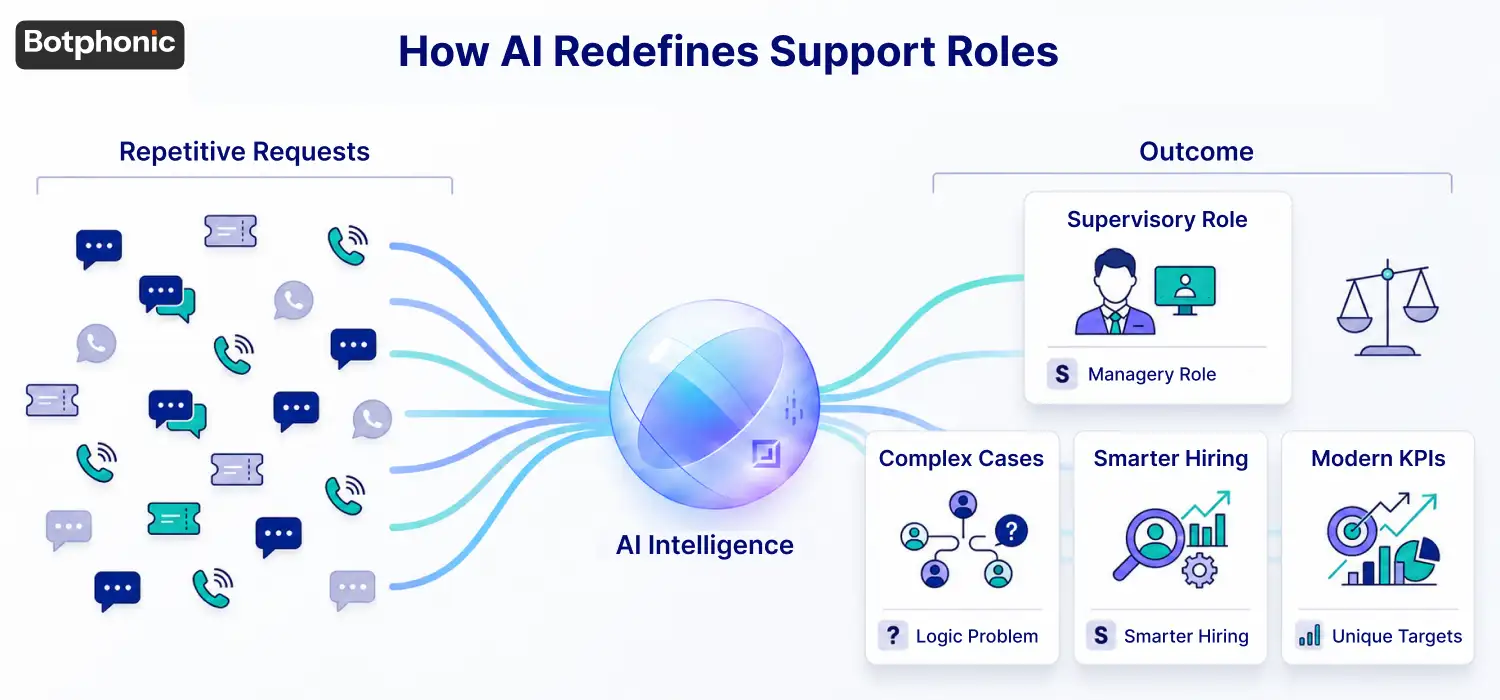
The AI for customer service does not manage repetitive activities. The support team has more important downstream impacts, and large enterprises are starting to plan for AI business solutions for those purposes.
Adapt With Supervisory Role
Senior managers or team leaders spend the majority of the time on analyzing the AI performance, enhancing knowledge bases, finding out the edge cases, and training human agents on managing complex situations. Now, it’s a different job position than before. Large enterprises that are installing AI now are also anticipating the second-order effects – as totally neglecting them costs you a lot.
Change The Agent Job Nature
Human roles shift, when AI takes care of the duplicate inquiries and FAQs, the human agents focus on the specialized tasks that directly affect the revenue. It administers complex situations, delivers warm transfer within seconds, and analyzes the answers that AI resolves. Changing the job’s name and the entire process of being hired and analyzed.
Modify The Hiring Criteria
If the daily calls are managed by the AI, the candidate needs varied skills – handled empathetic or complex nature of tasks and have stronger judgement quality. That impacts training sessions, recruitment procedures, and compensation.
Evolve KPIs
If the AI customer service resolves the volume of client calls, the average interaction time and first contact resolution becomes the least significant as the core metric. Now, enterprises use the new key performance indicators – routing quality, AI deflection rate, client satisfaction score with the AI assistant, and human agent performance in the intricate cases.
 NOTE
NOTE
Workforce Planning Angle That Actually Matter To Boards
The executive-level perspective that motivates to invest in the AI development projects at the big enterprises. The client service team is increasing. Customer expectation is growing. Executive teams have been forced to increase service quality without hiring more employees.
AI for customer service delivers something that other investors cannot : scalable capacity, which does not need any more human agents. When a large enterprise implements AI to manage day to day contacts, they can manage multiple clients without requiring more human agents. It means that the support team can increase in terms of handling clients – while the agents grow more patiently.
It is the workforce-scaling debate that instantly approved the AI budget from the board members. Not just employee replacement but it’s more about the decoupling support with the same level of employees, delivering flexibility among enterprises in how it maps and manages resources.
According to Mckinsey research, large enterprises receive gains when they execute their workflow around AI instead, adding AI into the existing procedure. This difference matters a lot. Not about the single feature but transforming the workforce planning in significant ways.
“Why Now” The Enterprises Are Moving?
Discussions about AI in client services have been happening for several years. Due to sudden urgency, the AI deployment significantly increased. The major changes have been done at the same time.
Client Expectation Take A New Turn
Customers are already experiencing AI on their daily routine, applications and clients products. The clunky IVR voice makes it more frustrating as they wait for a longer period and still routing the call to the wrong person. Big enterprises feel forced to make a bridge.
New Players First Adopting AI
The new enterprises entered in the market with the latest AI technology, they hired agents who are already trained so they have to invest their time less on training – executing the operations with the leaner teams, increasing the response time, and maintaining consistency. Established companies can’t even imagine the service quality benefits they get.
Increasing Waiting Cost
If the AI isn’t deployed, there is a wide gap between the current capacity and the required capacity. As the call volume increases, AI needs significantly increase. Enterprises who are not willing to invest in AI, now facing major backlashes from the customer, affecting their revenue.
Change The Market Dynamics
Maintaining retention rate and executing smooth recruiting procedures remains the most challenging part in many of the enterprises. Those companies who heavily relied on human agents for scaling growth or expanding services, creating instability in their revenue. AI investment is not the smart strategy but it is required in the competitive market.
A Strategic Framework For Enterprises Support Teams
The AI implementation is not a one-step procedure, the big enterprises are seeing the real outcomes from applying the structured process.
- Analyze Contact Volume Based On Complexity Factor: Examine the kind of contacts that are coming in, bifarcuated the percentage of routine and complex inquiries, it simplifies to train AI.
- Implementing AI To Manage High Call Volume: Prioritizing the routine work like handling the volume of calls, managing order, and supervising the account questions, which are easily taken up by the AI and require less human agents.
- Redesign Human Agent Work: After AI implementation, the human agent work is limited to handling complex cases, not wasting time on routine tasks. So, it is needed to redesign human responsibilities.
- Redefine KPIs For Hybrid Model: The performance indicators that matter before the AI implementation are not the one the right one after the AI. Create a new KPI before it goes live.
- Use AI-driven Insights For Hiring Strategies: The AI for customer service, delivering the single dashboard that shows how much volume handled by the AI, how much needed by the agents. Not through the single assumption.
- Scaling Customer Service Teams Gradually: As customer service automation handles major departments but still the specialized areas or functions need human expertise and require creative suggestions.
Learn how AI-enabled customer service helps your enterprise minimize operational expenses, increase agent productivity, and optimize workforce planning – all without increasing the headcount number.
Schedule a demoConclusion
Enterprises that have the highest client service quality are not the ones who have a larger team. They are ones who run their business with the smart strategies – understand the type of call volume, implement AI – which uses the most, and create a human team where human judgement is necessary. AI investment before scaling human agents is not the cost-cutting strategy but it is a structural procedure of how an enterprise is built to grow. The enterprises who run in that way have better human agent retention and enhance client experience. If your budget discusses how many human agents you need to recruit, it’s time to point out the different problems now.
