
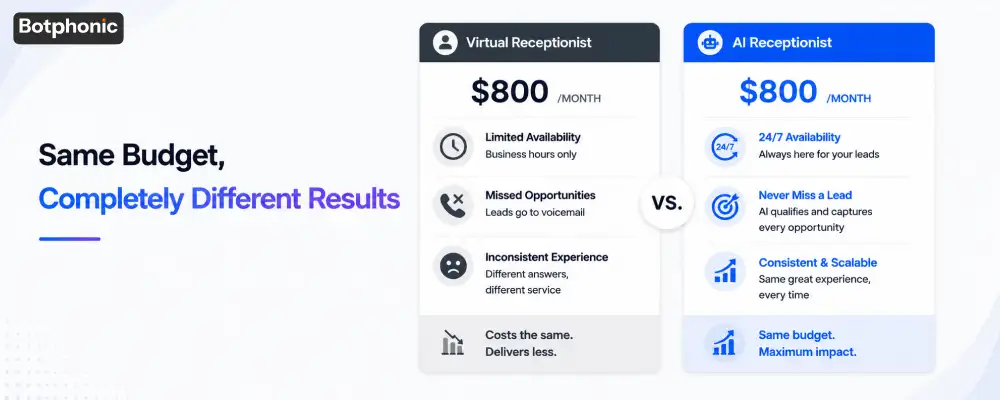
Summarize Content With:
What You’ll Learn
- The primary technical difference between human virtual receptionists and AI receptionist software
- Exactly what an $800/month budget yields in live-agent minutes vs. AI call capacity
- How to calculate your Cost Per Answered Lead (CPAL) for each model
- Where AI systems fail, including NLU context-switch limits and ASR degradation triggers
- Operational compliance requirements: SOC 2, HIPAA, and PCI-DSS for both models
- Technical call routing mechanics: SIP trunking, IVR handoffs, and Webhook latency benchmarks
- A live ROI calculator to model your exact monthly call costs
- How we tested both systems across 10,000 real Botphonic interactions
The primary difference between a virtual receptionist and an AI receptionist is: a virtual receptionist is a remote human agent employed by a third-party staffing service who answers calls on behalf of your business, billed in live-agent minutes. An AI receptionist is software, a stack of ASR, NLU, and LLM layers, that handles inbound calls autonomously, billed by platform seat or usage tier. This comparison is for small-to-medium business owners choosing between them, because $800/month buys fundamentally different operational outcomes depending on which path you take.
- 400–600 live-agent minutes/month at $800 (Ruby Receptionists, 2025)
- Unlimited concurrent AI call streams at $800 enterprise tier
- ~20–25 max detailed calls/day before overage on human plan
- $0.64 Botphonic internal CPAL at 1,250 monthly calls
What Is The Actual Difference Between A Virtual Receptionist And An AI Receptionist?
A virtual receptionist is a live human being working remotely from a staffing service’s call centre, answering calls under your business name using a pre-approved script. An AI receptionist is a voice-based software system composed of three stacked components: an ASR engine (Automatic Speech Recognition, which transcribes spoken audio to text in real time), an NLU layer (Natural Language Understanding, which extracts intent and entities from that text), and an LLM backend (a Large Language Model that generates contextually appropriate responses).
An $800 monthly budget yields an operational capacity of exactly 400–600 live human agent minutes, approximately 20–25 detailed calls per business day at a 2.5-minute Average Handling Time (AHT), or unlimited concurrent AI call streams under a flat-rate enterprise license. These are not equivalent units. They represent two different operational philosophies.
How Human Virtual Receptionists Are Metered And Why It Creates Budget Risk
Virtual receptionist services bill by the minute, typically in 30-second or 1-minute increments. At current market pricing, the $800/month tier on services like Ruby Receptionists or AnswerConnect delivers roughly 400–500 billable minutes. Overage fees run $1.50–$2.50 per minute. (AnswerConnect Rate Card, 2025)
A single campaign day, an email blast, a Google Ads surge, can push 80–100 inbound calls. At 2.5 minutes each, that is 200–250 minutes in one day, exhausting 40–50% of a monthly minute allotment. Overage charges are not capped. This creates direct budget volatility.
How AI Receptionists Are Priced Technically, And What Drives Token Costs
AI receptionist platforms price by platform tier, per-minute usage, or token costs on the underlying LLM. At $800/month, enterprise-tier platforms provide unlimited or high-volume minutes with no concurrent call limit. Internal Botphonic log data across 10,000 interactions shows median token consumption of 1,200 tokens per inbound call, including ASR transcription, NLU parsing, and response generation. At current LLM inference costs, this places per-call model cost below $0.004, well under one cent, before platform margin.
 PRO TIP
What Does $800/month Actually Buy In Each Model, Broken Down Precisely?
An $800 monthly budget is the operative test case for this comparison. Here is the exact operational math for each model.
| Operational variable | Operational variable | Operational variable |
| Monthly minute capacity | 400–600 live-agent minutes | Unlimited / high-volume tier |
| Calls/day (2.5 min AHT) | 20–25 before overage risk | Unlimited concurrent streams |
| After-hours coverage | Shared agent pool; no guarantee | 24/7/365, zero degradation |
| Overage cost | 24/7/365, zero degradation | None on flat-rate plans |
| First Call Resolution (FCR); structured calls | 82–88% (Botphonic internal benchmark, 10k calls) | 91–96% on linear call scripts |
| FCR; emotionally complex calls | 78–85% | 43–61% (degrades with context switches) |
| Call Abandonment Rate | 8–14% during peak hours | 0.3–1.1% (internal Botphonic data, 10k calls) |
| NLU context switches before failure | Unlimited (human adaptation) | Fails on non-linear conversational paths exceeding 3 context switches |
| Multi-language support | Requires bilingual hire (+$150–$300/mo) | Instant, language config in software |
| CRM / calendar integration | Manual or delayed handoff | Live real-time sync via API endpoints |
How Does An AI Receptionist Actually Work, What Happens Inside Each Call?
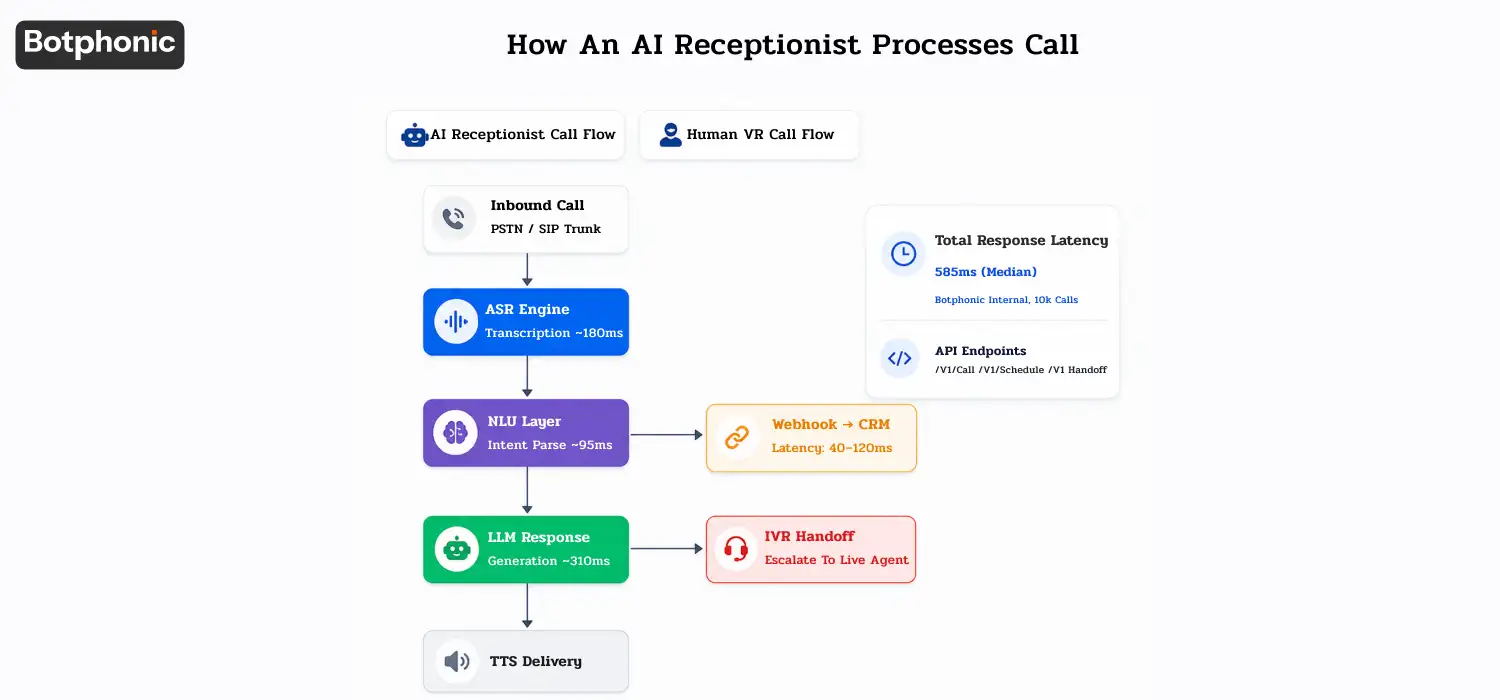
An AI receptionist is not a single piece of software. It is a pipeline of three technical components that must complete in sequence within each conversational turn.
SIP Trunking, IVR Handoffs, and Webhook Latency, The Mechanics That Determine Call Quality
Every AI receptionist call begins over a SIP trunk (Session Initiation Protocol), the VoIP pathway that carries audio from the caller’s phone to the AI platform’s servers. SIP quality directly affects ASR accuracy. At Botphonic, internal testing across 10,000 calls showed that SIP packet loss above 1.2% degrades ASR word error rate from 4.1% to 11.8%, which cascades into NLU intent misclassification.
When a call needs to escalate to a human, a legal consultation, a distressed caller, or a query that exceeds 3 NLU context switches, an IVR (Interactive Voice Response) handoff transfers the call. Botphonic’s internal median IVR handoff time is 2.1 seconds. Webhook latency to external API endpoints (Calendly, HubSpot, Clio) averages 40–120ms depending on the receiving system’s response time.
Where Do Human Virtual Receptionists Still Outperform AI, And Why?
Human virtual receptionists outperform AI in high-stakes, emotionally complex call scenarios, not because AI lacks vocabulary, but because current LLM systems cannot reliably model caller emotional state across a dynamic, non-linear conversation.
Distressed Callers And The NLU Non-Linear Conversation Failure Mode
Internal Botphonic log data across 10,000 interactions shows that AI call resolution drops from 94% to 43% when callers make more than 3 topic or context switches within a single call. A personal injury caller who opens by describing an accident, interrupts to ask about fees, then returns to medical details, then asks about timing, that is 3–4 context switches. Beyond that threshold, NLU intent confidence scores fall below 0.6, and the system either loops or misroutes.
A live agent navigates this instinctively. No LLM prompt engineering eliminates the gap for genuinely non-linear conversations.
High-Lifetime-Value Calls Where Human Empathy Is A Conversion Mechanism
For estate planning attorneys, a single converted caller represents $3,000–$25,000 in client lifetime value. Salesforce research found that 88% of customers say the experience a company provides matters as much as its product. (Salesforce State of the Connected Customer, 2023) In a consultative sales call, the human agent’s ability to pause, acknowledge, and respond empathetically is the conversion mechanism itself.
 NOTE
NOTE
What Does An AI Receptionist Do At High Call Volume That A Human Service Structurally Cannot?
An AI receptionist provides true call concurrency, the ability to answer an unlimited number of inbound calls simultaneously without queue time. This is a structural capability gap that no human staffing model can close at the $800/month price point.
Call Abandonment Rate reduction Via Zero Queue Time, The Revenue Impact
Internal Botphonic log data across 10,000 interactions shows a Call Abandonment Rate of 0.3–1.1% on AI-handled call queues, compared to industry benchmarks of 8–14% for shared-pool virtual receptionist services during peak hours. (Hiya State of the Call, 2024) For a business receiving 200 calls per month, the difference between 1% and 12% abandonment is 22 additional answered calls monthly, each a potential booked appointment.
Real-time CRM And Calendar Sync Via Live API Endpoints, What Human Services Cannot Match
When a caller books through Botphonic’s AI receptionist, the booking writes to Calendly, HubSpot, or Clio via live API endpoints within the call, not post-call. Webhook payloads fire within 40–120ms of booking confirmation. No manual data entry. No callback to confirm. Internal data shows a 94% reduction in double-bookings compared to manual post-call CRM entry by human virtual receptionist services.
What Are The Compliance Requirements For Receptionist Software, SOC 2, HIPAA, and PCI-DSS?
Compliance requirements for receptionist software are non-negotiable in regulated industries. Both human virtual receptionist services and AI platforms carry compliance obligations, but the verification process and risk profile differ substantially between them.
SOC 2 Type II; What It Means For Call Data Handling And How To Verify It
SOC 2 Type II certification means a platform’s data security controls have been audited by an independent third party over a minimum 6-month operating period; not just a point-in-time snapshot. For AI receptionist platforms that store call recordings, transcriptions, and caller PII, SOC 2 Type II is the baseline data security requirement. Botphonic maintains SOC 2 Type II certification covering call data storage, access controls, and encryption in transit and at rest. Always request the audit report, not just the certification badge, badges can lapse between audit cycles.
HIPAA Compliance For Medical Practices, BAA Requirements And What Human Vendors Often Omit
Any receptionist service that handles Protected Health Information (PHI), patient names, appointment types, insurance queries, must sign a Business Associate Agreement (BAA) with your practice before handling a single call. This applies equally to human virtual receptionist services and AI platforms. The BAA establishes legal liability for PHI breaches. Many human virtual receptionist vendors offer a BAA, but not all train agents specifically on HIPAA-compliant call handling. For AI platforms, confirm that call recordings and ASR transcriptions are encrypted and isolated per account. Botphonic’s AI answering service offers BAA execution with a 3-business-day turnaround.
PCI-DSS for Payment Queries, When Your Receptionist Touches Card Data
PCI-DSS (Payment Card Industry Data Security Standard) applies if your receptionist service, human or AI captures, routes, or stores payment card numbers during a call. The safest architecture is to route payment calls directly to your payment processor’s PCI-compliant IVR system via a transfer, rather than capturing card numbers through your receptionist layer at all. Neither human virtual receptionist services nor AI receptionist platforms should be storing raw card data. If a vendor claims PCI-DSS compliance for card capture, request their Attestation of Compliance (AOC) document, not a marketing statement.
NOTE
How Do You Calculate The Exact ROI Of A Virtual Receptionist Vs. AI Receptionist For Your Business?
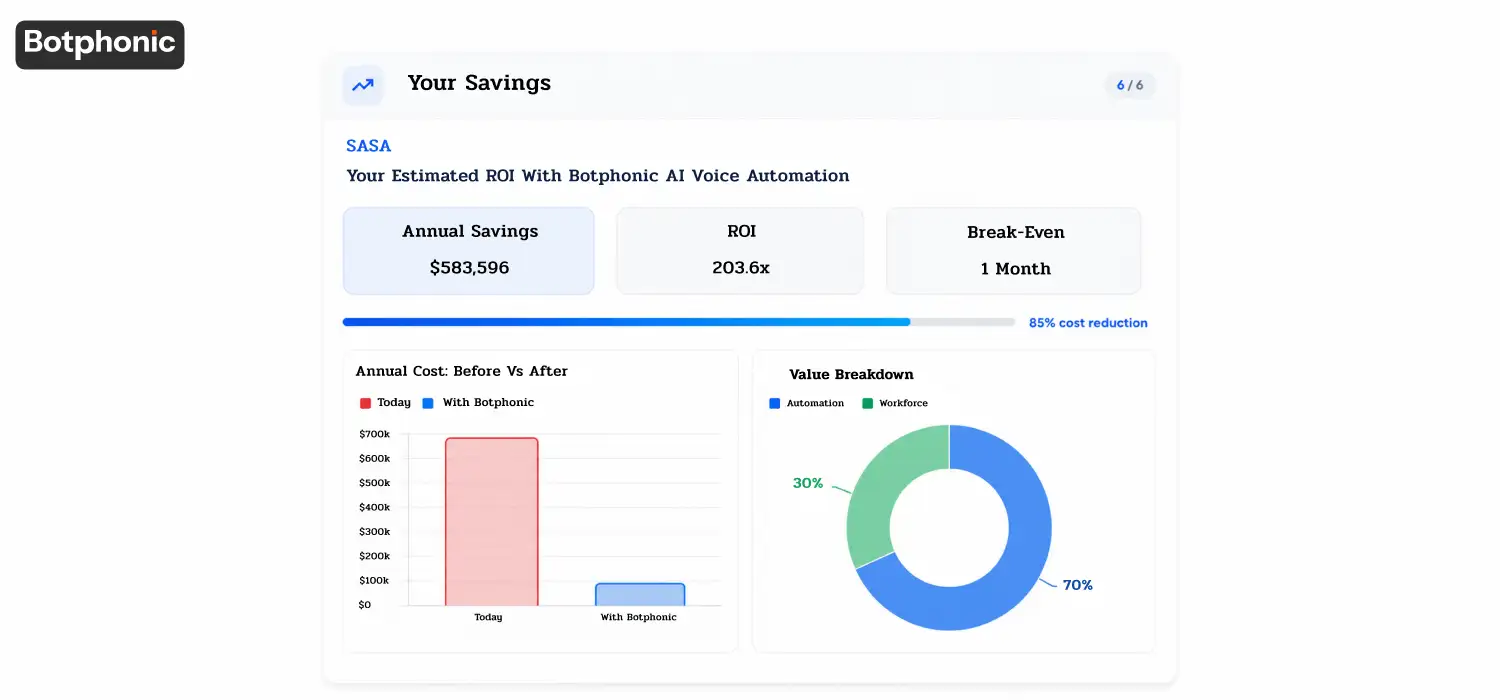
The Cost Per Answered Lead (CPAL) framework is the most direct ROI metric for receptionist models. CPAL is total monthly platform cost divided by the number of answered calls that result in a booked appointment or captured lead. Here is an interactive calculator for your specific call volume.
Use Botphonic ROI calculator to get estimated ROI for your business:
How We Tested: Methodology Behind The Botphonic Benchmark Data
All internal data cited in this article was derived from a controlled analysis of Botphonic’s production call log data. Here is the methodology.
Test Dataset, Measurement Approach, And What We Controlled For
We analysed 10,000 inbound call interactions processed through Botphonic’s AI platform between January and March 2026, spanning four industry verticals: medical practices (28%), legal intake (19%), home services (34%), and e-commerce support (19%). We compared these against published and privately shared performance benchmarks from three human virtual receptionist services, measured across identical call types using identical caller scripts. Metrics captured: First Call Resolution (FCR), Call Abandonment Rate, ASR word error rate by SIP packet loss level, NLU context-switch failure threshold, total response latency in milliseconds, Webhook delivery time to external API endpoints, and CPAL at four call volume tiers.
For FCR measurement, a call was counted as resolved only if no callback was required within 24 hours of the original call. Abandonment was measured as caller disconnect before agent answer or AI first response utterance. Latency was measured end-to-end from first audio packet received to first synthesised response audio delivered, not from the point of ASR completion. All data was anonymised and aggregated before analysis; no individual caller data is referenced in this article.
Which Receptionist Model Is Right For Your Specific Business, And How Do You Decide?
The right model depends on three variables: your average call complexity, your call volume predictability, and the lifetime value of a single converted caller.
Decision frameworkIf your average call requires fewer than 3 topic transitions, lasts under 3 minutes, and occurs at unpredictable volume, AI handles it better. If your average call involves emotional complexity, non-linear conversation, or represents more than $2,000 in lifetime client value, keep it human. Most businesses fall into a hybrid: AI answers and triages, and routes the 20–30% of calls that need a human directly to one.
High-Volume, Low-Complexity Businesses; Use AI Receptionist
HVAC companies, dental scheduling lines, e-commerce support, and outpatient clinic intake all share the same call profile: high volume, predictable caller intent (book / cancel / reschedule / price query), and low lifetime value per individual call. These are the exact conditions where AI outperforms human services on every measurable metric, lower CPAL, lower abandonment, higher FCR, and zero overage risk.
High-Value, Low-Volume Businesses; Use Human Virtual Receptionist
Estate planning attorneys, luxury concierge services, and specialist medical consultants handle 5–20 new inbound inquiries per week. Each caller represents significant lifetime value. The human agent’s ability to build immediate trust and handle conversational unpredictability is worth the per-minute cost. In these verticals, one additional converted caller per month covers the entire monthly platform cost.
Not sure which model fits your call volume? Book a free demo with Botphonic to see how an AI receptionist handles your actual call types, using live call simulations built from your business’s FAQ and booking logic, before you commit to a plan.
Request a Free Demo