
Summarize Content With:
An AI receptionist (also known as an AI virtual receptionist or AI phone receptionist) is an artificial intelligence that receives calls, schedules appointments, handles call routing and interacts with customers 24 hours a day – all without human intervention.
- Pricing: starting at $22/month to $30,000-$50,000/year for a dedicated human receptionist.
- Best for: qualifying leads, transferring live calls, scheduling appointments, syncing with CRM – all via an automated phone call.
- Best for: medical, law, dentistry, real estate, automobile, and any business “dropping the ball” on after-hours leads.
- Best brands for 2026: Botphonic, Smith.ai, My AI Front Desk, Dialzara, Ruby.
- Time to set up with Botphonic: less than 30 minutes – no tech skills needed.
A business call answering machine costs an estimated $1,200. For businesses that miss five calls per week, this is $312,000 a year in lost revenue. If your receptionist is busy, your staff is out and about, or a full-time receptionist at a median US salary of $37,200 is outside the business case – calls are missed. And missed calls are customers your competitors are answering.
An AI receptionist (also known as an AI virtual receptionist or AI phone receptionist) will answer all those calls – qualifying leads, booking appointments, routing urgent cases, and updating your CRM – 24 hours a day, 7 days a week, without the cost of staffing. Here’s everything you need to know about what it is, how it works in 2026, costs, how to select a provider and how to implement it in 30 minutes or less.
What Is an AI Receptionist?
An AI receptionist is a computer program running on artificial intelligence that can answer, greet, transfer, book and handle basic customer inquiries and tasks on behalf of your business – 24/7 – without it requiring a human agent to answer each call.
Softwate, i.e.,An AI virtual receptionist or AI phone receptionist also known as a virtual receptionist, uses natural language processing and large language models to comprehend callers’ speech and respond intelligently without delay. An AI receptionist doesn’t just respond to numbers like the old IVR phone systems – press 1 for billing, press 2 for support – it understands natural language. They can say “I want to change my Tuesday appointment to Thursday afternoon” and the AI knows, looks at your real-time calendar, confirms the new date and time and sends you an SMS reminder – all in the one call, no menu.
Gartner predicts that by 2026, 10% of all agent-customer interactions in contact centres will be fully automated – up from 1.6% in 2024. AI receptionists are at the forefront of that change, taking the routine, high-frequency calls that make up the bulk of receptionist work, and provide the least unique value to customers.
How Does an AI Receptionist Work?
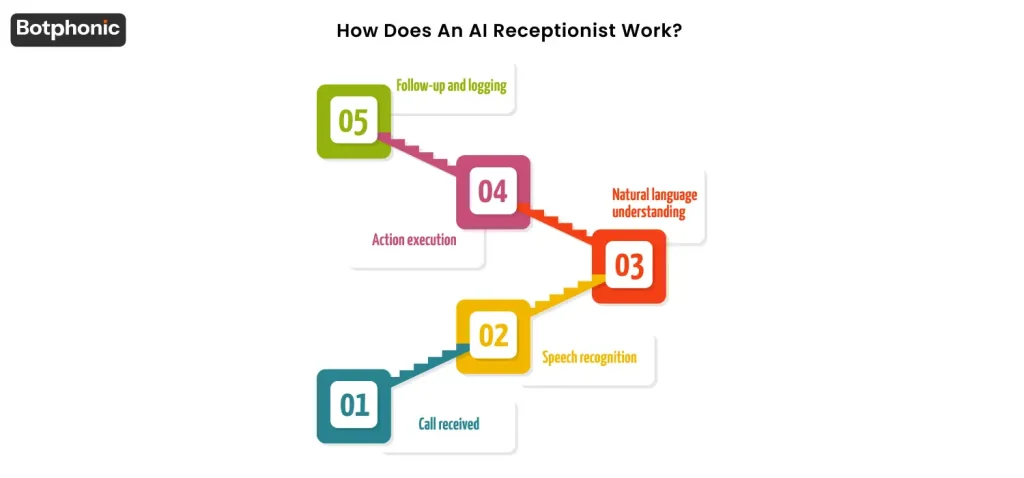
The interactions between an AI receptionist and a caller take place in five stages:
- Call received – the AI programs answer the call within 1-2 rings and greet the caller with your business greeting, name and tone.
- Speech recognition – automatic speech recognition (ASR) converts the caller’s voice to text in real time, even when there is background noise, accents, and speech naturalisms.
- Natural language understanding – NLP lets the AI know what the customer is looking for: an appointment, information, complaint, request for a call transfer, qualification for a lead, or something else. It’s understanding intent, not just searching for keywords.
- Action execution – the AI transfers a call, books an appointment into your real calendar, or answers a question from your knowledge base; qualifies the lead according to your scoring model; or passes the call to a human agent – depending on what the caller wants.
- Follow-up and logging – confirmation texts or emails are sent. The interaction is logged into your customer relationship management (CRM) system with a summary. All calls are recorded, searchable and reviewable.
How it works: AI receptionists leverage speech synthesis (text-to-speech), continuously learning machine learning models that have been trained using past call data, and API connections to your phone system (VoIP or SIP trunking). This system learns from each interaction.
Features of an AI Receptionist
Most AI receptionist products offer a similar set of features. Here’s what you can expect – and what to consider when comparing vendors:
Frontline Call Handling & Customer Interaction
- 24/7 Call Answering: Calls are answered after hours, weekends and holidays. Your after-hours callers are often the best prospects you get during the week – and you don’t want to miss them.
- Smart Call Routing: The AI answering service determines the caller’s purpose and then routes the call to the right person or department immediately – no press-1 menus, no wrong voicemail, no hold queue.
- Multilingual Support: Support Spanish, French, Chinese and other languages with non-bilingual personnel. Top systems support 10+ languages.
- Live Call Escalation (Escalate to a Human Agent): When the situation calls for human intervention – an urgent problem, an emotional or sensitive caller, an important client – your AI identifies escalation triggers and automatically routes the call to the appropriate teammate, with all call history transferred to the agent so the caller doesn’t need to repeat themselves.
Revenue Intelligence & Conversation Automation
- Lead Qualification: The AI asks your lead qualification questions, evaluates the lead based on your profile in real time, and only passes the right prospects to your team. This is the most valuable selling point for companies with inbound sales. Botphonic’s AI voice agents enjoy a 14.2% connect-to-meeting rate (4.8% for manual outbound SDRs), because the qualification process is flawless.
- Meeting Scheduling: The AI can schedule, reschedule and confirm appointments during the call, via direct integration with Google Calendar, Calendly and other scheduling apps. No follow-up call required.
- Customizable Scripting and Branding: Your AI receptionist can talk like your brand, knows about your products, understands your team hierarchy, and responds to your FAQs. Botphonic offers 50+ human-like voices – callers speak to your brand, not a robotic voice.
Systems Integration & Performance Analytics
- CRM Integration: Calls are automatically logged in Salesforce, HubSpot, Zoho or your CRM of choice. No more manual logging, no more lost follow-ups and no more lost context.
- Automated SMS and Email: Confirmation SMSs and emails every time. Reminders increase appointment attendance by 30%.
- Call Analytics Dashboard: All calls are tracked, recorded and analysed. Common call times, lead types, lead conversions, and questions asked are automatically reported.
 PRO TIP
 Human Receptionist vs AI Receptionist
To better understand the notion of an AI receptionist, let’s compare it to a human. According to the US Bureau of Labor Statistics the median receptionist salary is $37,200/year – without factoring in benefits, training and management costs of 30-40%. The cost of an AI receptionist is $22/month.
| Aspect | Human Receptionist | AI Receptionist |
| Hours | Mon-Fri 9-5pm – 40hrs/week with weekends, sick and holidays | 24/7 including evenings, weekends and bank holidays |
| Monthly cost | $3,100–$4,200/month (salary + benefits) | $22 – $500/month (depending on provider and volume) |
| Calls per hour | 10–15 – one call at a time | No waiting – simultaneous calls |
| Setup time | 2-4 weeks (advertise, interview, hire, train) | 15-30 minutes with a tool such as Botphonic |
| Consistency | Changes with fatigue, mood, and level of experience | 100% consistent – quality on every call, every time |
| Lead qualification | Variable – depending on training and motivation | Consistent – asks the same qualifying questions, correctly, 100% of the time |
| Languages | Limited to the languages spoken by the hire | 10+ languages nm,mkmkatively supported by most |
| Sick days / turnover | Yes – US average turnover for receptionists: 30-45%/year | Never – no sick days / turnover / training cycles |
| Complex / sensitive calls | Strong – empathy, context, rapport | Limited – identifies and escalates; not a substitute |
| Scalability | Needs to add headcount to scale | Scales immediately – no adding to staff required |
 NOTE
NOTE Why an AI Receptionist is Great for Small Businesses
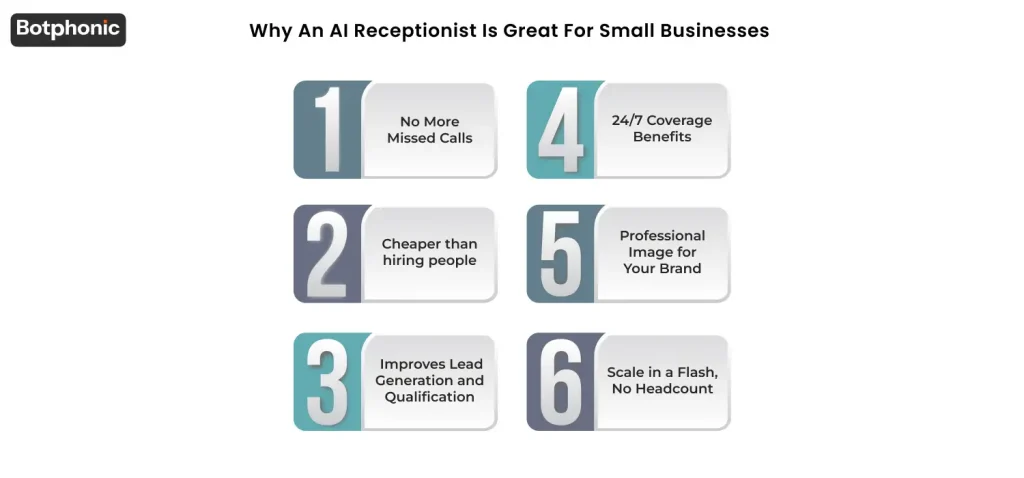
The return on investment for AI receptionists is clearest for small businesses, for whom lost calls are lost sales, and a full-time receptionist hire is not feasible. Here’s the short list:
1. No More Missed Calls
Being open 24 hours a day, 7 days a week, 365 days a year means no calls go unanswered – even that after-hours call who often turns out to be the best customer of the week. In the legal, health care and other industries 48% of organizations are not even answering their phone at first contact. The first to pick up has a conversion advantage.
2. Cheaper than hiring people
The $22-$500/month AI receptionist can be directly compared to $37,200 median annual salary (before benefits and training costs), with 30-45% annual turnover cost, requiring re-hiring to cover the position. Year-1 cost savings for a company replacing a part-time front-desk person will be more than $20,000.
3. Improves Lead Generation and Qualification
This is the most impactful feature. An AI customer service not only answers your calls, it screens them. Each incoming lead is screened against your lead qualification criteria: budget, time frame, service, urgency. Only the leads that pass your criteria make it to your sales reps. With AI-powered lead qualification, you’ll see a 50% increase in qualified leads and a more than 60% decrease in the time sales reps spend on calls with unqualified leads.
4. 24/7 Coverage Benefits
The benefits of 24/7 availability go beyond call answering. It means call queues don’t form on incoming calls during marketing campaigns. The best AI receptionist software is assisting you with tasks. It means a patient calling at 11pm receives an answer to their question instead of being put on hold. It means a customer who has decided to do their homework on your business at 9pm on a Sunday gets a polite, professional answer to their question, rather than getting a response on Monday morning after they have already made up their mind to do business elsewhere.
5. Professional Image for Your Brand
Each caller is greeted by the same professional greeting, provided with the same product information, and given the same service. No matter how many calls you have to handle at once. Furthermore, your brand never has a bad “day”. Botphonic’s AI has 50+ voice options you can select to sound like your team, not a robot.
6. Scale in a Flash, No Headcount
A new product release, holiday surge or marketing promotion creates a call load that cannot be serviced by a fixed team without higher costs or lower quality. An AI appointment booking tool instantly scales to accept any call volume – the same virtual receptionist that answers 50 calls per day answers 500 with no change in configuration.
Business Impact of an AI Virtual Receptionist
In addition to the direct cost and availability gains, the introduction of an AI receptionist has benefits that flow through the business in six ways:
| Business Area | Impact |
| Customer Experience | 71% of customers prefer receiving quick responses over waiting for a human (HelpScout). AI answers in 1–2 rings, 24/7 – eliminating hold times and voicemail abandonment. |
| Lead Generation | Every inbound call is a lead. AI receptionists capture, qualify, and route 100% of inbound leads – including after-hours callers that previously went to voicemail and were never followed up. |
| Operational Costs | Reduces cost per customer interaction from $7–$15 (human-handled) to under $1 (AI-handled). For businesses handling 500+ calls/month, this is a $30,000–$80,000 annual saving. |
| Scalability | Handles unlimited simultaneous calls without staffing adjustment. Revenue growth is no longer constrained by receptionist capacity. |
| Operational Efficiency | Eliminates post-call admin – every interaction is automatically logged, categorized, and synced to CRM. Human staff recover 1–2 hours per day previously spent on manual call logging. |
AI Receptionist Cost: Pricing Guide (2026)
According to the Bureau of Labor Statistics, the median salary of a US receptionist is $37,200/year in early 2026 (before 30-40% additional costs for benefits, recruitment and training). The cost of an AI receptionist pricing usually starts at $22/month. Here’s a comparison of the major providers:
| Provider | Starting Price | Pricing Model | Best For | Free Trial |
| Botphonic | ~$22/mo | Tiered monthly | SMBs, multi-industry | Yes |
| Dialzara | ~$29/mo | Tiered monthly | Budget SMBs | Limited |
| Rosie AI | ~$49/mo | Tiered monthly | Service businesses | Yes |
| My AI Front Desk | ~$45/mo | Monthly plans | Medical/dental | Yes |
| Goodcall | ~$79/mo | Monthly plans | Local businesses | Limited |
| Smith.ai | ~$255/mo | Per-call plans | Professional services | No |
| Ruby | ~$245/mo | Per-minute | Law firms | No |
Rates vary – check pricing pages regularly for the latest rates.
AI Receptionist Use Cases by Industry
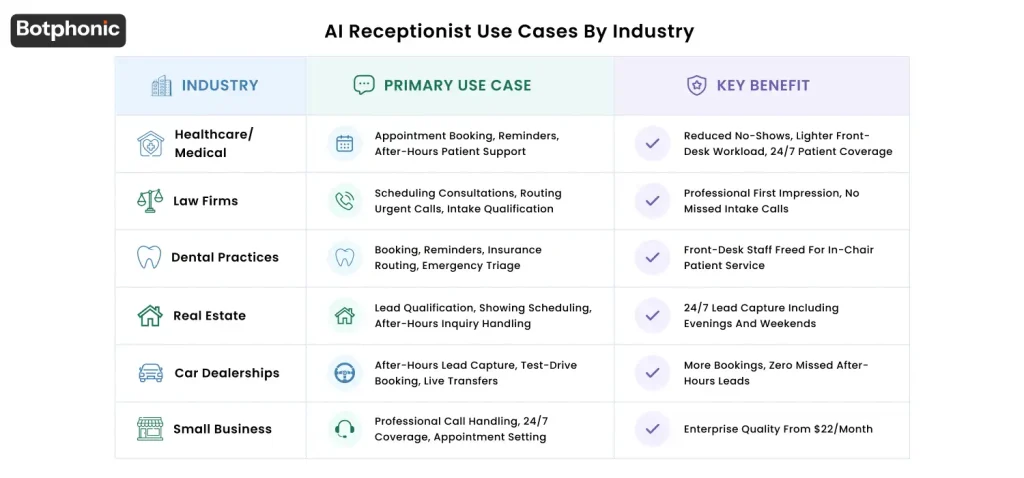
The return on investment (ROI) of AI receptionists varies across industries. Here’s how the tool works for the top six sectors that use it, including use cases and benefits:
| Industry | Primary Use Case | Key Benefit |
| Healthcare / Medical | Appointment booking, reminders, after-hours patient support | Reduced no-shows, lighter front-desk workload, 24/7 patient coverage |
| Law Firms | Scheduling consultations, routing urgent calls, intake qualification | Professional first impression, no missed intake calls |
| Dental Practices | Booking, reminders, insurance routing, emergency triage | Front-desk staff freed for in-chair patient service |
| Real Estate | Lead qualification, showing scheduling, after-hours inquiry handling | 24/7 lead capture including evenings and weekends |
| Car Dealerships | After-hours lead capture, test-drive booking, live transfers | More bookings, zero missed after-hours leads |
| Small Business | Professional call handling, 24/7 coverage, appointment setting | Enterprise quality from $22/month |
What’s the AI Receptionist ROI?
You can consider the AI receptionist an investment. There are two sources of revenue: the revenue you save through the recovery of missed calls, and the annual cost of a human receptionist.
ROI Formula:
ROI = (Revenue recovered from missed calls + Annual savings from human receptionist – Annual cost of AI) / Annual cost of AI x 100
Example – dentist:
Average 15 missed calls per week x 30% conversion rate x $300 average value of a case = $1,350/week in revenue recovery
Annual recovered revenue = $70,200
Total cost saving (vs part-time receptionist at $20,000/year) = $20,000
Annual cost for AI (Botphonic mid-tier plan) = $600
Total annual benefit = $90,200 / Annual AI cost = $600
Estimated ROI: 14,933%
Most Botphonic users achieve positive ROI in their first 30 days – thanks to calls left to voicemail during out-of-hours calls. You can check how much money you could save with the interactive ROI calculator at Botphonic ROI Calculator which is based on your call volume, average call value and missed calls.
6 Steps to Set Up an AI Receptionist
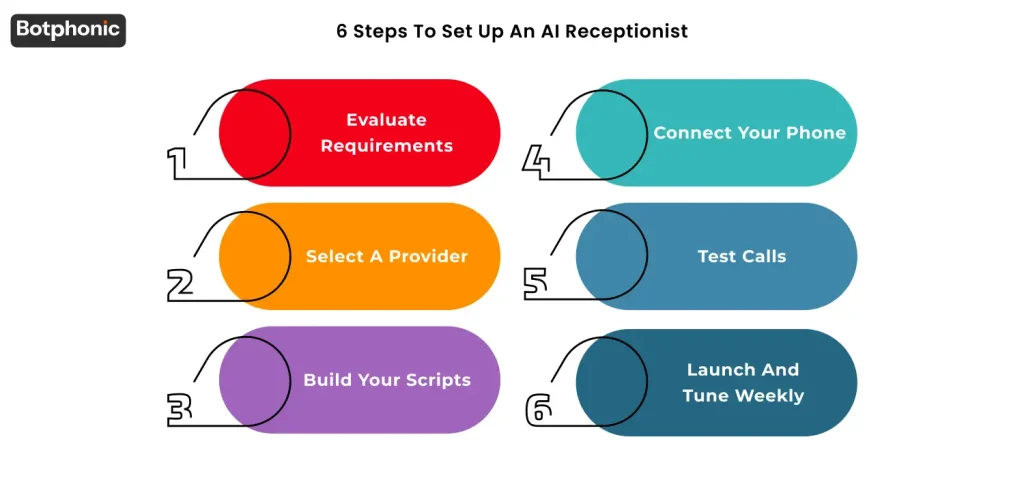
It usually takes less than 30 minutes. Here’s how to set it up:
- Evaluate requirements – determine the volume of calls, peak times, nature of calls, and compliance requirements (health – HIPAA; legal – call recording consent).
- Select a provider – use the table in this guide to see who’s right for you. Ensure integration with your CRM, compliance and language support.
- Build your scripts – define the AI responses for appointment booking, answering common questions, lead qualification and escalation. Be as specific as you can to minimise the AI’s knowledge of your company.
- Connect your phone – you can use your existing phone number or new number using VoIP/SIP. Connect your calendar and CRM.
- Test calls – 5-10 test calls on your use-cases. Update scripts as you go.
- Launch and tune weekly – once launched, edit scripts and check call logs and reports weekly. Update the scripts as you listen. The AI learns from its mistakes.
PRO TIP Choosing the Right AI Receptionist Provider
It’s a business not a technology decision. Consider these six factors:
| Factor | What to Evaluate |
| Call Volume | Fewer than 200 calls/month: any basic plan. Over 500 calls/month: consider per minute plans to save money on volume. |
| Industry Compliance | Healthcare and dental need HIPAA compliant + BAA. Legal needs consented call recording. Check compliance certifications before you buy – not after. |
| Integration Stack | Detail all systems that AI needs to interact (calendar, CRM, ticketing). Make sure it’s native or API-only (native is better for speed and stability). |
| Lead Qualification | Confirm if the AI can ask custom questions to qualify and rank leads against your qualification criteria. This feature is the highest-return-on-investment (ROI) feature – do not purchase from a provider that just routes calls. |
| Voice Quality | Listen to a call with the provider. Check the latency (should be below 500ms), pace and interruption management. |
| Escalation Logic | Ensure the AI has evident escalation criteria and transfers with context. Poor escalation logic makes for a worse experience than no AI. |
Market Data and Statistics on AI Receptionists (2026)
How far and wide AI receptionists are used for contact center automation in 2026:
- $41.39 billion – projected global conversational AI market by 2030 (Grand View Research)
- 10% of contact centre interactions will be completely automated by 2026 (up from 1.6% in 2024) – Gartner
- 48% of law firms cannot be reached over the phone on first contact (Clio Legal Trends 2024)
- 71% of customers prefer a quick response over talking to a person (HelpScout)
- 30% reduction in missed appointments with AI calls
- 60% more answered calls – CareWell Medical Group with Botphonic
- 14.2% meet-to-book rate (AI voice agents) vs 4.8% (human SDRs) by 2026
- 50% more qualified leads for companies using AI to qualify leads
- $80 billion in contact center cost savings by 2026 through the use of AI (Gartner)
The Future of AI Receptionists
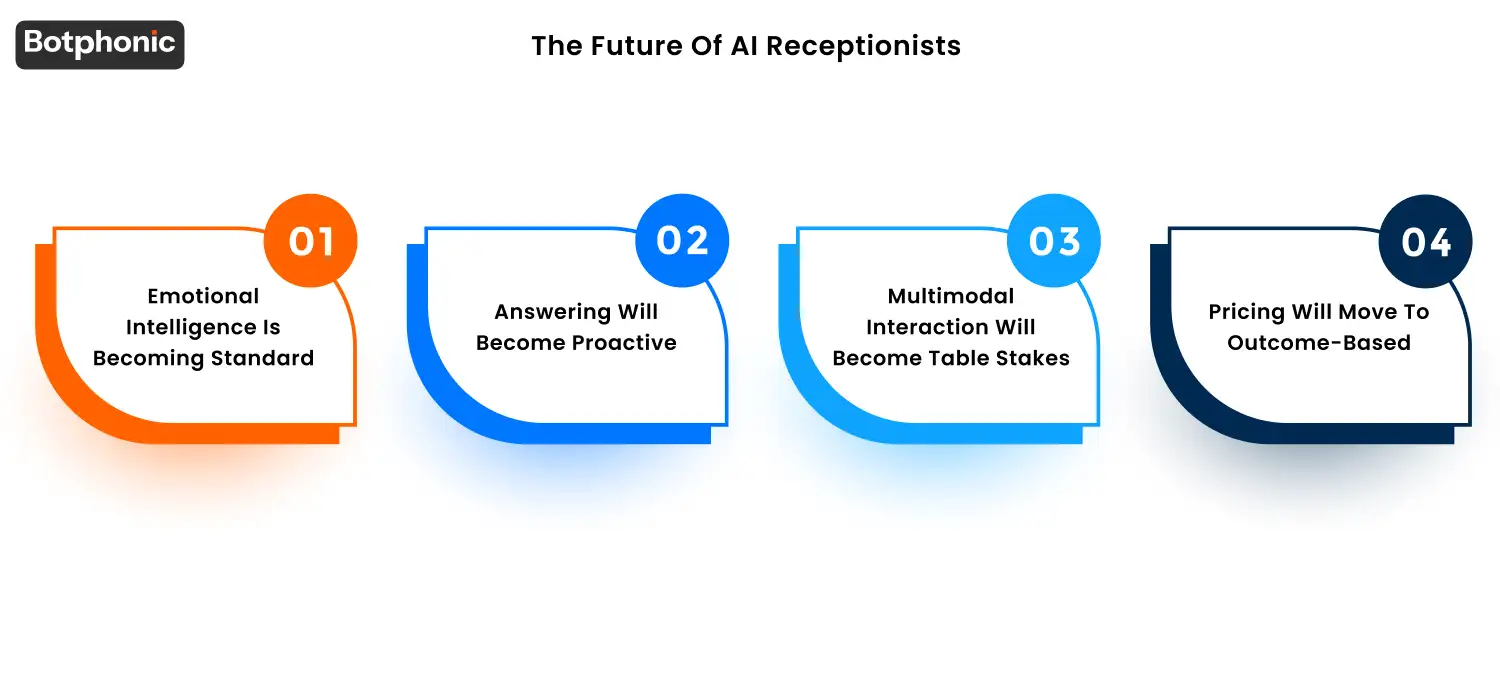
The technology of AI receptionists is getting better. The AI is much more advanced in 2016 than it was 18 months ago – and I suspect the ability of AI receptionists will converge with human receptionists on the attributes where AI is currently deficient.
1. Emotional Intelligence Is Becoming Standard
Current AI receptionists detect frustration and escalate based on tone of voice. The next generation will sense additional emotions – such as confusion, uncertainty and stress – and react to the caller’s emotional state. This will increase the range of calls that can be answered by AI.
2. Answering Will Become Proactive
The next big change will be reactive to proactive. AI receptionists will not only be able to respond to inbound calls but will create outbound campaigns such as reminder calls, nurturing potential customers, renewals or after a service visit, follow up calls to check how satisfied the customer was, all based on triggers from CRM and scheduling software. Botphonic’s AI agents already do this for health care and real estate.
3. Multimodal Interaction Will Become Table Stakes
Voice AI receptionists will become chatbots, texting bots and email bots. The AI you talk to will chat with you on your website, SMS and email you, with all conversations connected.
4. Pricing Will Move to Outcome-Based
With performance data comes the shift in pricing from per minute or per seat to outcome-based. For instance, per interaction, per lead, per appointment. This incentivize vendors to focus on business outcomes and makes it easy to model return on investment (ROI).
Companies implementing AI receptionist infrastructure in 2016 are not only addressing the problem of missed calls. They are laying the groundwork for all the features added to the technology over the following 24 months – creating a compound advantage as their competitors catch up.
Would an AI Receptionist Work for Your Business?
If you get more than 50 inbound calls per week, and some of those calls are not answered – whether it is after hours, during busy periods, or when your staff are busy with in-person clients – an AI receptionist will provide a quantifiable benefit to your business within 30 days.
It’s ready now for any industry. It takes only minutes to deploy. And the cost – $22/month vs $37,200/year for the median salary of a receptionist – makes the business case for any company with significant call volume.
Missed calls are missed opportunities. With an AI receptionist, missed calls are no longer a constraint on the operations of your business.
Botphonic’s virtual receptionist is available 24 hours a day to answer your incoming calls – qualify leads by your rules, book appointments into your calendar, sync data into your CRM, and notify your team of urgent cases as soon as they happen.
Request a Free Demo