
Summarize Content With:
AI Appointment Scheduling at a Glance
The case of AI in the appointment scheduling business is the most rapidly expanding type of business automation- and understandably so.
By 2026, the virtual receptionist market had hit 4.64 billion, with a growth rate of 9.8% CAGR, as many businesses will not be willing to use manual booking anymore, as they will prefer using an AI-based system that operates 24/7.
This guide covers:
- The process of AI scheduling appointments (step-by-step)
- The best aspects to consider in AI receptionist scheduling software
- 7 existing industries that are already using it with practical examples
- AI scheduling and manual scheduling (comparison table)
- The ability to install and start in a few hours, not weeks
Why Businesses Are Switching to AI Appointment Scheduling
Any missed appointment is a missed call. Each appointment that is missed is money. In companies with business based on bookings dental clinics, law offices, salons, real estate offices, financial advisors – the front office desk is the cash cow.
The problem is structural. One caller is taken care of by a human receptionist. They are on business time only, and get sick leaves. Also, they neglect to send reminders. and when the phone rings at 7:30 p.m. on a Friday, it rings to voicemail and that caller makes a booking with an opponent.
The State of Service research by Salesforce states that when customers have the expectation, they are more likely to buy again when their experience is positive. In the case of appointment-based business, such an experience begins during the initial call.
AI appointment scheduling eliminates all these points of failure. The AI responds immediately, verifies the availability, validates the booking and documents the interaction without a human being, at any time, and any number of callers. Businesses that have adopted it report:
- Automated reminders reduce no-show rates by 30-50% of all cases.
- Heavy retrieval of bookings after-hours that would have gone to voicemail.
- The front-desk staff time saved to do more valuable patient or client interaction.
- Stable quality of calls irrespective of the time of the day or the number of calls.
See Botphonic’s AI appointment booking features
How AI Appointment Scheduling Works
Realizing the mechanics enables you to judge platforms properly. Scheduling of AIs is not just a plain IVR menu. It is a workflow involving a multi-step process, which integrates natural language processing, live calendar, CRM sync, and automated follow-up. The following is what occurs on one inbound call:
- Call received: AI response within less than 3 seconds -24/7, any time of the day.
- Intent detection: NLP finds the intent: book Thursday-afternoon.
- Calendar sync: AI checks live availability via Google Calendar or Outlook
- Available slots: AI has 2-3 slots according to the choice of the caller.
- Booking confirmed: Appointment created; confirmation SMS/email sent to caller
- CRM updated: Call notes, caller name and booking notes automatically added.
- Reminder sent: Automated reminder 24-48 hours prior to the appointment.
- No-show follow-up: In case of cancellation, AI automatically provides rebooking or waitlist position.
The whole process of the workflow – answering the call to updating the CRM usually consumes less than 90 seconds. Consider that, on average, it takes 510 minutes of staff time to make the same booking manually, the efficiency case is now direct.
To explore more how AI is being applied in practice, see examples of AI appointment booking in action.
Top AI Appointment Scheduling Features to Look For
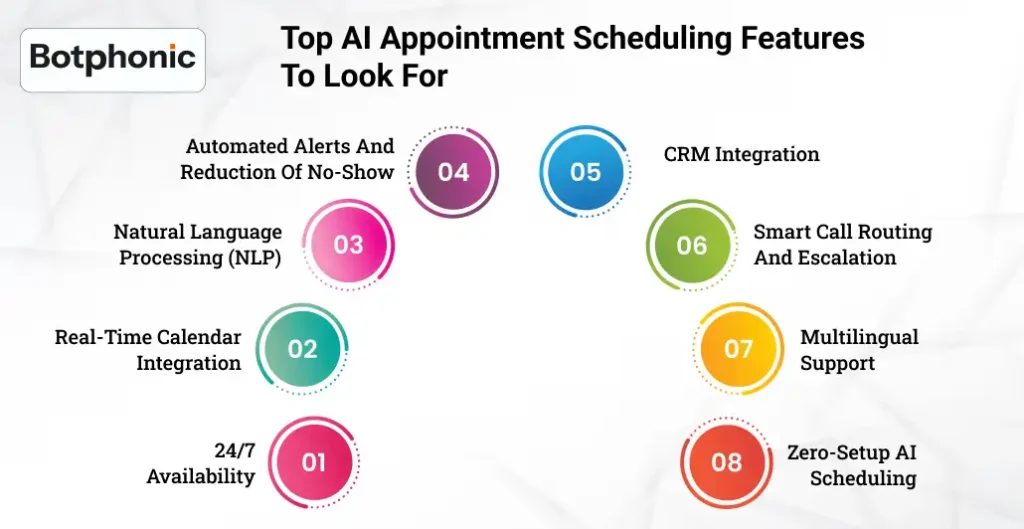
Not every AI scheduling tool is the same. These are the characteristics that will make a system truly automate your booking process or just another point of friction.
1. 24/7 Availability
The fundamental promise: no call is left unanswered. The patient who calls at 11 p.m. and the client who calls Sunday morning are treated completely by the AI. In businesses that experience high after-hours demand healthcare, legal, home services, real estate – this feature is worth the price alone. According to industry research, 74 percent of calls to small service enterprises are not answered during off-hours. Every call that is not answered is an opportunity to a competitor.
2. Real-Time Calendar Integration
The AI has to be connected to your calendar Google Calendar, Outlook, or practice management systems to look at real-time availability. Scheduling programs based on manual calendar updates or a different booking layer cause conflicts, duplication of bookings and staff frustration. Two-way, real time sync is a must.
3. Natural Language Processing (NLP)
The AI should be able to comprehend natural speech, not just keywords. A caller who utters that he/she would like to visit sometime next week, perhaps, Thursday or Friday afternoon, should not be given an error. In the analysis of 347,609 business calls conducted by NextPhone, the conversation is complex and multi-turn and the accuracy of contemporary NLP-based systems is high. The technical criteria that matter the most when considering AI scheduling software is its quality.
4. Automated Alerts and Reduction of No-Show
Making a reservation is just half the battle. Automated SMS and email reminder reminders by AI receptionists 24-48 hours prior to appointments consistently decrease no-show rates by 30-50. In the case of a medical practice, where 30+ appointments are made a day, a 20-percent decrease in the number of no-shows will restore considerable revenue on a monthly basis. Reminder workflow to be fully automated only staff action is required.
5. CRM Integration
Each reservation must automatically update CRM record of the caller. Botphonic is integrated to Salesforce, HubSpot, and Zoho and composes call notes, booking information, and intent of the caller in real-time to the contact record. Sales and service teams enter into each communication with the full information base in mind – no manual data input, no follow-up loss.
6. Smart Call Routing and Escalation
Scheduling calls are not all easy. Human judgment may be necessary in response to a caller who requests a particular doctor or an urgent same-day appointment or rescheduling a complex multi-part appointment. The AI should recognize these cases and gracefully escalate them – explaining to the receiving staff member the context of the call so that a caller does not need to repeat him/herself.
7. Multilingual Support
In markets with mixed populations, especially in the US where tens of millions of the population speaks Spanish as a first language, a monolingual scheduling system will lose bookings. The AI is required to pick up on the language of the caller and react accordingly, and the accent-sensitive recognition is needed instead of a strict dialect model.
8. Zero-Setup AI Scheduling
The most effective AI scheduling systems can be implemented within hours, not months. Botphonic is linked to your existing phone number and helps keep up to date with your calendar, and it sets up call flows via an onboarding process that requires no developers. AI receptionist pricing plans are available to compare and contrast the cost with your booking volume.
Eager to automate your appointment scheduling?
Booking Botphonic allows 247 bookings, ready in minutes. Try It Free →
AI Appointment Scheduling for Every Industry
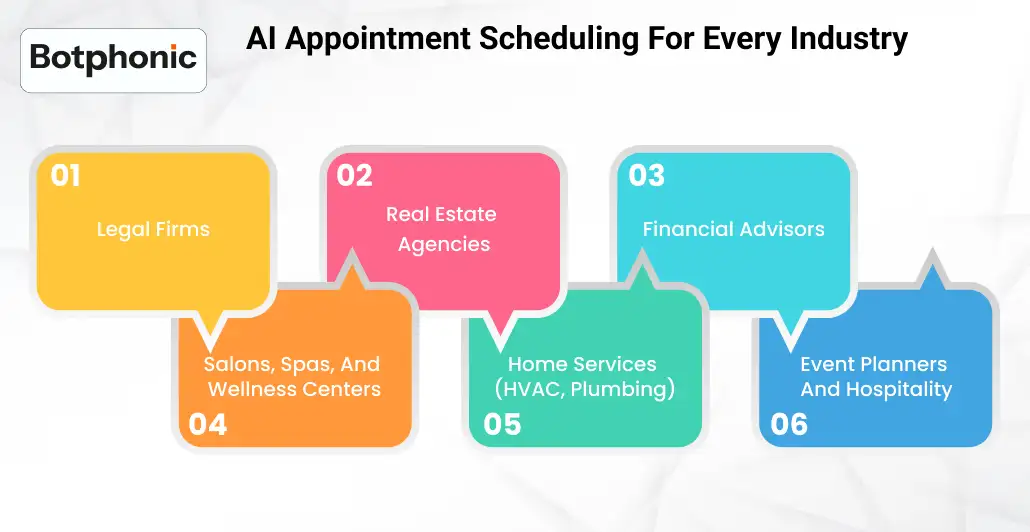
AI scheduling creates quantifiable value in any business model that is based on appointments. These are the seven industries with the highest adoption rates – and with the most obvious ROI.
1. Legal Firms
There are two particular scheduling issues in law firms; the incoming client intake calls which need to be qualified and the current client scheduling which needs to be checked on conflict. AI receptionists do all the work in the scheduling layer, including receiving new lead information, making appointments, and referring urgent cases (court deadlines, arrest cases) to a lawyer who is free. Companies document high lead capture rates in comparison to competitors that rely on voicemail since prospects that are not able to contact a firm in their first call often proceed to the next result in their search.
2. Real Estate Agencies
Specific calendar coordination is needed in property viewing requests, mortgage consultations and seller meetings. Real estate agents never sit at a desk, they are either showing real estate, at meetings, or on their way. An AI receptionist makes a booking of the viewings into the calendar of the agent, sends the confirmation to an agent and a client and does not require any manual intervention with the request of a reschedule. With multi-agent offices, smart routing enables any caller to get the appropriate agent depending on the location of the property or the type of transaction.
3. Financial Advisors
Financial advisory practices book high-value consultations that need to be carefully scheduled, no double-booking, sufficient preparation time to prepare the next appointment and good reminders to the advisor and client. AI scheduling manages intake qualification (new client or existing type of meeting), books against complex calendar rules, and provides preparation reminders and attaches relevant documents.
4. Salons, Spas, and Wellness Centers
Scheduling precision is paramount in high-volume appointment and short service-duration businesses. What will cascade out of this is a 45-minute massage that can not overrun other appointments. The accuracy of time in booking these businesses is done by AI receptionists that integrate with booking systems such as Calendly or Acuity. They steal service preference, stylist requests and special requests – and automatic reminders that radically cut no-shows, which are especially harmful in per-seat service businesses.
5. Home Services (HVAC, Plumbing)
Home service companies lose a lot of revenue due to lost after-hours emergency calls. When the air conditioner breaks down during a heat wave, the homeowner makes calls to 5-10 contractors. The first one to answer gets the job. AI scheduling records these emergency calls at any time and schedules the appointment and forwards urgent requests – keywords such as urgent, emergency or no hot water to the phone of an on-call technician. Industry statistics indicate that in 15.9 percent of all business calls, there is such urgency language.
6. Event Planners and Hospitality
Event planning consultations include complicated multi-parties scheduling, venue availability tests and time-based deposits. AI receptionists process the first inquiries, record details of events and schedule discovery consultations without a coordinator present during the inquiry.
 NOTE
NOTE How AI Scheduling Reduces No-Shows and Saves Staff Time
No-shows are among the worst operational issues of appointment based business firms. A lost appointment is not merely a lost revenue slot, but a slot that might otherwise be occupied by a person on the wait list, an unrecoverable staff hour, not to mention a fixed overhead expense that has been incurred anyway.
AI attacks no-shows in three fronts:
- Automated reminders: SMS and email notifications 24-48 hours prior to appointments. These are not only sent regularly, at the appropriate moment, and every time, as opposed to manual reminder calls, but also are sent at the correct time, at the correct frequency, and at the correct workload, regardless of the employee workload.
- Easy rescheduling: Unable to make their initial appointment, callers can reschedule through a return call that will be fully automated by the AI no hold times, no frustration, no need to just not show up.
- Waitlist management: A cancellation will be instantly communicated with the next person on the waitlist by the AI, and the slot can be sold back to recover lost revenue.
Businesses which apply all three always report a 30-50% decrease in no-show rates. A 30 percent decrease in a 20 percent no-show rate in a medical practice that has an average appointment value of $150 and 30 appointments per day recovers about $270/day about $67,500 per year.
For Example
Dental and Healthcare
The most widely adopted AI receptionist is in healthcare, with NextPhone call data revealing that 13.3% of all AI receptionist implementations are located in medical and dental offices. Its use case is simple: high demands in calls, revenue based on appointments, HIPAA compliance, and the need of patients after the working hours. AI scheduling will respond to after-hours calls, make appointments, reminders, and transfer urgent calls to on-call employees, all without compromising.
HIPAA-compliant data handling. A dental clinic with Botphonic is able to get all the after-hours booking requests instead of losing them to voicemail.
To get healthcare-specific instructions, refer to AI appointment booking software for hospitals and clinics.
Integration Capabilities: Integrating AI Scheduling with Your Tech Stack
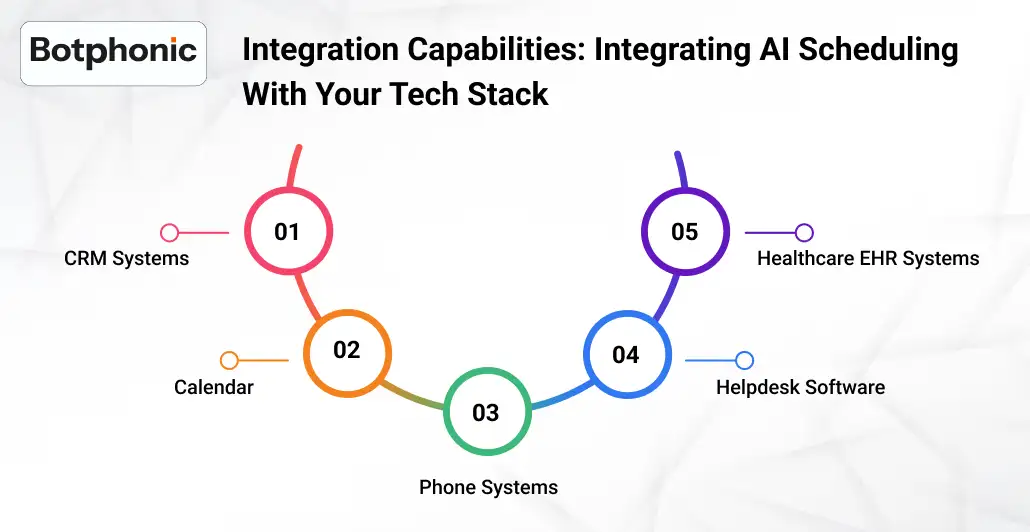
An AI scheduling application simply provides complete value when linked to your current tools. Isolated scheduling, which does not sync with your CRM, calendar, practice management platform, simply increases work.
Botphonic is compatible with:
- CRM systems: Salesforce, HubSpot, Zoho – all contacts automatically registered in the right contact.
- Calendar: Google Calendar, Outlook – two-way calendar is real-time and avoids duplication of bookings.
- Phone systems: VoIP services and regular landlines – no hardware modifications are needed.
- Helpdesk software: Zendesk, Freshdesk – help desk tickets generated automatically based on scheduled calls.
- Healthcare EHR systems: through API of medical practices that need practice management integration.
The Salesforce native integration of Botphonic takes care of this. To learn more about the API layer and other personalized integrations, See must have AI receptionist features that are necessary.
 PRO TIP
 AI Receptionist vs. Traditional Receptionist for Scheduling
Knowing where AI will work best and where the human factor is still needed can guide businesses to make a sensible deployment choice – and develop the appropriate hybrid model.
| Capability | AI Receptionist | Traditional Receptionist | Winner |
| Availability | 24/7 including weekends & holidays | Business hours only; coverage gaps | AI |
| Concurrent calls | Unlimited simultaneous calls | Typically 1–2 calls at a time | AI |
| Appointment booking | Books, reschedules & confirms instantly | Subject to hold times & errors | AI |
| No-show reduction | Automated SMS/email reminders | Manual follow-up calls needed | AI |
| CRM logging | Automatic after every call | Manual data entry required | AI |
| Setup time | Hours to days (no coding required) | Weeks to hire and onboard | AI |
| Monthly cost | $199–$500/month | $3,750–$4,000+ (salary + benefits) | AI |
| Complex empathy | Routes to human; simulated only | Genuine human connection | Human |
| Nuanced judgment | Limited; escalates edge cases | Strong situational awareness | Human |
| Language support | Multilingual by configuration | Depends on individual skills | AI |
The hybrid model is the most suitable concerning appointment-based businesses: AI takes all the routine booking calls – most of the inbound – and the human employees process the intricate cases, delicate talks, and rapport building interactions. This model provides the benefits of AI in terms of cost and availability and still preserves the human judgment that some interactions must have.
Companies that have embraced this model claim 40-60% front desk workload reduction and at the same time increase in the call answer rates and booking completion rates.
How to Set Up AI Receptionist Appointment Scheduling
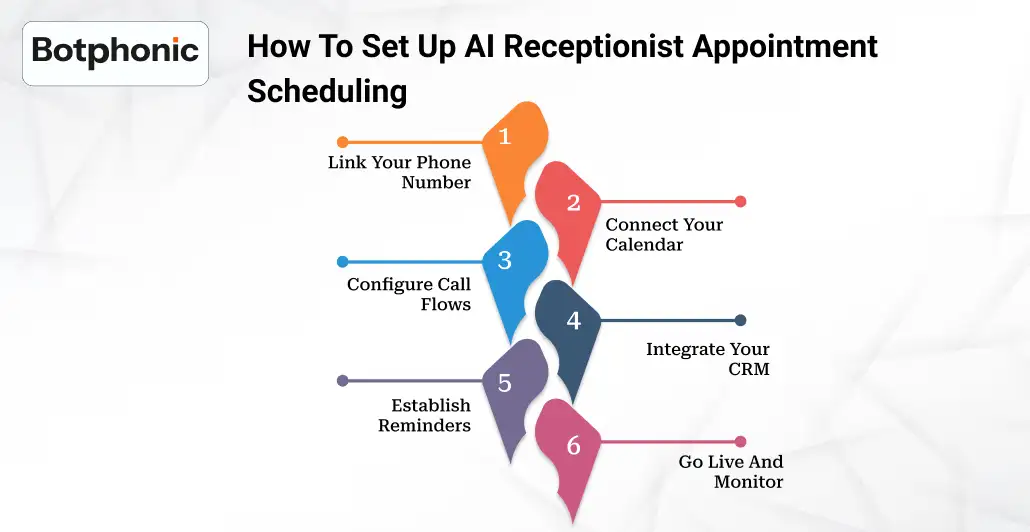
The majority of businesses oversize implementation complexity. In the case of Botphonic, the average time to deploy is 240 800 seconds, sign-up to live calls. The process is as follows:
- Link Your Phone Number: Port your existing number or supply a new number. No hardware modifications needed. Supports all the main VoIP providers and the traditional landlines.
- Connect Your Calendar: Google Calendar or Outlook. Availability is read in real time by the AI – set up buffer times, booking windows and any schedule rules (e.g. no same-day appointments with new patients).
- Configure Call Flows: Configure your greeting, routing logic, escalation triggers, and after-hours behavior. Business templates (dental, legal, real estate) are provided as out-of-box templates.
- Integrate Your CRM: Fields of caller data will be overlaid onto your Salesforce, HubSpot, or Zoho account. Each booking automatically forms or updates the appropriate contact record.
- Establish Reminders: Select automated SMS/email reminder time (24 hours, 48 hours or custom). Create your own message template, including your branding and custom pre-appointment instructions.
- Go Live And Monitor: The analytics dashboard of Botphonic displays the number of calls, the rate of booking success, the percentage of escalations, and the busiest hours on day one. Based on the initial two weeks of data, refine routing logic and discover any edge cases.
In firms with special needs – healthcare EHR integration, multi-location routing, or industry specific call flows – the API layer of Botphonic can be customized to integrate with proprietary or specialty platforms.
To evaluate pricing against your call volume and feature requirements, see Botphonic AI receptionist pricing. Before committing, it also helps to review AI receptionist reviews from businesses in your industry.
See Botphonic’s AI scheduling in action. Book a free demo
Getting Started with AI Receptionist Appointment Scheduling
AI-driven appointment scheduling went from being “nice-to-have” to the backbone of operations. In its place, it provides 24/7 appointment scheduling capabilities that are fully integrated with your calendar, automatic reminders, and fully automated CRM updates, all within 90 seconds of each interaction.
Industries ranging from healthcare and wellness to home services have the same experience. No-show rates are lower (30%-50% decrease), booking rate increases (particularly for non-traditional times such as outside of office hours), and front desk costs reduced substantially.
The key to success here is not an either-or proposition between AI and humans but using AI first, followed by humans when necessary. Use AI for scalability and speed, use humans for nuances. The only question is how many bookings you can risk. To learn more about all the capabilities of an AI receptionist, not limited to scheduling, see what is an AI receptionist and the benefits of AI receptionists to your business.
Begin automating your appointment booking. See the plans and prices →
Book a demo and watch how AI manages real calls, bookings, and follow-ups.
Book your free demo