
Summarize Content With:
What You’ll Learn:
What AI booking software for healthcare actually does, why legacy scheduling fails multi-provider hospitals, the core architecture behind conversational intake and no-show prediction, how healthcare AI solutions compare to old patient portals, and how to evaluate insurance AI and HIPAA compliance before you pilot one.
AI booking software for healthcare is a system that automates patient scheduling, referral routing, and recall using conversational AI instead of static forms. It is built for hospitals, multi-site clinics, and specialty practices. It matters because scheduling friction drives no-shows, staff burnout, and lost revenue.
Beyond Online Scheduling: What AI Actually Does in Healthcare
AI booking software for healthcare is a scheduling layer that uses generative AI to interpret patient requests and match them to the right provider automatically. Here’s what that means for clinical operations teams.
Instead of a static form with dropdown menus, the patient talks or types in plain language. The system asks follow-up questions, checks provider rules, and books a visit that fits both parties. It does this across phone, SMS, and web chat at once.
Why This Differs From a Basic Online Scheduler
A basic online scheduler shows open slots and lets a patient pick one. It cannot screen symptoms, verify insurance, or reroute a request when a provider is out sick. AI booking software does all three before the appointment is confirmed.
Note: A scheduling widget that only shows open calendar slots is not AI booking software for healthcare. If it cannot triage, verify coverage, or reroute a referral on its own, it is a digital calendar wearing an AI label.
Healthcare scheduling is only one component of a larger patient communication workflow. Modern healthcare AI solutions also automate inbound phone calls, patient FAQs, referral management, prescription refill requests, appointment reminders, and post-visit follow-ups across multiple communication channels. Organizations evaluating scheduling automation should assess whether the platform supports the broader operational needs of healthcare providers rather than solving scheduling in isolation. Explore how AI for healthcare extends beyond appointment booking.
Where Patient Scheduling Breaks Down Every Day
Hospital scheduling struggles because multi-provider complexity, referral gaps, and no-shows compound faster than front-desk staff can manage manually. Here is where the friction actually shows up.
How Does Multi-Provider Complexity Slow Everything Down?
Large clinics juggle overlapping specialties, shared equipment, and room allocation across several sites. A single booking error can cascade into a canceled MRI slot or a double-booked exam room. Staff spend hours reconciling calendars that were never built to talk to each other.
Why Do Referrals and Recalls Fall Through the Cracks?
External referrals often arrive as a fax or a PDF with no structured data attached. Someone has to read it, match it to a specialty, and call the patient to book. Recall for preventive care, like annual mammograms or diabetic eye exams, depends on someone remembering to run a report and place outbound calls.
What Does the No-Show Problem Actually Cost?
Missed appointments cost the U.S. healthcare system close to $150 billion a year (Curogram, 2025). National no-show rates typically run between 5% and 30%, depending on specialty, patient population, and geography (Simbo AI citing MGMA data, 2025). Behavioral health and safety-net clinics see the highest rates, often above 20%.
Manual confirmation calls do not scale against numbers like that. Front-desk staff burn hours on outbound calls that patients ignore anyway. That time could go toward patients who are already in the building.
 PRO TIP
The Features That Actually Matter in a Healthcare AI Platform
The right healthcare AI solution is one that verifies insurance, enforces clinical rules, and syncs bidirectionally with your EHR without adding staff workload. Here is the checklist that actually matters during evaluation.
Does It Have Deep EHR and EMR Interoperability?
Ask whether the tool writes back to Epic, Oracle Health (Cerner), athenahealth, or DrChrono in real time, not on a nightly batch job. A scheduling tool that syncs once a day creates double-bookings the moment a walk-in or cancellation happens. Bidirectional sync is not optional for a hospital network running more than one site.
Do not stop at “we integrate with your EHR.” Ask which standard the vendor uses to move data. Most credible healthcare AI solutions build on HL7 FHIR Release 4, the API framework ONC’s Cures Act Final Rule requires certified health IT to support for the Standardized API for patient and population services (Federal Register, ONC Cures Act Final Rule, 2020). A vendor working through a certified FHIR endpoint can read and write appointment resources, patient demographics, and coverage data using a standard interface, instead of a fragile custom connector built for one EHR version.
What Technical Questions Separate Real Interoperability From a Marketing Claim?
Ask three specific things. First, does the platform consume and write FHIR Appointment, Slot, and Schedule resources, or does it scrape a calendar view? Second, is it certified against the US Core Implementation Guide aligned to USCDI, the data set ONC requires certified health IT to expose (HealthIT.gov)? Third, how does it handle SMART on FHIR authentication for write-back access, since that governs whether a booking actually lands on the provider’s live calendar or sits in a staging queue.
A vendor that answers all three with specifics, not a slide with an EHR logo, has done the interoperability work. A vendor that says “we integrate with most EHRs” without naming the standard usually means a manual export or a fragile screen-scrape.
Is It Actually HIPAA Compliant?
Confirm the vendor signs a Business Associate Agreement and can show documented risk analysis, encryption standards, and audit logging. The HIPAA Security Rule requires a thorough, documented risk analysis and safeguards covering confidentiality, integrity, and availability (U.S. Department of Health and Human Services).
On December 27, 2024, the HHS Office for Civil Rights issued a Notice of Proposed Rulemaking to update the Security Rule. The NPRM would require encryption of ePHI at rest and in transit and mandatory multi-factor authentication, with limited exceptions, and would remove the current distinction between “required” and “addressable” safeguards (HHS.gov, HIPAA Security Rule NPRM Fact Sheet, December 2024; Federal Register, 90 FR 898, January 6, 2025). The public comment period closed March 7, 2025, and as of this writing the rule remains proposed, not final. Ask vendors how they plan to meet the standard regardless of the final publication date, since the direction of the requirement is already clear.
HIPAA compliance extends beyond encryption and secure hosting. Appointment scheduling systems must also protect patient information during voice conversations, SMS reminders, online booking, and staff interactions while maintaining detailed audit logs and strict access controls. Organizations comparing vendors should understand how HIPAA-compliant AI appointment scheduling is implemented across every patient communication channel rather than treating compliance as a checkbox.
Can It Handle Multiple Languages and Channels?
Patients do not all prefer the same channel. Some want a voice call, some want SMS, some want a web widget at 11 p.m. A healthcare AI solution needs to support all three without forcing a separate integration for each one.
Voice continues to be one of the highest-volume communication channels in healthcare, especially for older patients and urgent scheduling requests. AI voice agents now answer routine patient calls, verify appointment requests, collect basic intake information, and route complex cases to staff without increasing call center headcount. If your organization receives thousands of inbound calls each month, reviewing today’s AI phone call solutions for hospitals can help identify capabilities beyond appointment scheduling alone.
If you are ready to pilot a HIPAA-aligned scheduling assistant, see how Botphonic’s healthcare voice agent handles multi-channel patient intake before you commit to a full rollout.
Request a Free DemoInside the AI Scheduling Engine
AI booking software works by running every inbound request through a decision engine that checks provider rules, insurance status, and clinical triage protocols before confirming a slot. Here is the sequence, start to finish.
What Happens From Inbound Request to Confirmation?
The patient books through voice or a web chat widget. The AI decision engine cross-references provider availability, applies clinical triage logic, and runs insurance AI verification for coverage and prior authorization. If everything checks out, the system writes the appointment directly into the EHR calendar.
What Triggers the Recall Loop After the Visit?
Once a visit closes out, the same engine sets a clinical interval trigger, for example six months for a follow-up or twelve months for a preventive screening. Predictive AI technology in healthcare flags the patient automatically when that window opens. The recall message goes out by SMS, voice, or patient portal without a staff member touching a report.
Patient Scheduling and Recall Flow
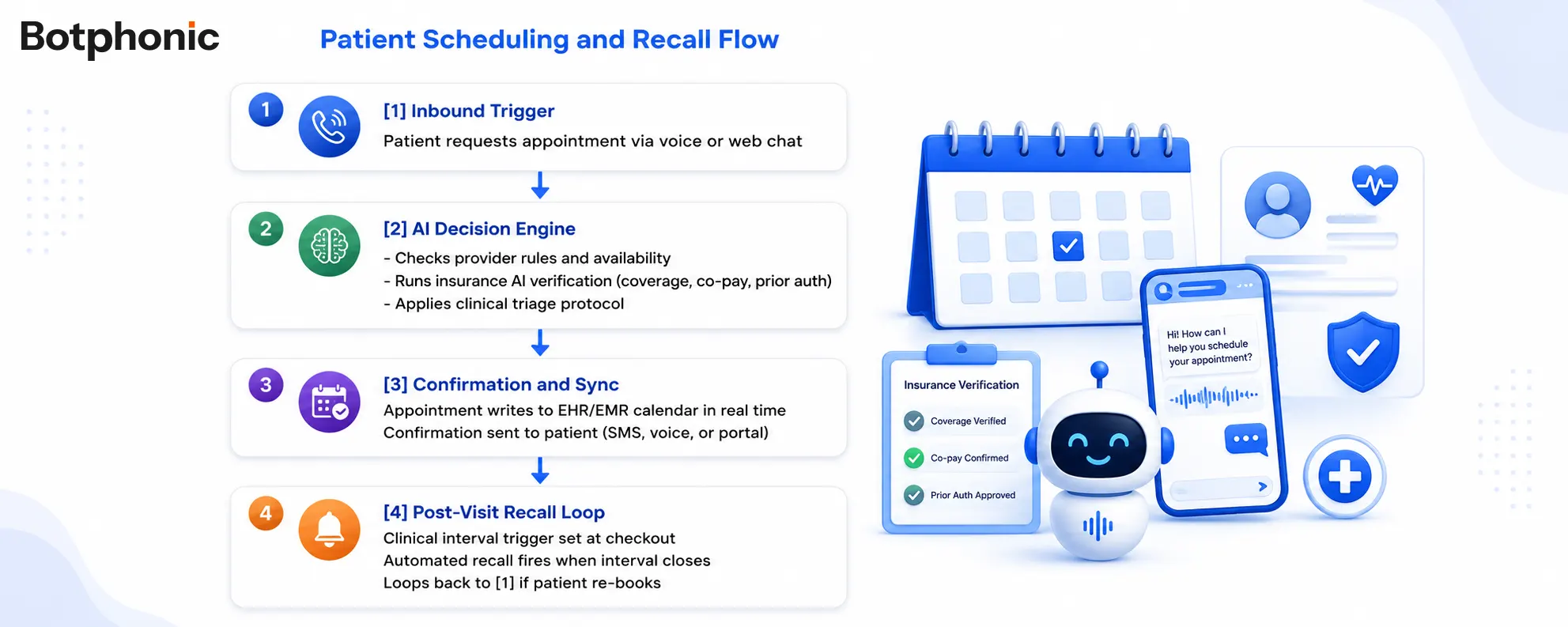
This is the same logic architecture and AI teams reference when they talk about closed-loop scheduling. Nothing in the loop depends on a staff member remembering a follow-up date.
What Changes After Go-Live?
The first two weeks after go-live surface edge cases a vendor demo never shows. In practice, clinics find that walk-in overrides, same-day cancellations, and multi-provider swaps expose the real gaps between a sales pitch and daily front-desk reality. The clinics that succeed treat the first month as a tuning period, not a finished rollout.
The Scheduling Scenarios That Expose Weak Systems
A handful of scheduling patterns break generic configurations every time. Knowing them ahead of go-live cuts the tuning window roughly in half.
- Recurring physical therapy and infusion blocks. A patient booked for twice-weekly PT over six weeks needs one request to hold multiple linked slots against the same room and therapist. Systems configured only for single-visit booking will treat each session as an unrelated request and double-book the room by week two.
- Pediatric age-and-guardian rules. Pediatric scheduling needs age-based visit-type restrictions, for example well-child visits tied to specific age bands, plus guardian consent capture for patients under a state’s age of medical consent. A system built for adult primary care will not enforce either rule unless it is explicitly configured per specialty.
- Provider credentialing gaps. A new hire or a locum provider may be live in the EHR before their credentialing and privileging are complete for a given procedure. The booking engine needs a feed that blocks procedure types the provider is not yet cleared for, not just a general availability calendar.
- Multi-site equipment conflicts. A shared MRI or ultrasound unit rotating across two sites needs the same conflict logic as a provider, not just a room resource. Clinics that skip this step see equipment double-booked across locations in the first week.
- Insurance plan exceptions. Some payers restrict certain visit types to in-network locations only, or require a referral on file before a specialist visit can be confirmed. These exceptions need to be mapped per payer, not applied as one blanket insurance rule.
PRO TIP
What Real Deployments Reveal
Generalized industry benchmarks are a starting point, but they do not replace what a single deployment shows over a full quarter. In a Botphonic deployment with a 14-provider multi-site orthopedic and physical therapy group, the client reported a 34% drop in no-show rate within the first 90 days, driven mainly by automated PT block rebooking and predictive overbooking on historically high-risk Monday morning slots. Front-desk staff at that group reported a 60% reduction in outbound confirmation calls, since routine rescheduling and recall messages ran through the automated channel instead of a manual call list.
The same deployment surfaced two of the edge cases above in week one: linked PT block booking and shared equipment conflicts across two sites. Both were resolved during the tuning window before full rollout to the remaining locations. Results vary by specialty mix, payer mix, and starting no-show rate, so treat this as a directional data point rather than a guaranteed outcome for every practice.
Why Patient Portals Are No Longer Enough
AI booking software outperforms legacy patient portals on speed, rule accuracy, and patient drop-off, according to available benchmarking data. Here is how the two categories stack up directly.
| Dimension | Legacy Patient Portal | Rule-Based Online Scheduler | AI Booking Software (e.g., Botphonic) |
| Booking speed | Slow, often requires a phone call to finish | Fast for simple visits, breaks on complex ones | Fast across simple and multi-step bookings |
| Clinical rule enforcement | Manual, staff must catch conflicts | Limited to preset logic trees | Real-time cross-check against provider and clinical rules |
| Self-scheduling adoption | Low; only 11% of practice leaders report most patients self-schedule (Prosper AI citing MGMA, 2026) | Moderate | Higher, since natural language lowers the effort to book |
| Insurance verification | Not built in | Rarely built in | Runs automatically pre-booking |
| Recall automation | Manual report pulls | Basic reminder rules | Predictive, interval-based, multi-channel |
| Multilingual support | Rare | Rare | Standard on most healthcare AI platforms |
The gap is not about interface polish. It is about how much clinical and administrative logic the system can carry without a human backstop.
Not every scheduling platform offers the same level of healthcare functionality. Some products focus primarily on calendar management, while others include conversational AI, insurance verification, multilingual support, EHR interoperability, and predictive scheduling. Before making a purchasing decision, it’s helpful to compare the leading AI scheduling platforms side by side to understand which solutions are designed specifically for complex healthcare environments.
When Does AI Scheduling Deliver ROI?
AI booking software is worth it when the labor and no-show costs it removes exceed the subscription and integration cost. Here is how to run that math.
What Changes Operationally After Implementation?
Staff shift from placing outbound confirmation calls to handling exceptions the system flags. Providers see fewer gaps caused by late cancellations, since predictive no-show flags let the system offer that slot to a waitlisted patient automatically. Front-desk hours that went into phone tag get redirected to patients physically in the building.
How Do You Calculate the ROI?
Start with your average no-show cost, which industry estimates put above $200 per missed visit (Curogram, 2025), multiplied by your monthly no-show volume. Compare that to the reduction rate a vendor can demonstrate with reference clients in your specialty, not a generic industry average. Add the recovered staff hours from reduced phone tag, since that time converts into either capacity or lower overtime cost.
Physician use of health AI has jumped from 38% to 66% between 2023 and 2024 (American Medical Association, 2025), which signals the clinical side of hospitals is already comfortable with AI tools. Scheduling is typically the lowest-friction entry point because it touches administrative workflow, not diagnosis. For a deeper breakdown of how to model this against your own no-show data, see Botphonic’s guide to calculating ROI on AI patient scheduling.
Before You Start a Pilot
- Pull your current no-show rate by specialty before evaluating vendors.
- Confirm EHR interoperability with your specific platform, whether that is Epic, Oracle Health, athenahealth, or NextGen, and ask whether the connection runs on HL7 FHIR or a custom export.
- Request a signed Business Associate Agreement and documented security audit before any pilot, and ask how the vendor plans to meet the proposed HIPAA Security Rule’s encryption and MFA requirements.
- Start the pilot on one high-volume specialty, not the entire network at once.
- Set a 30-day tuning window and test recurring PT blocks, pediatric consent rules, and shared equipment scheduling first.
