
Summarize Content With:
Why AI Receptionist Adoption is Picking up in 2026
The front desk is no longer a human only service. In the healthcare sector, hospitality, legal, retail, real estate, and financial services, businesses are swapping and supplementing standard reception processes using AI voice agents systems, which answer calls, direct queries, book appointments, and update CRMs without a human picking up the phone.
The transition is not a hypothetical one. In 2024, the market of the virtual receptionist and answering service was $3.85 billion. The industry estimates that number to be 9 billion by 2033, a 9.8% annual compound growth rate due to pressure on labor costs, 24/7 consumer pressure, and maturing voice AI precision.
It is the map of the adoption land in six industries, outlines the ROI standards that underlie the shift, describes what the technology really costs in 2026, and most importantly, addresses the risks that cause 74 percent of early adopters to grind before they grow.
What You Will Find in this Guide
- AI Receptionist Adoption by Industry – 6 Sectors, Real Numbers.
- Adoption by Industry Comparison Table.
- What is the Cost of an AI Receptionist? (2026 Pricing Breakdown)
- Pitfalls and Risks – The Reason Why 74 percent of Deployments Fail Before Scaling.
- Trends that will transform AI Receptionist Adoption in 2026.
- FAQ The Questions Buyers Ask.
- Your Next Step – Industry Decision Framework.
AI Receptionist Adoption by Industry: Who’s Using It and Why
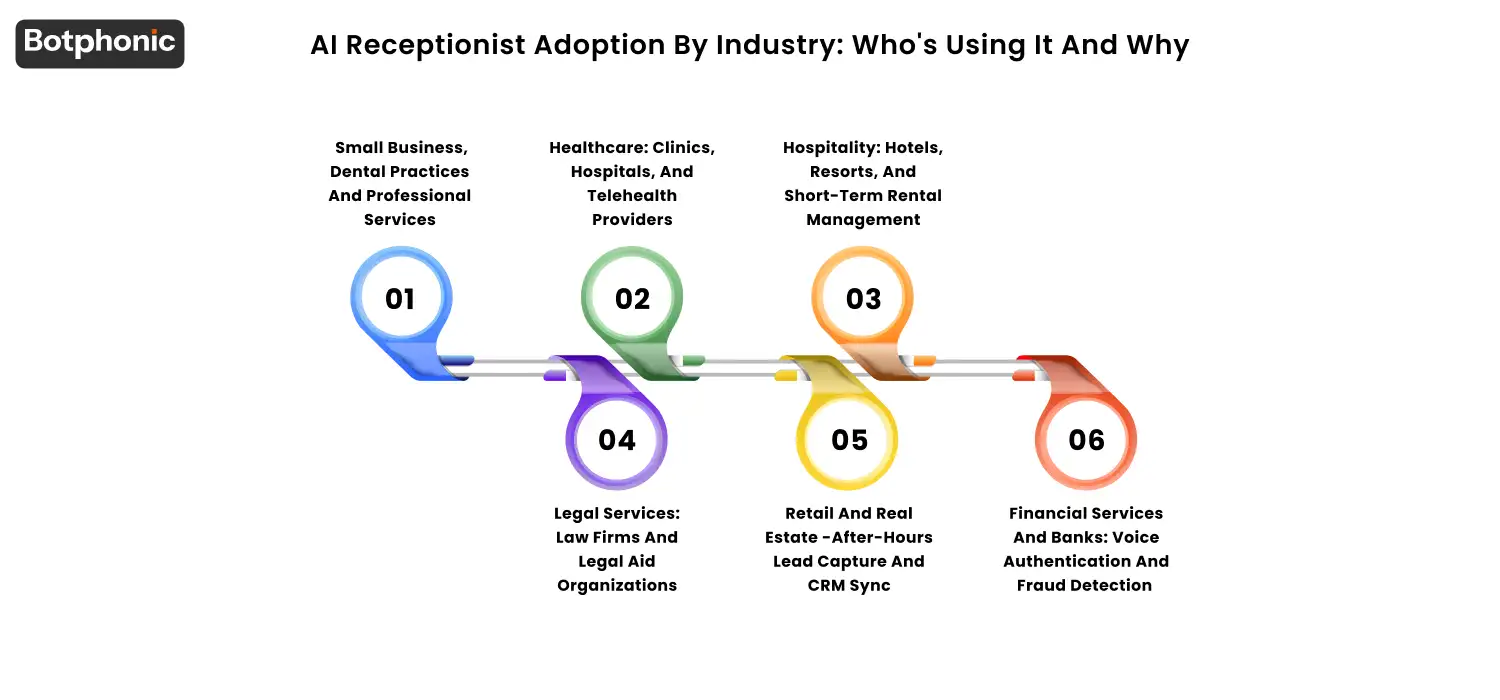
There are six industries that today are the most prevalent in terms of AI receptionist deployment in the United States. They have different drivers, compliance requirements and use cases. What they have in common: they all have high volumes of inbound calls, repetitive intake processes, and quantifiable cost due to after-hours or missed call contacts.
1. Small Business, Dental Practices and Professional Services.
Small and mid-sized businesses, including independent dental and chiropractic practices, accounting firms, and local professional services – are the most rapidly growing in terms of number of new deployments. The economics is simple: one missed call by a new patient or client will cost an average of $10,000 or more a year in a practice with moderate lead volume, based on the benchmarks of missed-contact costs published by sales analytics companies.
In these types of businesses, the AI receptionist works on two important windows: after hours (evenings and weekends when all staff is off duty) and peak-hour overflow (when hold times induce hang-ups). It responds instantly, records the intent of the call, makes appointments and forwards urgent issues through SMS to employees on call.
A dental practice that is receiving 300 inbound calls a month, 20 percent of which were going to voicemail prior to deployment, acquires an estimated 60 new bookable contacts a month after the deployment, payback period is less than 45 days at standard rates of per-minute.
 PRO TIP
Relevant internal resource of small business operators: see how Botphonic can be compared to traditional answering services.
2. Healthcare: Clinics, Hospitals, and Telehealth Providers
The most regulated and the most active vertical in terms of dollar investment in AI receptionist adoption is healthcare. As of 2026, an AI front-desk solution has been piloted or deployed by approximately 58% of US healthcare organizations, and is expected to have reached 75% adoption by 2027.
Appointment scheduling and no-show reduction are the most common cases of utilization. The use of AI receptionists to send automatic appointment reminders and rescheduling notifications has been associated with healthcare practices and reduced no-show rates 25-40% and a direct effect on utilization of providers. Simultaneously, the system processes insurance verification requests, lab result route requests, prescription refills requests, and post-visit follow-up requests without the input of a medical assistant to handle the call.
And this vertical does not negotiate HIPAA compliance. Responsible vendors cut up call recordings, implement data reduction and give Business Associate Agreements (BAAs). Prior to the implementation, medical operators should ensure that their AI receptionist provider has signed a BAA and has stored secured health information (PHI) in a HIPAA-compliant space.
 NOTE
NOTE
3. Hospitality: Hotels, Resorts, and Short-Term Rental Management
In the US, the urban hotels are estimated to receive 30–45% of the inbound calls that are not written in English due to international tourism and increasing non-native-English-speaking domestic travel market. Conventional front desks are hard pressed to man traditional front desks to cover multiple languages at an affordable cost; AI receptionists can do it in 20+ languages, and with dialect-level accuracy in contemporary deployments.
In addition to language, the hospitality use case focuses on reservation questions, room upgrades, amenity reservations, and local recommendations – all high-volume, formulaic interactions that AI executes with consistent quality irrespective of the number of calls or the time of day.
The short-term rental management companies (managing 50-500 properties) are one of the most fitting ones. One AI system can be used to make guest calls across all properties of the portfolio and direct the maintenance request to the corresponding vendor and record the interaction in the property management system.
In the case of hotel deployments, have the AI pass to a live agent when a caller is frustrated (sentiment-aware routing) or when they demand a resolution to a billing issue. These two classes are the highest escalation need and least tolerant to AI error.
4. Legal Services: Law Firms and Legal Aid Organizations
By not answering calls after business hours, law firms miss billable intake, and in personal injury, immigration, and family law, after-hours calls by potential clients are the norm. AI receptionists working in legal firms complete preliminary client intake: gathering contact details, type of matter, the level of urgency, and conflict-check information and direct to the relevant attorney or intake specialist.
As companies engage AI in client intake, they report a 30-50 percent reduction in the time spent on intake calls, which have been redirected to substantive work by paralegal personnel. The information received by the AI system is directly logged into the practice management platforms(Clio, MyCase, Filevine) eliminating data input.
The attorney-client confidentiality and privilege must be configured carefully. The AI should not store or record materials in a manner that produces transcripts of privileged communications that can be discovered. Most popular legal oriented deployments involve call summaries (not transcripts) and archive information in attorney client privilege compliant infrastructure.
NOTE
5. Retail and Real Estate -After-Hours Lead Capture and CRM Sync.
One of the most evident ROI uses of an AI receptionist technology can be seen in real estate. Property and listing produce calls of inquiry outside of business hours – evenings and weekends – when the agents are not available. According to industry statistics, real estate teams have a 35-60% loss of inbound leads to non-answered calls when they are only covered by humans.
An AI receptionist working on a real estate team will pick up the phone and qualify the lead (type of property, timeline, budget range, pre-approval status) and write the record to the CRM (Salesforce, HubSpot, Follow Up Boss) with a summary and priority score. The agent gets an SMS notification with the details of the lead and is able to call him back within minutes as opposed to knowing about the missed call the following morning.
High-volume inbound inquiry retail businesses such as furniture retailers, auto dealerships, appliance stores, etc. utilize AI receptionists to ask about product availability, scheduling appointments, and providing updates on the status of orders. These consist of structured, predictable questions that AI processes with consistency without sending to a specialist.
Before entering into a vendor contract, configure CRM write-back as a necessary service and not as a service of convenience. A capture and store AI puts a data silo between your current sales workflow and the proprietary system, which stores the captured ones.
6. Financial Services and Banks: Voice Authentication and Fraud Detection
The deployment of financial services has the greatest compliance overhead and the longest sales cycles. But the most quantifiable risk reduction benefits are involved in it as well. Voice authentication, whereby the AI recognizes a returning caller by voice print instead of PIN or password, decreases account takeover fraud by an estimated 40- 60 % in comparison to knowledge-based authentication alone.
The most rapidly transitioning subsector of the financial services market has been community banks and credit unions. These are driven by the expense of having live agent personnel on staff to deal with simple questions. Such as, balance checks, payment confirmations, loan status updates that AI can more precisely and at a fraction of the expense address.
The compliance with PCI-DSS regulates the use of payment data when it comes to AI-assisted calls. Compliant deployments capture card numbers with DTMF (keypad) instead of voice – this way sensitive data does not enter the processing pipeline of the AI. This is a technical constraint that cannot be compromised when it comes to payment inquiries of any AI receptionist.
Due to security checkpoints, compliance audits, and vendor certification considerations, financial services AI deployments usually take 90+ days between contract and go-live. Add this schedule to your plan.
Adoption by Industry: 2026 Comparison Overview
| Industry | Current Adoption | 2027 Forecast | Top Use Case | Compliance Focus |
| Healthcare | ~58% | ~75% | Appointment scheduling | HIPAA |
| Hospitality | ~44% | ~65% | Multilingual intake | PCI-DSS |
| Legal Services | ~38% | ~58% | Client intake automation | Attorney-client privilege |
| Retail & Real Estate | ~41% | ~62% | After-hours lead capture | CCPA / TCPA |
| Financial Services | ~35% | ~55% | Voice authentication | PCI / SOX |
| Small Business / SMB | ~29% | ~50% | 24/7 missed call coverage | TCPA |
What is the Cost of an AI Receptionist? (2026 Pricing Breakdown)
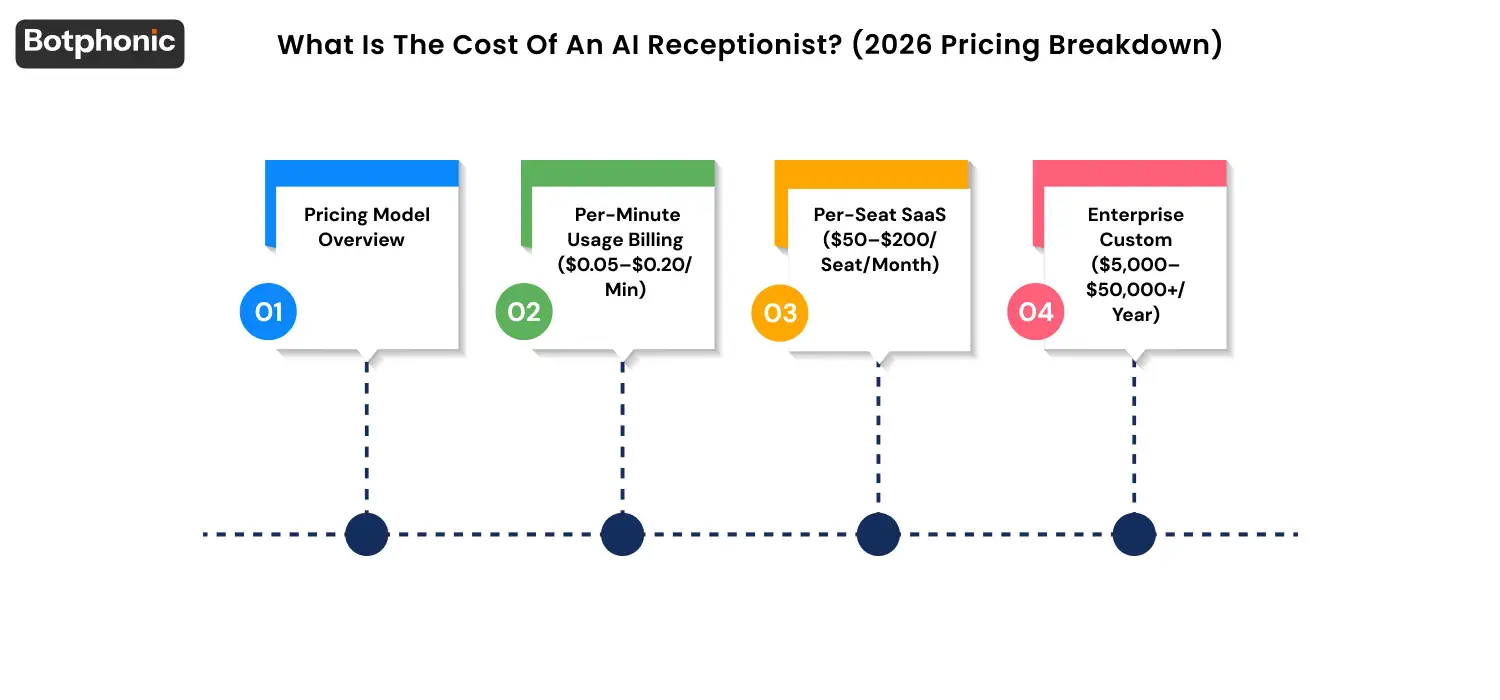
In 2026, AI receptionist pricing is designed in three different models that are tailored to organizational profiles. The options are broad, with a few cents per minute as the lowest price point of usage-based tools, and six figures as the highest price point of enterprise-wide contracts, so the first step is to determine what level fits your call volume and compliance needs.
1. Pricing Model Overview
| Tier | Price range best for | Examples |
| Per-Minute Usage | SMBs testing AI | Retell, Vapi, Botphonic PAYG $0.05-0.20/min |
| Per-Seat SaaS | 50-200/seat/mo Growing teams | Dialpad, RingCentral, GoTo. |
| Enterprise Custom | 5K or more/year 50K or more/year | Zoom, NICE, Gensys |
2. Per-Minute Usage Billing ($0.05–$0.20/min)
The most risk-free entry point of small businesses and organizations testing AI receptionist technology is usage-based billing. You only pay active call minutes, and no seat charges or long term contracts.
With an average of $0.10/min, a company that completes 500 call minutes each month spends 50 dollars, or less than one hour of human receptionist time. This type of model is employed by platforms such as pay-as-you-go by Retell AI, Vapi, and Botphonic.
3. Per-Seat SaaS ($50–$200/seat/month)
Common mid-market deployment models are monthly subscriptions per user or phone number. This level consists of platform functionalities such as CRM integrations, analytics dashboards, call routing rules, and dedicated support. Dialpad, RingCentral, and GoTo connect are the main players on this level.
The price is 100/seat/month per 5-agent team, which equates to an annual cost of 6000 USD – in other words, the annual fee is usually recouped in the first quarter solely in terms of saved staff time.
4. Enterprise Custom ($5,000–$50,000+/year)
Enterprise contracts are used by organizations that have 50 or more locations, have complicated compliance needs (HIPAA, PCI, SOX), develop voice personas on request, importance of SLA, and support implementation.
Applications such as Zoom, NICE, and Genesys are at this level. At this level, implementation times take 60-180 days and often involve the development of proprietary CRM or EHR systems using custom API.
PRO TIP
For Botphonic’s current pricing options, see our pricing plans
Risks and Pitfalls of AI Receptionist Adoption
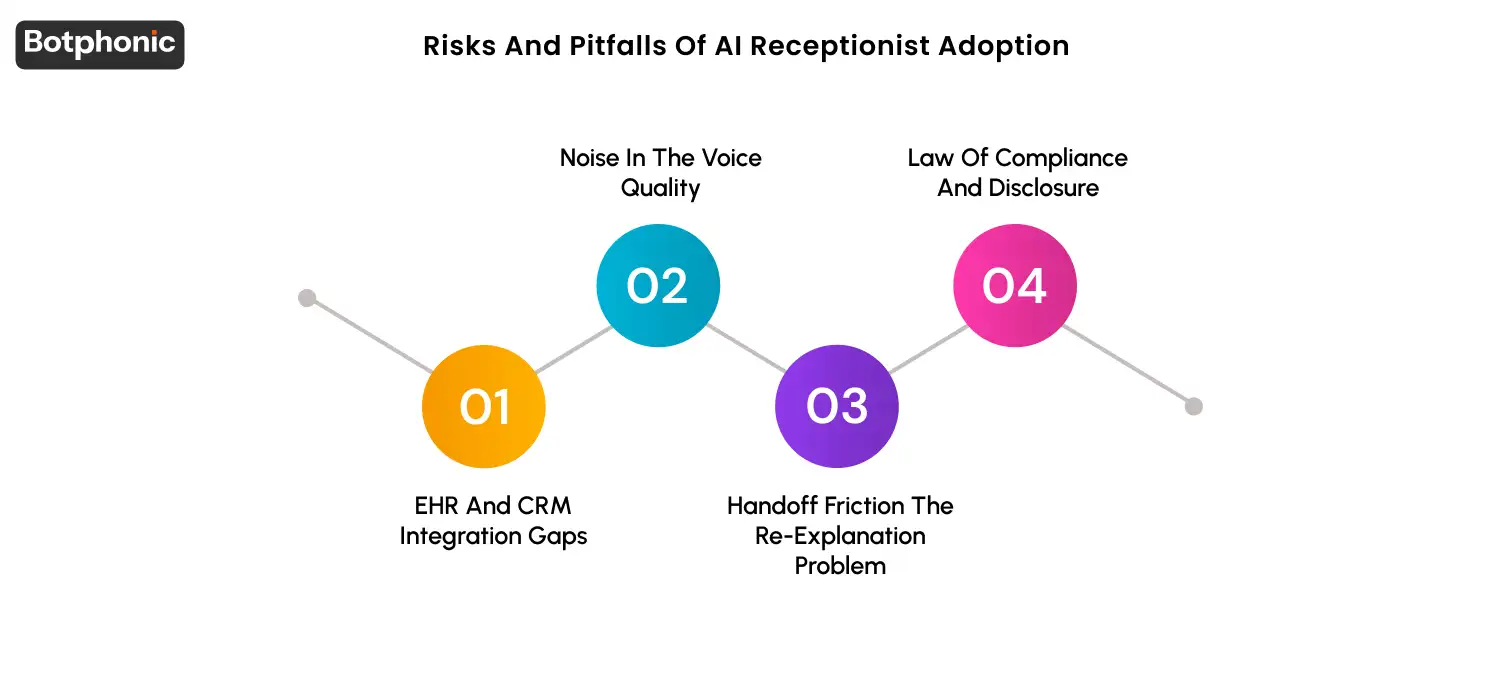
McKinsey’s State of AI 2025 report states that even though around 88% of enterprises are using AI, only around one-third (approximately 33%) have been able to scale AI for enterprise-level success from their pilot programs.
It is awareness of these pitfalls that distinguishes between those organizations that can deliver ROI within 60 days and those that give up the project within 90 days.
1. Pitfall 1: EHR and CRM Integration Gaps
The most typical deployment failure is that you find out after the go-live that the AI is unable to write directly to your existing systems of record. A receptionist AI that logs appointment requests in a proprietary portal will make staff re-key data into Epic, Cerner, Salesforce or your practice management system. This does away with the main efficiency gain.
How to prevent it: Insist on a live integration demonstration not a slide with your particular EHR or CRM version prior to contract signing. Request the vendor to display data that is in a test call into your system in real time.
2. Pitfall 2: Noise in the Voice Quality
The level of AI voice recognition reduces significantly when there is ambient noise: at the hotel lobby, in the retail store floor, in the dental waiting room or a construction-site office. Clean audio-calibrated systems often fail to identify intent to call when the background noise rises past 60 dB – so that they misroute calls and frustrate the callers.
How to prevent it: Operate your pilot in the loudest call setting that your employees are exposed to, as opposed to the least noisy setting. When the accuracy decreases to less than 90 percent in that setting, it is not time to roll out the system into production.
3. Pitfall 3: Handoff Friction The Re-Explanation Problem
Transferred callers who are forced to repeat their story to the human agent, as opposed to an AI, report frustration rates 3-4 times as much as callers who are directly connected to a human agent. This is a workflow design failure, rather than technology failure. The AI retrieves the summary of interaction; the human agent should be given it and read to pick up.
How to prevent it: You can set up screen-pop integration with the human agent interface showing the summary of a call with the AI before it transfers. This is supported on every platform in the enterprise tier, and should be activated and tested prior to launching.
4. Pitfall 4: Law of Compliance and Disclosure
The US state AI disclosure requirements are growing at a great pace. California, Illinois and some other states demand the use of automated phone systems where they identify themselves as non-human at the beginning of an interaction. Lack of compliance exposes one to regulatory risk. As well, HIPAA (healthcare), PCI-DSS (payments), and state privacy regulations (CCPA, VCDPA) also introduce certain data handling considerations that most SMB-tier AI platforms fail to meet by default.
How to prevent it: Before deployment, get written assurance of your vendor of his compliance posture in each state you are operating in. Take compliance documentation as a contractual deliverable, not a post sale discussion.
Trending Innovations Reshaping AI Receptionist Adoption in 2026
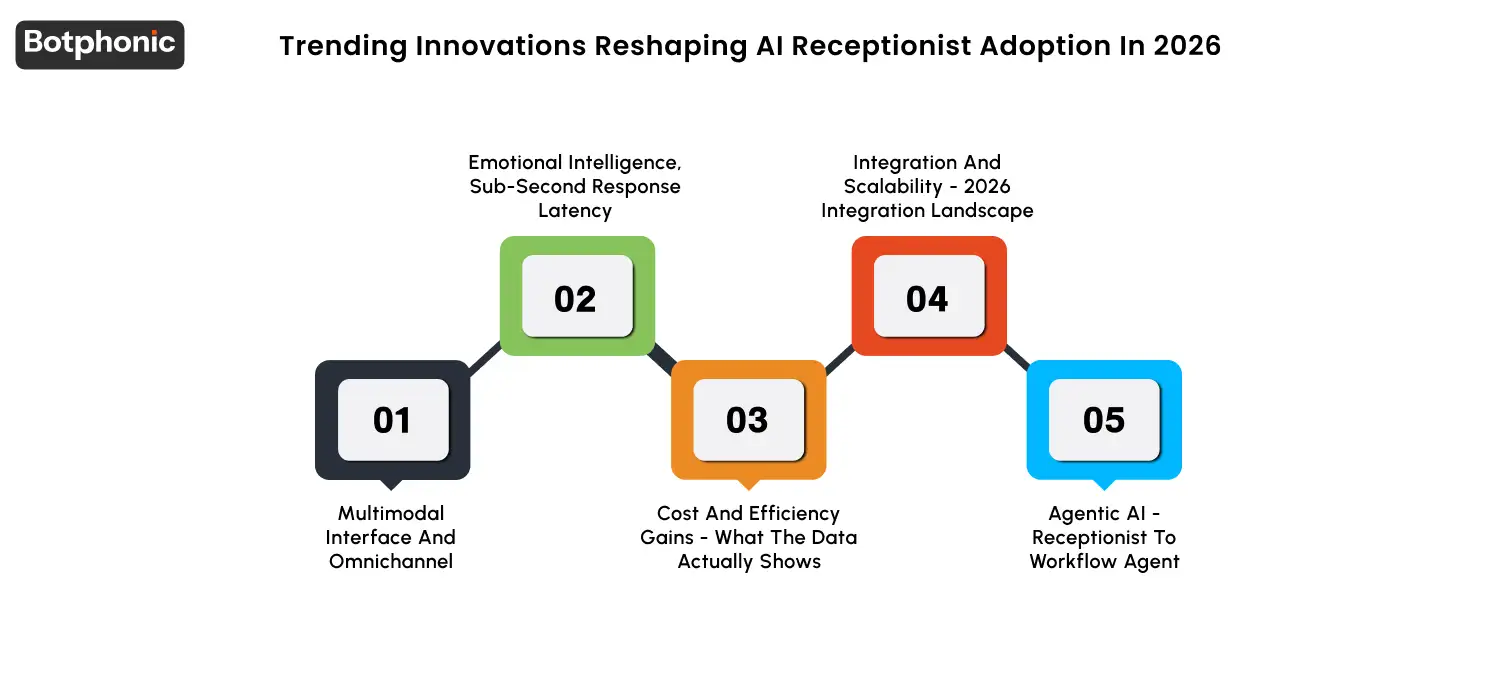
1. Multimodal Interface and Omnichannel
Contemporary AI receptionists are no longer voice-only. The 2026 landscape of deployment features coverage across phone, SMS, WhatsApp Business Cloud API, Microsoft Teams and web chat at the same time – all configured under a single layer. A customer who leaves a phone queue and sends a WhatsApp message will get the same experience, and the context will be shared between channels.
The use of SMS-first deployments is becoming more popular amongst companies whose customers are more likely to be younger than 35 years. And it’s where communication via text use would be more acceptable than voice calls. WhatsApp Business integration will specifically be useful to companies with a customer base of Spanish-speaking, Portuguese-speaking or South Asian customers, where WhatsApp has a greater number of daily active users compared to SMS.
PRO TIP
2. Emotional Intelligence, Sub-Second Response Latency
The latency of voice AIs in responding has decreased to 300-500ms in the top 2026 systems in 2023, compared to a 1,200-1800ms industry average in 2023: within the perceptual range, callers will cease to perceive an artificial conversation pause. This enhancement radically alters the experience of the callers: it feels like a conversation rather than navigating a phone tree.
Sentiment analysis is real-time along with latency. The AI recognizes signs of frustration on the part of the caller (high pitch of voice, frequent interruptions, profanity). It automatically escalates to a live agent, even before the caller asks to do so. This active handoff feature has decreased the negative call resolution rates in hospitality and healthcare deployments by an observable factor.
3. Cost and Efficiency Gains – What the Data Actually Shows
A study by Stanford University of AI use in service operations discovered a mean 68 percent improvement in CSAT, 40 percent decrease in operating costs, in organizations that successfully implemented conversational AI on scale. Such numbers are mature deployments that have been integrated with good CRM and staff training – not first-month pilot outcomes.
The realistic forecast of a new deployment in months one to three is a cost reduction of 15-25 percent and neutral or positive CSAT because configuration is optimized according to actual call information. The Stanford benchmarks can be met between months four and twelve with an effective implementation partner.
NOTE
4. Integration and Scalability – 2026 Integration Landscape
The AI receptionist platforms integration ecosystem is mature. Epic and Cerner (healthcare EHRs) and Salesforce Einstein and HubSpot (CRM), Clio and MyCase (legal practice management), Slack and Microsoft Teams (internal notification routing), and WhatsApp Cloud API (consumer messaging) are now supported by native connectors. This simplifies the deployment and avoids the use of custom middleware in most standard setups.
In 2026, scalability is not a technical challenge anymore, but an operational one. A system that supports 100 calls a month can support 10,000 calls a month without alterations to the infrastructure. The scaling issue is to make sure that call routing logic, escalation rules, and compliance configurations are revised as the business expands.
5. Agentic AI – Receptionist to Workflow Agent
The biggest change in AI receptionist technology in 2026 will be the transition to workflow execution rather than call-answering. The agentic AIs systems do not merely respond to a call and gather information, they perform tasks independently as an element of the interaction.
Within a healthcare agentic deployment, the AI responds and responds by checking the existing appointment history of the patient in the EHR, finding an open slot based on the provider availability, making the appointment, sending a confirmation SMS, and recording the interaction, all in just two minutes without human interaction.
In 2026, PYMNTS found that front-desk AI has reached the point of being no longer a conversational tool but an autonomous workflow agent, with Dialpad and Synthflow being the most frequently used commercial implementers of agentic capabilities. This is where the whole market is moving and companies implementing it should not only look at the vendors based on their current feature set but also look at their agentic roadmap.
Your Next Step: A Decision Framework by Industry
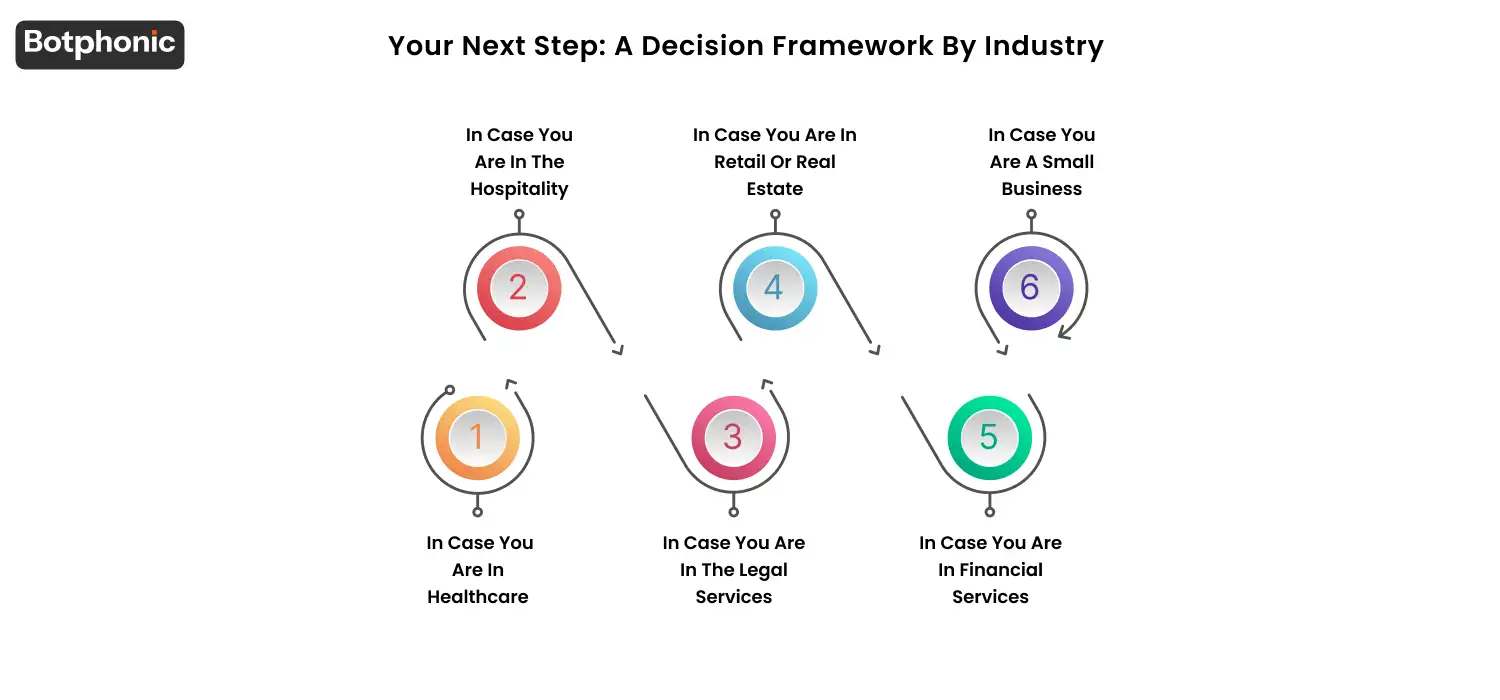
The deployment of AI receptionists is not a one-shot decision. But rather a series of deployment decisions, with various timelines, technical needs, and ROI drivers. The structure below indicates the fastest-to-value starting point, by industry, using deployment data across the six industries contained in this guide.
1. In Case You Are In Healthcare
Begin with booking appointments and automatic reminder calls. These are the most standardized interactions, and the highest-volume in a clinical setting, and they provide quantifiable no-show reduction within 30 days. Normal implementation schedule: 45-60 days (BAA implementation and EHR integration testing). First compliance obligation: HIPAA BAA with your vendor.
2. In Case You Are In The Hospitality
Begin with multilingual after-hours in-taking and reservation enquiry. Deploy on your most active language pair (English + Spanish in the US). Normal implementation time: 20-30 days. First configuration priority: sentiment-based escalation to live staff to resolve billing disputes and complaints.
3. In Case You Are In The Legal Services
Begin with after-hours client intake – get contact, type of matter, urgency and send a summary to the on-call attorney via SMS. Average implementation time: 30-45 days. Priority of the first compliance: establish the stance of the vendor on attorney-client privilege. And it helps declare compliance with the laws of the AI disclosure.
4. In Case You Are In Retail Or Real Estate
Begin with after-hours lead capture and CRM write-back. It is the best ROI deployment to the businesses where the leads come during the off-staffed hours. Normal deployment time: 14-30 days. First integration criteria: live CRM write-back demonstration prior to contract signing.
5. In Case You Are In Financial Services
Begin with common inquiry processing (balance inquiries, payment confirmations, branch hours) but not payment processing or account modification. Reserve voice authentication and fraud detection for a second deployment phase. After the baseline system is stable when baselining of the system is complete and fraud is detected. Normal deployment time: 90-120 days. Initial compliance requirement: PCI-DSS documentation with your vendor.
6. In Case You Are A Small Business
Begin with after-hours call answering on a usage basis of billing. Minimum commitment, no integration, go-live in less than three business days. Calculate the recovery rate of missed-call after 30 days. Consider appointment booking as the second step when the baseline is operating.
The companies that get AI receptionist ROI in 30-60 days have one thing in common. They implement the smallest scope possible, assess it, and build on a stable foundation. The businesses that stall try to deploy everything simultaneously and find out that integration is not working during a rollout.
Get a tailored AI receptionist cost and ROI estimate.
Schedule Your Demo Now!