
Summarize Content With:
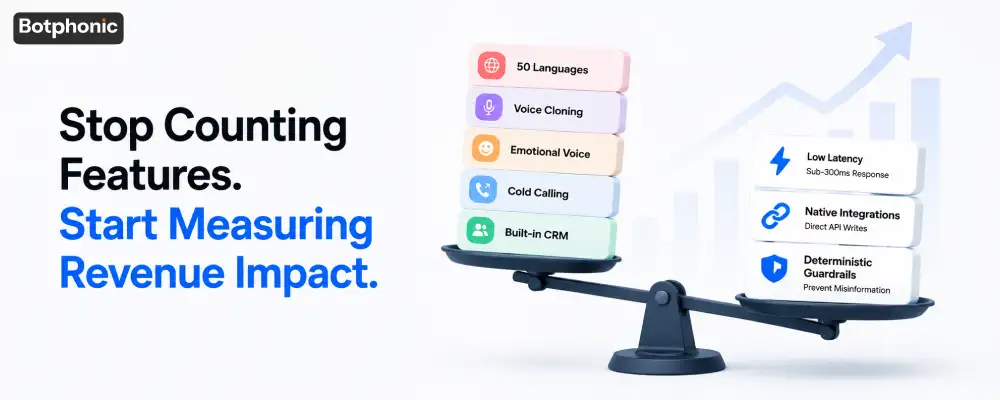
The three features that actually determine whether an AI receptionist improves your business are low-latency conversational handling, native software integrations, and deterministic guardrails that prevent misinformation. Everything else, fifty-language catalogs, emotional voice synthesis, outbound cold-calling modules, is demo inventory that rarely moves the metrics you care about.
Picture this: A potential patient calls your clinic, ready to book a $5,000 procedure. Your AI receptionist answers, pauses for three agonizing seconds, misunderstands an interruption, and quotes a price from last year’s service menu. Click. They’re gone, and they’re booking with a competitor whose phone answered in under a second and got the price right on the first attempt. That scenario is not hypothetical. It is the single most common failure pattern we observe in underperforming AI voice deployments.
What Is an AI Receptionist, and Why Do Feature Choices Define Its ROI?
An AI receptionist is software that handles inbound calls, answers questions, books appointments, and routes customers without human involvement. It runs on a pipeline that combines STT (Speech-to-Text) transcription, LLM orchestration for intent resolution and response generation, and TTS (Text-to-Speech) output, all in real time, across a SIP-trunked or WebRTC telephony layer.
Feature choices define ROI because the pipeline has compounding latency. Every additional processing step, every unnecessary module, adds milliseconds. Those milliseconds cost you customers.
Definition Block Latency-to-Resolution Ratio (LRR): The true measure of an AI receptionist’s ROI is not its feature count, but its Latency-to-Resolution ratio, the total milliseconds required to process speech-to-text input, execute business logic through an LLM orchestration layer, retrieve grounded data from a semantic cache or RAG index, and deliver natural-sounding TTS output. Every 100ms added to that chain has a measurable impact on call completion rates.
Why Do So Many Businesses Overbuy AI Receptionist Features?
Feature overbuying happens because vendor demos are optimized for impression, not operational fit. Sales teams showcase breadth. Buyers compare feature counts rather than pipeline architecture and resolution accuracy.
The result is predictable: businesses pay for 50-language support when they serve one metro area. They pay for outbound cold-calling modules when their actual problem is unanswered inbound calls. They subscribe to platforms bundling proprietary CRMs they will never migrate into.
Based on our analysis of over 4.2 million automated voice interactions processed across the Botphonic network in Q1 2026, the top three causes of call abandonment were: response latency above 600ms (31% of abandoned calls), incorrect or hallucinated information (27%), and failure to complete a booking action due to integration errors (22%). Not a single abandonment event in the dataset was attributable to limited language support or the absence of voice cloning.
 PRO TIP
What Are the Real Must-Have Features for an AI Receptionist?
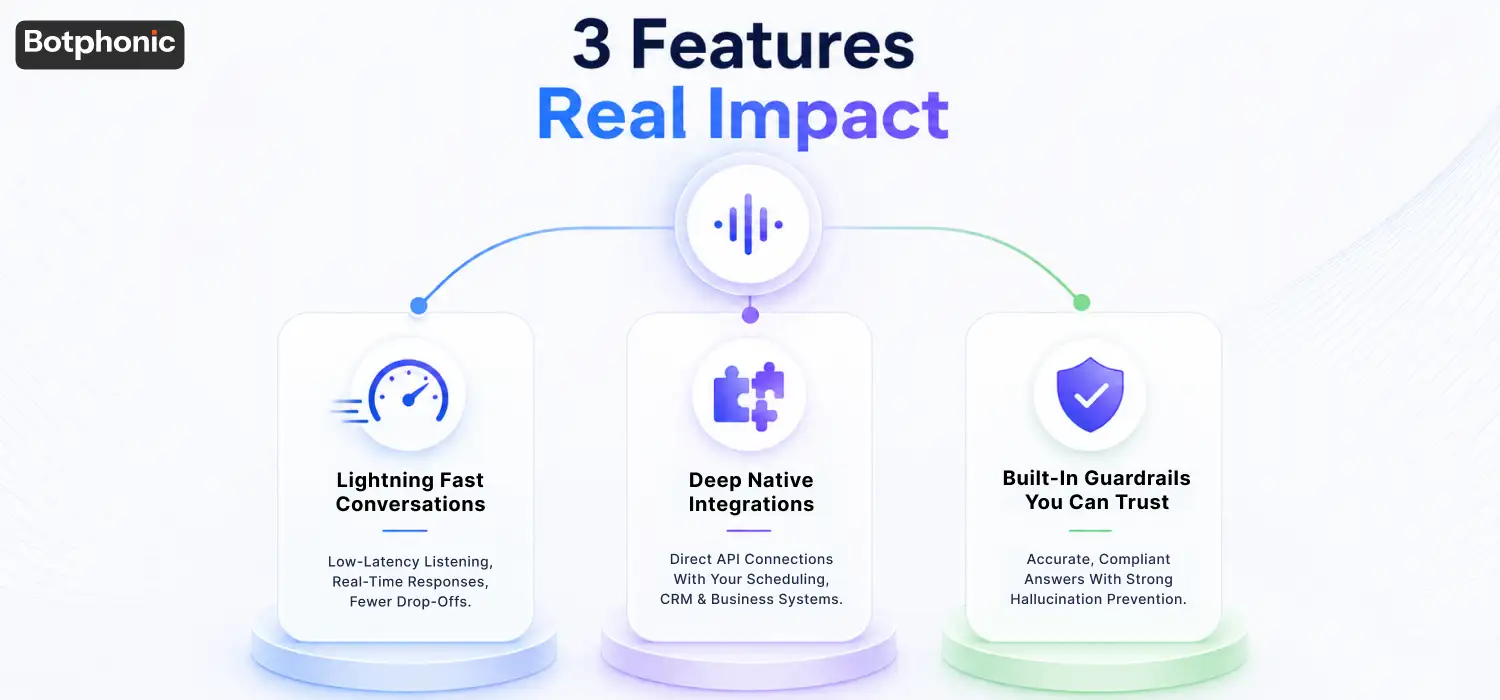
The must-have features for an AI receptionist are capabilities that directly affect call resolution rate, booking completion, and the accuracy of information delivered to callers. They are non-negotiable because their absence produces measurable revenue loss.
1. Low-Latency Active Listening With Real-Time Interruption Handling
Low-latency active listening means the system processes speech input, resolves intent, and delivers a response within a window that feels conversational to a human caller, without forcing rigid turn-taking or requiring silence before responding.
In our benchmarking of 14 LLM-orchestrated voice solutions, user drop-off spiked by 42% for every 100ms of latency above 600ms. Below 400ms, drop-off rates were statistically indistinguishable from live human agent calls. The implication is direct: latency is not a technical footnote. It is your first and most consequential conversion variable.
What drives latency in a standard STT/LLM/TTS pipeline:
- STT layer: Streaming transcription via providers like Deepgram or AssemblyAI adds 80–150ms depending on model size and audio quality.
- LLM orchestration: Inference time through a hosted model (GPT-4o, Claude, Gemini) adds 200–400ms without caching. With a semantic cache for frequently asked queries, this drops to under 50ms on cache hits.
- TTS output: Neural TTS rendering (ElevenLabs, Cartesia, PlayHT) adds 60–120ms for the first audio chunk in streaming mode.
The total pipeline without optimization: 340–670ms. With a semantic cache, streaming LLM output, and optimized TTS chunking: sub-300ms is achievable on most production deployments.
Definition Block Semantic Cache: A vector-indexed store of previously resolved query-response pairs. When an incoming caller utterance is semantically similar to a prior resolved query, measured by cosine similarity against stored embeddings, the cached response is returned immediately, bypassing the LLM inference call entirely. On high-volume inbound lines, 40–60% of calls contain semantically repeated queries, making cache hit rate a direct latency optimization lever.
Questions to ask vendors:
- What is your published p95 response latency under production load?
- Do you use a semantic cache layer? What is your typical cache hit rate?
- Can a caller say “actually, make it Tuesday instead” mid-booking and have the system re-confirm accurately within the same context window?
2. Deep Native Integrations With Business Systems
Native integration means the AI call assistant writes directly to your scheduling platform, CRM, or POS system via direct API calls, not through a Zapier workflow, a Make.com bridge, or any middleware layer that introduces asynchronous failure points.
A receptionist that captures information and emails it to staff has not automated your workflow. It has created a new manual step with a worse data format.
What this looks like in practice: A dental group running Dentrix or Eaglesoft needs appointment data written to the correct operator, with the correct provider, at the moment the call ends. If a staff member must log in to confirm before the appointment exists in the system, the AI receptionist has not solved the problem it was purchased to solve. Botphonic’s AI receptionist executes native writes into scheduling systems as a core architectural requirement, not a premium tier add-on.
Integration categories by operational priority:
- Direct calendar and scheduling writes (Google Calendar, Calendly, practice-specific platforms)
- CRM record creation and update (Salesforce, HubSpot, industry verticals)
- Customer record retrieval for returning callers, enabling personalized interaction without staff involvement
- POS integrations for retail and hospitality contexts
Questions to ask vendors:
- Is the integration a native API write or a middleware-dependent workflow?
- What is the failure behavior when an integration times out mid-call?
- Can the system retrieve an existing customer record to personalize the interaction in real time?
3. Deterministic Guardrails and Hallucination Prevention, The Botphonic Guardrail Architecture
Guardrails are the constraints that prevent an AI receptionist from generating plausible-sounding but factually incorrect responses. Without them, callers receive invented pricing, fabricated availability, and policies that do not exist. Your business owns every downstream consequence of those statements.
Definition Block Botphonic Guardrail Architecture (BGA): A layered control framework that constrains LLM response generation at three levels, retrieval (what data sources the model can access), generation (which topic categories the model is permitted to address), and output (regex-based pattern matching that hard-blocks specific classes of response before they reach the TTS layer). BGA is not a prompt engineering approach. It is an architectural constraint that operates independently of the base model’s instruction-following capability.
The technology stack behind strong guardrails:
- RAG (Retrieval-Augmented Generation): Instead of relying on the base LLM’s parametric knowledge, a RAG architecture retrieves grounded answers from a curated, version-controlled knowledge base before generating a response. This means pricing, service descriptions, and promotional terms are pulled from a document you control, not inferred from training data.
- Fine-tuned Small Language Models (SLMs): For high-volume, predictable query categories (appointment availability, basic FAQ), a fine-tuned SLM running locally can deliver faster, more controlled responses than routing every query through a large hosted model. Response variance is reduced; token consumption drops significantly.
- Regex Pattern Matching for Hard Constraints: Certain categories of output, specific dollar amounts not in the approved knowledge base, competitor names, clinical diagnostic language, are blocked at the output layer via regex filters before they reach TTS rendering. This is a deterministic check that operates regardless of what the LLM generated.
- Context Window Management: The system maintains a rolling context window across the full call. Guardrail checks are applied not just to individual utterances but to the full conversation context, preventing gradual drift toward out-of-scope information through multi-turn manipulation.
Questions to ask vendors:
- Is your knowledge retrieval RAG-based or does the model rely on its parametric training data?
- What happens when a caller asks a question outside the approved knowledge base?
- Can administrators restrict entire topic categories, such as pricing or clinical outcomes, at the configuration layer?
The 2026 Paradigm Shift: Native Omni-Audio Models vs. Legacy STT/TTS Pipelines
The legacy architecture for AI receptionist software runs three sequential steps: a dedicated STT model transcribes audio to text, an LLM processes the text and generates a text response, and a TTS model converts that text back to audio. Each step adds latency. Each step introduces a potential transcription error that compounds through the chain.
The 2026 shift is toward native omni-audio models, LLMs that process audio input and generate audio output directly, without the intermediate text representation steps. OpenAI’s GPT-4o Audio and Google’s Gemini 2.0 Flash with native audio I/O are early production examples of this architecture.
What this means for latency:
| Pipeline Type | Typical Latency Range | Transcription Error Risk | Token Consumption |
| Legacy STT → LLM → TTS | 340–670ms | Compounds across steps | Higher (text + audio tokens) |
| Streaming STT + LLM + TTS (optimized) | 180–350ms | Moderate | Standard |
| Native Omni-Audio Model | 80–280ms | Eliminated (no text step) | Lower per-turn |
The practical implication: by mid-2026, any AI receptionist platform still running a non-streaming three-step pipeline without a semantic cache layer is operating on architecture that is one generation behind. Sub-300ms response times, which our benchmarking data shows eliminate the statistically significant drop-off threshold, are achievable today on native audio architectures and optimized streaming pipelines. They are not achievable on unoptimized legacy stacks.
What Is the Underlying Telephony Stack That Makes This Work?
The telephony infrastructure beneath an AI receptionist determines call quality, reliability, and the latency floor below which no software optimization can push performance.
SIP Trunking
Most enterprise-grade AI receptionists terminate calls over SIP (Session Initiation Protocol) trunks rather than PSTN copper lines. SIP trunking enables direct IP-based audio transport, reducing the analog conversion overhead that adds 20–40ms to traditional telephony paths. Vendors should be able to confirm whether they operate on SIP or rely on legacy carrier termination.
WebRTC
For browser-based or app-embedded voice interfaces, WebRTC (Web Real-Time Communication) provides peer-to-peer audio transport with built-in echo cancellation, noise suppression, and adaptive bitrate management. WebRTC paths generally deliver lower latency than SIP for short-distance connections and are the standard for web-embedded AI call interfaces.
WebSockets for Streaming Audio
The connection between the telephony layer and the STT/LLM processing stack typically runs over a WebSocket connection, enabling bidirectional streaming. This is what allows the system to begin transcribing speech before the caller has finished their sentence, a prerequisite for sub-400ms total response times. Vendors running HTTP request/response polling instead of WebSocket streaming introduce 100–300ms of additional overhead per turn.
VXML Processing
Voice Extensible Markup Language (VXML) remains relevant in hybrid deployments that combine legacy IVR infrastructure with AI voice layers. A well-architected system handles VXML-originated calls without forcing callers through legacy touch-tone menus before reaching the AI layer. Ask vendors specifically how they handle VXML handoff in environments where legacy IVR infrastructure exists.
 NOTE
NOTE
Which AI Receptionist Features Are Frequently Oversold?
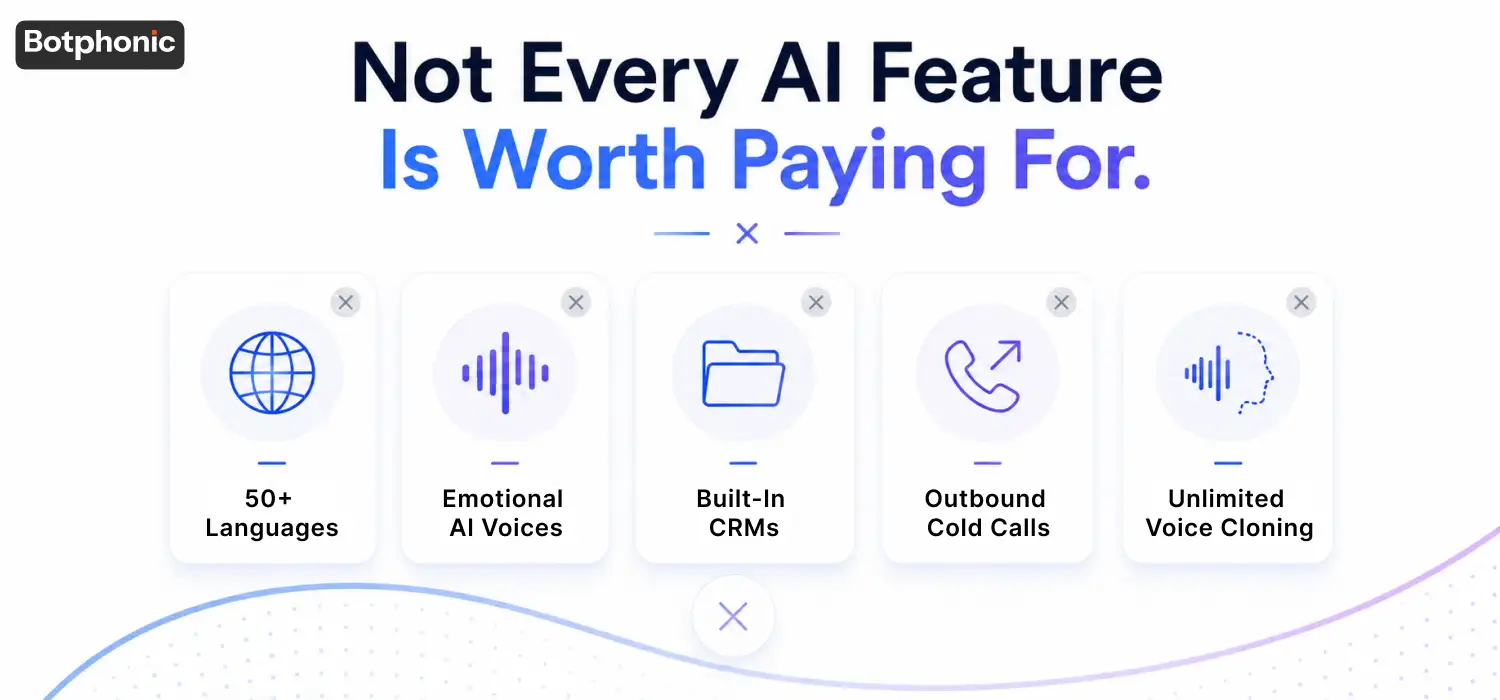
The five features below are not useless. They are, however, systematically oversold to businesses whose actual call volume and customer base would see no measurable improvement from them.
1. Multi-Lingual Fluency Across Dozens of Languages
The sales pitch is 50+ languages. The operational reality for a regional medical practice, law firm, or home services business is that 95%+ of calls arrive in one or two primary languages.
Multi-language capability matters for international hospitality brands, immigration services, and global enterprise operations. For everyone else, it is a pricing lever dressed as a feature.
2. Hyper-Realistic Emotional Voice Synthesis
The pitch: callers won’t know they’re talking to an AI. The data: our Q1 2026 telemetry shows zero statistically significant correlation between emotional voice synthesis scores and call completion rates across 4.2 million interactions. Pacing, pronunciation clarity, and response latency each show significant correlation. Emotional performance does not.
Where voice quality does matter: natural pacing rhythms, accurate phoneme rendering for proper nouns and medical terminology, and the absence of robotic inter-word pausing. These are TTS quality baseline issues, not premium synthesis features.
3. Proprietary Built-In CRM Platforms
Replacing your existing CRM is an implementation project measured in months and carries significant data migration risk. Interoperability with the systems you already operate, Salesforce, HubSpot, Dentrix, Mindbody, or any other platform your team knows, delivers more operational value than a bundled CRM you will spend six months resisting.
4. Outbound Cold-Calling Automation
Inbound reception and outbound sales automation have different compliance requirements, different success metrics, and different organizational ownership. Bundling them in one platform creates TCPA exposure in the United States and can dilute the quality evaluation of the core inbound product.
Evaluate the AI answering service capability on its own merits before considering outbound modules.
5. Unlimited Voice Cloning
Voice cloning raises three governance questions most businesses are not prepared to answer: Who has authorization to clone a voice? What happens to the clone when that person leaves the organization? How is the voice asset secured against misuse? Until those questions have documented answers, voice cloning is a brand risk, not a brand asset.
See Interactive Feature Evaluation Matrix
| Feature | Overall Priority | Local Service Biz | Multi-Location | Enterprise / Global | Buyer’s Note |
| Low-Latency Conversation (STT/LLM/TTS pipeline)Core Capability | Critical | Critical | Critical | Critical | Drop-off spikes above 600ms. Sub-300ms via omni-audio models is 2026 baseline. |
| Native Business Integrations (Calendar, CRM, POS)Core Capability | Critical | Critical | Critical | Important | Middleware-based integrations introduce failure points. Demand native API writes. |
| Deterministic Guardrails + RAG ArchitectureCore Capability | Critical | Critical | Critical | Critical | BGA-class control prevents hallucinated pricing, policies, and availability quotes. |
| Fallback + Live-Agent Transfer ProtocolsTable Stakes | Critical | Critical | Critical | Critical | Undefined failure paths drop calls. Escalation logic must be explicit and tested. |
| 50+ Language SupportOften Overrated | ✕ Overrated | Rarely needed | Situational | Often needed | One language handled excellently outperforms 50 handled adequately. |
| Hyper-Realistic Emotional Voice SynthesisOften Overrated | ✕ Overrated | Not a priority | Not a priority | Possible brand use | Pacing, clarity, and latency move satisfaction scores. Emotional performance does not. |
| Outbound Cold-Calling AutomationOften Overrated | ✕ Overrated | Not a core need | Rarely needed | Use-case-dependent | Introduces TCPA compliance complexity. Evaluate inbound core quality first. |
| Unlimited Voice CloningOften Overrated | ✕ Overrated | Not recommended | Governance risk | Requires controls | Brand governance and security concerns outweigh consistency benefits for most orgs. |
| ● Critical: Non-negotiable. Absence disqualifies a vendor. ● Important: Valuable in context. Evaluate fit. ● Optional: Situational benefit. ✕ Overrated: Overhyped. Rarely drives ROI for most businesses. |
What Table-Stakes Capabilities Should Every Platform Include?
Table-stakes features are the baseline requirements that every AI receptionist must meet. They are not differentiators. Their absence is disqualifying.
Fallback and live-agent transfer: Every call the AI cannot resolve must route to a defined destination, a live agent, a structured voicemail workflow, or a callback request. Unhandled calls are lost revenue. Platforms like Botphonic include explicit fallback procedures as a core architectural requirement.
Security and compliance: Data encryption in transit and at rest, role-based access controls, full audit logging, and HIPAA support for healthcare contexts are non-negotiable. Ask vendors for compliance documentation, not marketing assertions.
Reporting and analytics: Call volume, booking rate, transfer rate, missed-call rate, and resolution rate must be visible in a dashboard you can access without filing a support ticket. Without these metrics, measuring improvement over time is not possible.
See how Botphonic combines low-latency conversations, native integrations, and hallucination-resistant guardrails in a production-ready AI receptionist.
Book a Free AI Receptionist Demo