Summarise this article with
What You’ll Learn
- What Voice AI Sentiment Analysis actually means
- How sentiment detection works during live conversations
- The difference between sentiment analysis and intent detection
- How AI voice agents adapt based on customer emotions
- What happens after negative sentiment is detected
- How customer sentiment analysis improves call outcomes
- The role of sentiment analytics tools in customer operations
- How businesses use sentiment analysis AI to reduce escalations
- Common implementation mistakes
- Future trends shaping sentiment AI
The businesses winning customer experience in 2026 aren’t simply listening to what customers say. They’re listening to how customers feel.
- Every pause.
- Every interruption.
- Every change in tone.
- Every sign of frustration.
These signals often predict churn, escalation, negative reviews, and lost revenue long before a customer explicitly complains. This is where Voice AI Sentiment Analysis is transforming customer interactions. Traditional analytics tell you what happened. Voice sentiment analysis tells you what is happening right now. And more importantly, it enables AI customer service to respond before customer frustration turns into a business problem.
What Is Voice AI Sentiment Analysis?
Voice AI Sentiment Analysis is the process of using artificial intelligence to identify and interpret emotions during spoken conversations.
Instead of analyzing only words, the system evaluates multiple emotional signals simultaneously.
These signals include:
- Vocal tone
- Speaking speed
- Pitch variation
- Volume changes
- Interruptions
- Silence patterns
- Word choice
- Context
The result is a real-time emotional assessment that helps businesses understand whether a customer is:
- Satisfied
- Frustrated
- Confused
- Angry
- Urgent
- Interested
- Hesitant
Unlike traditional call recordings, which are reviewed after conversations end, AI sentiment analysis operates while the interaction is still taking place. That distinction changes everything.
Industry Statistics
| Metric | Finding |
| Customer experience impact | 80% of customers consider experience as important as products |
| Churn risk | 32% of customers leave after one bad experience |
| AI customer operations | Up to 30% service cost reduction |
| Contact center efficiency | AI analytics and automation streamline workflows by automating triage, surfacing instant documentation, and drafting responses, which typically reduces support resolution times by 30% to 50% |
| Revenue growth | CX leaders outperform competitors in growth metrics |
Learn more: Customer Service Automation in 2026: The Complete Roadmap From IVR to AI Voice Agents
The Biggest Myth About Sentiment Analysis
Most businesses think sentiment detection is simply about classifying conversations as:
- Positive
- Neutral
- Negative
That was true five years ago.
Modern sentiment analysis software goes much deeper. Today’s AI Voice Agents measure emotional movement throughout an interaction. A customer may begin a conversation frustrated. Become neutral halfway through.
Finish highly satisfied. The emotional journey matters far more than a final sentiment score. Businesses that focus only on end-of-call sentiment miss valuable opportunities to intervene during critical moments.
Why Intent Detection Alone Is No Longer Enough
| Intent Detection | Sentiment Detection |
| What the customer wants | How the customer feels |
| Appointment booking | Frustration about booking |
| Order tracking | Anxiety about delivery |
| Refund request | Anger about delay |
| Product inquiry | Excitement about purchase |
A customer calling about a refund may sound calm. Another customer requesting the same refund may sound furious. Intent remains identical. Sentiment changes everything. This is why modern Voicebot Integration combines intent recognition with customer sentiment analysis. Together they provide complete conversational context.
How Voice AI Sentiment Analysis Works
Most businesses assume sentiment analysis simply looks for positive or negative words inside a conversation.
In reality, modern Voice AI Sentiment Analysis is far more sophisticated.
During a live customer call, multiple AI Phone Call Recording and Analytics operate simultaneously to understand not only what the customer is saying but also how they are feeling while saying it. The technology combines speech processing, natural language understanding, machine learning, behavioral analysis, and real-time decision-making to build a complete emotional picture of the conversation.
Let’s break down what happens behind the scenes.
Step 1: Voice Signal Processing – Understanding Emotion Before Words
The first layer of analysis begins before a single word is interpreted.
As soon as a caller starts speaking, the Voice AI captures the raw audio stream and analyzes acoustic signals that often reveal emotions faster than language itself.
The system evaluates several vocal characteristics, including:
- Tone of voice
- Speaking speed
- Volume fluctuations
- Frequency and pitch changes
- Long pauses or silence
- Interruptions and overlaps
- Vocal stress indicators
- Breathing patterns
For example, a customer speaking rapidly with elevated volume and frequent interruptions may indicate frustration or urgency. Conversely, slower speech combined with extended pauses may signal confusion or uncertainty.
What’s important is that these emotional cues often appear before customers explicitly express dissatisfaction. A caller might remain polite throughout the conversation, yet their vocal patterns can reveal growing frustration.
This acoustic analysis forms the foundation of sentiment detection because emotions are often communicated through voice dynamics rather than word choice alone.
Example
Customer says:
“I’m just trying to understand why my order hasn’t arrived yet.”
The sentence itself appears neutral.
However, if spoken with a raised pitch, faster pace, and audible stress, the Voice AI may classify the emotional state as frustrated rather than neutral. This is one of the biggest advantages of Voice AI Sentiment Analysis compared to traditional text-based analysis.
Step 2: Speech-to-Text Conversion – Transforming Conversations Into Data
Once the audio signal has been analyzed, the conversation is converted into text using Automatic Speech Recognition (ASR). This step creates a structured transcript that can be processed by advanced text sentiment analysis and sentiment analysis AI models.
At this stage, the AI examines:
- Specific words and phrases
- Emotional language
- Contextual meaning
- Sentence structure
- Conversational intent
- Repetition patterns
- Escalation indicators
Unlike basic keyword detection systems, modern sentiment analysis on text considers context.
For example:
Statement 1
“I can’t believe how quickly this was resolved.”
Contains the phrase “can’t believe.”
Without context, this could appear negative. However, the AI recognizes positive sentiment because of the surrounding language.
Statement 2
“I’ve called four times and nobody has helped me.”
This sentence contains frustration indicators, repeated effort signals, and potential escalation risk. The system identifies not only negative sentiment but also the likelihood of customer dissatisfaction increasing.
This contextual understanding is powered by advanced sentiment analysis models trained on millions of customer interactions and large sentiment datasets collected from support conversations, reviews, surveys, and contact centers.
 PRO TIP
Step 3: Sentiment Analysis Model Scoring – Measuring Emotional Intensity
After evaluating both the voice characteristics and transcript content, the AI Phone Call combines these signals to generate emotional scores. This is where real intelligence begins.
Traditional sentiment analysis software often categorizes interactions into three simple buckets:
- Positive
- Neutral
- Negative
Modern AI sentiment analysis tools go much deeper.
Instead of assigning a single label, they generate emotional probability scores across multiple categories simultaneously.
Example Sentiment Breakdown
| Emotion | Confidence Score |
| Frustration | 82% |
| Urgency | 77% |
| Confusion | 65% |
| Satisfaction | 10% |
| Trust | 35% |
This provides a far more accurate understanding of customer behavior. A customer may not be angry. They may simply be confused. Another customer may sound neutral but exhibit strong urgency.
Each emotion requires a different response strategy.
Advanced sentiment analytics tools continuously update these scores throughout the conversation. Rather than producing one final sentiment result at the end of the call, the AI tracks emotional changes second by second.
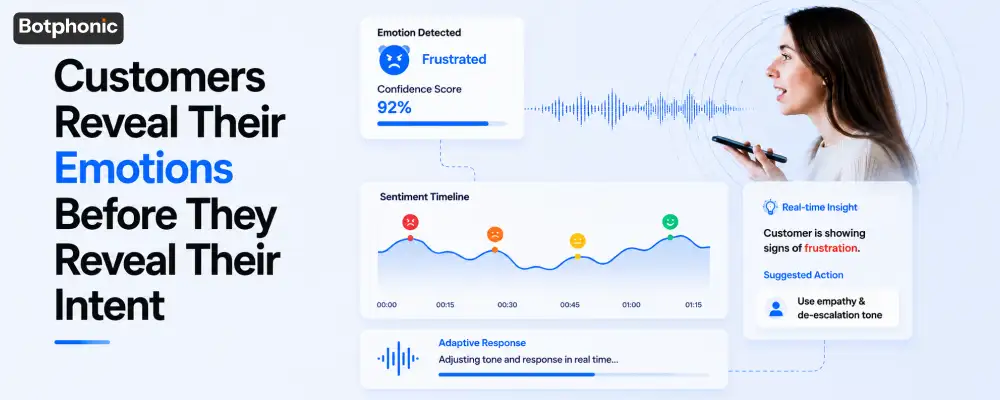
This creates what is known as an emotional timeline, allowing businesses to identify the exact moments where customer sentiment improved or deteriorated.
Step 4: Real-Time Decision Engine – Turning Emotion Into Action
This is where most articles about customer sentiment analysis stop. They explain how AI detects emotion. They rarely explain what happens next.
However, detection alone creates no business value. The real value comes from what the Voice AI does after sentiment is identified.
Once emotional scores cross predefined thresholds, the system activates decision-making workflows designed to improve the outcome of the conversation.
Scenario 1: Rising Frustration
Suppose the AI detects that customer frustration has increased from 40% to 85% within the first minute of the call. Instead of continuing with a standard conversation flow, the Voice AI may:
- Slow down its speaking pace
- Simplify explanations
- Offer faster resolution options
- Prioritize escalation paths
- Reduce unnecessary questions
The goal is to de-escalate the interaction before frustration becomes anger.
Scenario 2: High Escalation Risk
If the AI identifies severe negative sentiment combined with repeated complaints, the system may automatically trigger:
- Supervisor notifications
- Priority routing
- Retention workflows
- Immediate human intervention
This allows businesses to resolve issues while the customer is still engaged rather than after they have already left negative feedback or requested cancellation.
Scenario 3: Customer Confusion
Not every negative emotion is anger. Sometimes customers simply need more clarity. When confusion indicators increase, the Voice AI can:
- Rephrase information
- Provide step-by-step guidance
- Offer additional explanations
- Ask clarifying questions
This improves resolution rates without requiring human involvement.
Scenario 4: Positive Buying Signals
Voice AI sentiment analysis is not only useful for support teams. Sales teams use it as well. If the system detects excitement, curiosity, or high engagement during a sales conversation, it may:
- Trigger lead scoring updates
- Notify sales representatives
- Schedule follow-up actions
- Flag opportunities as high-intent prospects
This transforms sentiment analysis from a support tool into a revenue-generation tool.
Step 5: Continuous Learning and Optimization
Modern sentiment AI systems do not remain static. Every conversation contributes additional learning data. Over time, the AI becomes better at identifying:
- Industry-specific emotions
- Customer behavior patterns
- Escalation triggers
- Resolution indicators
- Buying signals
For example, frustration in a healthcare conversation may sound different from frustration in an insurance or eCommerce interaction. Advanced models continuously adapt to these nuances, improving sentiment accuracy over time. This is why enterprise-grade sentiment analysis software often outperforms traditional rule-based systems that rely solely on keywords.
Real-Time Sentiment Timeline of a Customer Call
| Time | Customer Emotion | Sentiment Score | AI Action |
| 00:20 | Frustrated | -78 | Flag Risk |
| 01:05 | Angry | -92 | Alert Supervisor |
| 02:10 | Neutral | -25 | Continue Monitoring |
| 03:15 | Relieved | +38 | Remove Escalation Flag |
| 04:40 | Satisfied | +87 | Mark Successful Resolution |
What Happens After Sentiment Is Detected?
This is where most articles about Voice AI Sentiment Analysis stop. They explain how AI identifies emotions such as frustration, confusion, satisfaction, or urgency, but they rarely discuss what happens next.
The reality is simple: detecting customer emotions alone doesn’t improve customer experience. The real value comes from how businesses use those emotional signals to change the outcome of the conversation while it is still happening.
A customer who feels frustrated at the beginning of a call can leave satisfied by the end of it if the right actions are taken at the right time. This is where modern Voice AI platforms create measurable business impact.
Sentiment-Driven De-Escalation
One of the most valuable applications of sentiment analysis is de-escalation. When Voice AI detects rising frustration, impatience, or anger, it can automatically adjust how the conversation is handled. Instead of continuing through a standard workflow, the system responds to the customer’s emotional state.
For example, if a caller sounds increasingly frustrated, the AI may shorten responses, avoid unnecessary questions, and focus directly on solving the issue. If the customer appears confused, the AI can simplify explanations, break information into smaller steps, and verify understanding before moving forward.
In more sensitive situations, the system may proactively offer escalation options instead of forcing the customer through a lengthy process. This prevents frustration from building further and helps customers feel that their concerns are being taken seriously.
Rather than treating every caller the same way, the conversation becomes dynamic and adapts based on how the customer is feeling in real time.
Intelligent Call Routing
Not every customer requires the same level of support.
Traditional call routing systems generally send customers through predefined queues based on department selection or account type. Voice AI adds an emotional layer to that process.
When sentiment analysis identifies a customer as highly frustrated, upset, or at risk of leaving, the system can immediately prioritize that interaction. Instead of waiting in a standard support queue, the customer may be routed directly to a senior agent, retention specialist, or escalation team.
For example, a long-term customer threatening to cancel a subscription should not receive the same treatment as a routine billing inquiry. Voice AI recognizes these situations automatically and adjusts routing decisions accordingly.
This reduces wait times for high-priority cases, improves resolution speed, and helps businesses prevent churn before it happens.
The result is a smarter support operation where customer emotions help determine the most appropriate path to resolution.
Real-Time Agent Coaching
Voice AI doesn’t only monitor customers. It also acts as a support system for agents.
During live conversations, sentiment analytics tools continuously evaluate both the customer’s emotional state and the progress of the interaction. If the conversation begins moving in a negative direction, the AI can provide guidance to the agent while the call is still active.
For instance, if frustration levels start increasing, the system may recommend empathy statements, alternative responses, or specific troubleshooting steps. It can also surface relevant knowledge-base articles, previous customer interactions, or recommended next actions based on the context of the conversation.
This real-time assistance helps agents respond more effectively, especially during difficult interactions. Instead of relying solely on training or memory, agents receive actionable recommendations exactly when they need them.
The benefit is twofold: customers receive better support, and agents gain confidence when handling complex conversations.
 NOTE
NOTE
Supervisor Intervention
Some customer interactions carry greater business risk than others.
A highly frustrated enterprise client, a customer with a history of escalations, or a caller discussing cancellation may require immediate attention from management.
Voice AI can identify these situations automatically and notify supervisors while the conversation is still in progress. Instead of discovering the problem days later during quality assurance reviews, supervisors receive real-time alerts when sentiment reaches critical levels.
This allows them to monitor the interaction, provide assistance to the agent, or join the conversation directly if necessary.
For businesses handling high-value accounts, this capability can make a significant difference. Early intervention often prevents complaints, reduces churn risk, and helps preserve important customer relationships.
Rather than reacting after a poor experience has already occurred, organizations can take action before the situation becomes a larger problem.
Automated Follow-Up Actions
The impact of sentiment analysis doesn’t end when the call ends.
Once the conversation is complete, Voice AI can trigger automated workflows based on the customer’s emotional journey throughout the interaction.
A satisfied customer may receive a review request or feedback survey. A customer showing signs of churn risk may be added to a retention campaign. A highly engaged prospect might be routed directly into a sales follow-up sequence.
Because the system understands how the customer felt during the conversation, follow-up actions become more relevant and personalized.
This transforms sentiment analysis from a reporting tool into a decision-making engine that influences the entire customer lifecycle.
From Emotion Detection to Business Action
The biggest misconception about sentiment analysis is that it exists purely for analytics dashboards and post-call reporting.
In reality, modern Voice AI platforms use sentiment as an operational signal.
They don’t simply identify emotions.
They respond to them.
Whether it’s de-escalating a frustrated customer, routing high-risk callers to specialized teams, assisting agents during live conversations, or triggering proactive follow-ups, the true value of Voice AI Sentiment Analysis comes from turning customer emotions into immediate business actions.
That’s the difference between understanding how customers feel and actually improving their experience.
Beyond Customer Service: Revenue Applications of Sentiment AI
Another major content gap across competitor pages is the assumption that sentiment analysis only benefits support teams.In reality, revenue teams are increasingly adopting sentiment AI.
Sales Qualification
Sales conversations contain emotional buying signals.
AI can identify:
- Purchase interest
- Pricing concerns
- Competitive objections
- Decision confidence
This creates stronger qualification models.
Retention and Churn Prevention
Customers rarely cancel without warning signs. Negative sentiment often appears weeks before churn occurs. Organizations using sentiment analysis AI can proactively intervene before customers leave.
Lead Scoring
Traditional lead scoring evaluates demographics. Voice AI evaluates emotional engagement. Prospects showing excitement, urgency, and curiosity often convert at higher rates.
How Voice AI Sentiment Analysis Improves Core Contact Center Metrics
Most organizations deploy sentiment analysis to improve measurable business outcomes.
| Metric | Impact |
| First Call Resolution | Higher |
| Customer Satisfaction | Higher |
| Escalation Rate | Lower |
| Churn Risk | Lower |
| Average Handle Time | Lower |
| Agent Burnout | Lower |
| Retention Rate | Higher |
This transforms sentiment analysis from an analytics tool into an operational tool.
The Future of Voice AI Sentiment Analysis
The next generation of sentiment analysis AI will move beyond emotion recognition.
Future systems will predict:
- Churn probability
- Purchase likelihood
- Escalation risk
- Customer effort
- Loyalty scores
Voice AI will no longer simply understand conversations. It will continuously optimize them. The future isn’t sentiment detection. It’s sentiment-driven automation.
With Botphonic’s Voice AI Sentiment Analysis, you can detect frustration, predict escalations, route conversations intelligently, and create better customer experiences in real time.
Book Free Demo Now!