
Summarize Content With:
Summary
McKinsey estimates the average cost of an inbound call at $7.16 per call. Botphonic’s AI phone calls are $0.40 per minute. This cost difference – $7.16 minus $0.40 – is not a price point. It is the economics behind moving from linear to zero marginal cost economies of scale. This article explores the economics of zero marginal cost AI telephone calls, the data on how much this actually saves, and how zero marginal cost is being applied in 2026 across all industries.
Introduction
Marginal cost is the cost to make an additional unit. With a human agent manning the call center, the marginal cost of one more call is obvious: you have to hire another agent or have the agents work longer, and either way costs increase proportionally.
The cost of AI voice agents is $0.07-$0.15 per minute compared to $29-$42 per hour for a US agent. More significantly, when you have the AI voice agent in place, the marginal cost of an extra call is the same as the marginal cost of any other call (100th call or 100,000th call). This is the meaning of zero marginal cost: scaling has no impact on cost.
This is no fantasy. Gartner estimates in 2026, conversational AI will save $80 billion in contact center costs. The economics are not on the way – they are already changing the way companies build their phone systems now.
What Zero Marginal Cost AI Phone Calls Actually Mean
The term “zero marginal cost” is drawn from economics, such as Jeremy Rifkin’s Third Industrial Revolution. The idea: after the initial fixed cost of the technology platform, the cost of each additional unit approaches zero. Software, streaming, information – digital goods – have been produced this way for years. It costs the same fraction of a cent to stream every song downloaded on Spotify.
The same model is being applied to phone calls with AI. Here is the economic distinction:
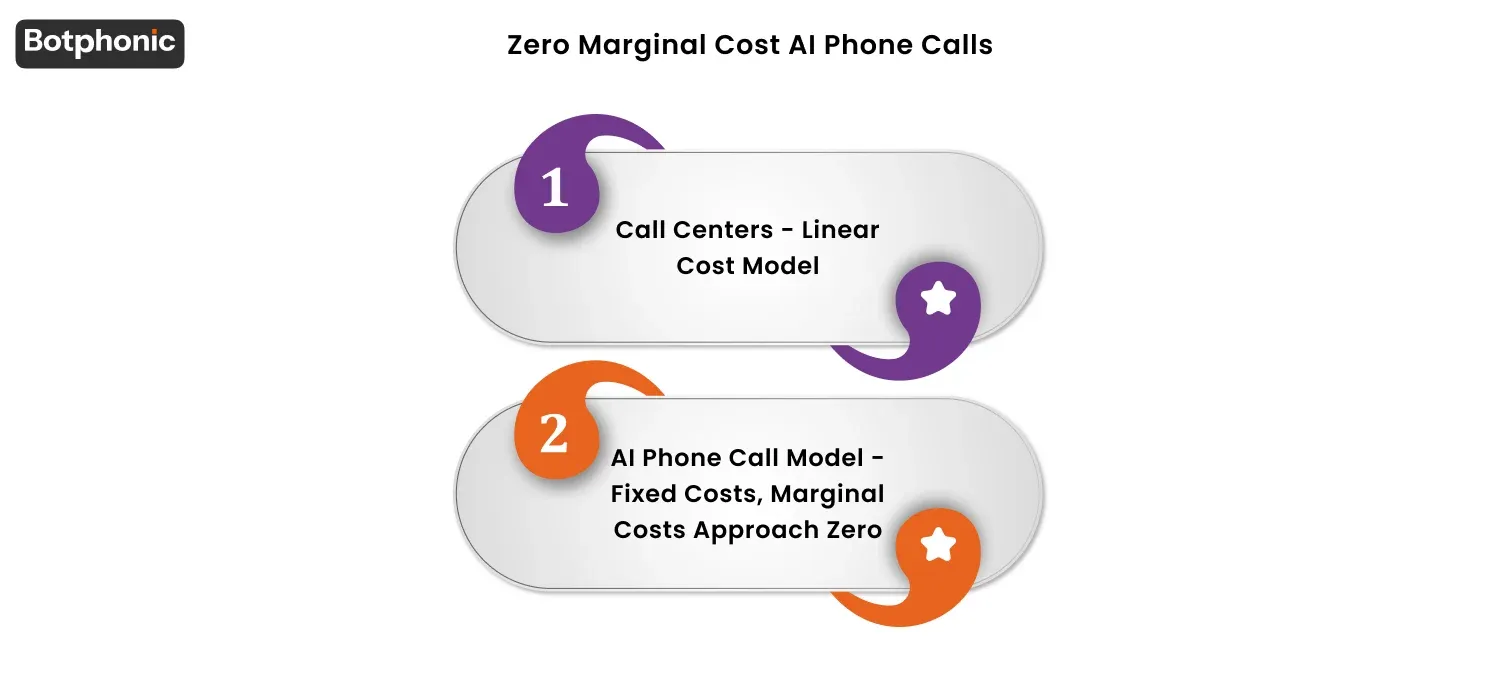
Call centers – linear cost model
The cost of taking another call is the cost of an additional agent minute (paid overtime) or additional agent (paid salaries, benefits, training, management). A medium sized enterprise call center (20 full time agents) costs about $700,000 per year in staffing alone (not counting infrastructure and compliance costs).
More calls = more cost, proportionally
AI phone call model – fixed costs, marginal costs approach zero
Platform costs are fixed (infrastructure, LLM access, telephony). The incremental cost for each additional call is a few cents per minute, not dollars per agent-hour. The cost for the company that takes 1,000 calls a month is higher than the cost for the company taking 100,000 calls a month – but the marginal cost of an additional call is the same. It stays flat. That’s zero marginal cost.
 NOTE
NOTE
The Numbers: Human Calls vs AI Phone Calls in 2026
The annual cost of human phone operations vs AI phone operations is now an established comparison. These are the facts:
| Cost Element | Human Agent | Botphonic AI |
| Cost per call (McKinsey average) | $7.16 | $0.40/min |
| Cost per hour of operation | $29–$42 (US agent) | Fixed platform rate |
| Scale from 1,000 to 10,000 calls | Requires 10x more agents | Same infrastructure |
| After-hours coverage | Overtime or night shift premium | No additional cost |
| Training cost per new agent | $4,000–$7,000 | Knowledge base update |
| Annual turnover cost (30-45% industry average) | Repeated for every departure | Zero |
| Calls handled simultaneously | 1 per agent | Unlimited |
| Cost reduction at 10,000 monthly interactions | Baseline | 76% reduction |
At 10,000 calls per month, the AI solution has a 76% lower cost than human agents – $26,500 per month or $318,000 per year. At 50,000+ volumes, savings increase to more than $1.5 million a year as variable cost reductions kick in.
The cost of a human agent is approximately $2.35 per phone call (including salary, benefits and overheads) on a 40-hour week. An AI agent costs $0.38 per call – a 83% cost savings across all calls.
These are not projections. These are the statistics deployers of AI systems are quoting in 2026.
Why “Near-Zero” and not “Zero”
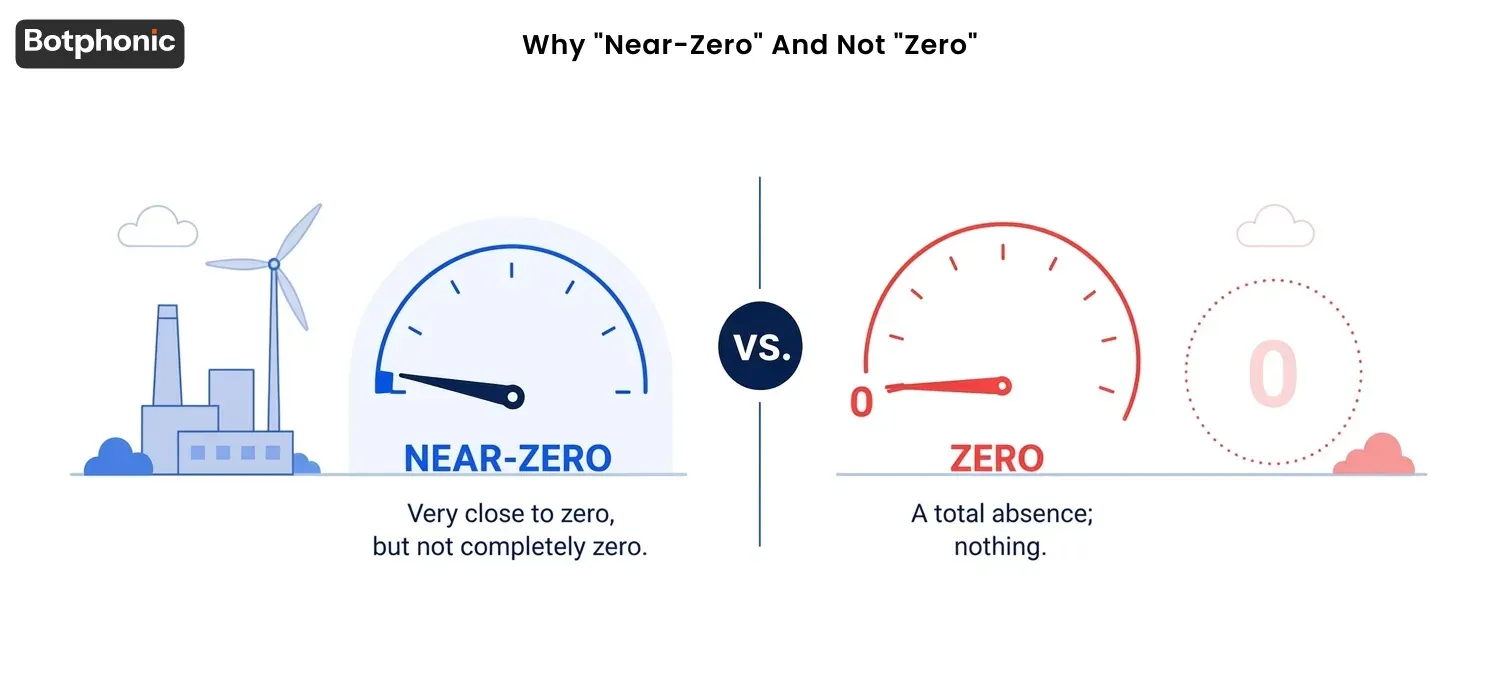
Being realistic about economics is important. Zero marginal cost phone calls are “near-zero” rather than zero AI phone calls, for three reasons:
- Computing costs grow with scale: Each AI phone call uses LLM tokens, speech-to-text transcription, and text-to-speech. Where software costs taper off as you get better with optimization, with AI the costs are a linear function of volume – the more popular your AI feature is, the more it costs to run. With Botphonic’s pricing, these compute costs are bundled into the $0.40/min – but they are there.
- Per-minute cost to telephony: SIP trunking, number setup and carrier termination costs exist for each and every call. They’re generally a fraction of a cent per minute, and don’t materially affect the economic analysis, but they are there.
- Configuration and maintenance are real costs: Configuring AI call sequences, ensuring knowledge base currency, transcribing calls and revising scripts are all activities that require human labour. Companies with the highest ROI consider this maintenance routine, dedicating 2-4 hours per week (for a system handling several thousand calls), to this task.
Despite all of the above, what remains true: In research conducted by Deloitte, AI changes the focus to cost per resolution, reducing the unit economics of providing service by 65-90% while enhancing the customer experience. Even with the cost of compute, telephony and maintenance, the cost difference between AI phone and human phone is significant and scales with volume.
Botphonic Provides Zero Marginal Cost AI Phone Calls
Botphonic’s design takes advantage of the zero marginal cost model. Here’s how each piece fits in:
- Voice-Based Artificial Intelligence: AI agents with more than 65 human-like voices can initiate answer calls at any scale. No waiting for customers, no over-time for the system. The cost of 50 simultaneous calls at 2am on a Sunday is the same as the cost of 5 calls at 10am on a Tuesday.
- Less Than 300ms Latency: It means there is no tell-tale delay that indicates callers are speaking to a machine. Conversations that sound like humans lead to higher resolution rates – and higher resolution rates mean fewer call-backs and fewer calls for the same result.
- Built-In Integration With Popular CRM Systems: The system automatically syncs with CRM platforms such as Salesforce, HubSpot, and Zoho, ensuring it records every call the AI handles in the customer’s CRM profile, logs outcomes, and triggers follow-ups. While human call-center agents spend 5–10 minutes on post-call administration for every call, the AI system handles this work instantly.
- Unlimited Simultaneous Calls: Human call centers face natural limits on how many concurrent calls they can handle, but Botphonic’s system scales to meet peak demand such as during a product launch, the Christmas season, or a new marketing promotion without requiring staffing changes or incurring additional costs.
- Default HIPAA, GDPR and SOC 2 Type II Compliance: It means companies in highly regulated industries do not need to pay for compliance advice and infrastructure on top of the cost of the platform. Compliance is a fixed, not marginal cost.
The Economics Across Different Business Types
The zero marginal cost effect varies by the size and volume of calls. Let’s consider the economics in three typical scenarios:
Small Business (Less than 1,000 calls per month)
At these levels, zero marginal cost AI phone calls deliver their biggest benefits through reliability and accessibility rather than cost savings. A small medical practice, real estate office, or contractor cannot afford a full-time receptionist 24 hours a day. Pure usage-based pricing plans with zero fixed fees and all-inclusive per-interaction pricing keep monthly costs at $450–600 for 300 interactions, making AI receptionists comparable in cost to part-time human agents and enabling organizations that could not afford fixed fee structures to adopt AI services.
For small businesses the return on investment proposition is: AI phone coverage at the same cost as part-time human coverage, but 24/7 coverage without illness, training or attrition.
Mid-Market Business (1,000-10,000 calls per month)
Here the zero marginal cost model really shines. For most contact centers, this is 30-50% cost reduction on call types automated. For a company with 5,000 calls a month average cost of $7.16 per call, that’s $35,800 in monthly call handling costs. At Botphonic’s $0.40/min cost with average call time of 3 minutes, the same call volume cost around $6,000 – a $29,800 monthly cost reduction or $357,600 per year.
At these volumes, the ROI calculator (botphonic.ai/roi-calculator) calculates the exact call cost savings for your call volume and average call duration.
Enterprise (10,000+ calls per month)
With 10,000 calls monthly, AI delivers 76% savings. At 50,000+ volumes, cost reduction reaches more than $1.5 million per year as the variable cost reduction takes effect.
For enterprises, the zero marginal cost model also removes the complexities of managing people – scheduling, planning, staffing for peak periods and the 30-45% annual attrition rate that requires continuous hiring and training. The management costs alone, even without agent costs, provide substantial savings at enterprise scale.
Zero Marginal Cost AI Phone Calls in Healthcare
The first draft of this blog was focused on healthcare – for good reason. Healthcare is the sector that benefits most from the zero marginal cost model, because there is the greatest discrepancy between required call volume and manpower.
A hospital system that needs to deliver appointment reminders, medication reminders, check-ins after hospital discharge, alerts to stay up-to-date with preventive care, and calls to refill prescriptions across thousands of patients is unviable to staff at a reasonable cost. To engage patients, the number of calls required would be beyond the size of the call center that most healthcare systems can afford.
Zero Marginal Cost AI Calls
Appointment Reminders
A clinic that sees 500 patients a week can call all 500 of them automatically the day before their appointments for a few hundred AI minutes. The 30% drop in the “did not turn up” rate more than justifies the cost of the AI system.
Medication Adherence
AI is necessary to make automated calls to check for medication side effects, whether the patient has started a medication and needs a refill cost-effective. The cost of providing adherence calls would be higher than the value of the call for most common medications, at human-agent rates.
Post-Discharge Follow-Ups
Readmission rates drive a huge share of value-based costs for hospitals. Post-discharge AI telephone interactions asking patients how they are, alerting nurses to troublesome symptoms, and confirming appointments apply zero marginal cost economics to a critical clinical outcome.
Botphonic’s AI healthcare solution delivers all of these use cases with HIPAA-compliant call workflows, data encryption and audit logs. CareWell Medical Group saw 60% more calls answered, 2.5× more leads reactivated, 30% fewer missed appointments and 25% greater patient satisfaction with Botphonic’s AI voice agents.
More than Healthcare: Companies Using Zero Marginal Cost AI Calls
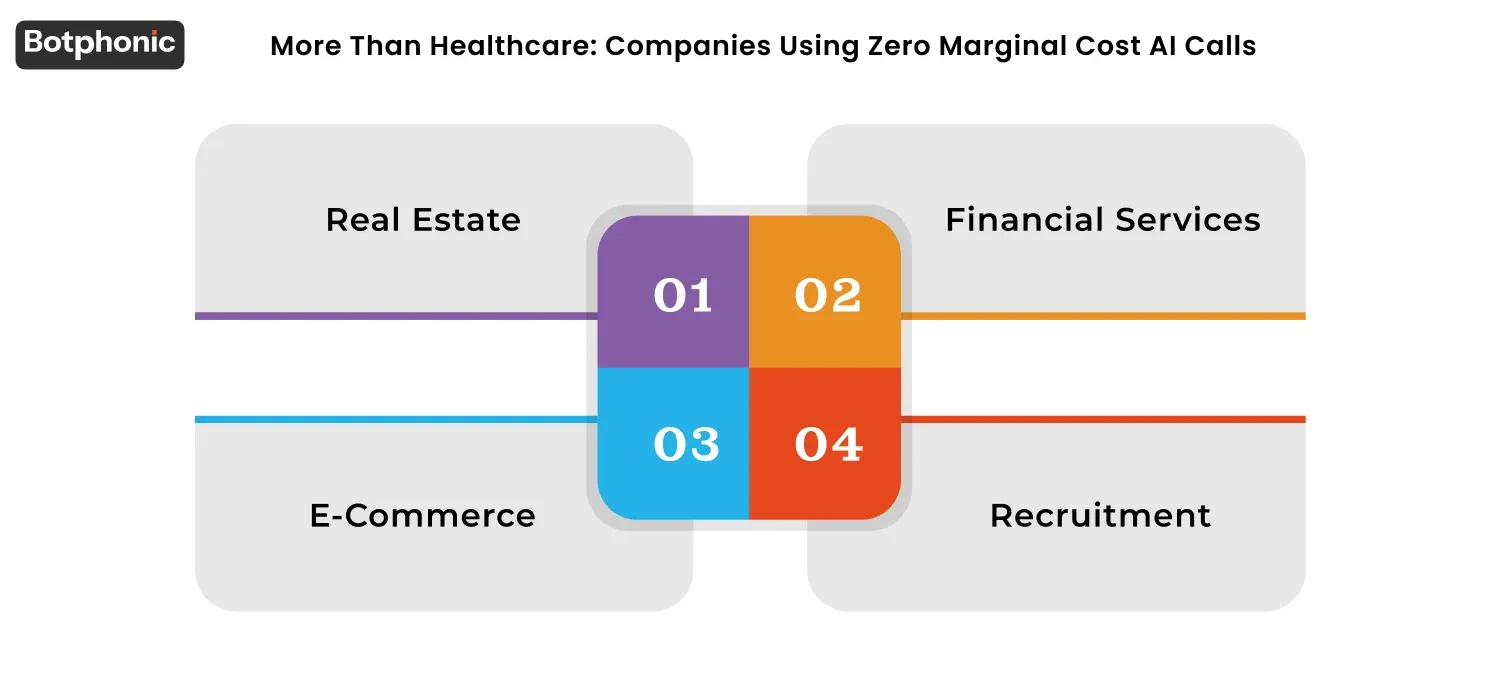
The same economics that make zero marginal cost phone calls so powerful for healthcare apply in every business that receives a lot of phone calls:
Real estate
Qualification calls, responses to property inquiries and appointments for property viewings come at random times and often after hours. AI conducts initial qualification for all leads, all hours of the day, for the same cost per call whether it is a quiet Tuesday or a busy Saturday following the release of a new property listing.
Financial services
Account inquiry, loan status, payment reminder, and other compliance-based disclosures scale. AI agents can handle repetitive financial services calls from beginning to end for less than $1 each. For a credit union or bank with tens of thousands of account inquiry calls per month, this is a cost transformation with no impact on service.
E-commerce
Order status, shipping information, returns, and product information are the highest volume, lowest complexity retail support calls. The cost of an AI agent is around $0.38 per call – a 83% immediate cost reduction per call. For online retailers that deal with seasonal spikes – Christmas, Black Friday – the zero marginal cost approach removes the headache of hiring for these events.
Recruitment
First round screening phone calls, scheduling interviews and follow up emails for hundreds of candidates per week are repetitive interactions at their finest. AI can recruit and screen the entire top-50% of the funnel at zero marginal cost.
 PRO TIP
The Compounding Advantage of Zero Marginal Cost Scaling
The value of the zero marginal cost model from a strategic perspective (as opposed to an operational one) is the compounding advantage.
For a business with human agents to handle their telephone calls, expansion in the number of customers means expansion in the number of agents. Recruiting, training and managing the headcount absorbs time, money and management resources. The growth of the business is partly limited by its capacity to hire staff for its support operations.
A business that has zero marginal cost phone calls is not constrained. They can double their customer base without increasing headcount. Doubling or tripling lead flow is not a crisis, it’s a welcome opportunity. Market expansion – geographic, product or segment – does not require creating a new service team to serve it.
Human-AI hybrid call centres deliver an 87% success rate and 8.7 out of 10 customer satisfaction – leveraging AI’s zero marginal cost to handle volume, and humans to handle complexity. This is the win-win model: AI scales the volume at close to zero incremental cost; humans operate on complexity with the best possible service.
What Zero Marginal Cost AI Phone Calls Actually Mean
Let’s be clear what it is not, to manage expectations:
- It is not a substitute for human judgement. It does not replace a human in complex disputes, complaints, trouble shooting across multiple systems, regulatory anomalies and relationship building interactions. Zero marginal cost AI phone calls deal with the routinised interactions – not all interactions.
- It is not maintenance-free. AI scripts need updates when products, policies, or procedures change. Teams must review phone conversations to identify conversational issues. Knowledge bases need up-to-date information to provide accurate answers. The cost of managing this remains low compared to a human team, but it still exists.
- It takes some time to deploy. It takes days to train an AI phone system to your product set, escalation and playbook. Companies that deploy without sufficient training data tend to have fewer resolutions and more escalations than those which take time to set it up.
What zero marginal cost AI phone calls do offer: no marginal costs, 24/7 service without overtime rates, no variability of skill, and a scalable platform that doesn’t require commensurate staffing costs.
Conclusion
The unit economics of zero marginal cost AI phone calls is a fundamental transformation of phone operations. McKinsey reports the average inbound call costs $7.16. Botphonic offers virtual phone calls for $0.40 a minute. The AI agents manage the calls through to resolution at a cost of less than $1 per call – 65-90% lower unit economics.
Companies creating operations around this model in 2026 are not only cutting their costs today. They’ll be removing the constraint that links headcount to the call volume – and they’ll be creating an operational structure that grows with their business, not against it.
The math is simple. The decision is not.
