
Summarize Content With:
What You’ll Learn
- Why Voice AI gives incorrect answers even after training
- How a Voice AI Knowledge Base improves response accuracy
- How Knowledge Base Integration for Voice AI Agents works behind the scenes
- Why RAG architecture is replacing traditional AI training
- How enterprise knowledge reaches voice agents in real time
- The frameworks leading companies use to reduce hallucinations
Everyone wants smarter Voice AI. Most businesses are solving the wrong problem. They focus on voice quality. Accent realism. Conversation design. Prompt engineering.
Yet the biggest reason Voice AI deployments fail isn’t because the AI sounds robotic. It’s because the AI says something incorrect. A customer asks about pricing. The Voice AI gives outdated information.
A patient asks about appointment policies. The Voice AI references an old process. A prospect asks whether a service is available in their city. The Voice AI guesses. One wrong answer can destroy trust faster than a robotic voice ever could.
This is why the conversation around Voice AI has shifted dramatically over the last two years.
The question is no longer:
“How do we make AI sound human?”
The question is:
“How do we make AI consistently accurate?”
The answer is a properly designed Voice AI Knowledge Base supported by retrieval-augmented generation (RAG), knowledge grounding, and real-time access to enterprise information.
This guide explains how modern Voice AI systems retrieve information, how Knowledge Base Integration for Voice AI Agents reduces hallucinations, and how organizations deploy enterprise knowledge to voice agents at scale without sacrificing accuracy.
Industry Data That Highlights the Accuracy Challenge
- 72% of business leaders say AI accuracy is their biggest concern when deploying customer-facing AI systems.
- Organizations using retrieval-based AI systems report significantly lower hallucination rates compared to standalone LLM deployments.
- McKinsey estimates knowledge workers spend nearly 20% of their time searching for information.
- Poor knowledge management costs large organizations millions annually through inefficiencies and customer service errors.
- Companies implementing AI-powered knowledge systems report faster customer resolution times and higher customer satisfaction.
Learn more: Voicebot CRM Integration for Agencies: How to Connect AI Voicebots Into Multi-Client CRM Workflows
What Is a Voice AI Knowledge Base?
A Voice AI Knowledge Base is a centralized collection of trusted business information that Voice AI agents can access during live conversations.
Instead of generating responses from training data alone, the AI retrieves verified information before answering.
Knowledge sources often include:
- FAQs
- Product documentation
- Help centers
- CRM records
- SOPs
- Policy documents
- Internal wikis
- Appointment systems
- Pricing databases
Think of it this way. Traditional AI answers from memory. Knowledge grounded AI answers from evidence.
Why Traditional Voice AI Agents Make Mistakes
Most Voice AI agents today are powered by large language models (LLMs) that excel at understanding human language and generating natural-sounding responses. They can answer questions, hold conversations, and handle customer interactions in ways that feel remarkably human.
The limitation is simple: the AI does not automatically know your business. It has no built-in understanding of your pricing structure, service offerings, operating policies, inventory levels, appointment availability, contracts, or internal processes. While it may understand general concepts related to your industry, it lacks access to the specific information that makes your business unique.
As a result, when customers ask highly specific questions, the AI attempts to generate the most likely answer based on patterns it learned during training. This process works well for general conversations, but it becomes risky when accurate business information is required. The response may sound professional, detailed, and convincing, even when the information itself is incorrect.
This behavior is commonly known as an AI hallucination. Contrary to popular belief, the AI is not intentionally providing false information. Instead, it is trying to fill gaps in its knowledge by predicting what the answer should be. Unfortunately, in customer service, sales, healthcare, legal services, and other business-critical environments, even a small mistake can lead to customer dissatisfaction, lost revenue, compliance concerns, or operational problems.
Consider a customer asking whether a product is in stock, whether same-day appointments are available, or whether a particular service is offered in their area. If the Voice AI does not have access to real-time business information, it may provide an answer that sounds accurate but does not reflect reality. Every incorrect response weakens customer trust and creates additional work for human teams who must later correct the mistake.
A knowledge base is simply stored information. What determines the quality of a Customer Service Automation is how quickly and accurately the system can find the right information during a live conversation. In practice, customers do not ask questions exactly as they appear in a document. They use different wording, incomplete phrases, industry jargon, and sometimes even vague descriptions of what they need.
For example, a customer might ask, “What happens if I cancel my annual plan before renewal?” Even if the exact phrase doesn’t exist inside the knowledge base, the AI Voice Solutions for Small & Medium Businesses must understand the customer’s intent, identify that the question relates to cancellation policies, locate the relevant section of documentation, and determine whether the retrieved information is reliable enough to use.
This entire process happens in real time. The Voice AI must interpret the question, search through potentially thousands of documents, rank the most relevant information, validate confidence levels, generate a response, and deliver it naturally through speech. All of this must happen within a few seconds. Any delay can make the conversation feel unnatural, while inaccurate retrieval can lead to incorrect answers.
This is where many Voice AI implementations struggle. Businesses often assume that uploading more documents automatically improves accuracy.
The best Knowledge Base Integration for Voice AI Agents focuses on retrieval accuracy rather than document volume. A smaller, well-structured knowledge base managed with effective Knowledge Base Software and intelligent retrieval mechanisms often outperforms a massive repository of information that the AI cannot efficiently search. The goal is not simply to give the AI more information. The goal is to help the AI find the right information at the exact moment the customer needs it.
How a Voice AI Knowledge Base Actually Works
A Voice AI Knowledge Base is much more than a collection of documents. It acts as the intelligence layer that allows Voice AI agents to access, retrieve, and use business information during live customer conversations. The goal is simple: provide accurate answers based on verified company data instead of relying on assumptions or generic AI responses.
Here’s what happens behind the scenes every time a customer asks a question.
Step 1: The Customer Asks a Question
The process begins when a caller speaks naturally, just as they would with a human representative.
For example:
“Do you offer same-day HVAC repairs?”
The customer doesn’t need to use specific keywords or follow a scripted flow. Modern Voice AI systems are designed to understand natural conversations, different accents, and varied ways of asking the same question.
Step 2: Speech Recognition Converts Voice Into Text
Once the customer speaks, the Voice AI uses automatic speech recognition (ASR) technology to convert the audio into text.
This step creates a machine-readable version of the conversation that can be analyzed instantly. High-quality speech recognition is critical because even a small transcription error can affect the accuracy of the final response.
For example:
Customer Speech:
“Do you offer same-day HVAC repairs?”
Transcribed Text:
“Do you offer same day HVAC repairs?”
This conversion typically happens within milliseconds.
Step 3: Knowledge Retrieval Searches Business Data
After understanding the question, the system begins searching relevant business knowledge sources.
Instead of searching the public internet, it searches only approved company information such as:
- Frequently Asked Questions (FAQs)
- Help center articles
- Product and service documentation
- Internal knowledge bases
- CRM records
- Pricing information
- Company policies
- Standard operating procedures (SOPs)
- Appointment scheduling systems
The retrieval engine identifies the most relevant pieces of information related to the customer’s request and ranks them based on relevance and confidence.
For example, if the caller asks about same-day HVAC repairs, the system may retrieve:
- Service availability policy
- Service area coverage information
- Technician scheduling rules
- Emergency repair guidelines
This retrieval process is often completed in less than a second.
Step 4: Context Generation Creates a Trusted Knowledge Layer
Once relevant information is found, the retrieved content is transformed into context that the AI can understand and use.
This step is extremely important.
Rather than allowing the language model to generate an answer from memory, the system provides verified business information directly to the AI before it responds.
For example, the retrieved context may contain:
“Same-day HVAC repairs are available Monday through Saturday for customers located within our primary service area. Availability depends on technician scheduling and appointment demand.”
The AI now has factual business information to work with instead of relying on assumptions.
Step 5: Response Generation Builds the Answer
Using the retrieved context, the Voice AI generates a conversational response.
The key difference is that the AI is instructed to answer using only approved information retrieved from the knowledge base.
For example:
“Yes, we offer same-day HVAC repair services in most of our service areas. Availability depends on technician schedules, but I’d be happy to check today’s availability for your location.”
The response remains natural and conversational while staying grounded in verified company knowledge.
This dramatically reduces hallucinations and improves answer accuracy.
Step 6: Voice Delivery Responds to the Caller
Once the response is generated, text-to-speech technology converts the answer back into natural human-like speech.
The caller hears a smooth, real-time response that feels similar to speaking with a trained employee.
Modern Voice AI platforms can also adjust tone, pacing, and pronunciation to create a more natural customer experience.
From the caller’s perspective, the entire process feels instantaneous.
What Is RAG (Retrieval-Augmented Generation)?
Retrieval-Augmented Generation (RAG) is the technology that makes a modern Voice AI Knowledge Base accurate, reliable, and business-ready.
Traditionally, AI models generate answers using information learned during training. While this allows them to hold natural conversations, it also creates a major problem: they may provide answers that sound correct but are actually inaccurate. This happens because the AI relies on patterns and probabilities rather than verified business information.
RAG solves this problem by giving the AI access to real-time knowledge before it responds.
Instead of answering from memory alone, the AI first searches trusted business data, retrieves the most relevant information, and then generates a response based on that information. This process significantly improves accuracy and reduces hallucinations, making it the foundation of the Best Voice AI With Knowledge Base Support platforms.
 NOTE
NOTE
When a customer asks a question, the AI does not immediately generate an answer.
Instead, it follows a retrieval-first workflow:
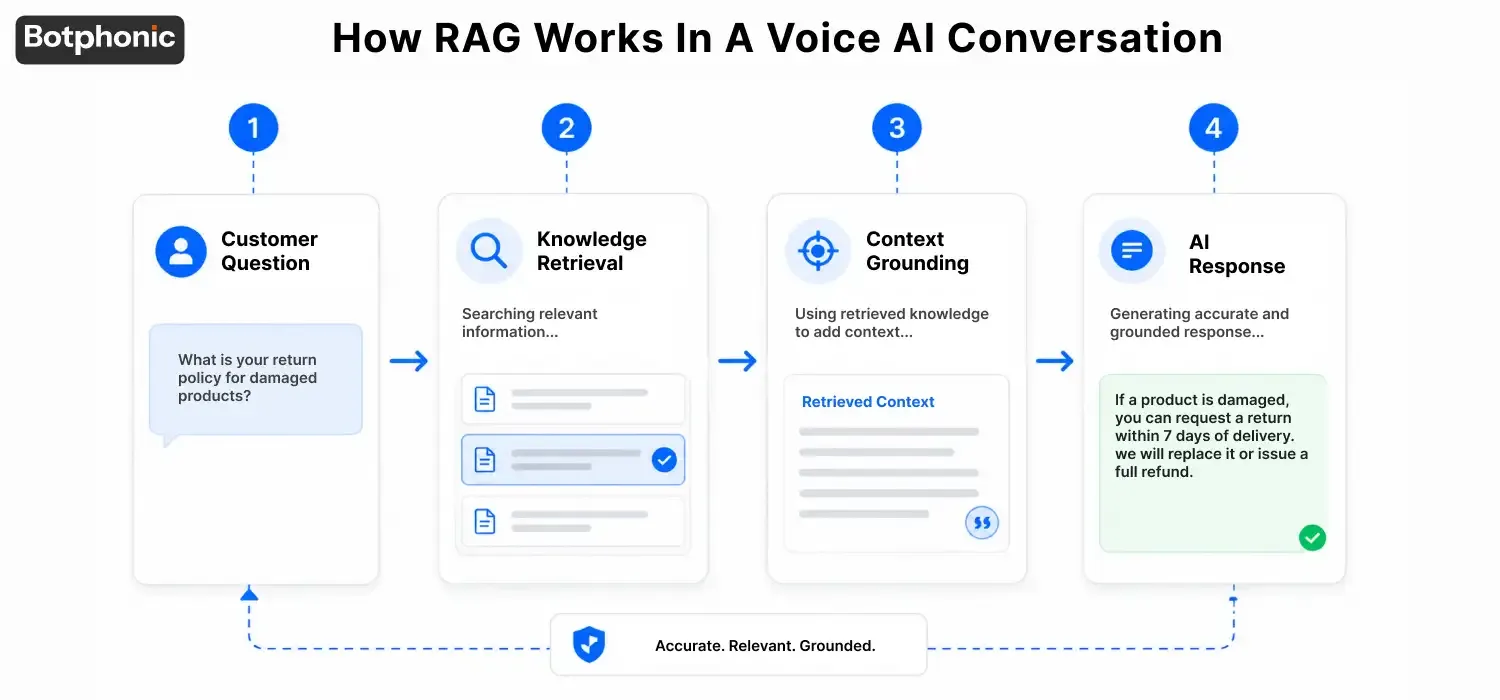
Let’s look at what happens behind the scenes.
Step 1: The Customer Asks a Question
A caller speaks naturally.
For example:
“Do you offer emergency HVAC repairs on weekends?”
The Voice AI first converts the spoken request into text and identifies the customer’s intent.
Step 2: Knowledge Retrieval Begins
Instead of relying on its training data, the system searches connected business knowledge sources for relevant information.
These sources may include:
- FAQs
- Product documentation
- Service catalogs
- Internal SOPs
- CRM records
- Pricing databases
- Appointment systems
- Policy documents
The retrieval engine scans thousands of pieces of information within milliseconds and identifies the most relevant content related to the customer’s question.
Step 3: Context Grounding
Once the information is retrieved, it is injected into the AI’s context window. This process is known as grounding.
For example, the system may retrieve:
“Emergency HVAC repair services are available on Saturdays and Sundays between 8 AM and 8 PM within designated service areas.”
The AI now has access to verified business information before generating a response.
This is the most important difference between traditional AI and RAG-powered AI.
Step 4: Response Generation
Using the retrieved information, the AI creates a natural conversational response.
Instead of guessing, it responds using approved company knowledge.
For example:
“Yes, we offer emergency HVAC repair services on weekends between 8 AM and 8 PM. I can also check technician availability for your location if you’d like.”
The answer sounds human because the language model generates it, but it remains accurate because the information comes from the Knowledge Base.
 PRO TIP
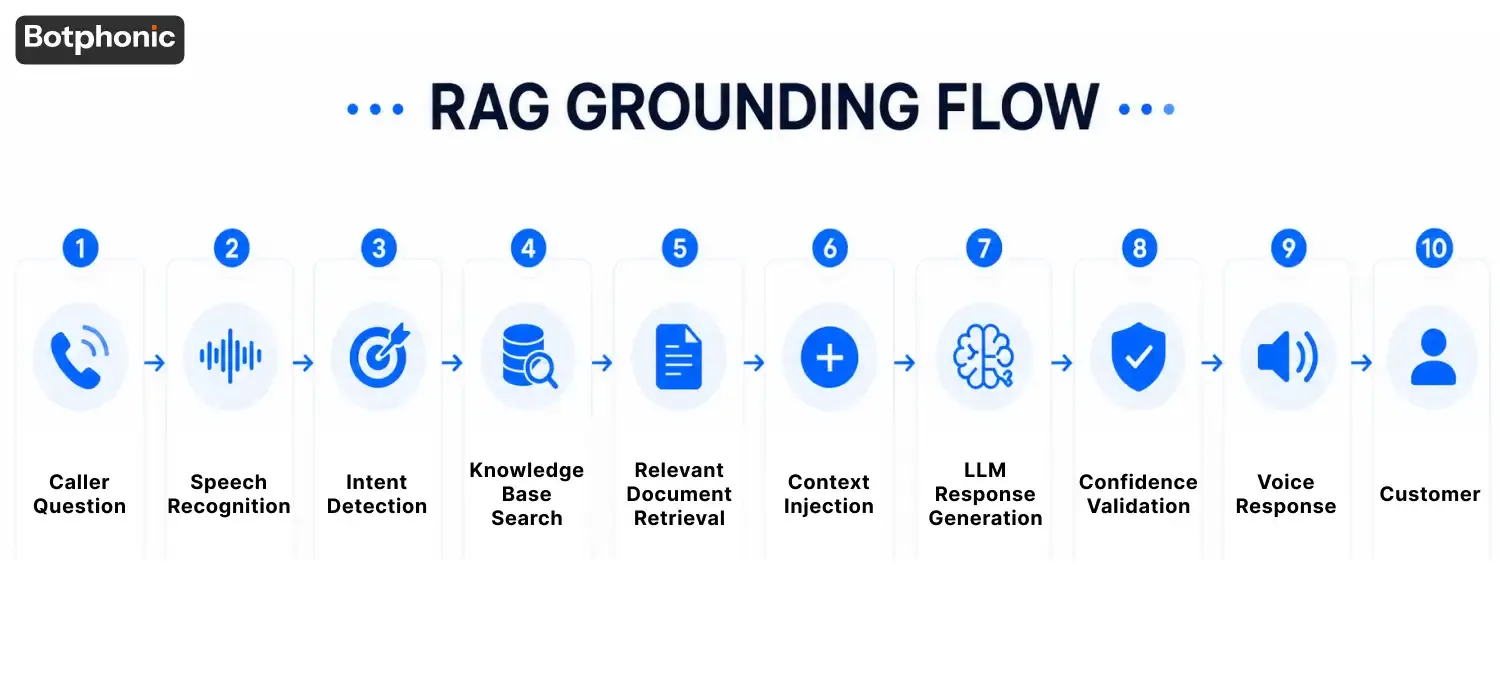
The RAG Grounding Flow for Voice AI
Why RAG Is More Accurate Than Traditional AI
Without RAG, a Voice AI agent depends entirely on what it learned during training.
This creates several challenges:
- Information becomes outdated.
- New products aren’t reflected.
- Policy changes require retraining.
- Business-specific information may not exist in the model.
RAG eliminates these limitations because the AI retrieves information directly from live business systems. When a policy changes, the Knowledge Base changes. The AI automatically uses the updated information without retraining.
This is why Knowledge Base Integration for Voice AI Agents has become the preferred architecture for customer-facing AI deployments.
The Real Benefit of RAG for Businesses
Many articles describe RAG as a technical retrieval framework. The business impact is much simpler.
RAG transforms Voice AI from an intelligent guesser into an informed assistant.
Without RAG:
Customer: “What’s your cancellation policy?”
AI: Attempts to predict the answer.
With RAG:
Customer: “What’s your cancellation policy?”
AI: Retrieves the actual policy and explains it accurately.
That difference can determine whether a customer trusts your business or loses confidence in it.
Why RAG Matters for Enterprise Knowledge to Voice Agents
As organizations scale, information becomes distributed across multiple systems.
Policies may live on one platform. Product information may exist in another. Customer records may sit inside a CRM. Appointment availability may come from scheduling software.
RAG enables enterprise knowledge to voice agents by connecting all these information sources into a unified retrieval layer. The Voice AI can then access the right information at the right time, regardless of where it is stored.
RAG Is the Future of Voice AI Accuracy
The future of Voice AI is not bigger language models. It is better retrieval. Organizations are realizing that customers care less about how intelligent an AI sounds and more about whether its answers are correct.
That’s why Retrieval-Augmented Generation has become the backbone of every serious Voice AI Knowledge Base strategy. It combines the conversational ability of large language models with the reliability of real business knowledge, creating AI agents that are both natural and trustworthy.
How Knowledge Base Integration for Voice AI Agents Reduces Hallucinations
- Provides Verifiable Context: The AI responds using company-approved information.
- Eliminates Information Guessing: If no information exists, the AI can escalate instead of inventing.
- Supports Real-Time Updates: Knowledge changes immediately without retraining.
- Maintains Consistency: Every customer receives the same approved answer.
- Enables Compliance: Critical for regulated industries such as healthcare, finance, and legal services.
The Five Layers of Enterprise Knowledge to Voice Agents
Most organizations underestimate how much information Voice AI needs. A complete enterprise knowledge to voice agents strategy typically includes:
| Layer | Example |
| Public Knowledge | FAQs, Help Center |
| Product Knowledge | Documentation, Features |
| Operational Knowledge | SOPs, Policies |
| Customer Knowledge | CRM Data |
| Real-Time Knowledge | Availability, Scheduling |
The highest-performing Voice AI systems connect all five layers.
Real-Time Retrieval vs Static AI Training
| Metric | Static Training | RAG Knowledge Base |
| Accuracy | Medium | High |
| Updates | Slow | Instant |
| Hallucination Risk | High | Low |
| Scalability | Limited | Excellent |
| Compliance | Difficult | Easier |
This is why RAG has become the preferred architecture for enterprise Voice AI.
How Botphonic Uses Knowledge Base Integration for Voice AI Agents
Botphonic combines Voice AI with advanced knowledge retrieval architecture. Instead of relying on static scripts, Botphonic dynamically retrieves verified business information during conversations.
Capabilities include:
- Multi-source Knowledge Base connections
- CRM-powered personalization
- RAG-based grounding
- Real-time information retrieval
- Automated escalation logic
- Continuous knowledge updates
This allows businesses to deploy Voice AI that remains accurate even as information changes.
Train your Voice AI using a trusted Knowledge Base and turn every conversation into an accurate, reliable customer experience.
Book Free Demo Today!