
Summarize Content With:
What You’ll Learn:
- What an AI voice migration plan actually involves and why it differs from a software upgrade
- The real operational trade-offs of contact center modernization (not vendor talking points)
- A phased cutover runbook: from number porting to NLU tuning
- How to evaluate AI platforms for business without getting locked into the wrong stack
- The exact metrics that tell you your migration worked
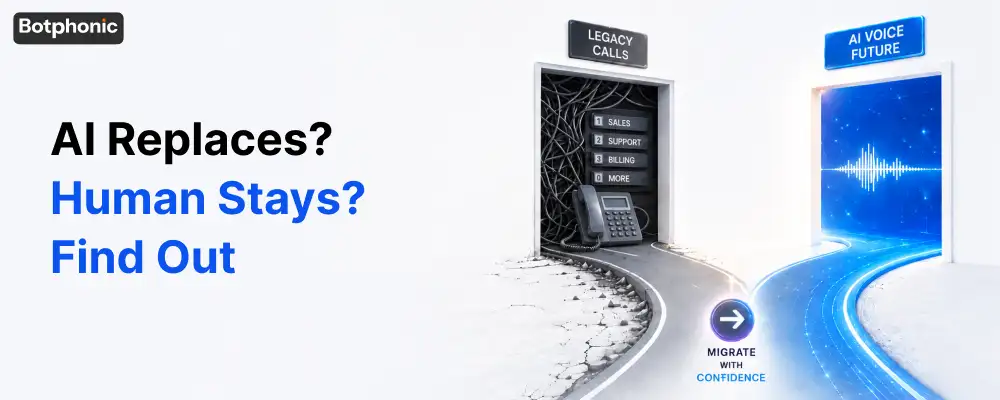
An AI voice migration plan is a structured phased approach for replacing legacy telephony infrastructure, PRI lines, SIP trunks, and IVR trees, with conversational AI agents. It’s built for operations and IT leaders at call centers and growing businesses. Get it wrong, and CSAT collapses on day one.
What Is an AI Voice Migration Plan and Why Should You Care?
A migration plan for artificial intelligence in voice is not a switch-on/something-toggle. This will determine how your inbound and outbound calls get transferred from human-operated and legacy-IVR systems to AI-based voice agents without any service interruptions.
The main point in using artificial intelligence in high volume telephony does not lie in reducing costs. The point lies in handling concurrent communications without making a customer satisfaction go to hell.
90 percent of all migrations fail due to treating this process as software roll-out. But it is not a software roll-out; it means that you are changing the carrier layer, routing logic, data pipeline, and experience layer at once.
 NOTE
NOTE
What Are You Really Gaining and Losing Switching to AI Voice?
It’s time for some honest gain/loss sheet. This one is.
What you are gaining:
- Unlimited instant scalability, no queue wait times, no capacity constraints
- 100 percent data structuring on every single call
- Handling that is consistent through every single call, with no fatigue or variance
What you lose:
- Human intuition the trained operator who knows when something is escalating into a complaint
- Non-linear and unstructured complaint resolution
- Team familiarity the agents are familiar with the current system, not the new one that needs retraining
 PRO TIP
How to Audit Your Baseline Before Migration?
Voice cutover baseline audit is a methodical mapping of the current infrastructure KPIs, routing logic and integration endpoints before anything else comes into play.
This is the process that gets missed most often and is the biggest cause of post-migration disasters.
The items that should be included in your AI call assistant audit:
- Configurations of the legacy open CTI and SIP trunk carrier agreements
- All IVR menus including undocumented ones set up by engineers no longer with the company
- Base AHT (Average Handle Time), containment rate, and CSAT by queue
- CRM Integration Endpoints, your existing system writes into Salesforce, Hubspot, or a custom instance through webhook/native connector?
“The legacy code trap” is a reality. Existing routing flows can live undocumented with no architect left who understands how it works. You have to reverse-engineer them pre-cutover, not post.
What Is a Safe AI Voice Migration Runbook?
A safe AI AI phone call migration runbook is a phased deployment plan. It does not include a “Big Bang weekend” migration, where all your work will be completed in one shot and your Monday will result in support fire drill.
Phases of a migration in action look like this:
Phase 1: Number Porting & Carrier Configuration
Number Porting and carrier configuration is your gating factor here. It may take anywhere from 5 to 15 business days to port a toll-free number depending on your carrier. No software configurations can bypass it. Make sure this process is done before anything else.
Make sure that your carrier supports your target AI platform in terms of SIP termination capabilities. Not all carriers do and BYOT (Bring Your Own Telephony) framework is different per each vendor.
SIP Trunk End Point Termination and Firewall Configuration
SIP trunk end point termination refers to routing the outbound traffic from your provider on the SIP trunk to an IP endpoint in your AI platform’s media server instead of routing to a traditional PBX system. It’s at this step that most first-time deployments expose themselves to potential security problems.
Required firewall settings for secure voice data transfer:
- UDP 5060 (SIP signaling): Allow incoming and outgoing connections for your carrier’s SIP proxy IPs to your AI platform’s SIP end point. Do not allow access from any other IPs — only the known carrier IPs.
- UDP 10000 – 20000 (RTP media stream): Allow access to the RTP port range for the Real-time Transport Protocol traffic. This includes the audio traffic. Limit access to your carrier’s media gateway IPs only.
- TLS 5061 (encrypted SIP): If your provider uses SIP over TLS, use that setting. Sending unencrypted SIP signaling over the network constitutes a violation of GDPR and PCI-DSS.
- SRTP requirement: Require Secure RTP for all audio traffic containing payment card information or PII. This is because RTP is unencrypted by default.
Ensure also that your AI platform provides you with a fixed list of media gateway IPs for allowlisting. Dynamic IP ranges from the firewall management point of view are operationally impossible.
Phase 2: CRM & Knowledge Base Data Synchronization
The performance of your AI agent will depend entirely on the data you give it. Check whether your AI platform has its own CRM integration or pulls data via webhooks.
Native integrations to CRMs such as Salesforce or HubSpot reduce latency. While webhook processes are more flexible, both methods must be validated for reporting consistency – post migration numbers should match pre-migration.
Phase 3: The Parallel Pilot Approach
Never connect any revenue-generating inbound phone numbers on day one. Test your pilot project with low-risk internal phone numbers such as helpdesk, facilities, or off hours phone numbers that generate no revenue.
This stage shows whether your AI agent can handle caller behavior and scale customer communications, beyond QA tests. Do this test for at least two weeks before going live.
Phase 4: Prompt Tuning and NLU Edge-Case Hardening
Natural Language Understanding (NLU) breaks down consistently in four ways: accents, aggressors (interrupters), noisy environment, and complex / multi-step requests.
Before opening up traffic broadly, try all four of these. Test with actual call recordings from your audit, not with artificial prompts. Botphonic allows prompt-level tuning that tunes for interrupter and confirmation loop handling.
Example of an NLU edge-case failure:
This is a real example of an edge-case NLU failure in a billing queue migration scenario. The caller says:
“Yeah, no, I already paid that – the one from last month, not this month – why do I have a late notice? “
An untuned agent replies:
“Yes, I can help you with making a payment today. Would you like to pay now?”
The agent locked onto the word “paid” and routed to the payment intent – completely missing the issue here. The customer repeats themselves, and the agent confirms their mistake. This is a compound intent failure where there is a denial (already paid), a time frame (last month), and a dispute implied (why am I getting a late notice).
The hardened version includes explicit instructions for the agent to detect negation before detecting an intention to pay and treat all questions that end with “again?” as escalations and not as transactional requests. Without the prompt’s logic, the above scenario will break every single time.
How Do You Choose the Right AI Platform for Your Call Volume?
Choosing the right AI platform for business requires making sure your telephony architecture matches your scale needs, not choosing the platform from demos.
For small businesses, the BYOT model with platforms like Botphonic represents the most feasible starting point. You maintain your carrier, you add the AI layer, and you don’t have to build up a new telephony infrastructure.
| Criteria | Hosted Contact Center (e.g., NICE CXone, Genesys Cloud) | BYOT Framework (e.g., Botphonic, Twilio + AI Layer) | Standalone Conversational API (e.g., Dialogflow CX) |
| Setup Complexity | Low, pre-integrated stack | Medium, you bring carrier | High, requires full orchestration build |
| Customization Depth | Moderate | High | Very High |
| Best For | Enterprise with existing CCaaS | Businesses migrating existing SIP trunks | Developers building custom voice products |
| Reporting | Built-in | Depends on CRM integration | Custom build required |
| AI for Small Business Fit | Lower (cost, complexity) | High, low-code options available | Low without dev resources |
For agencies who work on client follow-up workflows, here is what you need – check out the guide by Botphonic on AI phone call automation for agency client follow-ups.
How Do You Know That Your Migration Worked Properly?
Post-migration validation refers to the structured procedure aimed at proving that your AI voice system outperforms pre-migration baselines for routing, data accuracy, and customer satisfaction.
Most of the teams think their migration was successful much earlier. It isn’t. Real stabilization starts two weeks after launch.
Routing Fidelity
Is the fallback vector reliable? Does your AI agent escalate cleanly to human operators for unresolvable complex requests, or does it loop, fail, or fall back to silence?
Test all fallback vectors under load before you go live. It is critical.
Data Validation and Compliance
Make sure transcriptions are accurate, PCI redactions are active on payment conversations, and audio is limited to compliant regional hosting.
If your process is regulated by HIPAA, GDPR, or PCI-DSS, these tests need to be validated pre-cutover, not post-audit.
SLA Exception Protection During the Transition Window
The CSAT will dip artificially during weeks one and two. People are navigating a new system and agents are escalating from requests that are unfamiliar.
Establish temporary SLA exception periods with your leadership before go-live. An average dip of two points during the first week is expected. A dip of five or more without recovery by week three is time to stop and refine.
What Really Happens In Call Centers
Processes that skip the parallel testing period (Phase 3) regularly experience increased rates of escalation during the first 30 days.
This isn’t downtime; this is the process that prevents a recovery effort after go-live.
See how Botphonic helps teams cut over from legacy telephony to AI voice agents without disrupting customer experience.
Book a demo today.Is Voice Migration with AI Beneficial for Small Businesses?
It is for small businesses, but they need to be prepared for more time than enterprises need, and have little room for configuration errors.
According to Deloitte’s Global Contact Center survey for 2025, 76% of contact centers’ leaders state that AI-powered call handling cut down their cost-per-contact in one year of operation. Q1 2026 results on the Botphonic deployment show that operations which successfully deployed their voice migration through full phased cutover, including the parallel pilot, achieved their target containment rates 40% faster than those who implemented a direct cutover approach.
Key benefits for small operations include:
- No after-hours lost calls (revenue generation)
- Structured data capturing for all 100% of calls (previously unavailable)
- Decrease in load on live agents for high volume low complexity calls
Risk factor would be underestimating the process itself, as failure of configuration of the AI-powered agent will be detrimental to customer trust more quickly than in an enterprise setting.
If you’re evaluating whether AI voice is the right move for your business, Botphonic’s breakdown of why agencies are turning to AI phone call automation covers the decision criteria in detail, including where it doesn’t make sense yet.
