
Summarize Content With:
What You’ll Learn
- How Voicebot CRM Integration changes agency operations
- Why most agency CRM workflows break after the call ends
- How agencies can automate lead attribution using AI voicebots
- A framework for managing multi-client voicebot data at scale
- How to build client reporting systems using voice AI and CRM automation
- Common implementation mistakes agencies make and how to avoid them
- A practical roadmap for deploying voicebot CRM integration across agency accounts
Most agencies invest heavily in lead generation. They optimize landing pages. Launch ad campaigns. Improve conversion rates. Track every click. Yet a surprising number of agencies lose visibility immediately after a lead picks up the phone.
The problem isn’t lead generation. It’s what happens after the conversation. A prospect calls. An appointment is booked. Questions are asked. Objections are raised. Intent is revealed. But none of that information consistently reaches the CRM.
The result? Incomplete attribution. Poor reporting. Missed opportunities. And frustrated clients asking the same question every month:
“Which leads are actually turning into revenue?”
This is where Voicebot CRM Integration becomes an operational advantage rather than a technology upgrade.
For agencies managing multiple clients, the goal isn’t simply automating calls.
The goal is creating a closed-loop system where every conversation automatically enriches CRM records, updates attribution models, improves reporting accuracy, and gives clients complete visibility into the customer journey.
The agencies winning in 2026 are no longer just managing campaigns. They’re managing customer intelligence. And Voicebot CRM Integration sits at the center of that transformation.
Industry Statistics Agencies Should Pay Attention To
| Statistic | Why It Matters For Agencies |
| According to Salesforce, sales representatives spend only 28% of their week actively selling, while administrative work consumes a significant portion of their time. | Voicebot CRM automation reduces manual CRM updates. |
| EMarketer research found that companies with strong lead management practices generate 50% more sales-ready leads at 33% lower cost. | Better attribution improves client ROI reporting. |
| Nucleus Research reports that CRM implementations deliver an average $8.71 return for every $1 invested. | CRM enrichment directly impacts profitability. |
| IBM estimates that organizations lose substantial revenue annually due to poor data quality and incomplete customer records. | Voicebot integrations improve CRM data accuracy. |
| Outreach AI reports that fragmented customer data remains one of the largest barriers to revenue forecasting accuracy. | Agencies managing multiple clients need unified data flows. |
Why Agencies Need Voicebot CRM Integration More Than Most Businesses
Most CRM integration discussions focus on sales teams. Agencies face a completely different challenge.
They manage multiple clients. Multiple campaigns, multiple attribution models and multiple sales pipelines. And often multiple CRM platforms.
A single agency might manage:
- HubSpot for one client
- Salesforce for another
- GoHighLevel for local businesses
- Zoho CRM for SMB accounts
Without automation, every call becomes another manual data-entry task. Voicebot CRM Integration solves this by turning customer conversations into structured CRM data automatically.
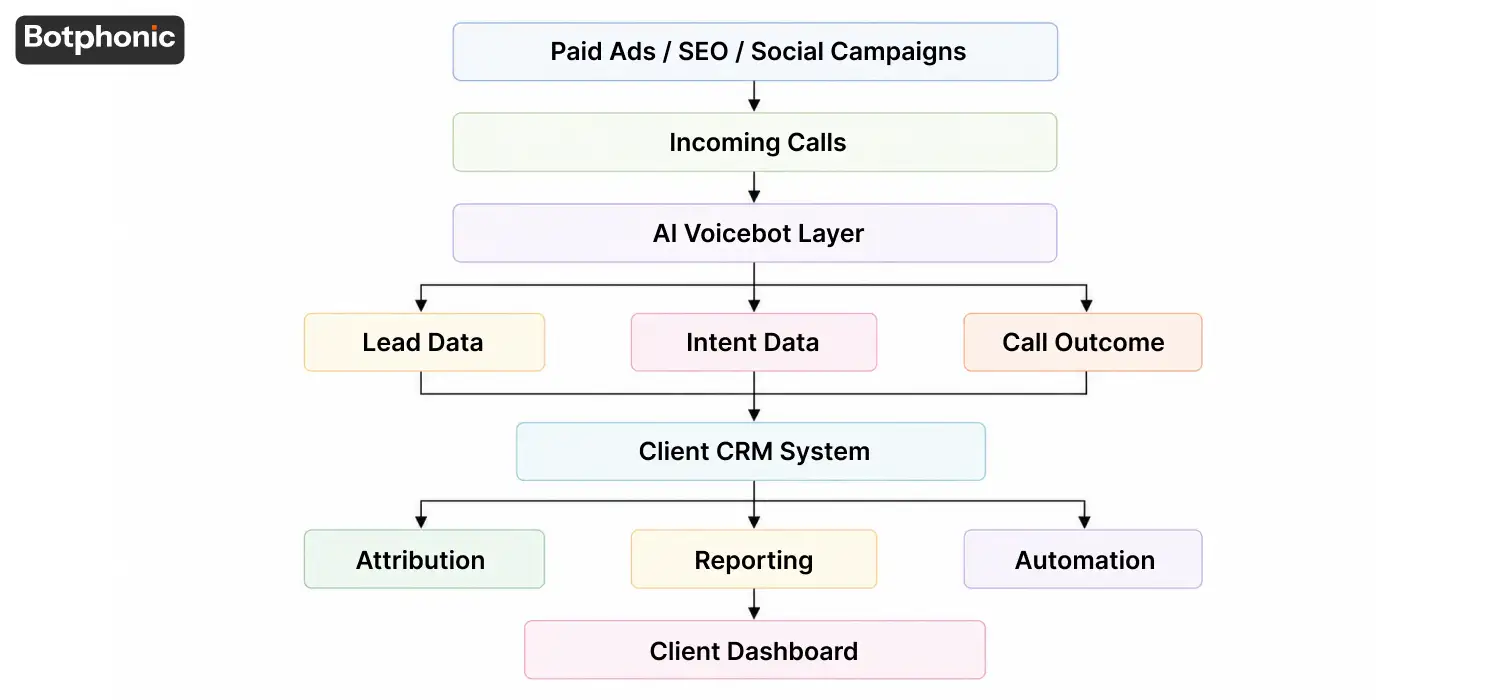
Instead of simply recording calls, the system captures:
- Lead source
- Customer intent
- Appointment outcomes
- Objections raised
- Purchase readiness
- Call disposition
- Conversion signals
The CRM becomes more than a contact database. It becomes a revenue intelligence platform.
Agency Voicebot CRM Workflow
The Biggest CRM Problem Agencies Don’t Talk About
Most agencies can tell clients:
- Cost per click
- Cost per lead
- Landing page conversions
But many struggle to explain:
- Which conversations became appointments
- Which calls became customers
- Which campaigns produced revenue
This creates an attribution gap. The customer journey becomes invisible the moment a phone call starts. AI Voice Agents closes this gap automatically. Every interaction becomes measurable, every lead becomes trackable and every campaign becomes accountable.
 NOTE
NOTE
How Voicebot CRM Integration Improves Client Reporting
Client reporting is often one of the most time-consuming parts of agency operations.
Account managers spend hours gathering data from:
- Call tracking systems
- CRM platforms
- Ad platforms
- Appointment tools
- Sales teams
Voicebot integrations eliminate much of this manual work. The voicebot automatically pushes structured call outcomes into the CRM.
This allows agencies to report metrics such as:
| Traditional Reporting | Voicebot CRM Reporting |
| Leads Generated | Qualified Leads Generated |
| Calls Received | Calls Converted |
| Clicks | Revenue Conversations |
| Form Fills | Sales Intent Captured |
| Cost Per Lead | Cost Per Qualified Opportunity |
Clients care about revenue. Not activity. Voicebot CRM Integration helps agencies report outcomes instead of metrics.
Most agencies don’t struggle with one client. They struggle with fifty. As client volume grows, so does operational complexity.
Different clients require:
- Different qualification criteria
- Different call scripts
- Different lead scoring models
- Different reporting structures
AI Call Assistant allows agencies to standardize processes while maintaining client-specific customization. This creates operational leverage. Instead of hiring more account managers, agencies scale through automation.
 PRO TIP
7 Agency-Specific Voicebot CRM Use Cases
- Automatic Lead Attribution: Voicebot CRM integration automatically captures lead sources and records them inside the CRM. Agencies no longer need to manually track where phone leads originated, making campaign attribution far more accurate.
- Appointment Qualification: Before scheduling a meeting, the voicebot can collect key qualification details such as budget, service requirements, location, and purchase timeline. This ensures sales teams receive better-qualified opportunities.
- Multi-Location Campaign Reporting: For franchise and multi-location clients, voicebots can automatically assign calls to the correct branch or office. This helps agencies generate more accurate location-based performance reports.
- Client Intake Automation: Voicebots can gather customer information, service requirements, and initial qualification details before automatically creating or updating CRM records, reducing administrative workload.
- Missed Call Recovery: Instead of losing potential customers when calls go unanswered, voicebots can immediately engage callers, capture their details, and create follow-up opportunities within the CRM.
- Sales Pipeline Enrichment: Every customer conversation contains valuable buying signals. AI Cold Calling can automatically update CRM records with customer intent, objections, and qualification data, helping sales teams prioritize opportunities.
- Revenue Attribution Reporting: By connecting call outcomes directly to CRM and marketing data, agencies can track which campaigns generate appointments, opportunities, and revenue rather than simply reporting lead volume.
Voicebot CRM Integration vs Traditional CRM Workflows
| Capability | Traditional Workflow | Voicebot CRM Integration |
| Lead Capture | Manual | Automatic |
| CRM Updates | Delayed | Real-Time |
| Attribution Tracking | Partial | End-to-End |
| Reporting Accuracy | Moderate | High |
| Client Scalability | Limited | High |
| Data Consistency | Variable | Standardized |
| Opportunity Tracking | Reactive | Proactive |
Common Agency Mistakes When Implementing Voicebot CRM Integration
- Tracking Calls Without Tracking Revenue: Many agencies record conversations but fail to connect them to actual sales outcomes. Without attribution, valuable customer data remains disconnected from business results.
- Using the Same Workflow for Every Client: A real estate lead behaves differently from a legal or healthcare prospect. Applying identical qualification logic across all clients often reduces lead quality and reporting accuracy.
- Automating Data Capture Without Actionable Reporting: Collecting data is only half the job. Agencies should ensure voicebot insights are translated into meaningful reports that clients can easily understand and act upon.
- Neglecting CRM Data Quality: Duplicate records, inconsistent fields, and outdated contact information can weaken automation performance and create unreliable reporting.
- Prioritizing Call Volume Over Business Outcomes: More calls do not automatically mean better results. Agencies should focus on qualified leads, appointments booked, pipeline growth, and revenue attribution rather than raw call numbers alone.
A Practical Roadmap for Agencies
Phase 1: Automate Lead Capture
Start by connecting your Conversational AI directly to the CRM. Every inbound and outbound conversation should automatically create, update, or enrich contact records without requiring manual data entry.
Phase 2: Implement Attribution Tracking
Once lead capture is automated, connect calls to specific campaigns, traffic sources, and marketing channels. This gives agencies clear visibility into which activities generate qualified opportunities.
Phase 3: Build Client Reporting Systems
Create dashboards that focus on outcomes such as qualified leads, appointments booked, and revenue influenced rather than vanity metrics like call volume alone.
Phase 4: Scale Across Multiple Clients
After proving success with a few accounts, deploy standardized voicebot workflows, CRM integrations, and reporting frameworks across your client portfolio to improve operational efficiency.
Phase 5: Optimize with Conversation Intelligence
Use AI-generated insights to identify customer objections, buying signals, conversion patterns, and emerging trends. These insights help agencies continuously improve campaign performance and client results.
The Future of Voicebot CRM Integration for Agencies
The next evolution won’t be call automation. It will be conversation intelligence.
Voicebots will increasingly identify:
- Purchase intent
- Churn signals
- Customer objections
- Competitive mentions
- Revenue opportunities
Before human teams review the conversation. For agencies, this means moving beyond lead generation. Toward revenue operations, toward predictive reporting and toward measurable client growth.
Botphonic helps agencies connect AI voicebots directly to CRM workflows, automate attribution, improve reporting accuracy, and scale client operations without increasing administrative workload.
Book Free Demo Today!