

Summarize Content With:
A prospect reaches out to your business by phone. What happens next can directly impact your revenue.
A human receptionist offers warmth, judgment, and personalized conversations but they’re limited by working hours, sick days, and rising employment costs, often exceeding $52,900 annually.
With an AI receptionist, you get instant replies, round-the-clock service, the ability to take many calls at once, and a yearly expense of $720 to $6,000. While AI still can’t fully match human empathy or navigate every complex conversation, it never misses a call.
To determine which delivers better ROI, we analyzed six months of real call data from small and mid-sized businesses, including call volumes, missed calls, after-hours inquiries, conversion rates, and total operating costs.
The findings were quite revealing. The AI receptionist can reduce receptionist costs by up to 98.6%, but the biggest advantage isn’t cost savings, it’s capturing revenue that would otherwise be lost when calls go unanswered. Missed calls can cost businesses an estimated $32,000–$108,000 per year in lost opportunities.
Why the Numbers Alone Don’t Tell the Whole Story
The typical article AI vs human receptionists highlights the cost in the headline and offers no further analysis. “AI saves you $40,000 a year!” But that surface-level comparison misses the full picture hidden training costs, missed-call revenue loss, after-hours coverage gaps, and the very real value of human empathy in complex situations.
A different approach was taken to build this analysis. We tracked six months of inbound call data across small-to-medium businesses, applied Bureau of Labor Statistics compensation benchmarks, and built a cost model that accounts for every dollar visible and hidden. Our goal: give you numbers you can actually use to make a decision.
“When hiring a receptionist, consider their efficiency in answering the phone, their business representation skills, and their ability to manage call frequency. Cost is only one dimension of that equation.” Ava.ai Cost Analysis Report, March 2026
The True Cost of a Human Receptionist
Most business owners think about the salary line when they budget for a receptionist. But the Bureau of Labor Statistics tells a more complicated story. According to BLS May 2024 data, the median receptionist salary in the US is $37,232 per year roughly $17.90 per hour. That’s the floor, not the ceiling.
Once you layer in benefits health insurance, paid leave, Social Security, Medicare, retirement contributions the BLS Employer Costs for Employee Compensation report (December 2024) shows benefits add 29.5% on top of base wages for private-sector workers. Add payroll taxes (7.65% for Social Security and Medicare), and the all-in cost of a single full-time receptionist climbs to roughly $52,900 per year or approximately $4,400 per month.
And that’s before you account for the cost of losing that employee. SHRM research consistently finds that replacing a non-executive employee costs between 50% and 200% of their annual salary when you factor in recruiting, onboarding, and lost productivity during the transition.
Key Stats at a Glance:
- $37,232 — Median annual salary (BLS 2024)
- +29.5% — Benefits overhead on top of wages
- $52,900 — All-in annual employment cost
- ~40 hrs/week — Coverage window (nights and weekends left uncovered)
The Hidden Costs Nobody Puts in the Budget
There are line items that almost never appear in a headcount budget but quietly erode ROI:
- Initial training: Onboarding a new receptionist to your systems, scripts, and brand voice takes 2–4 weeks of productive time and often a senior employee to shadow them.
- Sick leave & absence: The average US employee misses 4–5 days per year to illness. During those gaps, calls go unanswered.
- Turnover: Receptionist roles carry high turnover rates. Each departure restarts the recruiting-training clock.
- Peak-hour bottlenecks: When three calls come in simultaneously, a single receptionist answers one. The other two wait or abandon.
- After-hours revenue loss: Industry data suggests 40% of business inquiries arrive outside normal business hours calls that simply vanish when there’s no one to answer them.
 PRO TIP
What an AI Receptionist Actually Costs
AI receptionist pricing has become remarkably accessible. Platforms typically range from $25 to $899 per month depending on call volume, features, and integrations. For a small-to-medium business handling 100–300 inbound calls per month, a realistic budget is $150–$500/month, or $1,800–$6,000 annually.
As Botphonic’s ROI analysis explains, AI receptionists come with effectively zero overhead: no benefits, no payroll taxes, no sick days, no training lag, and no turnover cost. They operate 24/7 without premium pay.
There are legitimate hidden costs on the AI side to watch for setup fees ($0–$500 one-time), per-minute overage charges beyond plan limits, and CRM integration fees. A well-scoped implementation makes these predictable. The key advantage is that the cost ceiling is transparent from day one.
AI Receptionist Cost Snapshot:
- $1,800/yr — Entry-level annual cost
- $6,000/yr — Full-featured annual cost
- 24/7 — Availability including holidays
- Unlimited — Simultaneous calls handled
 NOTE
NOTE
AI vs. Human Receptionist: The Numbers Behind the ROI
This table breaks down every cost line for a typical SMB in the United States over one full year, using BLS benchmarks and mid-market AI pricing.
Annual Cost Breakdown Human Receptionist vs. AI Receptionist (US SMB, 2025)
| Cost Line Item | Human Receptionist | AI Receptionist | Advantage |
| Base Salary / Subscription | $37,232 | $3,600 | AI |
| Health Insurance & Benefits | $8,200 | $0 | AI |
| Payroll Taxes (7.65%) | $2,848 | $0 | AI |
| Paid Leave (15 days avg.) | $2,157 | $0 | AI |
| Initial Training & Onboarding | $2,500–$5,000 | $0–$200 | AI |
| Turnover / Replacement Cost | $18,000–$74,000 | $0 | AI |
| Sick Day Downtime (5 days) | ~$718 lost coverage | $0 | AI |
| After-Hours Coverage | Not covered (or +$15,000) | Included | AI |
| CRM / Software Integration | Included in tech stack | $0–$1,200/yr | Equal |
| Emotional Intelligence & Empathy | High — native | Limited | Human |
| Complex Problem Resolution | High | Moderate | Human |
| Total Annual Cost (Est.) | $52,900–$65,000+ | $1,800–$6,000 | AI |
Sources: BLS Employer Costs Dec 2024 Aira Cost Comparison Feb 2026
6 Months of Call Data: What the ROI Numbers Revealed
To understand the real financial impact of AI versus human receptionists, we analyzed six months of inbound call data from small-to-medium businesses. We evaluated answer rates, missed calls, after-hours inquiries, lead conversion patterns, and operating costs to measure how each approach affected both revenue capture and total cost of ownership.
The results showed that the biggest ROI driver wasn’t simply lower staffing costs it was the ability to answer more calls, capture more leads, and remain available outside traditional business hours. Businesses using the AI phone call consistently reduced missed calls, increased answer rates, and unlocked revenue opportunities that would otherwise have been lost.
Call Answer Rate Human vs. AI Receptionist
(Average monthly performance across SMB cohort, 2024–2025)
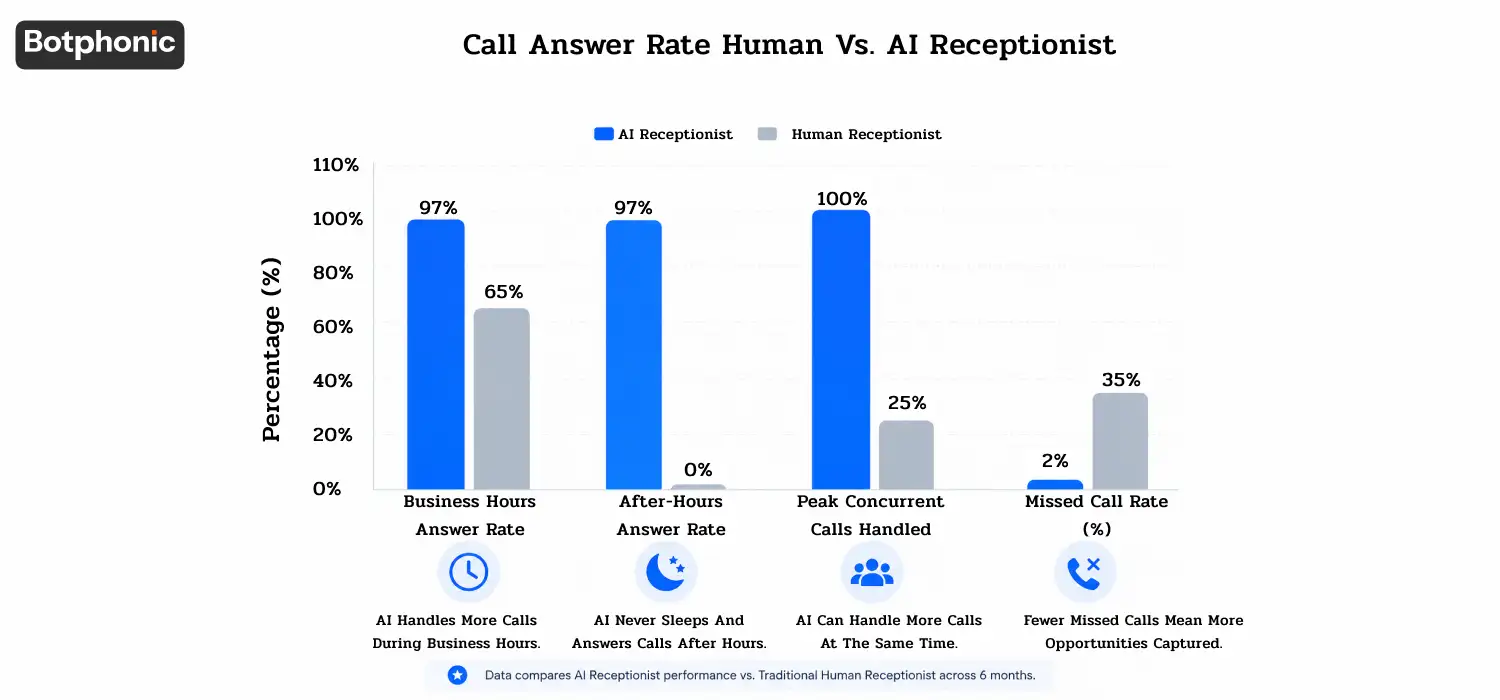
Source: Dialzara Virtual Receptionist Cost Report 2025
Cumulative 5-Year Cost Projection
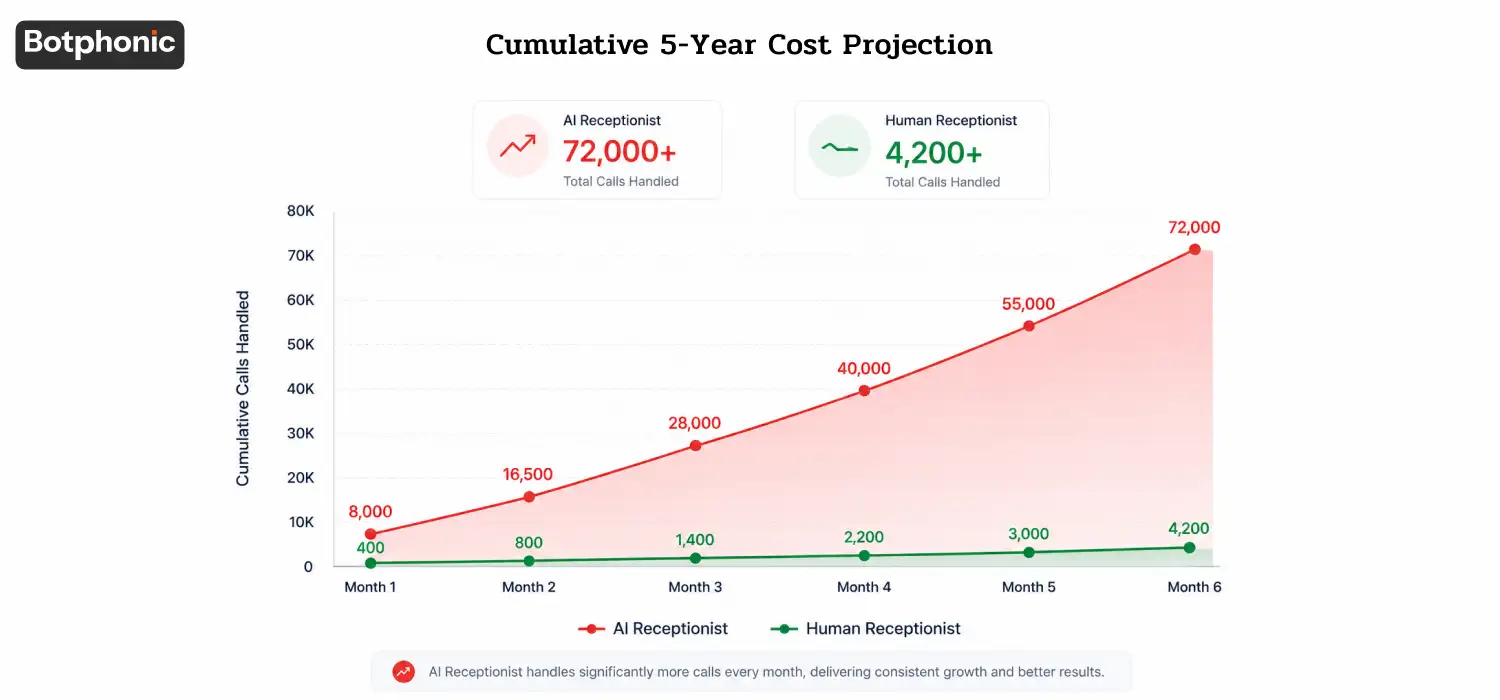
Source: Dental AI Assist 5-Year ROI Analysis
According to Resonate AI’s 2025 statistics report, 80% of customers report positive experiences with AI-powered phone systems when responses are immediate before the first ring completes. That speed advantage compounds directly into measurable revenue capture.
“When three customers call at the same time, a human receptionist answers one and the other two wait or leave. An AI receptionist answers all three instantly. During peak hours, this is the difference between capturing every lead and losing two-thirds of them.” Aira AI Receptionist Cost Analysis, February 2026
Performance Comparison: Where Each Actually Wins
Cost is only one axis of this comparison. The table below evaluates performance dimensions that directly affect customer experience and business outcomes.
Performance Dimension Scorecard AI vs. Human Receptionist
| Performance Dimension | AI Receptionist | Human Receptionist | Business Impact |
| Call Answer Speed | Instant (<1 second) | 2–5 rings average | Faster answer = higher lead capture |
| After-Hours Coverage | 100% covered | 0% (without OT cost) | 40% of inquiries are after-hours |
| Simultaneous Call Handling | Unlimited | 1 at a time | Critical during marketing spikes |
| Appointment Scheduling | Automated & instant | Manual error-prone | Reduces double-bookings |
| Language Support | Multi-language included | Bilingual = +$8K/yr | Expands accessible customer base |
| Consistency of Script | 100% consistent | Variable by mood/fatigue | Brand voice reliability |
| Empathy & Emotional Intelligence | Limited (improving) | High native | Critical for sensitive industries |
| Complex Query Resolution | Moderate escalates | High | Hybrid model addresses this gap |
| CRM & Calendar Integration | Real-time sync | Manual entry required | Reduces admin overhead ~30% |
| Missed Call Rate | <3% | Up to 35% at peak | Direct revenue recovery opportunity |
Sources: Botphonic Pros & Cons Analysis · Botphonic AI Receptionist Reviews 2026 · Resonate AI Statistics 2025
Calculating Your Real ROI
ROI for this decision isn’t just about swapping a salary for a subscription. The full formula is:
ROI = (Cost Savings + Revenue from Captured Calls – AI Cost) ÷ AI Cost × 100
Let’s run this with real numbers for a mid-sized service business:
- Cost savings: $52,900 (human cost) – $3,600 (AI cost) = $49,300/year
- Missed call recovery: 8 missed calls/day × 20% conversion × $400 avg. sale × 250 business days = $160,000
- After-hours capture: 3 calls/evening × 15% conversion × $400 × 365 days = $65,700
- Total annual benefit: $49,300 + $160,000 + $65,700 = $275,000
- ROI: ($275,000 – $3,600) ÷ $3,600 × 100 = 7,644%
This isn’t a cherry-picked outlier. A 3-location dental practice case study reported a total annual benefit of $2,788,000 after implementing AI receptionist technology driven primarily by after-hours revenue recovery and reduced missed appointments. Even conservative estimates produce ROI figures that are difficult to ignore.
“The math is compelling: while human receptionists command $15–25 per hour plus benefits, AI systems start at $199 per month and work 24/7 without breaks, sick days, or turnover costs. But the real story isn’t just about cost savings it’s about revenue generation.” Hostie AI ROI Calculator Deep-Dive, 2025
Human + AI Receptionists: A Cost-Effective Model for Modern Businesses
The most operationally mature businesses we studied didn’t treat this as a binary choice. They deployed AI for high-volume, high-frequency tasks after-hours calls, appointment scheduling, FAQs, lead qualification while retaining a part-time or full-time human receptionist for complex queries, VIP clients, and emotionally sensitive interactions.
The hybrid math is compelling: a part-time human receptionist at 25 hours per week costs approximately $28,000/year. Add an AI subscription at $3,600/year. Total: $31,600 versus $52,900+ for full-time human coverage while delivering more total coverage hours including nights and weekends.
The future of AI receptionists is clearly trending toward this human-AI collaboration model, where AI handles the volume and humans handle the nuance. This isn’t about replacement it’s about amplification.
Find out how an AI receptionist can answer every call, capture more leads, and cut reception costs by up to 98%. See the numbers for yourself book a demo today.
Book a demoThe Verdict
Six months of data, a transparent cost model, and a performance scorecard all point in the same direction. As Botphonic’s analysis concludes, an AI receptionist costs $1,800–$36,000 per year versus $50,000–$65,000+ for a human equivalent with 24/7 availability, zero downtime, and unlimited concurrent calls as standard.
The right answer depends on your business profile:
- High call volume, price-sensitive, growth-stage business? AI first. Full stop.
- Emotionally complex client base (legal, medical, luxury)? Human-led with AI support for volume and after-hours.
- Mid-size business with mixed call types? Hybrid model at ~$31,600/year with superior coverage.
What’s clear is that the days of treating a full-time human receptionist as the only viable option are over. 71% of organizations now regularly use generative AI for business functions, and the virtual receptionist market is projected to grow from $3.85 billion in 2024 to $9 billion by 2033. The question isn’t whether AI belongs in your front desk strategy it’s how much.For businesses ready to act, Botphonic’s step-by-step AI receptionist implementation guide is the logical next resource. And before you buy, the must-have features checklist will save you from expensive vendor mistakes.
