
Summarize Content With:
What You’ll Learn
- How real businesses are using AI receptionists to answer calls, qualify leads, and improve customer response times.
- How modern voice AI uses technologies like ASR, NLP, RAG, Function Calling, and Agentic AI to automate customer interactions.
- Common mistakes companies make when implementing AI receptionists and how to avoid them.
- Key lessons learned from real-world deployments that can help you maximize conversions, customer satisfaction, and operational efficiency.
Introduction
Every missed call represents a potential lost customer. The cost of delayed responses is substantial. Harvard Business Review found that businesses responding to leads within an hour are nearly 7x more likely to qualify those prospects compared to companies that respond later. This is one reason many organizations are adopting AI receptionists to ensure every inquiry receives immediate attention.
For many small and mid-sized businesses, that problem happens more often than owners realize. Calls arrive after business hours, during busy periods, or when staff members are already helping customers. The result is simple: opportunities slip away.
This is one reason AI receptionists have become one of the fastest-growing categories in business automation. Instead of relying entirely on human staff to answer every call, businesses are using AI-powered voice assistants to answer questions, schedule appointments, qualify leads, and route callers to the right department.
But what happens after implementation? Do businesses actually see measurable benefits? What challenges appear once the excitement wears off? And what lessons emerge from real-world use?
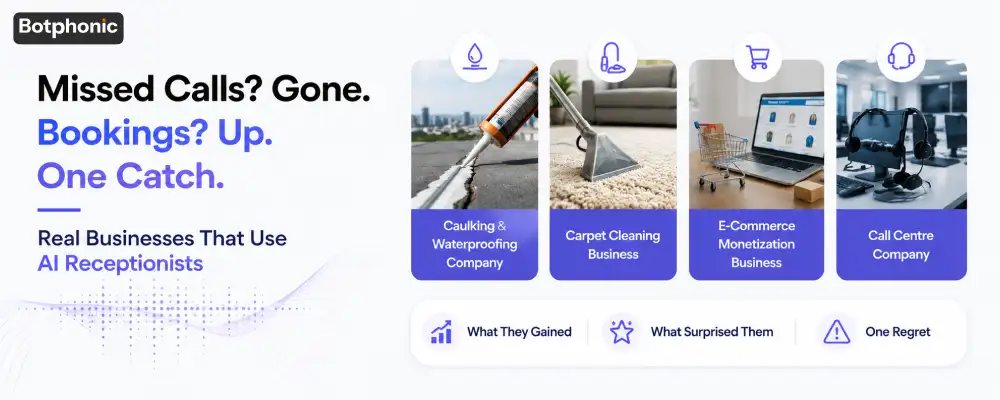
In this article, we’ll explore real life examples AI receptionists through four business case studies across caulking and waterproofing, carpet cleaning, e-commerce monetization and call centre company. You’ll learn what each business gained, what surprised them the most, and one regret or lesson that could help you avoid costly mistakes when evaluating AI receptionists for your own organization.
Why Businesses Are Turning to AI Receptionists
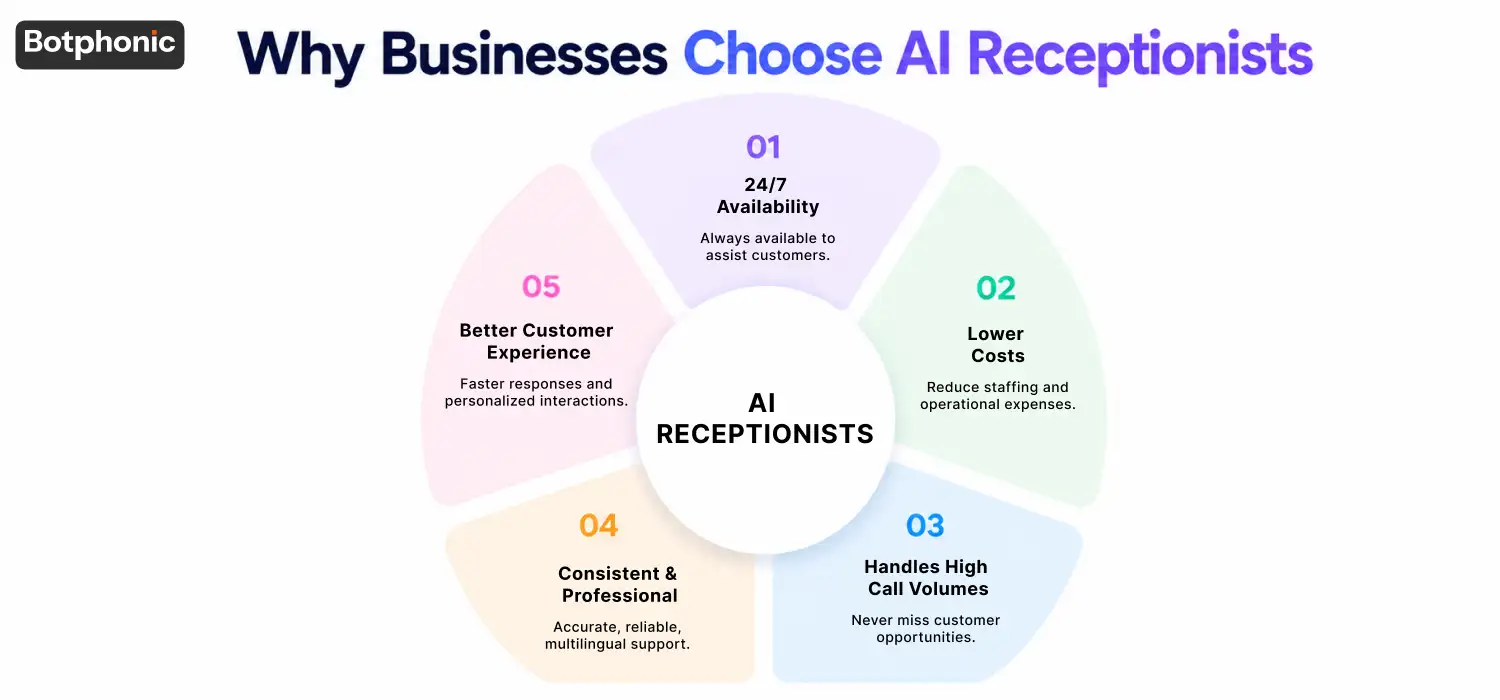
1. 24/7 Round-the-clock Support
- During traditional times, receptionists used to work limited hours, but as time goes on, customers are expecting support even at midnight.
- AI receptionists are there to provide round-the-clock service, managing calls, chats, and even inquiries.
2. Significant Cost Savings
- Hiring and training new human receptionists can be time-consuming and expensive.
- AI receptionists reduce overhead costs by eliminating salaries and benefits.
3. Handles High Volumes Efficiently
- During seasonal times, human receptionists are bound to get overwhelmed with a sudden increase in the number of calls.
- AI receptionists are made to manage unlimited calls simultaneously, ensuring there are no missed opportunities.
4. Consistency and Professionalism
- Sometimes there are bad days or errors during the call made by human receptionists.
- Although AI ensures a consistent service and provides standardized greetings along with multilingual support.
5. Enhanced Customer Experience
- Incorporating NLP, AI helps build trust by sounding natural and engaging.
- Offers features like personalized greetings, multilingual support, and quick response time too.
What an AI Receptionist Actually Does
An AI receptionist is a voice-based assistant that answers incoming calls and performs tasks such as:
| Function | Business Impact |
| Call Answering | Reduces missed calls |
| Appointment Scheduling | Improves booking efficiency |
| Lead Qualification | Prioritizes high-value prospects |
| Call Routing | Sends callers to correct departments |
| FAQ Handling | Reduces repetitive work |
| After-Hours Support | Extends availability |
The most effective deployments combine automation with human escalation rather than replacing staff entirely.
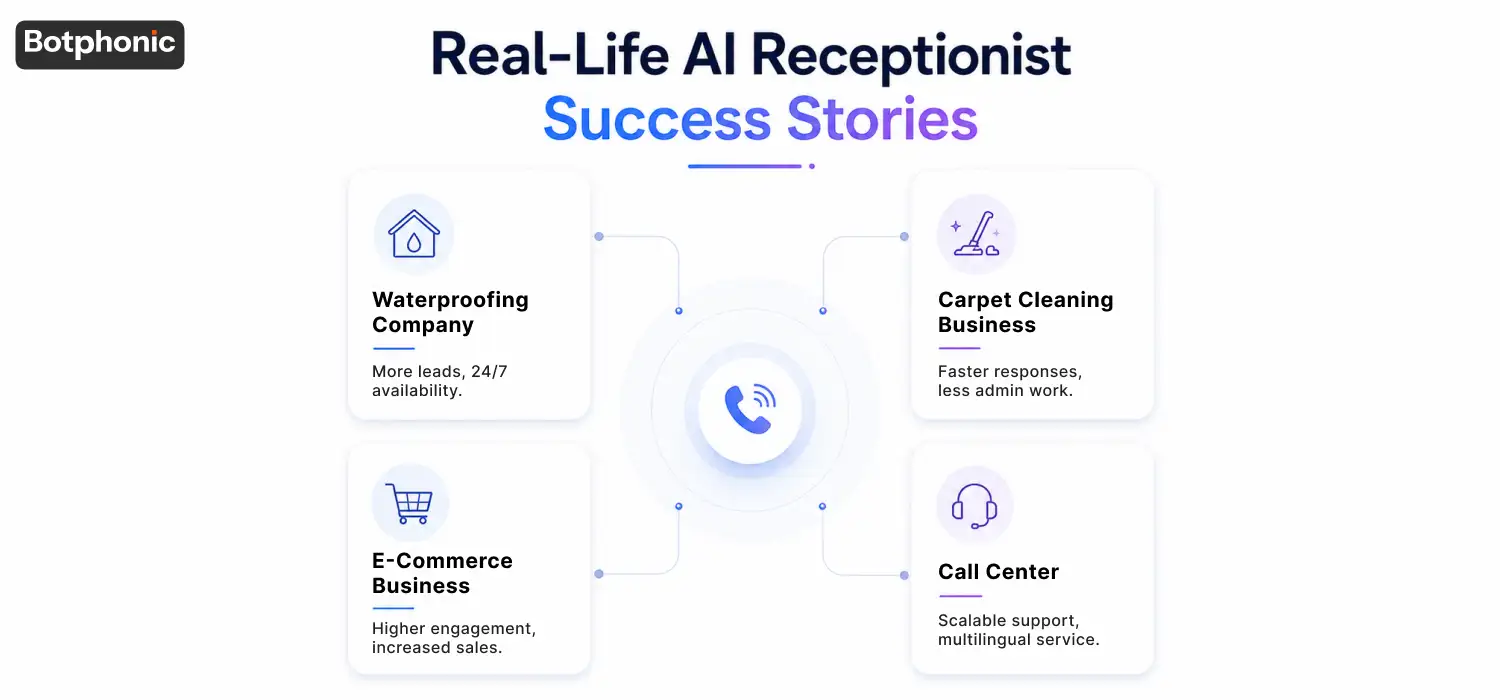
Real-Life Examples of AI Receptionists
Case Study #1: Caulking & Waterproofing Company
What They Gained
A waterproofing and caulking company struggled with a familiar problem in home services. Potential customers often called while crews were on job sites. Missed calls meant missed revenue.
After implementing a Botphonic AI assistant, the company was able to answer inquiries around the clock, qualify leads automatically, and schedule appointments without requiring office staff to be available at all times. The business reported improved lead capture and faster responses to new inquiries. This helped reduce the number of prospects who contacted competitors after failing to reach someone on the first call.
What Surprised Them
The biggest surprise was how many high-intent calls arrived outside standard business hours. Homeowners dealing with leaks, moisture issues, or urgent repairs often searched for help during evenings and weekends. The AI assistant ensured those opportunities were not lost.
One Lesson Learned
The company discovered that call handling alone is not enough. Success depended on connecting the AI assistant with scheduling workflows and follow-up processes. Without a structured handoff, qualified leads could still fall through the cracks.
Key Takeaway
For field-service businesses, the value of an AI receptionist is often less about automation and more about ensuring every inbound lead receives an immediate response.
 PRO TIP
Case Study #2: Carpet Cleaning Business
What They Gained
The carpet cleaning business faced challenges managing appointment requests, quote inquiries, and customer questions during busy cleaning schedules. Staff frequently had to choose between serving customers on-site and answering incoming calls.
After deploying a Botphonic AI voice agent, the company automated appointment scheduling, handled common service inquiries, and provided instant responses to potential customers. This reduced administrative workload and allowed technicians to focus on service delivery rather than phone management.
What Surprised Them
Management expected operational savings but was surprised by the increase in customer satisfaction. Callers appreciated receiving immediate answers instead of leaving voicemail messages and waiting for callbacks.
The business also discovered that many callers preferred obtaining pricing information and booking appointments without interacting with a human agent.
One Lesson Learned
Not every customer interaction should remain fully automated. Complex cleaning requirements, specialty fabrics, and commercial projects still required human consultation. Establishing clear escalation rules improved overall customer experience.
Key Takeaway
AI receptionists perform best when handling repetitive requests while transferring specialized conversations to experienced staff members.
Case Study #3: E-Commerce Monetization Business
What They Gained
An e-commerce-focused company wanted to improve customer engagement and increase revenue opportunities from inbound and outbound interactions.
Using AI-powered voice conversations, the business automated customer outreach, qualification processes, and follow-up interactions. The system helped identify customer interests, recommend relevant products, and guide buyers toward purchasing decisions. The company experienced stronger engagement and increased revenue opportunities through more personalized customer interactions.
What Surprised Them
The team initially viewed AI as a support tool. Instead, they discovered it could actively contribute to revenue generation by identifying buying signals and recommending products based on customer conversations.
This shifted their perception from cost reduction to revenue optimization.
One Lesson Learned
The quality of recommendations depended heavily on customer data. Incomplete product information and disconnected systems limited performance. Better integrations produced better results.
Key Takeaway
The strongest ROI often comes when AI receptionists participate in sales conversations, not just customer support.
 NOTE
NOTE
Case Study #4: Call Centre Company
What They Gained
One of Botphonic’s featured success stories involved a large call centre organization managing more than two million calls per month. The company faced challenges handling growing inquiry volumes, language diversity, staffing limitations, and customer service expectations.
After implementing Botphonic’s voice AI agent, the organization reported:
| Metric | Reported Improvement |
| Customer Engagement | +40% |
| Revenue | +21% |
| Client Satisfaction | +9% |
| Ticket Volume | -50% |
The AI system provided multilingual support, operated 24/7, handled large inquiry volumes simultaneously, and helped automate customer interactions.
What Surprised Them
The company expected cost savings but was surprised by the scalability of the AI solution. The system was able to manage customer inquiries continuously without the staffing constraints associated with night shifts and peak-volume periods.
One Lesson Learned
The biggest lesson was that AI works best as an extension of customer service teams rather than a replacement. Human agents remained critical for complex issues, escalations, and relationship-building conversations.
Key Takeaway
Large-scale call centers gain the greatest value when AI handles repetitive inquiries while human teams focus on high-value customer interactions.
Start by identifying how many calls your team misses each week, how many leads arrive after hours, and how much time staff spend answering repetitive questions. These numbers often reveal the biggest opportunities for improvement.
Request a Free Demo