
Summarize Content With:
AI receptionist deployments typically don’t blow up in your face. They perish without a sound, around month three or four. The pilot starts energised, initial figures are good and then something goes wrong. Call quality drifts. Front office personnel cease to believe in the routing. A compliance question arises which was not asked in a timely manner. ROI request from finance and no clean baseline. At month 6, the deployment is technically up, but no one is talking of it.
This is the page to stop that from happening.
The same nine failures keep recurring in all deployments, no matter whether it’s in healthcare, dental, home services, real estate, legal, or BPO. All are no-technology issues. They are all implementation-discipline issues. The key to these differences lies in naming them a head ahead and preparing the rollout to defuse each one, otherwise, they get quietly shelved at month four, instead of adding value to the users’ experience for two years.
This implementation playbook is for the audience that will be responsible for the rollout: the Project Manager running the runbook, the IT Lead wiring up the CRM and telephony integrations, the Operations Lead redesigning the call flows, the Front-Office Lead managing the change with the staff who are answering the telephone today, and the Executive Sponsor who will ask “where’s the ROI” at the quarterly reviews. One failure mode for each persona is given, with one sub-section dedicated to each persona in §11.
If you are only reading three sections, read the pre-implementation checklist and (the nine failures and the 6-phase plan. All other information backs these three.
Before You Begin, The 5-Item Pre-Implementation Checklist
| # | Item | Pass criteria | Owner |
| 1 | CRM / data hygiene audit | <10% of contact records are missing from critical data fields; and no duplicate contact records on top 50 accounts. | IT Lead |
| 2 | Call-type inventory | Top 10 call types by monthly volume, AHT and resolution rate respectively. | Ops Lead |
| 3 | Escalation rules definition | Each of the 5 always-escalate categories named with the human / queue escalates to. | Ops Lead + Front-Office Lead |
| 4 | Compliance review | Vendor BAA for scope of HIPAA / TCPA / state law completed; legal reviewed. | IT Lead + Compliance Officer |
| 5 | Stakeholder alignment | Unified action and goals in tight quarters, with Executive Sponsor, IT Lead, Ops Lead, and Front-Office Lead in the same room, agreeing on objectives and KPIs. | Project Manager |
If this checklist is not green at the end of week one, then stop the kickoff. Without it, failures in §2-§10 occur more quickly when going live.
 NOTE
NOTE
1. Data, Scope & Operational Design Failures
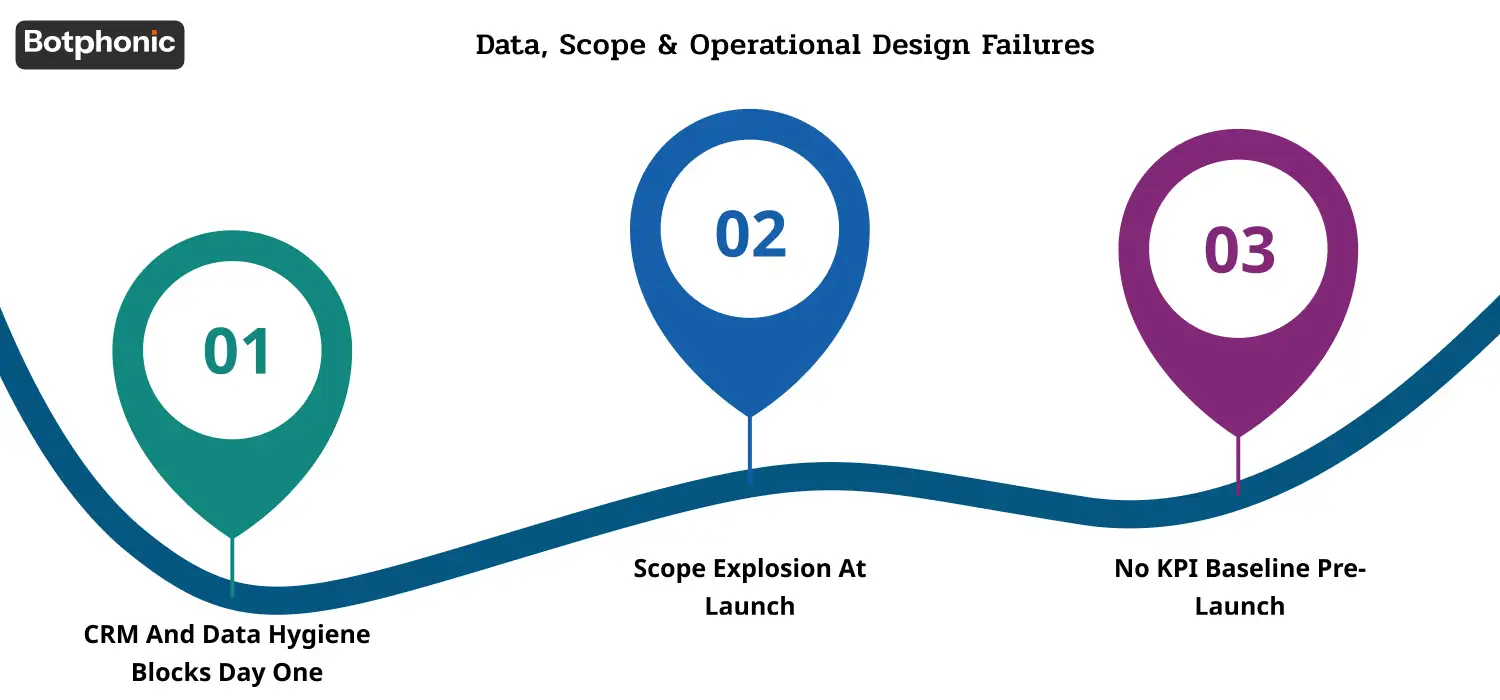
Failure #1: CRM and Data Hygiene Blocks Day One
What it looks like: The AI is connected and receives its first real mission. The caller’s record is in three places in your CRM, two with different phone numbers, none of which is the caller ID. The AI has to prompt the caller for info which is already in your records. The caller is aggravated. Internal team panics.
Why it happens: AI receptionists bring data quality to the forefront. Humans get around dirty CRM data in existing front office workflows. AI cannot. It brings to the surface that which was already present.
How to prevent:
- 2-4 week pre-pilot data hygiene sprint
- Establish field completeness criteria prior to pilot (e.g., 90% of contact records that have valid phone, email and last interaction date).
- Prior to go-live, go through the top 50-100 accounts and compare for deduplication
- Create a CRM update workflow with the aim of adding detail to the call summaries, not pollution.
Vendor question: Let’s say a caller does not have a CRM record or has had multiple records, how does your platform deal with this situation and how do call summaries get back into the CRM?
Failure #2: Scope Explosion at Launch
What it looks like: The AI automatically deals with all possible phone calls from the get-go. New patient intake, appointments, billing inquiries, insurance verification, after-hours emergencies, etc. Quality bands are brought down over the diversity. Trust collapses.
Why it happens: Each internal stakeholder has an action type that they want addressed. If it is an investment we’re going to make, then it should make sense to do this. The pilot turns into a 40 call-type kitchen sink.
How to prevent:
- Find the most frequent 5 types of calls, typically 70-80% of all call volume.
- Attach the pilot to those 5 only!
- Define an explicit “out of scope” category which should be routed to humans.
- Once the top 5 call types are stable, plans to add the others (6-15) in 30 day increments.
- Vendor question: “Demonstrate a customer who began with the top 5 call types and subsequently grew by 10 more types later on. How was the rollout plan?
Failure #3: No KPI Baseline Pre-Launch
What it looks like: A three-month follow-up to leadership requests ROI report. No one tracked pre-deployment call volume, abandonment rate, average handle time, first call resolution or after-hour missed calls. There’s no logic to the ROI argument.
Why it happens: It was a “we’ll get to it” item that didn’t get to.
How to prevent: Make sure to track these 8 KPIs for at least 30 days prior to go-live.
| KPI | Measurement method | Why it matters | The target is set at 90 days after the launch. |
| Total call volume | Phone-system logs | Demand baseline | Same or higher |
| Abandonment rate | The inbound calls failed to connect or to place an outbound call. | Customer experience floor | -50% to -70% |
| Average handle time (AHT) | Connected call duration | Efficiency baseline | Stable or -10% |
| First-call resolution (FCR) | The rate at which surveys were completed or followed up by a telephone call. | Quality of resolution | +10-20% |
| After-hours missed calls | Calls outside business hours unanswered | Hidden revenue leak | -80% to -95% |
| The number of hours spent in the front office on the phone.Front Office Staff Hours on Phone. | Time tracking | Labor recovery | -30% to -50% |
| Cost per call resolved | Total cost / calls | Unit economics | -40% to -60% |
| Customer-satisfaction proxy | Customer Satisfaction (CSAT), Net Promoter Score (NPS) / Sentiment for reviews. | Trust signal | Stable or improving |
The post-launch number without the baseline column is meaningless if the baseline column hasn’t been filled in.
Vendor question: What’s your native dashboard and which of these KPIs does your platform track without us putting on analytics?
2. Execution, Testing & System Reliability Gaps
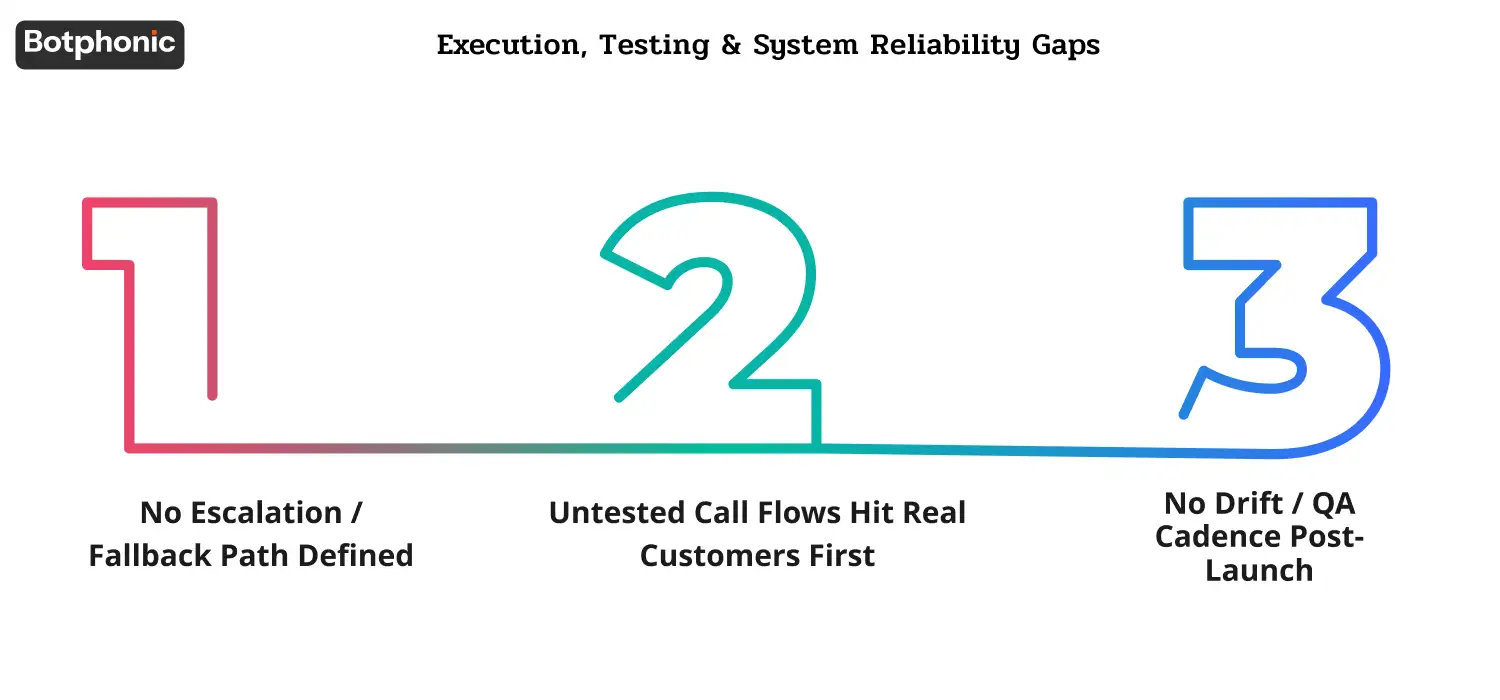
Failure #4: No Escalation / Fallback Path Defined
What it looks like: A caller has an extensive billing problem or a safety / urgent-medical inquiry. The artificial intelligence is attempting to deal with it. The discussion turns sour. The caller calls off mad and leaves a review.
Why it happens: The escalation matrix was not written. When the default vendor setting is used, the AI tries all calls. Conservative routing was never turned on.
How to prevent:
Non-negotiable in any sane deployment (Always-escalate categories):
- Anything safety related (medical urgency, safety concern, threat language)
- All matters relating to custody, minors and vulnerable adults
- Anything mental-health related
- Detailed information regarding legal action (refund, complaint, threat of action)
- Anything the caller asks be escalated (“can I speak to a person”)
The “say ‘human’ anytime” rule: accept a request for a man to man transfer at any time during the conversation, no matter what the reason is.
Vendor question: Does your platform deal with a caller stating ‘I want to talk to a real person’ and can it be done mid call without a re-prompt?
Failure #5: Untested Call Flows Hit Real Customers First
What it looks like: The AI is made available to internal team test calls only. Real customers encounter scenarios not anticipated by scripted calls within 48 hours — heavy accents, background noise, profanity, emotional callers, multilingual handoffs, etc. The first week is about how to extinguish fire.
Why it happens: Testing for synthetic calls was squeezed into time. Internal team tests are not a true representation of the distribution of real calls.
How to prevent:
- Over 100 scripted scenarios pre-launched, including the top 5 call types and edge cases.
- Library required: Edge-case – multilingual (top 2 LEP languages), heavy accent, background noise, profanity, emotional / distressed callers and kids on the line.
- Conduct a red team exercise on your own system; test it out before customers do!
- Before AI-led pilots, a 50 call shadow-mode pilot.
Vendor question: “Explain your QA test harness, what scenarios does your team use and can we include ours prior to go-live?
Failure #6: No Drift / QA Cadence Post-Launch
What it looks like: When it comes to phone interactions, complaints begin to rise after 3 months. No one listens to AI call recordings. Quality has slipped — a new call pattern is poorly handled by the AI or a vendor model change altered behavior. When someone realizes, 2 months of customer experience has been lost.
Why it happens: Post launch QA was considered to be the responsibility of the vendor or it was put on the backburner after go-live.
How to prevent:
- Weekly QA review first quarter – random sample: 20 calls per week – audit for accuracy, brand voice, escalation rate, customer satisfaction signals.
- Monthly QA review from then on
- All of the below are drift triggers, and cause a deeper review:
- The cadence for the retraining is at least once a month and at least once a week during the first quarter.
- A single dashboard that displays all the §6 KPI list, which is accessible to the Executive Sponsor.
Vendor question: “I upgrade and retrain weekly/biweekly, and customers are updated in advance on model changes.
3. Governance, Trust & Organizational Readiness Breakdowns
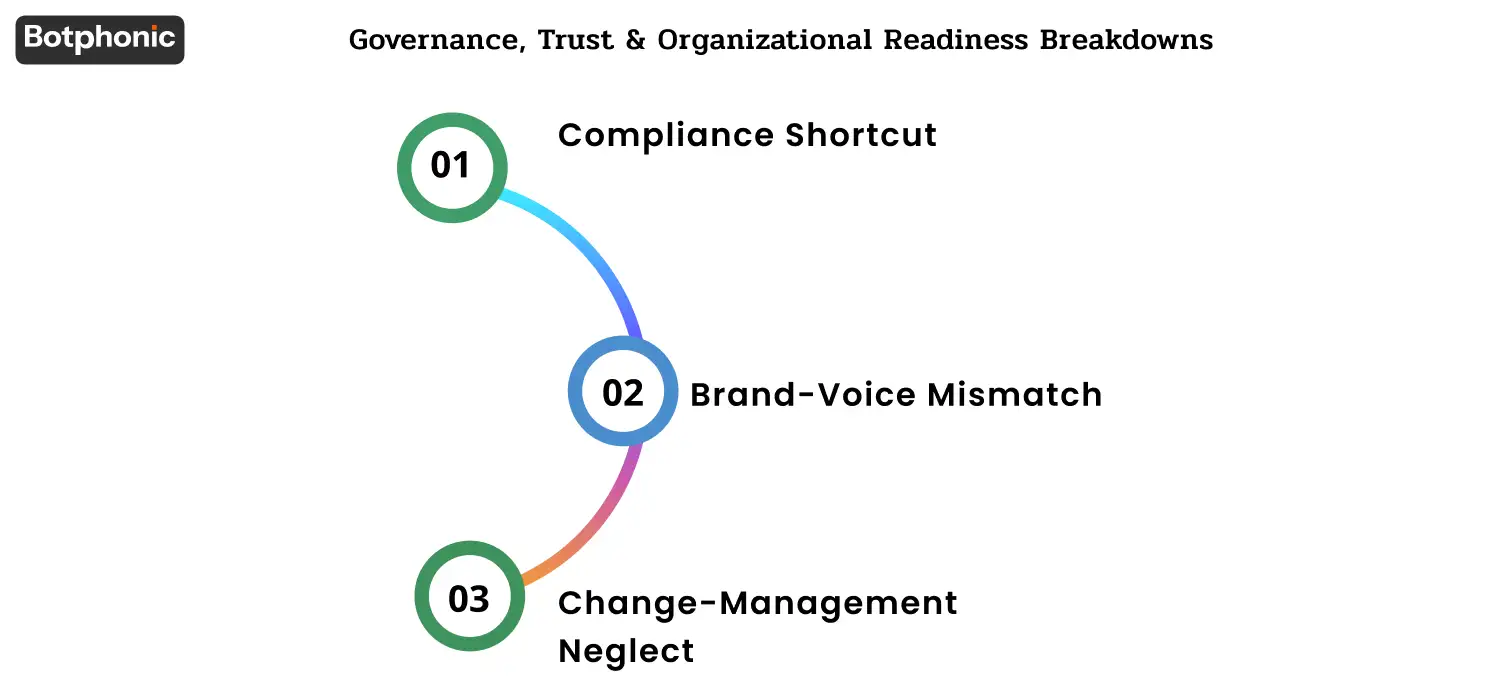
Failure #7: Compliance Shortcut
What it looks like: Deployed successfully. Six months later, a compliance audit (HIPAA, state insurance, state biometric privacy) identifies the AI receptionist as missing BAA or audit logs, or recordings not being encrypted enough. Remediation is more costly than the deployment.
Why it happens: Compliance was not considered a deliverable, but rather a checkbox about “HIPAA Compliance” that the vendor checked off.
How to prevent:
In the healthcare, dental, mental-health, medical billing scope:
- Signed BAA prior to any PHI moving.
- The term “school official” / “business associate” is defined by the context.
- Attached SOC 2 Type II report reviewed (and within 12 month period).
- Control mapping requested for HIPAA.
- Audit logs set to retain for 6 years and protected against tampering.
- Encryption at rest (AES-256) and in transit (TLS 1.2+) is documented in BAA and/or security schedule
For any outbound use case (TCPA-scope):
- Obtain written consent on record prior to AI-initiated outbound
- The integration and scrubbing of the DNC list.DNC list integration and scrubbing.
- Time-of-day restrictions configured
- State-level overlay considered (some states may have more stringent regulations than federal TCPA)
In cases involving state biometric law scope (Illinois BIPA, Texas CUBI, Washington biometric law):
- Disabling or explicit consent of voice biometrics taken.
Vendor question: “Produce your SOC 2 Type II report, your HIPAA control map and your BAA template — and I’ll redline the BAA before signing it.
Failure #8: Brand-Voice Mismatch
What it looks like: AI does not sound like their practice / dealership / agency. They feel they are speaking with a business, not their dentist / contractor / agent. NPS drops.
Why it happens: When the device was first set up by the vendor, their default voice settings were adopted. The training for brand-voice was omitted. No one heard the first 50 calls for production with a brand-voice ear.
How to prevent:
- Before pilot: tone (warm vs efficient), pacing, brand vocabulary, business name pronunciation, common-customer-name pronunciation
- If your brand has a unique receptionist, or owner voice, use custom-voice clone (with caution as voice biometrics has compliance overhead)
- Define brand voice in the first week of the pilot, make front and Operations Lead listen to recordings, mark anything that doesn’t sound like the brand.
- Brand-voice should pass mustard on the ‘would this come from our front office’ test, not the ‘is this technically polite’ test.
Failure #9: Change-Management Neglect
What it looks like: F front office personnel perceives the AI to be a threat to their employment. They unnecessarily route calls to human agents (“the AI doesn’t work well with this type of call”). In face-to-face communication, they let customers know “The phone system is trying out something new. Pilot adoption tanks.
Why it happens: The communication to staff was “we’re going to start using AI for some calls” rather than “we’re redesigning the role and changing the comp plan of the position we’re using AI for,” which is implied and no role redesign or comp plan changes were included.
How to prevent:
- Mark capacity recovery as a different business goal than headcount replacement in all internal communication.In all internal communication mark capacity recovery as a different business goal than headcount replacement.
- Rewards for comp-plan changes that are the result of AI-generated rather than “cheating”Rewards for comp-plan changes that are AI-generated, not “cheating”
- The shift for front-office personnel from call-takers to AI-supervisors + customer-experience specialists.Redesigning front-office jobs from call-taker to AI-supervisor + customer-experience specialist.
- A session during which staff members review calls for the AI to learn from, and get on the side of the AI
- First 30 day buddy system – front office staff and AI “sharing” the queue, with staff checking the AI for calls each week.
This is the silent failure that is responsible for the demise of many deployments. Allow time and attention for it.
Persona Playbooks, What Each Role Owns
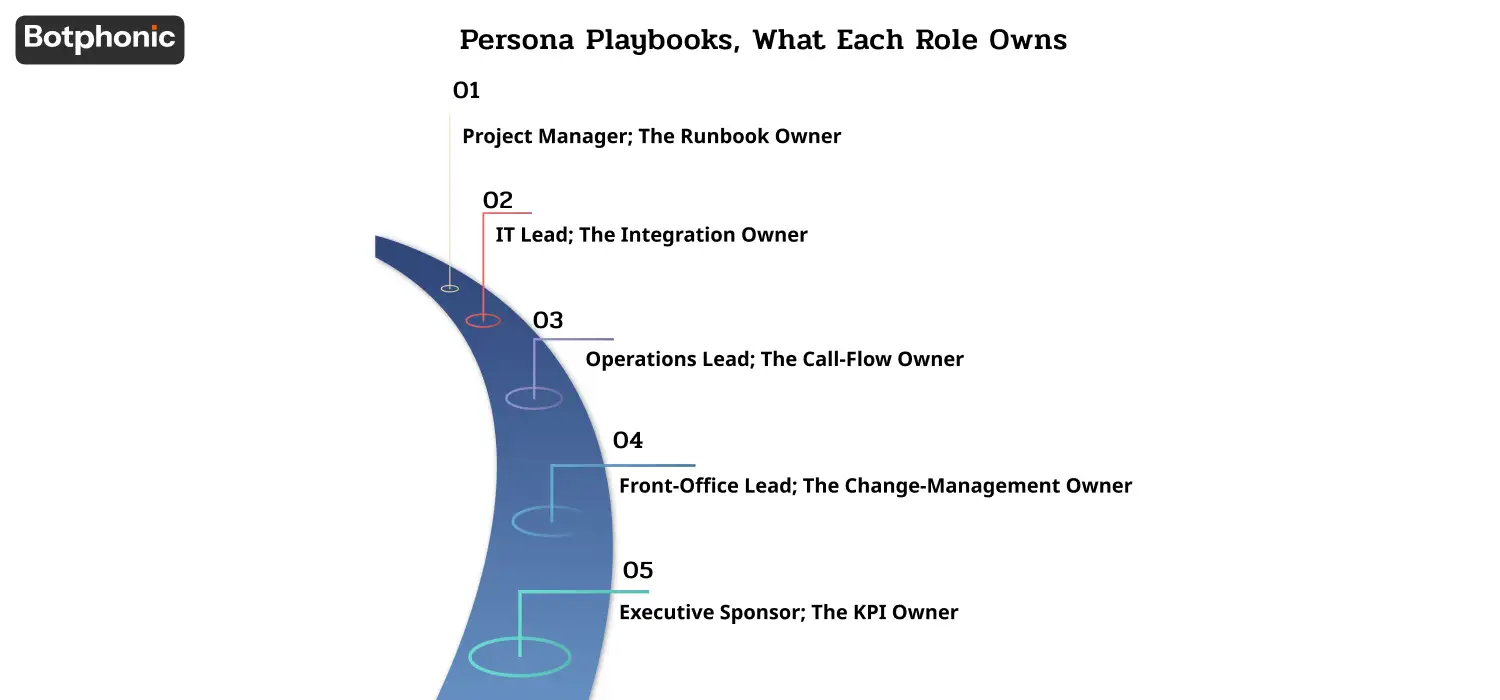
Project Manager; the runbook owner
You have the timeline, the checklist and the cross-functional alignment. Your three priorities:
- Request checklist green prior to game start
- Ensure that §6 (KPI baseline) is taken prior to go-live
- Make sure to make the §10 weekly QA reviews a habit from Week 1.
IT Lead; the integration owner
You own CRM hygiene (§2), integrations and the technical side of compliance (§7). Your three priorities:
- Run the §2 data hygiene sprint
- Test CRM, telephony and (if applicable) EHR / DMS / SIS integrations in a sandbox environment
- Secure the compliance controls (audit logs, encryption, BAA)
Operations Lead; the call-flow owner
You have the call-type inventory (§3), escalation matrix (§4), synthetic-call testing (§5), and post-launch QA cadence (§10). Your three priorities:
- Establish the top 5 call types; turn down scope creep.
- Create the escalation matrix and document it prior to pilot.
- Take full responsibility for weekly QA review for first quarter
Front-Office Lead; the change-management owner
You havechange management and brand voice. Your three priorities:
- Be present at the announcement of the AI internally
- Take ownership of the 50 call brand-voice audit during pilot
- Help the front-office team transition to their new role
Executive Sponsor; the KPI owner
You have KPI baseline and the ROI after the pilot conversation. Your three priorities:
- Review the list of KPIs prior to the go-live.
- Get the §10 monthly QA summary
- Based on the data, call it at 90 days for expansion / pause / kill.
 PRO TIP
The 6-Phase Implementation Plan (How To)
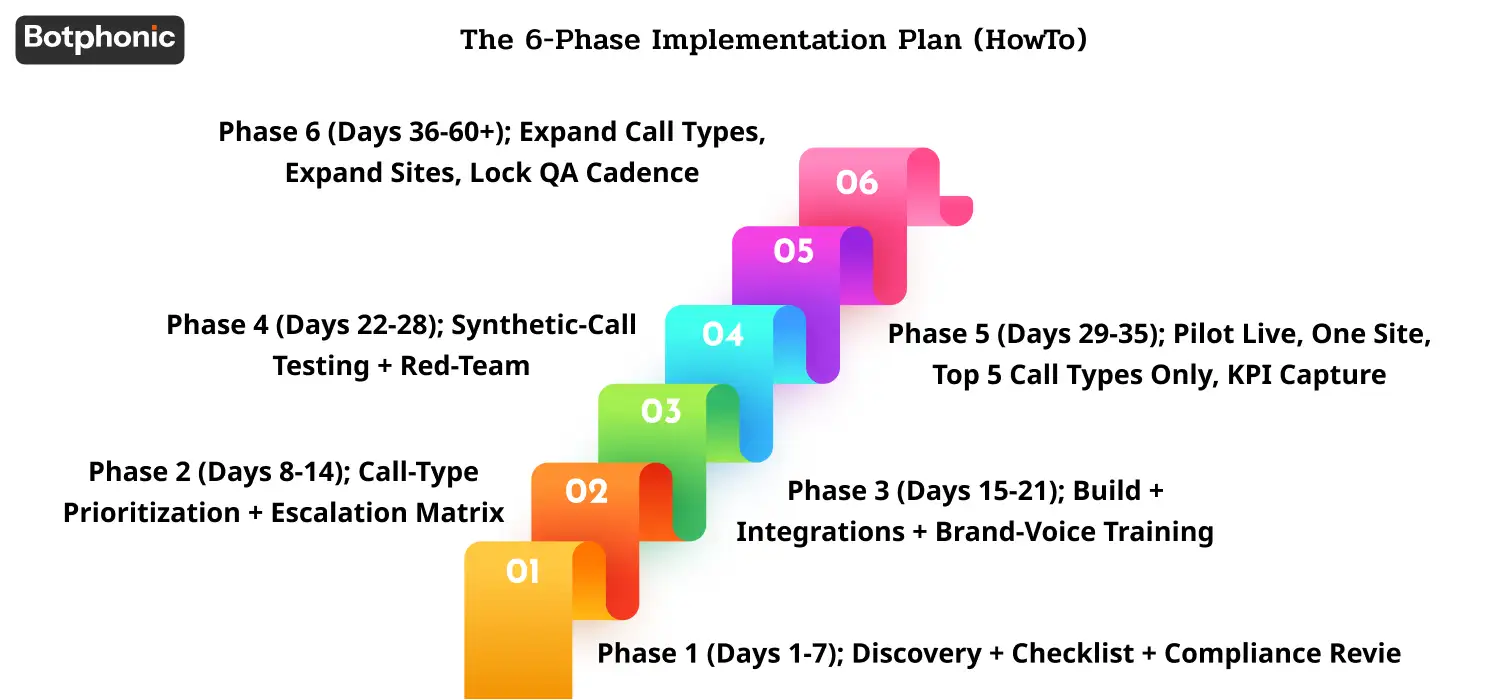
Phase 1 (Days 1-7); Discovery + checklist + compliance review. Perform pre-implementation checklist on Run §1. Set scope to top 5 call types. Compliance Review – legal. Confirm vendor BAA.
Phase 2 (Days 8-14); Call-type prioritization + escalation matrix. For the top 5 call types, document them in detail with sample dialogs, escalation rules, and what it is expected to look like. Construct the always-escalatecategories from §4. Specify how to measure the §6 KPI baseline.
Phase 3 (Days 15-21); Build + integrations + brand-voice training. Vendor configures the platform. IT installs CRM, telephony and any vertical specific integration. Brand-voice training session. Compliance controls verified.
Phase 4 (Days 22-28); Synthetic-call testing + red-team. There are 100+ scripted scenarios that go through the platform. Edge cases that were tested (multilingual, background noise, accents, profanity, emotional callers). Problems addressed and resolved.
Phase 5 (Days 29-35); Pilot live, one site, top 5 call types only, KPI capture. Gradual rollout to small number of participants. Call Log Review Week 1. The Front-Office Lead hears the recordings each day from a sample.
Phase 6 (Days 36-60+); Expand call types, expand sites, lock QA cadence. After adding the top 5, continue to expand every 30 days. Maintain §10 weekly-QA then monthly cadence. Leadership reports to first ROI at day 90.
The value of most deployments that made it to 90 days and all 9 failures defused, continues for years. Rarely do deployments make it to 90 days of quality when they do not follow these steps.
You can even read our buyer’s guide for AI scheduling software for more details.
Implementation by Industry; Quick Reference
| Industry | Top compliance items | Top integrations | The most common types of failure. |
| Healthcare / dental | Ensure HIPAA BAA, voice-biometric handling, and audit logs are in place.Provide HIPAA BAA, voice-biometric handling and audit logging. | Patients’ payment processor.Patient payment processor – Epic, athenahealth, Dentrix. | #1 (data hygiene), #3 (clinical escalation), #6 (HIPAA shortcut), #8 (clinician change-management) |
| Legal | Confidentiality and conflict checks, disclosure of retainers | A case-management system (Clio, MyCase, PracticePanther). | The three numbers correspond to the following specific concepts: #3 (conflict escalation), #6 (privilege handling), #7 (brand voice = trust). |
| Finance / accounting | The scope of PCI, TCPA outbound, KYC. | CRM (Salesforce Financial Services), payment processor | These are among the top three priorities for #6 (PCI scope) and #9 (QA cadence for regulator audit defense). |
| Home services | TCPA residential, DNC, state contractor licensing | FSM (ServiceTitan, Housecall Pro, Jobber) | The three answers are: #1 – Data hygiene, #6 – TCPA / DNC, #8 – Technician / Dispatcher change-mgmt |
| Real estate | License disclosure, fair-housing, anti-steering | A CRM (Follow Up Boss, BoomTown, kvCORE) | #3, #7 (Fair Housing Sensitive Escalations, Brand Voice = Agent Trust) |
10 Questions to Ask Before Your First Pilot
- Please provide us with the latest SOC 2 Type II report and vertical compliance control mapping.
- Take me one of our customers, our size and let me talk to him.
- What is your usual sequence of events as a pilot, and what are the most common failures you encounter?
- What’s the CRM hygiene must for day one?
- What happens if “I want a real person” comes up during the conversation in your platform?
- Explain your QA testing harness and how to add scenarios to it.
- How often do you retrain after launch and how is model update communicated?
- What metrics are shown on your native dashboard?
- If we don’t achieve success criteria in our pilot, what will the rollback process be like?
- Let me see three customers who stopped or backed down and what they found out.
Meanwhile, you should also know about the must-have features of an AI phone call assistant. The most crucial question is the last question. Vendors that have a valid point to discuss rollback are more likely to be reliable than those who do not.
Audit your rollout plan before customers audit it for you.
Schedule A Demo