
Summarize Content With:
The AI vs human receptionists debate often ends with a simple conclusion: one is better than the other. But in reality, the answer isn’t that straightforward.
Different businesses have different needs. A busy healthcare practice handling hundreds of appointment calls each day faces very different challenges than a small office that receives only a handful of calls. As a result, the effectiveness of an AI receptionist or a human receptionist can vary significantly from one organization to another.
Rather than declaring a universal winner, this article focuses on the factors that actually influence the outcome. We’ll look at situations where human receptionists provide advantages that technology cannot easily replicate, as well as the areas where AI receptionists can deliver measurable operational benefits.
The key point is that the decision is rarely about choosing between people and technology. Instead, it comes down to three practical variables that affect call handling, customer experience, and overall efficiency. Understanding these variables can make the choice much clearer and help businesses invest in the solution that best fits their requirements.
Setting the Frame: Why “Better” Is the Wrong Question
When business owners ask “should I use an AI receptionist or a human?”, they’re usually asking the wrong question. The correct question is: under what conditions does each option deliver more value for my specific business?
The answer, in almost every case, comes down to three measurable variables: call volume, availability window, and interaction complexity. Nail those three, and the decision almost makes itself.
Before we get there, let’s be intellectually honest about what human receptionists bring to the table because dismissing them entirely would be disingenuous and ultimately unhelpful.
Where Humans Genuinely Win: The Honest Concession
Human receptionists are not obsolete. They are genuinely superior in specific, well-defined situations. Any fair comparison must acknowledge this plainly.
Emotional complexity and empathy
When a patient calls in distress, or a client is angry after a bad experience, a skilled human receptionist reads tone, pace, and emotional subtext with accuracy that no current AI system truly matches. They can say “I can hear this is frustrating let me personally make sure this gets resolved” and mean it in a way that lands authentically.
According to SurveyMonkey’s 2025 consumer research, 79% of Americans strongly prefer interacting with a human over an AI agent. The primary reason? People feel human agents better understand their needs.
Contextual judgment in novel situations
If a caller describes a situation that falls outside every defined workflow a genuine edge case a human can exercise real-time judgment. They can decide to break protocol when breaking protocol is the right call. Current AI receptionists handle defined intents excellently but still struggle with genuinely unprecedented requests.
Brand representation for high-stakes relationships
For law firms, boutique consultancies, or luxury service providers where the first call is the pitch, a human receptionist’s personal warmth can be part of the product itself. That’s a legitimate brand strategy, not sentimentality.
“The question is never whether AI can replace human empathy it cannot, not fully. The question is whether human empathy is actually what your call volume requires at every touchpoint, or whether it’s needed only at certain critical moments.” Customer Experience Research, Gartner 2024
| Statistic | Figure | Source |
| Americans who prefer human over AI in customer service | 79% | SurveyMonkey, 2025 |
| Customers who’d prefer companies not use AI at all | 64% | Gartner, 2024 |
| Consumers who actually prefer AI over humans | 8% | SurveyMonkey, 2025 |
 NOTE
NOTE
Variable 1: Call Volume The Tipping Point That Changes Everything
This is the single most decisive variable in the AI receptionist vs human debate. At low call volumes under 50 calls per month a human or a shared answering service is perfectly adequate. The economics and operational complexity don’t justify an AI layer.
But call volume scales. Human capacity doesn’t.
A single human receptionist handles one call at a time. Two simultaneous calls means one goes to voicemail. Five simultaneous calls during a Monday morning rush means four potential leads lost permanently.
Industry analysis of 347,609 real business calls by NextPhone (2025) shows that AI receptionists:
- Resolve 90–95% of calls without any escalation
- Answer in under 5 seconds
- Maintain 99% positive caller sentiment
Human receptionists, by contrast, answer in 30–90 seconds and charge per minute on top of base salary. At 300+ calls per month, the economics swing dramatically.
“At 300+ calls per month, the per-minute cost of a traditional answering service exceeds AI pricing significantly while still not delivering completed bookings.”
Zenoti 2025 Benchmark Report
Annual cost comparison by call volume
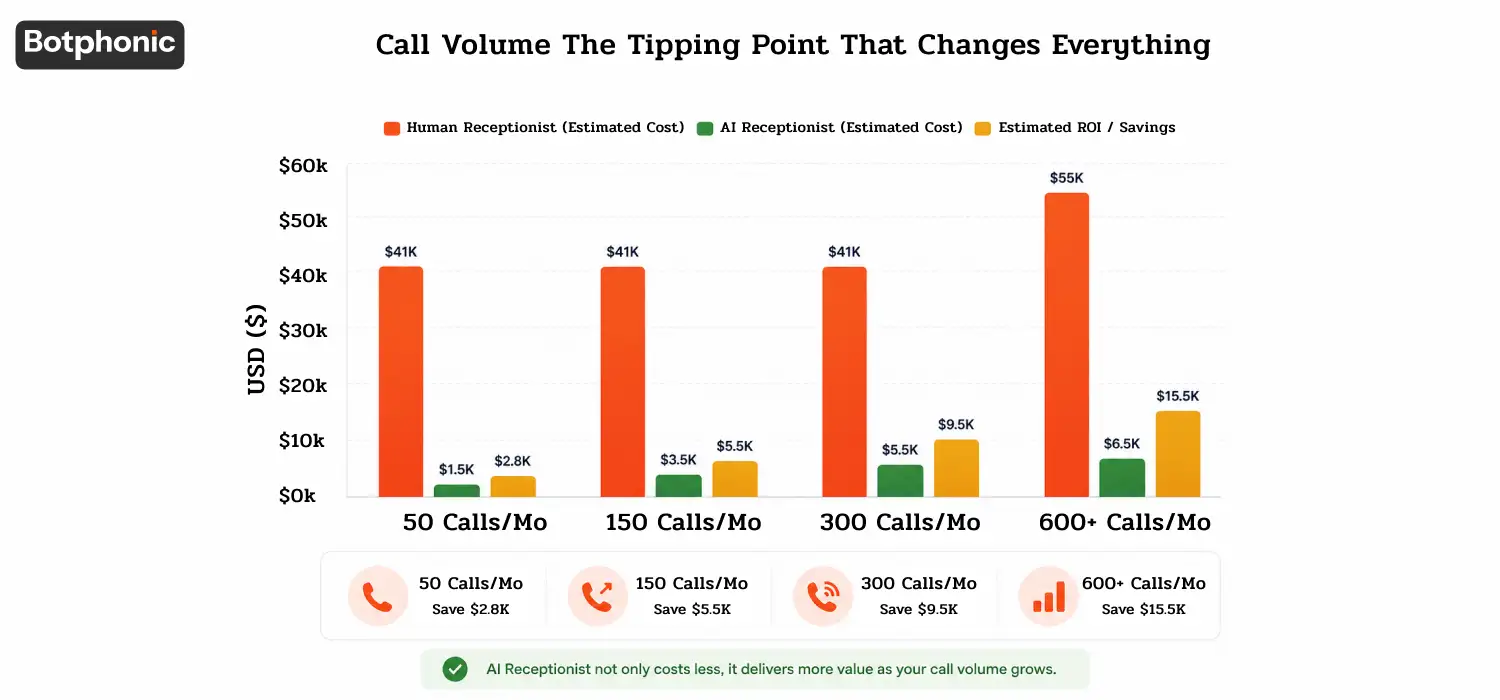
Sources: NextPhone AI Statistics 2025 · Bureau of Labor Statistics 2025 · Zenoti Benchmark 2025
According to NextPhone’s 2025 data, AI receptionists cost $600–$4,800 per year versus $30,000–$60,000 per year for a human receptionist an 87–97% cost reduction, alongside unlimited simultaneous call handling.
 PRO TIP
Variable 2: Availability Window 40 Hours vs. 168 Hours
A traditional receptionist works roughly 40 hours a week 9 AM to 5 PM, Monday through Friday. That is 40 hours out of 168 available hours in the week. As NextPhone’s research illustrates, the other 128 hours? Your calls go to voicemail.
For industries where urgency is embedded in the service HVAC, plumbing, healthcare, legal intake, real estate those 128 hours represent an enormous, silent revenue leak.
Invoca’s research confirms that 62% of calls to home services businesses go unanswered, and industry-wide, home services contractors miss 60–80% of incoming calls. One HVAC contractor in NextPhone’s case study would have captured 23 emergency calls that came in after hours calls that went to voicemail and converted to competitor revenue instead.
The Zenoti 2025 Benchmark Report confirms the baseline: 35% of business calls go unanswered every single month across industries.
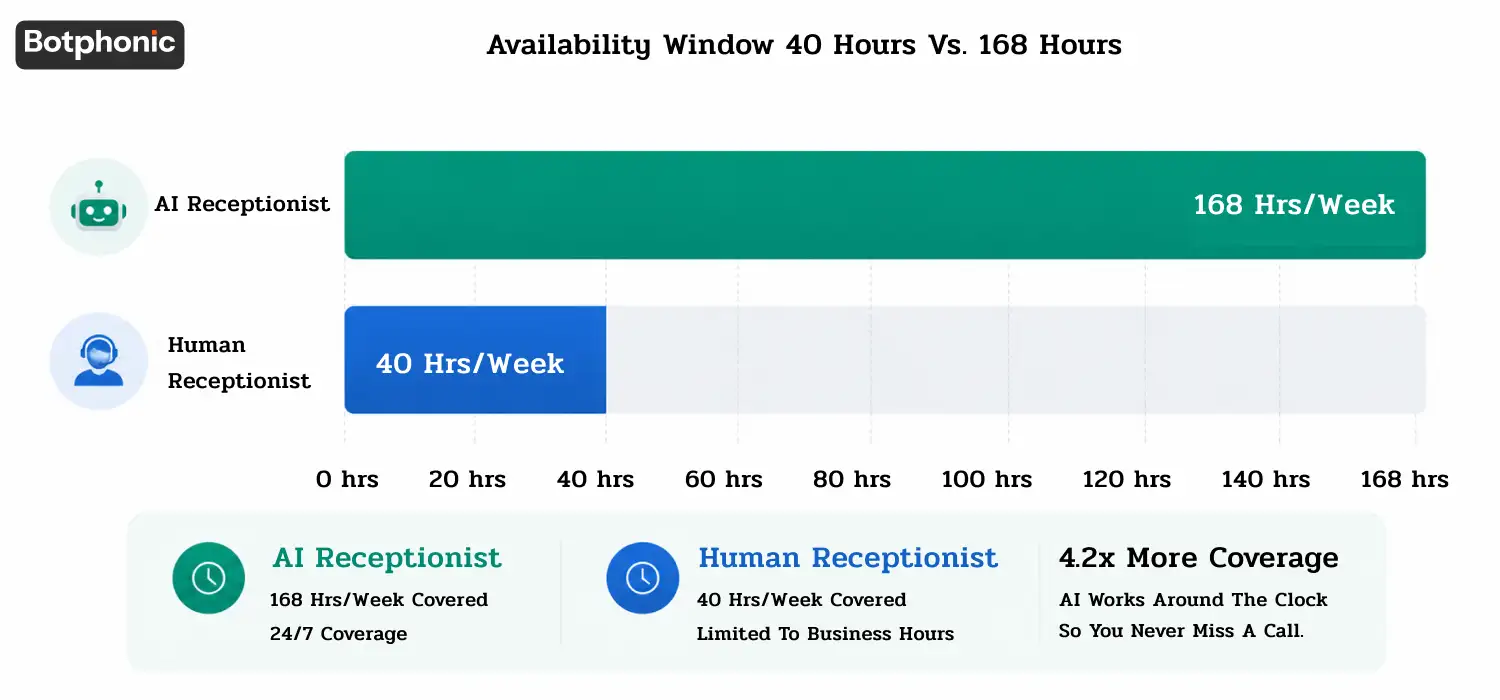
The 24/7 availability gap is not just about missed calls it’s about who calls after hours. These are often your highest-intent callers: someone in an emergency, someone making a final purchase decision after comparing options, or an international prospect in a different time zone. They are disproportionately valuable and disproportionately lost.
Explore how this works in practice: Will AI Replace Human Receptionists? Pros and Cons Botphonic’s detailed breakdown of where the hybrid model wins.
Variable 3: Interaction Complexity Where the Decision Splits
This is the variable most businesses get wrong. They assume their calls are complex. Usually, they’re not.
When you break down what an average business phone call actually involves, the vast majority fall into a handful of categories:
- Appointment booking or rescheduling
- Hours, location, or directions queries
- Pricing and service questions
- Standard FAQs
- Call routing to the right department or person
These are transactional, not complex. They require accuracy, speed, and availability not emotional depth or novel judgment.
The 90/10 split that defines the decision
Based on Smith.ai’s 2025 analysis of their AI-first and hybrid call data:
| Call Type | % of Total Volume | Best Handled By |
| Routine transactional (booking, FAQ, routing) | ~75–90% | AI |
| Moderately complex (multi-step queries, some nuance) | ~8–15% | AI with escalation option |
| Genuinely complex (emotional, novel, relationship-critical) | ~5–10% | Human |
In Smith.ai’s AI-first model, only 25% of calls involve a live agent at any point. That is the hybrid model working as designed AI handles the bulk; humans step in precisely where they add irreplaceable value.
Advanced AI systems can easily understand different accents, bilingual conversations, and fast or stressed speech. AI voice assistants not only understand words, but they also understand the intent of the customers. Remember the must-have features while adopting the AI receptionist.
The key insight here: you don’t have to choose between AI and human as a binary. The smart deployment is AI as the first layer handling the 90% efficiently and accurately with clean, graceful escalation paths for the 10% that genuinely needs a human.
For a deeper look at how modern AI handles intent and complexity: AI Receptionist Technology: Your New Business Ally.
Which option wins by business type
| Business Type | Call Volume | After-Hours Need | Complexity Level | Recommended |
| HVAC / Plumbing / Home Services | High | Critical (emergencies) | Low–Medium | AI-first |
| Medical / Dental Practice | High | Medium | Medium | Hybrid |
| Boutique Law Firm | Low–Medium | Low | High (sensitive) | Human-first |
| Salon / Spa / Beauty | High | Medium | Low | AI-first |
| Real Estate Agency | Medium–High | High (weekend showings) | Medium | AI-first |
| Luxury Consultancy / Brand | Low | Low | High (relationship-driven) | Human-first |
| E-commerce / SaaS Support | Very High | High (global) | Low–Medium | AI-first |
| Startup / SMB (growing fast) | Medium (scaling) | Medium | Low–Medium | Hybrid |
Assessment based on industry data from Resonate AI, Zenoti, and Botphonic industry analysis.
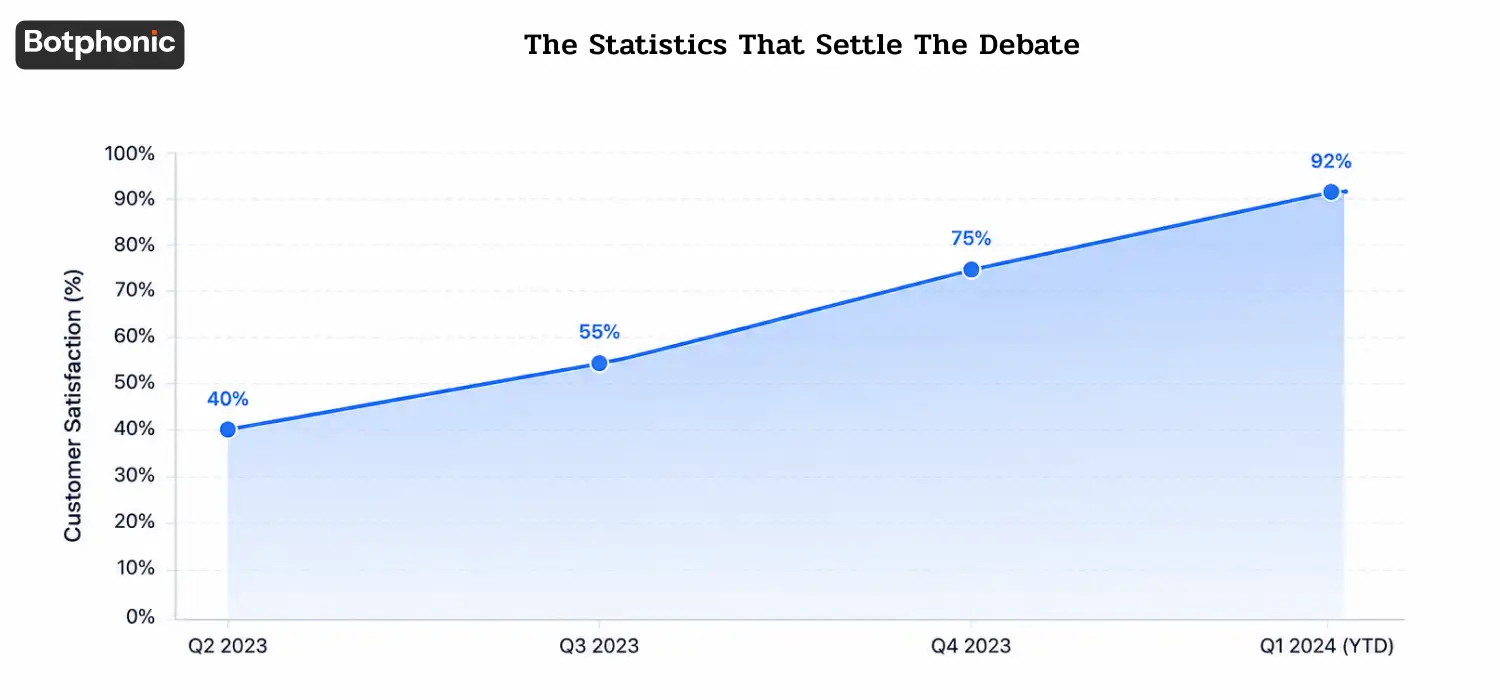
The Statistics That Settle the Debate
The market data is unambiguous about where adoption is heading. Whether or not consumers say they prefer humans, businesses are deploying AI at a historic rate and satisfaction scores are holding up.
| Statistic | Figure | Source |
| AI in business functions (2024) | 78% of organisations | McKinsey via NextPhone |
| CS leaders planning AI by 2025 | 85% | Gartner, Dec 2024 |
| US small businesses using AI for customer service | 50% | Talkdesk via NextPhone |
| Virtual receptionist market (2024) | $3.85 billion | NextPhone 2025 |
| Projected market by 2033 | $9 billion | NextPhone 2025 |
| Voice AI agents market CAGR | 45.8% | NextPhone 2025 |
| Calls going unanswered per month | 35% | Zenoti Benchmark 2025 |
| Home services calls going unanswered | 60–80% | Invoca via NextPhone |
| Generative AI org adoption increase (6 months) | +9% | Resonate AI 2025 |
| AI call resolution without escalation | 90–95% | NextPhone 347k call analysis |
For a deeper look at the technology powering these results: AI Receptionist Technology: Your New Business Ally.
The right answer comes down to just 3 key variables get them right, and the choice becomes obvious. See how your current call flow performs and find out which option actually fits your business best.
Request a Free DemoThe Honest Verdict
Here is where we stop hedging and give you the direct answer.
If your business receives more than 100 calls per month, has any after-hours demand, and handles primarily transactional interactions AI is the right first layer. Full stop.
The economics are not close. The availability gap is not close. The scalability advantage is not close. Where human receptionists retain genuine superiority deep emotional complexity, novel judgment, high-stakes relationship management those situations represent a small minority of actual call volume for most businesses. Deploy AI for the 90%. Keep human escalation for the 10%.
If, however, you run a boutique operation where every single call is a high-stakes, relationship-defining moment and your volume is genuinely low enough that one skilled person can handle it then investing in an exceptional human receptionist is the right call. Know which business you have.
The hybrid model eliminates the false binary entirely. AI handles volume, availability, and consistency. Human agents step in precisely when they add irreplaceable value. That is not a compromise it is the optimal architecture.
