
Summarize Content With:
TL;DR: The 18-Month Front-Desk Blueprint
Three shifts are redefining what AI receptionists can do, and who you need alongside them:
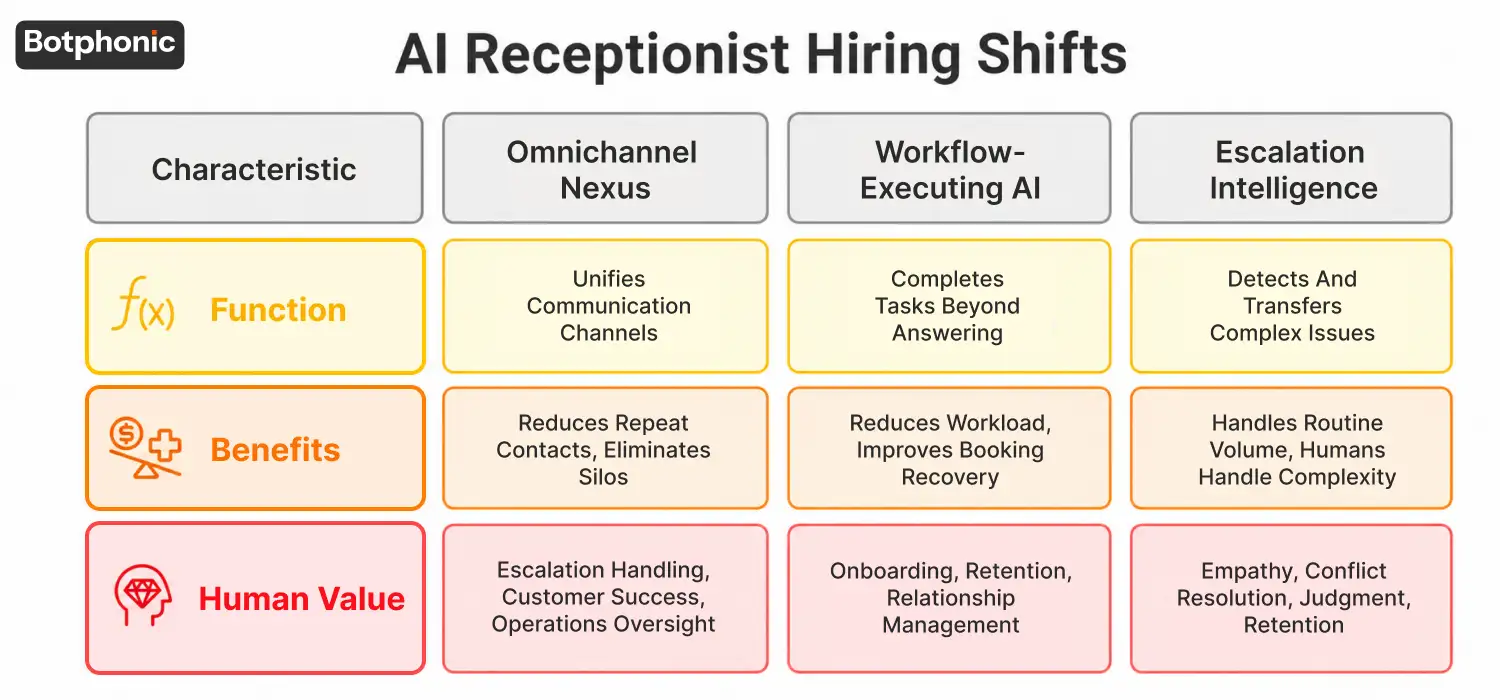
Shift 1: The Botphonic Omnichannel Nexus: AI receptionists now unify voice, SMS, web chat, and intake forms into a single interaction thread. Roles built around moving information between platforms are at high automation risk. Internal data across 1.2 million Botphonic calls in Q1 2026 shows a 41% reduction in repeat-contact rate when unified channel history is active.
Shift 2: Autonomous Workflow Execution: AI phone agents complete actions, not just answers. Appointment scheduling, cancellation backfill, CRM updates, and outbound lead recovery now run without human initiation. Automated cancellation backfill reduced open calendar slots by 34% across Botphonic clients in the same period.Shift 3: Escalation Intelligence: Real-time conversation context modeling routes the right calls to human staff before frustration peaks. Botphonic data shows warm-transfer recipients report 28% higher post-interaction satisfaction scores compared to cold-transfer recipients.
The future of AI receptionist is not a distant concept, it is actively reshaping administrative hiring right now. This article is for business owners, operations managers, and HR teams evaluating front-desk staffing decisions. Read this and you will know: which front-desk roles automation will eliminate first, which roles will grow in demand, what your 18-month workforce plan should look like, and how three industries, healthcare, legal, and home services, are already restructuring around these changes.
Why Are Businesses Rethinking Front-Desk Hiring Right Now?
Unanswered phone lines cost SMBs an average of $8,000 monthly in lost pipeline. That figure does not include staff time consumed by repeatable, low-judgment tasks that now have viable automation alternatives. Customers arrive through phone, web forms, SMS, and live chat simultaneously, and they expect the person or system they reach to already know who they are.
Organizations still running single-channel front-desk operations are not just inefficient. They are structurally misaligned with how customers communicate in 2026. The hiring decisions made in the next 18 months will determine whether a business catches up, or keeps paying for a staffing model built for a different era.
Shift 1: What Is the Botphonic Omnichannel Nexus and Why Does It Change Hiring?
The Botphonic Omnichannel Nexus is Botphonic’s proprietary framework for unifying customer interactions across every inbound and outbound channel into a single, persistent interaction record, so that every AI-handled conversation is informed by everything that came before it, regardless of channel. Here is what that means for front-desk staffing decisions.
Omnichannel AI Coordination
Omnichannel AI coordination is the capability of an AI receptionist system to maintain a continuous, unified customer interaction record across multiple communication channels, including voice calls, SMS, web chat, and digital intake forms, by linking each interaction to a shared contact identity. This eliminates channel-based information silos and enables context-aware responses at every touchpoint.
Why Does Channel Fragmentation Create a Hidden Staffing Cost?
Traditional receptionist software manages one interaction at a time on one channel. A staff member answers the phone, logs a message, and moves to the next call. When the same customer sends an SMS an hour later, the next staff member has no context. That gap requires human effort to close, every time.
Botphonic’s internal data across 1.2 million calls processed in Q1 2026 found a 41% reduction in repeat-contact rate when a unified interaction history was active. Customers who would otherwise call back to re-explain their situation resolved their needs in a single contact. That is a direct reduction in front-desk volume, without any change in staffing levels.
Modern AI receptionist systems operating under the Omnichannel Nexus framework combine voice, web chat, SMS, appointment forms, and customer records into one workflow. A customer who submits a form Monday, sends a text Monday afternoon, and calls Tuesday is recognized at the start of that call, with full prior context already loaded.
What Front-Desk Roles Does This Put at Risk?
Roles built around moving information between systems, relaying chat notes to a scheduler, logging call summaries into a CRM, forwarding form submissions to the right department, are the first candidates for automation under an omnichannel model. The coordination work disappears when the system does it automatically.
| Role Type | Automation Risk | Skills That Retain Value |
| Message relay / call logging | High | None; task is fully automatable |
| Routine appointment scheduling | Moderate | Judgment on exceptions and unusual cases |
| Cross-channel follow-up | High | None; task is fully automatable |
| Customer escalation handler | Low; demand growing | Conflict resolution, empathy |
| Operations coordinator | Low; stable to growing | Systems oversight, process design |
| Customer success specialist | Low; demand growing | Relationship management, retention |
 PRO TIP
Shift 2: How Are AI Receptionists Moving From Answering Questions to Completing Work?
Workflow-executing AI means the system does not respond and wait, it acts. It schedules appointments, sends confirmations, collects missing intake documents, fills cancellations from a waitlist, and updates records. Here is how that changes what you need to hire for.
Workflow-Executing AI
A workflow-executing AI system is a conversational agent capable of initiating and completing multi-step operational tasks, such as appointment creation, document collection, CRM record updates, and outbound follow-up communications, without requiring human intervention at any step. It differs from a question-answering AI in that it produces operational outcomes, not just informational responses.
What Does an AI Receptionist Actually Do When It “Executes a Workflow”?
Consider three high-value examples:
Cancellation backfill. A client cancels a 2 p.m. slot. The AI identifies the next eligible person on the waitlist, contacts them via the Botphonic AI phone call system, confirms the booking, updates the schedule, and sends a confirmation, without a staff member involved. Botphonic’s Q1 2026 data shows this process reduced open calendar slots by 34% across clients using automated backfill. For a practice running 200 appointments per week, that recovery translates directly to revenue that would otherwise be lost.
Outbound lead recovery. A prospect fills out a contact form and does not hear back within 24 hours, a window where lead conversion probability drops sharply. The AI initiates a follow-up call or SMS automatically. Botphonic’s outbound lead recovery sequences show a 27% contact-to-booking conversion rate on leads that would otherwise have gone cold within 48 hours.
Intake document collection. A new client completes a form but skips required fields. The AI sends a targeted follow-up, by SMS or call, requesting only the missing items. Staff time spent chasing incomplete intake dropped by 62% among Botphonic healthcare clients in Q1 2026.
What Jobs Does Workflow Execution Change Most?
It eliminates roles structured around process administration, maintaining waitlists, sending manual reminder calls, following up on incomplete forms. Roles structured around judgment, relationship management, and client experience are not at risk.
In practice, teams using Botphonic for workflow execution have redeployed that recovered staff time into client onboarding, retention outreach, and escalation handling, higher-value work that directly affects customer lifetime value.
 NOTE
NOTE
Shift 3: How Is AI Getting Better at Knowing When to Involve a Human?
Escalation intelligence means AI systems now evaluate full conversation context, not just keywords, to determine when a human needs to take over. They assess sentiment trajectory, interaction history, urgency signals, and unresolved confusion together. Here is why this reshapes front-desk team structure.
AI Escalation Intelligence
AI escalation intelligence is the capability of a conversational AI system to analyze real-time sentiment, language pattern shifts, interaction history, and contextual urgency signals in order to identify when a customer interaction requires human involvement, and to execute a structured handoff before the customer explicitly requests one.
Why Did Early AI Systems Escalate at the Wrong Times?
First-generation systems used keyword triggers: if a customer said “cancel” or “manager,” the call transferred. Most of those transfers were false alarms. Worse, they interrupted interactions that the AI could have handled, and failed to escalate interactions that genuinely needed human judgment.
Modern systems assess the full conversation arc. Repeated questions, escalating emotional tone, unresolved confusion across multiple prior contacts, and unusual request patterns all factor into the escalation decision. The AI acts on pattern, not vocabulary.
What Does a Well-Executed Escalation Actually Look Like?
When the escalation threshold is crossed, the Botphonic system executes a warm transfer. The human agent receives a real-time summary of the conversation, the issue, the customer’s history, the sentiment trajectory, and the point of escalation, before the call connects. The customer experiences a brief hold, not a cold drop with no context.
Botphonic’s Q1 2026 data shows warm-transfer recipients report 28% higher post-interaction satisfaction scores compared to cold-transfer recipients across equivalent complaint categories. The difference is not the human, it is the context the human receives before the conversation begins.
How Should Reception Teams Be Structured Differently?
| Current Structure | Likely Structure in 18 Months |
| Staff split between routine calls and escalations | Staff focused almost entirely on escalations |
| Generalist receptionists handling all inbound | Specialists in conflict resolution and retention |
| High call volume distributed across all staff | AI handles volume; humans handle complexity |
| Hiring for availability and phone manner | Hiring for judgment, empathy, and retention skill |
explore Botphonic’s AI call assistant and test real call scenarios before committing to any staffing changes.
Try BotphonicWhat Does This Mean for Healthcare, Legal, and Home Services Specifically?
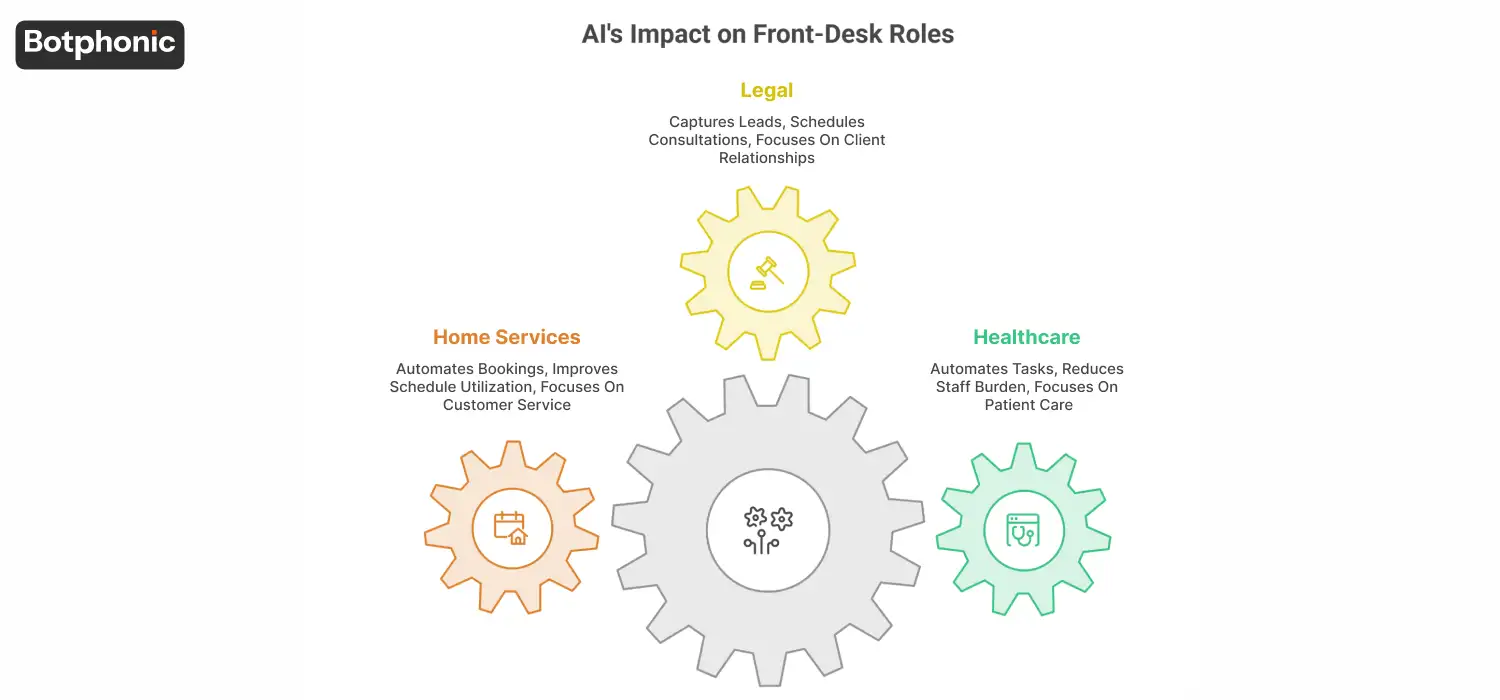
Generic front-desk advice does not account for the compliance environments, client relationship dynamics, and workflow structures that differ sharply by industry. Here is what the three-shift model looks like in practice for each.
How Are Healthcare Practices Restructuring Front-Desk Roles?
Healthcare operates under HIPAA compliance requirements and patient relationship norms that make both over-automation and under-automation costly. The Omnichannel Nexus model is particularly high-value here because patients frequently contact practices across multiple channels before and after appointments.
What is changing: Practices using Botphonic AI customer service with Jane App and Epic EMR integrations are automating appointment scheduling, cancellation backfill, intake document collection, and reminder calls. In Q1 2026, Botphonic healthcare clients using automated intake follow-up reduced incomplete intake forms by 62%, directly cutting the administrative burden on clinical support staff.
What human staff are doing instead: Patient-facing roles are shifting toward care coordination, complex scheduling decisions (multi-provider, multi-appointment care plans), insurance exception handling, and emotional support for anxious or distressed patients. These interactions require clinical empathy and contextual judgment that AI does not replicate.
Compliance note: Any AI vendor touching patient scheduling or intake data must execute a HIPAA Business Associate Agreement before deployment. Confirm SOC 2 Type II certification as a baseline security requirement. This is non-negotiable and should be the first question asked in any vendor evaluation.
How Are Legal Practices Restructuring Front-Desk Roles?
Legal intake is high-stakes and high-friction. A potential client who reaches voicemail during an initial call has a documented tendency to call the next firm on their list. The cost of a missed intake call is not just a lost appointment, it is a lost matter.
What is changing: Law firms using AI receptionist systems for intake are capturing leads outside business hours, qualifying callers by practice area, and scheduling consultations automatically. Botphonic’s outbound lead recovery data shows a 27% contact-to-booking conversion rate on leads followed up within 24 hours, a window most law firms miss entirely when relying on manual callbacks.
What human staff are doing instead: Legal receptionists are shifting toward conflict-of-interest screening, sensitive matter intake (personal injury, family law, criminal defense), and relationship management for existing clients. These tasks require legal knowledge and discretion that cannot be delegated to an automated system.
Compliance note: Legal intake often involves privileged information. Confirm that any AI vendor processing intake calls has appropriate data handling agreements in place and that call recordings and transcripts are stored within your data governance framework.
How Are Home Services Businesses Restructuring Front-Desk Roles?
Home services, HVAC, plumbing, electrical, cleaning, landscaping, operate on dense inbound call volume, tight scheduling windows, and high cancellation rates. The front-desk burden is almost entirely repeatable: quote requests, appointment scheduling, rescheduling, and dispatch coordination.
What is changing: Home services businesses using Botphonic are automating inbound booking, appointment reminders, and cancellation recovery. The 34% reduction in open calendar slots from automated backfill is particularly impactful here, a cancelled afternoon slot that gets refilled within an hour is a direct revenue recovery with no staff involvement.
What human staff are doing instead: Dispatch coordination for complex or multi-technician jobs, customer escalations involving property damage or service disputes, and upsell conversations with existing clients are where human staff are being redeployed. These interactions have higher revenue and relationship implications than routine booking.
Case Study: How a Regional Healthcare Group Restructured Its Front Desk Over 18 Months
A regional outpatient physical therapy group operating across four locations, anonymized as Clearbrook Health, deployed Botphonic’s Omnichannel Nexus framework in Q2 2025 with the goal of reducing administrative overhead without cutting patient-facing capacity.
Starting point: Four locations, 12 front-desk staff total, handling approximately 1,800 inbound calls per month. Staff reported spending 65% of their time on scheduling, rescheduling, reminders, and intake follow-up. Patient satisfaction scores for “ease of scheduling” averaged 6.8 out of 10.
What changed in the first 90 days: Inbound scheduling, cancellation backfill, and intake document follow-up were fully automated. Outbound appointment reminders shifted to AI-handled SMS and voice. Front-desk call volume handled by human staff dropped by 58%.
What changed by month 18: Clearbrook Health reduced front-desk headcount from 12 to 7 through attrition, no forced redundancies. The 7 remaining staff were retitled as Patient Experience Coordinators and spent the majority of their time on care plan coordination, insurance exception handling, and escalated patient concerns. Patient satisfaction scores for “ease of scheduling” rose to 8.9 out of 10. Revenue per available appointment slot increased 19% due to improved cancellation backfill and reduced no-show rates.
The staffing lesson: The reduction was not the goal, the reallocation was. The five roles that were not replaced were roles built entirely around information relay and routine scheduling. The seven retained roles became more skilled, more patient-facing, and more directly tied to practice revenue.
What Can AI Receptionists Still Not Do Reliably?
Complex relationship building. Long-term clients, high-value accounts, and patients with ongoing care needs build trust through human contact over time. AI supports those relationships. It does not build them.
Unpredictable requests. Situations with no precedent in your processes, unusual exceptions, custom arrangements, novel complaints, still require human judgment. AI operates within defined parameters.
Emotionally charged conversations. A patient anxious about a diagnosis, a client disputing a significant charge, a customer who has been ignored three times, these conversations require emotional attunement that current AI systems cannot replicate.
Business-consequence decisions. AI can surface options and follow rules. It cannot own decisions involving brand risk, legal nuance, or significant financial implications.
See how an AI receptionist helps you in managing crucial tasks and what are its other limitations that you should know about.
How Should Employers Build Their Hiring Plan for the Next 18 Months?
Step 1: Audit actual task distribution. Pull one month of call logs, form submissions, and CRM entries. Sort every recurring task into: fully repeatable, judgment-dependent, or relationship-dependent. Most businesses find 40–60% of front-desk time is in the first bucket.
Step 2: Evaluate technology readiness. Know the technology behind AI receptionists, identify whether your scheduling platform, CRM, and phone system can integrate with an AI receptionist. For healthcare practices, confirm HIPAA BAA availability and SOC 2 Type II certification with any vendor you evaluate.
Step 3: Rewrite role definitions. Job descriptions from two years ago do not describe the role your front-desk staff will be doing in 18 months. Rebuild them around escalation handling, relationship management, and customer retention, not call volume.
Step 4: Build a task allocation map.
| Task Category | Approach |
| Routine information requests | Automate |
| Standard appointment scheduling | Automate |
| Cancellation backfill | Automate |
| Outbound lead recovery | Automate |
| Intake document follow-up | Automate |
| Complaint resolution | Human-led |
| Complex onboarding | Human-led |
| Exception handling | Human-led |
| Reporting and system oversight | Hybrid |
