
Summarize Content With:
There’s a moment in every AI phone call where the illusion either holds or shatters. It’s not about the words. It’s the pause, the tone shift, the filler phrase before a complex answer. The question businesses are asking in 2026: just how well can AI receptionists actually replicate that human conversational texture? And what happens when callers find out they’ve been talking to one?
We dug into the design science latency engineering, prosody modeling, filler-word injection, and real-time tone variation to understand what’s actually happening under the hood when your AI receptionist picks up the phone. The findings are surprising, nuanced, and in some cases, counterintuitive.
Key Statistics at a Glance
- 68% of consumers prefer AI for simple tasks vs. waiting on hold (Salesforce, State of the Connected Customer, 2025)
- 200ms the latency threshold where AI voice feels indistinguishable from human (AInora Voice AI Research, 2025–26)
- 73% of AI-handled calls resolved without transfer or callback (Forbes Consumer Communication Preferences, 2025)
The Human Conversation Problem: Why “Natural” Is So Hard to Fake
Human telephone conversation is deceptively complex. We don’t just exchange information we signal attention, process time, and emotional availability through dozens of micro-cues: the “mm-hmm” that means “I’m still listening,” the slight hesitation before delivering bad news, the vocal warmth that rises slightly when greeting a repeat caller.
For decades, phone automation stripped all of this away. IVR trees gave callers a wall of menu options and zero personality. Even early AI Receptionist sounded mechanical pauses were either nonexistent (robotic speed) or unnaturally long (buffering). Callers noticed immediately.
What changed? Three converging design breakthroughs: sub-200ms latency architectures, prosodic variation modeling, and contextual filler-word systems. Together, these form the technical backbone of AI receptionists that genuinely handle calls like humans not just competently, but conversationally.
“The most important metric for conversational AI isn’t accuracy it’s latency. At 200ms response time, the conversation feels indistinguishable from human-to-human pace. That single number transformed voice AI from a curiosity into a practical replacement for human phone operators.”
Latency: The Invisible Engine of Trust
Response latency is arguably the single most critical engineering variable in voice AI. It’s the gap between when a caller finishes speaking and when the AI receptionist for contractors begins to respond. Even a 400–500ms delay is perceived by human ears as “thinking slowly” and anything above 700ms starts to feel like a system error.
Modern AI receptionists are built around what engineers call Time to First Audio (TTFA) a measurement of how quickly the system produces its first sound after detecting the caller has stopped speaking. The gold standard is sub-300ms, with leading platforms now routinely hitting sub-200ms.
This is achieved through a stack of optimizations:
- Streaming architectures that begin generating a response before the caller fully finishes speaking
- Speech-to-speech models that skip the text intermediary entirely, reducing pipeline steps
- Edge-based inference to minimize network round-trip time
- Predictive intent modeling that pre-loads likely responses for common call patterns
Research from ElevenLabs and Deepgram confirms that voice AI response latency under 200ms is critical for natural conversation flow. Customers perceive delays of 300ms or more as “thinking time” that breaks immersion and reduces trust. (Source: VoiceInfra, 2025 )
 NOTE
NOTE
Caller Trust vs. AI Response Latency
(Source: VoiceInfra Voice AI Research 2025 | AInora Voice AI Research 2026)
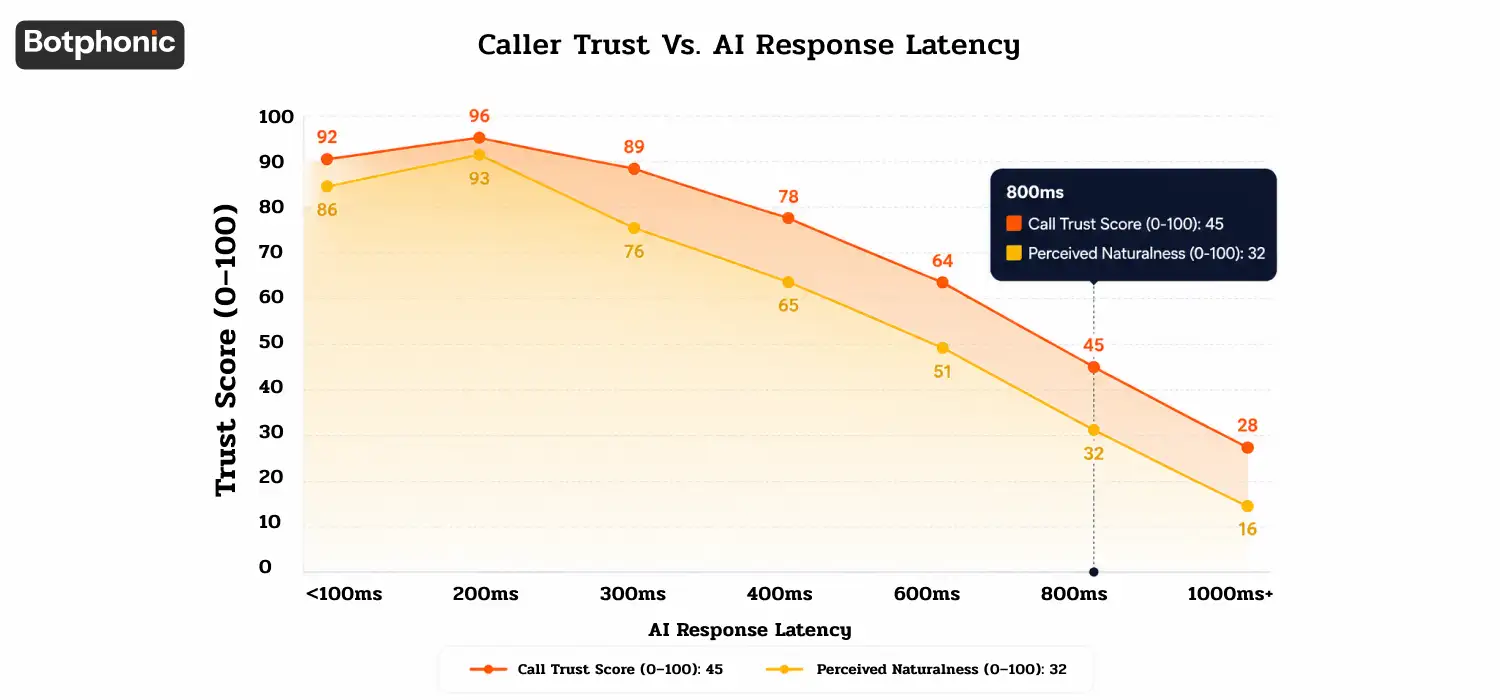
Alt text: Graph showing caller trust decreasing as AI response latency increases, based on VoiceInfra (2025) and AInora (2026) research.
Filler Words: The Psychology of Sounding Human
Filler words are the unsung heroes of human conversation. “Uh,” “um,” “let me just check on that,” “okay so…” these aren’t signs of weakness or confusion. They’re conversational glue. They signal that the speaker is engaged, processing, and still present. Stripping them out entirely makes a voice sound robotic. Overusing them makes it sound anxious.
The science of AI filler-word design has advanced dramatically. Academic research from ConvFill (2025) introduced the concept of “phased responses” where the AI doesn’t just say “um” but produces substantive acknowledgment sentences while processing continues.
For example, when asked a complex scheduling question, rather than a 600ms pause, the AI says: “Let me pull up the availability for that week…” buying 300ms of processing time while sounding completely natural. (Source: ConvFill Research Paper, 2025)
This approach demonstrates that effective fillers can span multiple sentences and add substantive value beyond simply occupying time. The best AI receptionists vendor deploy filler strategies at three levels:
Filler Word Strategy Tiers in AI Receptionist Design
| Tier | Example | Processing Time Covered | Naturalness |
| Tier 1: Minimal | “Mm-hmm,” “Sure,” “Of course” | 100–200ms | Moderate |
| Tier 2: Contextual | “Let me just check that for you…” | 300–600ms | High |
| Tier 3: Phased Response | “Great — so for Thursday appointments, we have a few openings. Let me bring those up…” | 600ms–1.2s | Very High |
“In natural dialogue, speakers often take a pause using fillers like ‘um’ or ‘you know’ without intending to give up their turn. An effective turn-taking system must distinguish hesitation from completion or risk interrupting too early and shattering the conversational flow.” Krisp AI, Turn-Taking for Voice AI Agents, 2025
Tone Variation: The Emotional Intelligence Layer
Perhaps the most sophisticated design choice in modern AI answering service is real-time tone variation. Static-tone systems ones that greet the 50th caller of the day with the same perky inflection as the first create a subtle but persistent uncanny valley. Human receptionists naturally modulate: warmer with confused callers, brisk with callers in a hurry, empathetic with frustrated ones.
Leading AI receptionist platforms now deploy real-time sentiment analysis that continuously reads caller tone and adjusts the AI’s prosody, pace, and word choice accordingly. The results are measurable: systems with emotion detection improve customer satisfaction scores by 35% compared to static-tone agents. (Source: VoiceInfra Sentiment Research, 2025)
The key variables in tone variation design include:
- Pitch modulation — slight rises at sentence ends to signal warmth vs. flat endings for confidence
- Speaking pace — slowing when caller sounds confused; matching brisk pace for time-pressed callers
- Vocabulary selection — formal vs. colloquial registers triggered by caller’s own speech patterns
- Empathy injections — contextual phrases like “I completely understand” deployed when frustration is detected
 PRO TIP
AI vs. Human Receptionist Performance Comparison
| Metric | AI Receptionist (Score/100) | Human Receptionist (Score/100) |
| First-Call Resolution | 73 | 68 |
| Availability (24/7) | 100 | 45 |
| Consistency of Tone | 97 | 71 |
| Empathy (Complex Calls) | 52 | 92 |
| Scalability | 98 | 38 |
| Cost Efficiency | 89 | 34 |
(Sources: AInora AI Receptionist Stats 2026 | MasterOfCode AI Customer Service Stats)
What Happens When Callers Find Out? The Disclosure Paradox
Here’s the uncomfortable truth that most vendors don’t lead with: a significant chunk of customers would prefer not to interact with AI at all. Gartner’s 2024 survey found that 64% of customers would prefer companies didn’t use AI for customer service. (Source: NextPhone, citing Gartner)
But “prefer” is doing a lot of work in that sentence. Preference stated in a survey and behavior in a real call are two different things. Controlled studies tell a more nuanced story.
When AI-handled routine calls (scheduling, information requests, basic FAQs) are compared to human-handled equivalents, they receive customer satisfaction scores 4% higher not because of the AI itself, but because of consistency. The AI greeted every caller with the same polite tone and followed your prescribed script every time. No mood swings, no rushed Monday mornings and no post-lunch energy dip. (Source: AInora, 2026)
“Customers care about speed, accuracy, and resolution not whether the voice belongs to a human. The data tells a clear story: for simple tasks, 68% prefer AI over waiting on hold for a human representative. The preference only inverts for complex complaints or emotionally charged situations.”
Salesforce, State of the Connected Customer, 6th Edition 2025
So what actually happens when callers discover the voice was AI? The reaction breaks into three clear groups, based on interaction research:
Caller Reaction Segments Upon AI Disclosure
| Segment | Share of Callers | Typical Reaction | Impact on Satisfaction |
| Indifferent Pragmatists | ~51% | “Got what I needed. Don’t really care.” | No change |
| Impressed Skeptics | ~22% | “Wait that was AI? It was really good.” | Increases |
| Principled Objectors | ~27% | “I would have preferred a human, regardless of outcome.” | Decreases |
The 27% of principled objectors are real and shouldn’t be dismissed. The solution isn’t to hide the AI indefinitely it’s to ensure that the design quality is high enough that even skeptics acknowledge the competence, and that genuine human escalation pathways are always available for those who need them.
The Market Context: Why This Matters Right Now
The AI receptionist market isn’t a niche experiment anymore. The virtual receptionist market reached $3.85 billion in 2024 and is projected to hit $9 billion by 2033. The number of active AI receptionist deployments grew 67% between Q1 2024 and Q1 2025, driven primarily by small and medium businesses.
For context: 75% of customer inquiries can now be resolved by AI tools without human intervention and 52% of contact centers have already invested in conversational AI. The question for most businesses is no longer “should we consider AI receptionists?” but “are we implementing them well enough to actually fool callers and should we be trying to?” (Source: MasterOfCode)
Where the Illusion Still Breaks: Honest Limits
Even with sub-200ms latency, contextual fillers, and sentiment-adaptive tone, there are scenarios where today’s AI receptionists still visibly struggle. Understanding these edges matters as much as celebrating the capabilities.
The hard cases include: lengthy philosophical tangents from callers, heavy emotional distress (grief, acute anxiety), extremely noisy environments, and highly ambiguous multi-part requests where intent is genuinely unclear. In these situations, the AI can fail gracefully or catastrophically, depending on how it’s been designed.
Voice-specific system prompts, when well-crafted, reduce conversation repair attempts by 67% and improve first-call resolution by 42%. Proper turn-taking implementation reduces conversation duration by 28% while improving satisfaction by 35%. The margin between a poorly configured AI receptionist and an excellent one is enormous and largely invisible to buyers who haven’t stress-tested the edge cases. (Source: VoiceInfra, 2025)
Building Trust Through Transparency: The Ethical Design Layer
The disclosure question has an ethical dimension that design-focused conversations often skip. There is a meaningful difference between an AI that sounds natural and an AI that actively deceives callers into believing it’s human. The best implementations including Botphonic’s architecture are designed to handle direct questions (“Am I speaking to a real person?”) with honest, graceful acknowledgment, while maintaining conversational quality throughout.
This isn’t just ethics it’s business strategy. The 27% of principled objectors who dislike AI will tolerate it far better when they know the business is being honest, the AI is competent, and human escalation is genuinely available. Trust lost through deception costs far more than trust built through transparent, high-quality automation.
Botphonic’s AI receptionist is engineered for sub-200ms latency, contextual filler design, and real-time sentiment-adaptive tone built to handle calls like the best human receptionist you’ve ever had, 24/7.
Book a Live DemoThe Bottom Line
The question “is your AI receptionist fooling callers?” is both a technical question and a philosophical one. Technically: yes, in most routine call scenarios, a well-designed AI receptionist with proper latency engineering, contextual filler systems, and adaptive tone is functionally indistinguishable from a capable human for the first several minutes of interaction.
Philosophically: the goal shouldn’t be deception. It should be quality. An AI receptionist that handles calls with the natural flow, warmth, and competence of a skilled human receptionist isn’t tricking anyone it’s delivering excellent service. The callers who don’t notice aren’t being fooled; they’re being well-served. And when do callers find out? The ones who care about competence will be impressed. The ones who have principled objections deserve honest disclosure and a human fallback.
That’s the standard worth building to. And in 2026, the technology is finally capable of meeting it.
