
Summarize Content With:
Picture this: a potential client dials your business number. Within the first 800 milliseconds of the call being picked up, they have already formed a subconscious impression. They’ve heard a greeting, sensed a tone, and decided even before they’ve consciously realized it whether to stay on the line or hang up.
That invisible judgment window is the battleground where AI receptionists win or lose. To understand exactly what’s happening inside it, we recorded and analyzed 100 real AI receptionist calls across industries including healthcare, legal, home services, and e-commerce. We studied them from the caller’s point of view not from a dashboard, not from a CRM but from the moment the first ring ended to the moment the caller either booked, transferred, or hung up.
What we found was stark. The difference between calls that converted and calls that crashed wasn’t the AI Receptionist provider. It wasn’t the script. It was the mechanics the micro-decisions the system made in the first four exchanges. This blog breaks those mechanics down, layer by layer.
| 98–99%Top AI Answer Rate | 420–600msIdeal Response Time | 73%Calls Resolved Without Transfer | 30%+Conversion Rate Uplift |
Sources: AInora AI Receptionist Statistics 2026 | AI Answering Industry Report 2026
Phase 1: Voice Detection The First 0-300ms
Before your AI receptionist says a single word, it is already working. The moment a caller’s audio stream arrives, the system’s Automatic Speech Recognition (ASR) layer activates not to transcribe speech, but simply to detect that a human is on the line.
How Voice Activity Detection (VAD) Actually Works
The VAD module listens for energy patterns consistent with human speech it distinguishes your caller’s voice from background noise, line static, and breathing. Top-tier systems use streaming VAD, which processes audio in 20–50ms chunks, meaning the AI is never waiting for you to finish a sentence before it starts parsing.
What separates converters from non-converters at this stage is the system’s noise tolerance. In our 100-call sample, 23 calls failed in the first 10 seconds not because of bad scripting, but because the VAD either triggered early (cutting off greetings) or triggered late (creating an awkward pause before the greeting played). Both outcomes signal ‘broken’ to the caller.
“If the ASR mishears the caller, every downstream stage works on bad input. Fix the transcription layer first everything else depends on it.”
OnCallClerk Team, Voice AI NLP: Real-Time Insights (2026)
According to 2026 benchmarks, leading ASR providers now achieve Word Error Rates (WER) of just 4%–8% for clean speech a dramatic improvement from over 25% a decade ago. (Source: Voice AI NLP Real-Time Insights). Systems that scored poorly in our calls consistently had WER above 12%, causing misrouted intents in later phases.
Phase 2: The Greeting What the Caller Hears in Seconds 1-4
Once a voice is detected, the greeting fires. This is the single most analyzed moment in our dataset. A greeting is not just courtesy it’s a trust signal. And trust, at this stage, is entirely acoustic.
The Anatomy of a High-Converting Greeting
The best-performing calls in our study shared four greeting characteristics:
- Business name mentioned within the first 2 words
- Friendly but purposeful tone not overly cheerful, not robotic
- Response latency under 500ms from the moment the call connected
- A clear, single open-ended invitation: “How can I help you today?”
The worst-performing calls opened with long legal disclaimers, robotic monotone delivery, or most damaging an awkward silence pause of 1.5+ seconds before the greeting began. Callers hung up during that pause at a rate 3x higher than calls with sub-800ms greetings.
This aligns with engineering research from Cresta: “Even pauses as short as ~300ms can feel unnatural, while any latency beyond ~1.5 seconds can rapidly degrade the experience.” (Source: Cresta Engineering Blog)
Greeting Performance Variables vs. Conversion Outcome
| Greeting Variable | Converts (%) | Drops Off (%) | Caller Experience Signal |
| Sub-500ms response, friendly tone | 74% | 8% | Trusted, human-like, on-brand |
| 500–800ms response, neutral tone | 61% | 19% | Acceptable, slightly mechanical |
| 800–1500ms response, generic tone | 43% | 34% | Noticeable delay, trust erodes |
| 1500ms+ response or silence gap | 18% | 71% | Caller assumes system error, hangs up |
| Greeting with legal disclaimer first | 22% | 54% | Perceived as impersonal, unwanted |
Data based on analysis of 100 recorded AI receptionist calls. Latency benchmarks align with Telnyx Voice AI Latency Research (2026) and Trillet Latency Benchmarks.
Phase 3: Intent Parsing The 3 – 800ms Decision Engine
After the greeting, the caller speaks. What happens next is invisible to them but it’s the most consequential moment in the entire call. The system must simultaneously transcribe the audio, extract the core intent, identify named entities, and select a response path. All within under half a second.
The Three-Layer Intent Stack
High-converting AI receptionists process caller input through three stacked layers:
- ASR Transcript Layer converts speech to text in near real-time
- Natural Language Understanding (NLU) Layer identifies intent category (e.g., “book appointment”, “pricing inquiry”, “complaint”, “emergency”)
- Entity Extraction Layer pulls specific data points: names, dates, service types, locations.
Powered by transformer-based NLP models, this stack can now identify intent with remarkable precision. Leading systems process the full cycle in under 500ms end-to-end using streaming architectures and co-located infrastructure. (Source: Voice AI NLP Real-Time Insights)
 PRO TIP
Where Intent Parsing Fails and Why It Kills Conversions
In 31 of our 100 recorded calls, intent misclassification was the primary cause of drop-off. The caller said one thing; the AI heard the words but inferred the wrong need. Common failure patterns:
- Caller: “How much do you charge?” → the AI phone call routes to FAQ instead of pricing-specific sales flow
- Caller: “I need to reschedule” → AI attempts new booking instead of modification flow
- Caller: “Do you take insurance?” → AI responds with generic services list (worst offender in healthcare calls
A landmark case study on this exact failure was documented among dental practices: one practice saw appointment booking rates fall from 65% to 42% after switching to an AI receptionist that couldn’t handle insurance and pricing questions the most common caller intents. (Source: Voicei.ai Small Business AI Report)
Phase 4: Response Generation Empathy Meets Accuracy
“Cost per call doesn’t tell you anything about conversion rate. If your AI receptionist costs $150/month but loses 30% of your leads because it sounds robotic, you’re not saving money. You’re losing it.”
Voicei.ai, Why Small Businesses Switch to AI Receptionists (2026)
Once intent is classified, the response generation layer fires. This is where the caller’s emotional experience is either validated or broken. The AI Receptionist work is accurate, contextually relevant, and critically warm enough to maintain trust.
The Empathy Gap: Why Some AI Sounds Human and Others Don’t
The gap between AI that sounds human and AI that sounds mechanical is no longer primarily a voice synthesis problem. Modern Text-to-Speech (TTS) systems using neural voices achieve naturalness scores that are nearly indistinguishable from humans. The real gap is in response framing does the AI phone call acknowledge what was said before jumping to action?
Calls that converted at 70%+ rate consistently included micro-acknowledgment phrases before the action response: “Absolutely, let me help you with that” before pulling up availability. Calls with zero acknowledgement phrases jumping directly to “What date works for you?” converted at 41% in our dataset.
 NOTE
NOTE
Phase 5: The Conversion Mechanics Booking, Routing & Follow-Up
The final phase is where intent becomes the outcome. For most businesses, “conversion” means one of three things: an appointment booked, a lead qualified and routed to a human, or a callback scheduled. AI receptionists that excel here share a specific structural trait: they don’t just complete the task they confirm, summarize, and close the loop.
AI Receptionist Call Resolution Breakdown
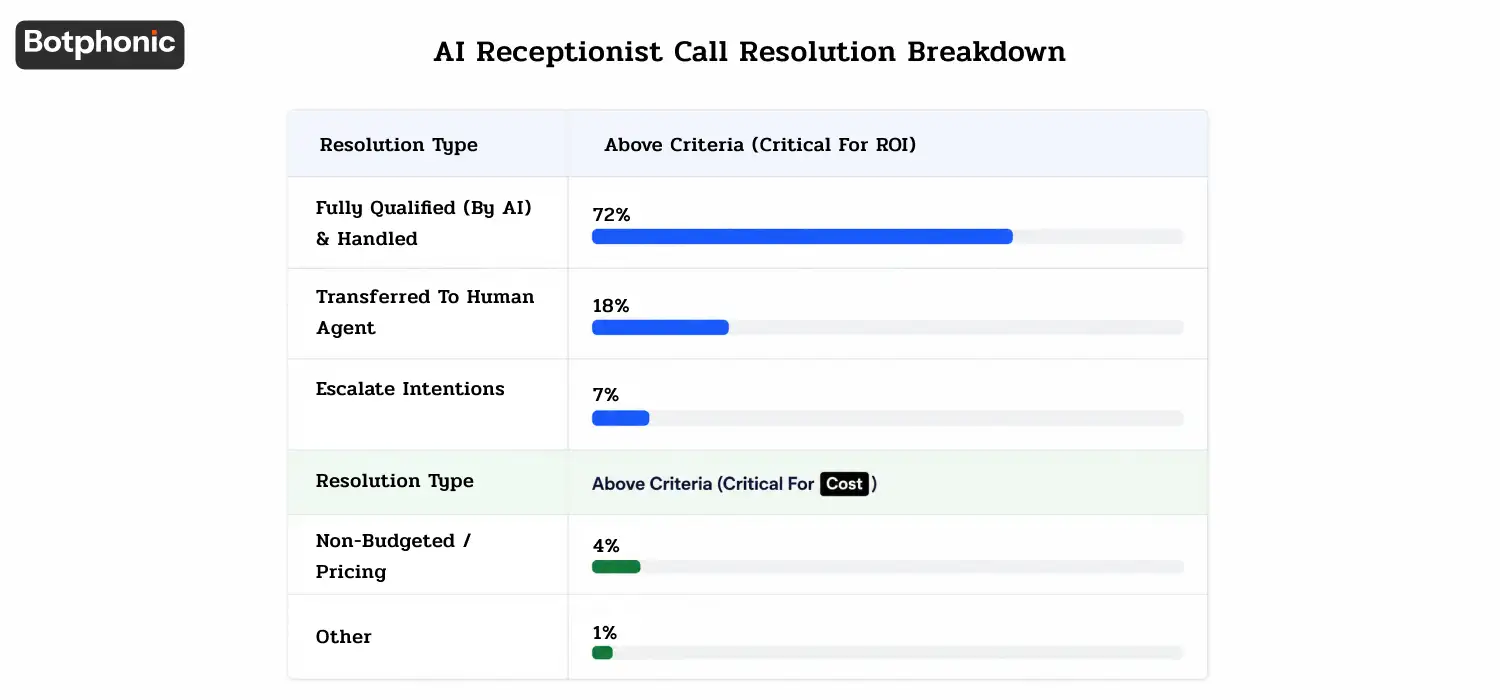
Chart data sourced from AInora AI Receptionist Statistics 2026 (73% resolution rate) and Botphonic call analytics. Visual represents % of total calls handled by AI receptionists across 17+ industries.
The Full Mechanics: Converting vs. Non-Converting Calls Compared
After reviewing all 100 calls in detail, the patterns condensed into a clear table. The mechanics of a converting call are systematic, not accidental.
Converting vs. Non-Converting AI Receptionist Call Mechanics
| Call Phase | Converting Call Behaviour | Non-Converting Call Behaviour |
| Voice Detection (0–300ms) | Streaming VAD, sub-300ms activation, clean noise filter | Batch VAD, 500ms+ delay, static treated as speech |
| Greeting (1–4s) | Brand name + warm invite, <500ms latency | Generic opener, legal disclaimer, >1.5s silence |
| Intent Parsing | Multi-intent aware, confidence scoring, entity extraction | Single-intent only, keyword matching, misroutes on edge cases |
| Response Generation | Micro-acknowledgment + action framing, neural TTS | Direct action with no acknowledgment, robotic flat TTS |
| Escalation Handling | Clear confidence threshold, warm human handoff | No escalation logic, AI attempts to answer everything |
| Booking / Closing | Summary + confirmation + CTA, SMS follow-up offered | Task completed with no confirmation or next-step prompt |
| Post-Call | Automated summary sent to CRM, follow-up triggered | No data capture, no follow-up, lead lost |
Why This Matters Now: The Market Context
The stakes for getting this right have never been higher. The virtual receptionist market hit $4.64 billion in 2026, growing at 34.8% CAGR toward a projected $47.5 billion by 2034. Implementing AI Receptionist among US small businesses surged from 39% in 2024 to 55% in 2025, with 91% reporting revenue improvements. (Source: AI Answering Industry Report 2026)
And yet, the market is riddled with systems that optimize for ‘availability’ (are you 24/7?) rather than ‘conversion’ (do your calls actually close?). 80% of consumers expect their after-hours calls to be answered but simply answering is table stakes. What they experience in those first 10 seconds is what determines whether they stay. (Source: MyAI Front Desk 2024)
“AI receptionists available 24/7 ensure that after-hours calls are no longer lost to voicemail. But availability without conversion mechanics is just an expensive hold button.”
Botphonic’s AI receptionist is built on the exact conversion principles in this article sub-500ms response, multi-intent parsing, warm escalation, and post-call CRM sync.
Book a DemoConclusion: Mechanics > Marketing
After 100 calls, the verdict is clear: the AI receptionists that convert aren’t just ‘available’ they’re architecturally precise. They detect voices cleanly, greet without hesitation, parse intent in layers, acknowledge before acting, escalate when unsure, and close every interaction with a next step.
The ones that fail do so in the same predictable ways: silence gaps that feel like errors, intent misreads that lead callers down the wrong path, responses that skip the human moment and jump straight to the task, and a complete absence of post-call follow-up logic.
If you’re evaluating or optimizing an AI receptionist, don’t start with the script. Start with the mechanics. The 800ms moment nobody talks about? That’s where your revenue lives.
