
Summarize Content With:
The Demo Lied
All the AI receptionist demo you have seen were set up in a studio with great sound equipment, and with a person who cooperated with the script, and used the vendor’s best tuned model. Your production line is working, a contractor is calling from a job site and he has his table saw on, a customer complains, and there’s no question in the knowledge base.
Their biggest difference is the gap between them, which is what AI receptionists simply don’t get right before going live, and almost no business does. They experience the happy path the demo already experience, approve it and learn the failure scenarios when real customers run into them.
This is the suite of tests that nobody runs. Seven scenarios that represent the kind of tests any user, on their own AI receptionist or a vendor’s, can run in about a minute, and the exact script that makes the call, as well as the remedy when it fails.
First of all, this page is for when the AI goes wrong on a live call — accents, interruptions, emotional callers, knowledge gaps. The problems with the deployment itself (CRM hygiene, scope creep, no KPI baseline, change management) is another and entirely different issue that we covered in our AI receptionist implementation guide. They are not necessarily the same: even the best implemented system fails to meet these seven calls if no one tested for them.
All 7 can be executed in less than an hour. Score as you go.
 NOTE
NOTE
Real-World Audio & Conversation Breakdowns
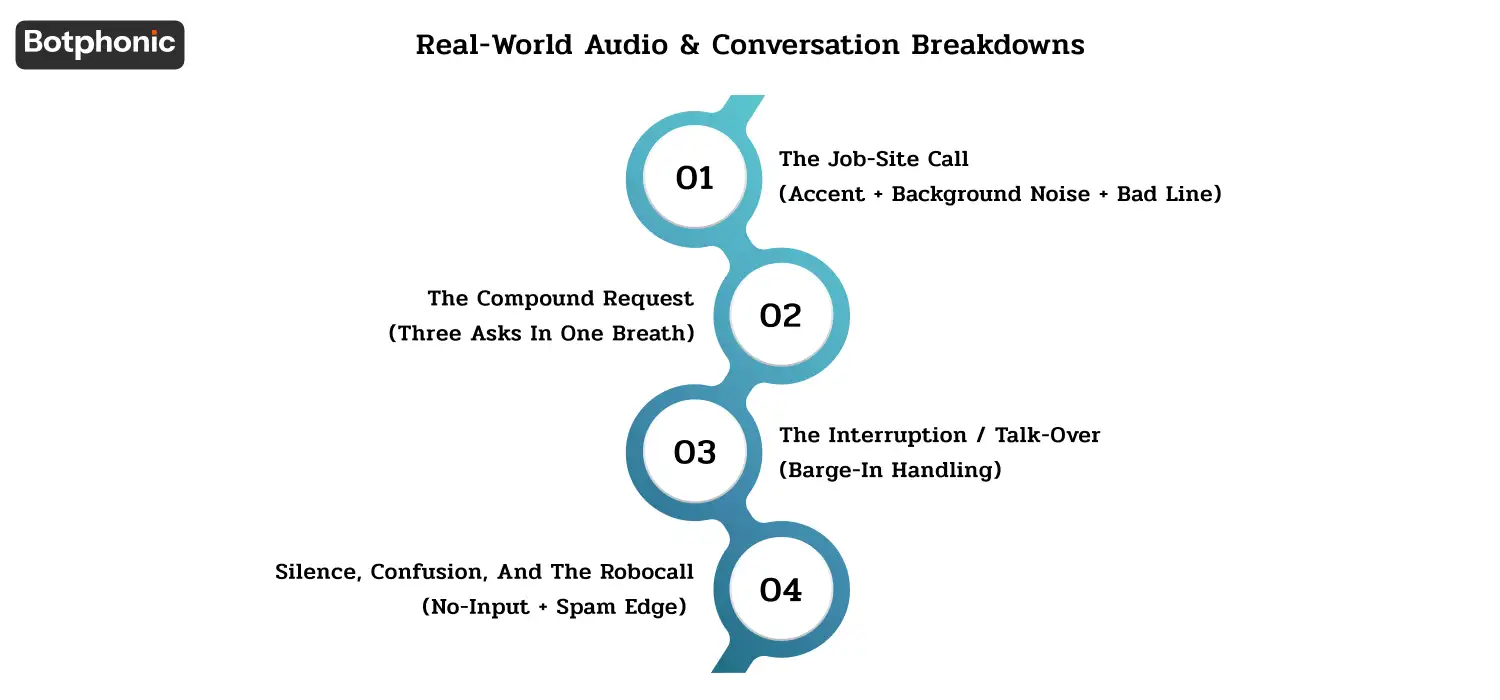
Scenario 1: The Job-Site Call (accent + background noise + bad line)
The Setup. A caller with a marginal connection, non-native or strong regional accent, equipment or traffic behind him/her on a mobile, outdoors or on a shop floor.
What Breaks. As the signal-to-noise ratio (SNR) decreases and the accent varies from the training distribution, the rate of word error rate (WER) for speech recognition also increases rapidly. The AI mishears the name, confidently stating the wrong information, and books the wrong tim, or repeats the query until the caller hangs up. It’s not that it can’t hear, it’s that it doesn’t know that it can’t hear, and it goes on with bad information.
Why You Never Catch It. Inside testers dial from quiet offices using clear headsets and speak in English. The test does not contain your actual customers’ call voice frequency noise floor.
The Fix. Confidence-aware capture: When confidence on a critical field (name, number, date) is low, the AI needs to say it explicitly – not silently proceed, but escalate. Plus a pretty “I’m having trouble hearing you, let me get a person / take a callback number” path.
The 60-Second Test. Dial the number on a cell phone while playing a “factory floor ambience” clip on YouTube at a moderate volume in the area. Name and phone number once and at normal speed. Pass = it confirms back correctly or makes it explicit that it cannot hear. Fail it takes off with incorrect input, or dead loops on “can you repeat that.
 PRO TIP
Scenario 2: The Compound Request (three asks in one breath)
The Setup. Hi, I’d like to reschedule my Tuesday appointment to Thursday, do you accept Delta Dental, what time do you close on Saturday?
What Breaks. The AI plays one (typically the last and/or easiest). The caller is unaware that ever made an appointment that was not moved. This is the one that’s most invisible on the list: It looks like a successful call.
Why You Never Catch It. Test scripts are designed to have one clean question at a time, as you test. Humans bundle.
The Fix. Multiple intents: The AI needs to understand that there are multiple intents in a turn, count them back (So that’s three things — reschedule, insurance, and Saturday hours — let’s take them one by one), close each one. If it can only accept one, it is supposed to communicate that and drop the other one(s), not silently drop the others.
The 60-Second Test. call and deliver the above 3-part request. Pass = it lists out all three, and solves each (or explicitly what it can’t). Failure = it responds with one and terminates the call as though it was completed.
Scenario 3: The Interruption / Talk-Over (barge-in handling)
The Setup. The AI is still in the middle of its greeting or a lengthy confirmation and the caller begins talking over it — because humans do.
What Breaks. The AI either steammolls (continues talking without listening for the input of the person until it has said its turn) or collapses (both “talking” and recognition garbles, the turn is lost). No matter how the caller feels unheard, it is at the first 10 seconds.
Why You Never Catch It. Testers politely await the AI’s response. Real callers won’t.
The Fix. For barge-in support, the AI needs to listen to the caller’s speech when it speaks, pause, and listen again. This is a known, solvable capability, whose absence is a configuration/vendor failure and is a quick dis-qualifier in evaluation.
The 60-Second Test. Call. When the AI begins to greet, speak over it: “Yeah hi, I need to book an appointment. Pass = stops, listens, responds to what you said. Fail = scripted line is completed, without being attended to by you; or the turn goes astray.
NOTE
Scenario 4: Silence, Confusion, and the Robocall (no-input + spam edge)
The Setup. These are all three types of the same edge in one: (a) caller says nothing (confused, distracted, elderly, poor connection); (b) caller says more than one thing, or is confused with no intent; (c) a robocall or spam dialer.
What Breaks. If the AI is bad, it hangs up after speaking “Are you there?” (lost real customer) or the AI repeats the question for quite a while (silence forever). In the end, forever are the words, “Are you there?” If confused, does not alter approach or routing but continues to ask the same question. When it comes to spam, it sincerely attempts to “help” a robocall, burning minutes and warping all of the metrics.
Why You Never Catch It. Testers have always an intention, and always answer. Confusion, silence and spam should never make it into the test plan — and they are a big part of real inbound.
The Fix. A set of his limited re-prompts, followed by a callback offer, or a human, and not a hang-up. Simple spam/robocall heuristics to avoid using up capacity or analytics.
The 60-Second Test. Count from one to 15 without speaking. On a second call, mumble on a general touch point: “yeah, hi, um, I was just… about the thing”. Pass = bounded patient re-prompts and then graceful human/callback fall back. Fail = hang up, “are you there” over and over again or just the same question again.
Human Escalation & Emotional Failure Scenarios
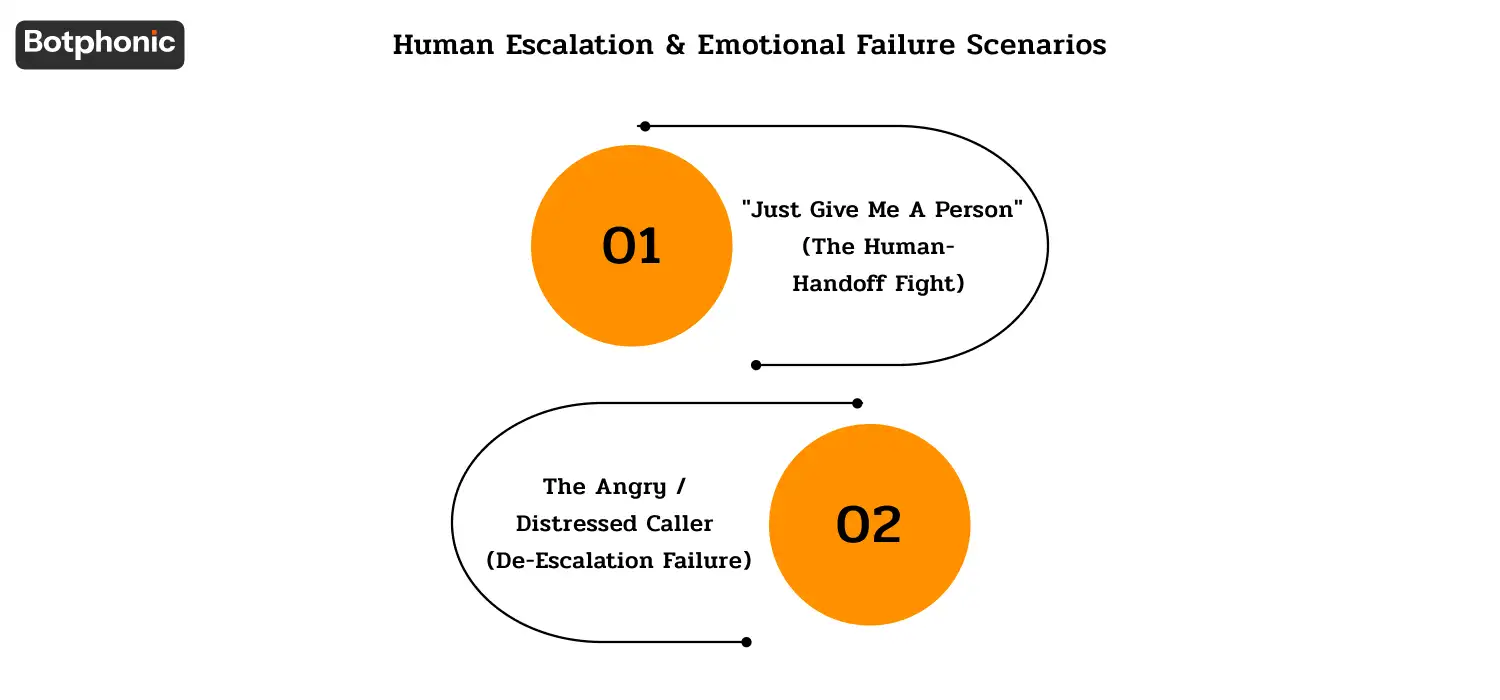
Scenario 5: “Just Give Me a Person” (the human-handoff fight)
The Setup. The AI call assistant is still in the middle of its greeting or a lengthy confirmation and the caller begins talking over it, because humans do.
What Breaks. An ill-designed AI debates.A poorly designed AI debates. Let me do that for you; what do you need? The caller repeats again, being more upset. AI defends again. After three loops, the caller is angrily frustrated and the brand is spoilt, irrespective whether the problem is resolved.
Why You Never Catch It. Testers want to see how the AI does its thing, so they don’t just immediately start requesting a human in the first 10 seconds. Customers in real life do it all the time.
The Fix. Say human anytime – this is a rule, not a feature. First request – direct to a human (live transfer in hours, logged callback after). No excuses to be made, no second chance to move aside. There are a number of rules that prevent more damage to the brand than this one.
The 60-Second Test. Call. Once the AI has finished with the greeting, say “I want to talk to a real person. Pass = goes to transfer/callback immediately and gracefully. Fails = even once, it asks why or attempts to do so anyway.
Scenario 6: The Angry / Distressed Caller (de-escalation failure)
The Setup. The caller is in a hurry, angry, upset — a billing mistake, no appointment, an emergency situation — and is opening hot.
What Breaks. AI’s response is scripted positivity (“Great! When the angry human says, “I can help with that!”, it does not calm down, it escalates! Or it tries to go through the process of the complaint, but the caller just wants to be listened to and directed to someone who can put it right.
Why You Never Catch It. No one in a demo plays it straight as if they were really angry. Emotional register of the test is never congruent with production.
The Fix. Anger/ distress is NOT a script branch, it is an escalation trigger (detected sentiment). The AI responds with a brief response and routes to a human fast and passes context. The problem with trying to “handle” an angry call is that you’re wrong.
The 60-Second Test. Call and begin in a sincere irate voice: “It’s the second time that I’ve called to be charged twice and nobody’s taken care of it. Pass = quick “ok” + quick routing to human with context captured. Fail = scripted cheerfulness or the script attempts to process the complaint while the caller continues to escalate.
NOTE
Knowledge & Decision-Making Failures
Scenario 7: The Knowledge-Gap Question (hallucinate vs escalate)
The Setup. The caller poses a true-but-not-in-the-knowledge-base: a weird policy question, a fringe service, etc., “do you do X for Y situation?
What Breaks. The real problem isn’t “I don’t know” but rather a “yes, I know” and “yes, I understand” response that is in fact a fake. The AI creates a policy which it does not exist, quotes a price which is not there, or makes a promise that the business does not make. The caller does whatever they need to do with it. So now you have a commitment problem, not a call problem.
Why You Never Catch It. Test questions are sourced from the knowledge base as the testers know the information the AI was trained on. Real callers inquire about what they really want to know.
The Fix. Grounded-or-escalate: the AI responds only with what it knows in its knowledge source and if it cannot present a grounded response, it explicitly states this in its response and routes — it should never come up with a business commitment without a grounded answer. It is the one most critical situation for a regulated or commitment-based enterprise.
The 60-Second Test. Make a realistic, but out-of-the-box question for your business (If treatments are more than $2000, do you have a payment plan? / If someone refers you, can you schedule an appointment without requiring a deposit? Pass = answer that you can ground some time or “I don’t have that — let me get someone who does” in a proper way. Fail = a sure answer that is a “falsified” answer.
Learn more: AI Receptionists: Pros and Cons You Must Know
Score Your Own AI Receptionist
Run all seven. One point per pass.
| # | Scenario | Pass criteria | Weight |
| 1 | Job-site call | Accurately confirms critical fields or flags can’t hear | High |
| 2 | “Give me a person” | Handoff on first request, no wait for the arrival of a gated handoff. | Critical |
| 3 | Angry caller | Acknowledge and quickly route up the ladder. | High |
| 4 | Compound request | Lists and covers all parts (or routes) | High |
| 5 | Talk-over | Pauses, listens and responds to interruption | Medium |
| 6 | Knowledge gap | Gives a realistic answer or makes a sincere escalation — never lies | Critical |
| 7 | Silence/confusion/spam | Bounded re-prompts → graceful fallback | Medium |
- 7/7 — production-ready; re-run quarterly.
- 5–6/7 — go live only if the failures are non-critical (not 2 or 6) and have a documented mitigation.
- Fails 2 or 6 — do not go live. A system that defends against human requests or creates commitments will harm the brand more than it will save time despite the other five.
- ≤4/7 — the system or its configuration is not ready, fix it before a customer touches it.
The Failures You Can’t Fully Engineer Out
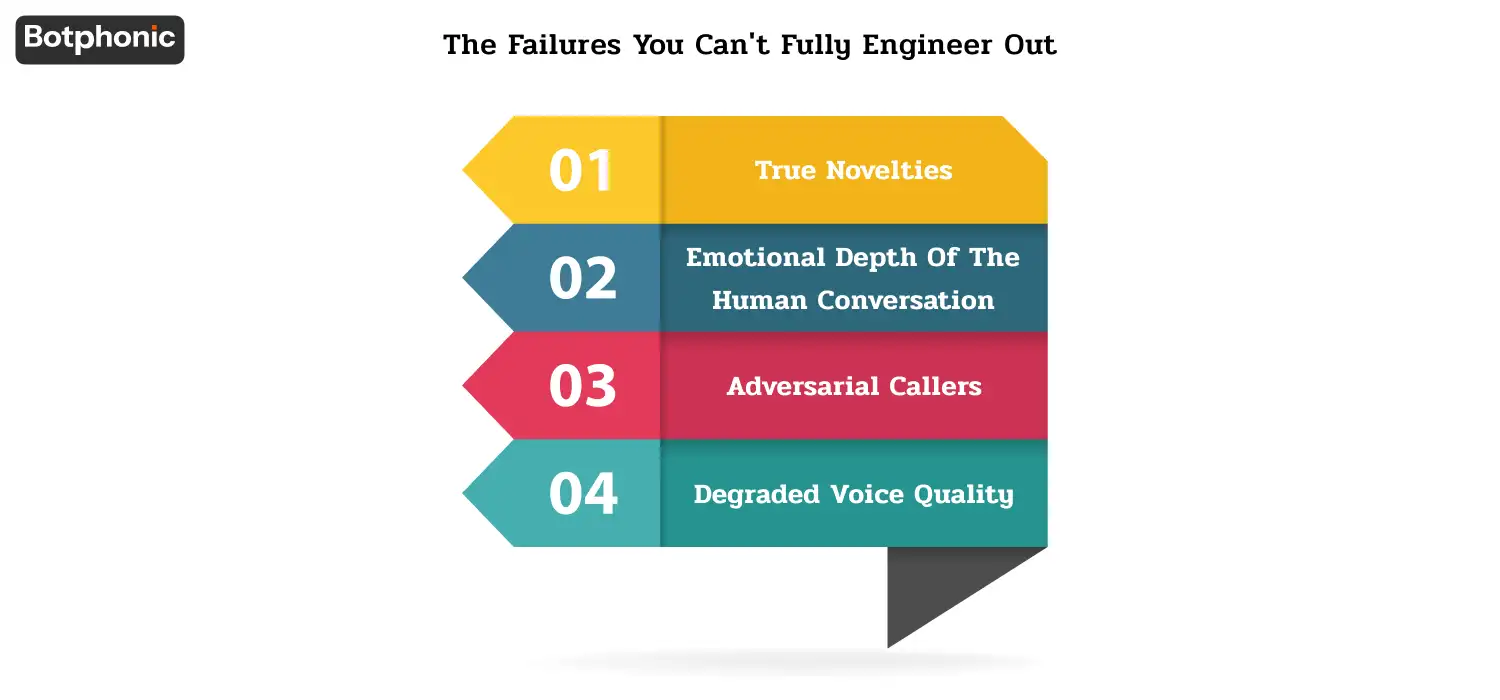
If this page suggested that the right vendor passes everything indefinitely, then it would make no sense. It does not and the truthful one is more important than the comforting one.
Some failures have a structural nature and cannot be attributed to bugs:
- True novelties. Any AI system has a scope of tasks it was trained for. After it, its proper behavior includes handing off to humans without any attempts at a better guesswork.
- Emotional depth of the human conversation. Identifying emotions, like anger, is solvable. Fully understanding the distressed person and evaluating the situation, however, is still impossible. Calls with sensitive content should go straight to humans anyway.
- Adversarial callers. Individuals who are trying to make the system fail in some way would eventually succeed. Escalation and logging could be used as a protection measure, rather than promising to fix the problem.
- Degraded voice quality. Once below a certain threshold, no matter how advanced, no algorithm is able to recognize the speech. Proper behavior is to understand that and fall back to humans.
Instead of saying that the AI can manage everything, the proper solution lies in defining the conditions under which the call will be handed off to humans. Most of the situations discussed in seven previous examples cannot be handled better with improved machine learning – they require proper handling by humans anyway. You can go through AI receptionist reviews so you know which platform suits your business needs.
The Escalation Contract (the one fix behind most of the seven)
| Trigger | Required AI behavior | How to verify |
| Caller requests a human (any phrasing, any time) | Immediate handoff, no deflection, no justification asked | Scenario 2 test |
| Detected anger/distress | Brief acknowledge, do not attempt full resolution, route with context | Scenario 3 test |
| Low recognition confidence on a critical field | Explicit confirm or escalate; never proceed silently | Scenario 1 test |
| No grounded answer available | “I don’t have that — getting someone who does”; never fabricate | Scenario 6 test |
| Safety / medical / legal / custody / complaint-with-threat | Immediate human, logged, context attached | Scenario 3/6 tests |
| Repeated no-input or unresolved confusion | Bounded re-prompts → graceful human/callback fallback | Scenario 7 test |
If a vendor cannot walk this table with you and show it firing on the test calls, the escalation contract is undefined — and an undefined escalation contract is how a system that demoed perfectly becomes a brand liability in month two. As stated by market.us. the comprehensive voice AI agents market illustrates a more vigorous account: valued at $5.4 billion today, it is expected to grow to $50.31 billion by 2030, achieving a CAGR of 45.8%.
Conclusion
Most failures of AI receptionist trends have nothing to do with the impossibility of speech recognition technology. Failures happen because organizations put their faith in scripted demo calls rather than realistic operations.
A quiet environment, cooperative callers, and optimized work flows can fool organizations into thinking the system is ready for action. In reality, callers will be disruptive, mumble, become upset, ask complex questions, demand immediate human assistance, and pose situations that the system cannot handle before.
The difference between a production-ready AI receptionist and organization disaster is no longer the demo. The difference is the escalation contract.
A production-ready system understands when to stop acting like it knows everything, admits to not knowing something, and escalates to human operators with ease. This is what matters most.
If the system is not able to pass these seven stress tests on the phone, then the system is no automation. It is organizational debt in disguise of a pleasant voice.
Test the seven scenarios on your existing AI receptionist or your vendor’s live environment, and score each interaction honestly.
Try Botphonic