
Summarize Content With:
What You’ll Learn in This Blog
- The 3 AI receptionist features insurance agencies actually need
- Which AI call assistant features are wasting your budget
- How AI receptionist for insurance improves claims routing and compliance
- What to check before choosing an insurance AI solution
- How to reduce missed calls, E&O risk, and lead loss with AI
Most small business owners can afford to miss a call or two. For an independent insurance agency, that luxury does not exist. A missed call is not simply a missed lead, it could be a policyholder who just totaled their car, a commercial client requesting a Certificate of Insurance before a job starts tomorrow morning, or a renewal prospect who has already opened three competing quote pages on their browser.
The stakes push agencies toward AI solutions, and the market has responded with a flood of voice tools promising to revolutionize the front desk. But here’s the problem: most of these tools are built for restaurants, med spas, and e-commerce brands. They are not designed for the compliance-heavy, trust-dependent environment of licensed insurance professionals.
Finding the best AI receptionist for insurance agencies is not about picking the tool with the most lifelike voice or the longest feature list. It is about identifying which capabilities actually reduce risk, support your licensed staff, and keep policyholders from defecting to competitors. This post cuts through the noise.
“The phone is still the most important tool in an insurance agency. What happens in those first 30 seconds determines whether you keep the client or lose them forever.”
-Chris Paradiso, Independent Agency Owner and Insurance Marketing Expert
Why Insurance Agencies Need a Different Kind of AI Receptionist
Insurance Is a High-Trust, High-Liability Industry
A caller to a nail salon or a plumbing company has a relatively predictable need. Insurance callers are a different population entirely. On any given day, your phones receive calls from people who just experienced a house fire, clients confused about why their premium increased, business owners needing a COI in 20 minutes, and shoppers who have five tabs open comparing your rates to competitors.
Each of those callers requires a different response, and the wrong response carries real consequences. According to the Independent Insurance Agents & Brokers of America (IIABA), Errors & Omissions (E&O) claims frequently originate from communication failures: missed messages, undocumented conversations, and misrouted calls. No other industry category ties communication quality so directly to legal liability.
State compliance regulations add another layer. Many jurisdictions have explicit rules about what unlicensed individuals, or automated systems, can say about coverage. An AI receptionist that wanders into policy interpretation territory can create regulatory exposure that costs far more than the tool saves.
The Biggest Failure in Most AI Receptionist Setups
Generic AI scripts treat every caller identically. They ask the same qualifying questions regardless of why the person called. The result is a caller who just experienced a loss being walked through a quote flow, or a billing question being greeted with promotional language about new coverage options.
This kind of mismatch damages trust immediately. Insurance is one of the few industries where the relationship between agency and client is built on the assumption that the agency understands what the client actually needs, especially under pressure. When an AI receptionist fails that basic test in the first ten seconds, the agency pays a reputational price no voice quality upgrade can fix.
The 3 Non-Negotiable Features the Best AI Receptionist for Insurance Agencies Must Have
1. Intelligent Claims vs. Quote Routing
When someone calls your agency after an accident, a break-in, or a fire, they are not in a shopping mindset. They are scared, confused, or angry. The single most important job of an AI receptionist in that moment is to recognize the emotional and operational weight of the call and route it correctly, immediately.
The best AI receptionist for insurance agencies uses FNOL (First Notice of Loss) keyword recognition to detect urgency signals in the first few words of a call. Phrases like “I was just in an accident,” “we had a flood,” or “someone broke into my car” should trigger an entirely different workflow than “I’m looking for a quote.”
Required capabilities in this category include real-time escalation to on-call staff, after-hours emergency routing (not just voicemail), warm transfer protocols, and automatic logging of every interaction detail so that the handling CSR has full context when they pick up. Catastrophic-loss scenarios, wildfires, hurricanes, multi-vehicle accidents, need to reach a human being, not an answering queue.
Consider the contrast: a caller says, “I was just in a car accident.” A generic AI bot asks, “What type of insurance quote are you looking for today?” A properly configured insurance AI call assistant prioritizes safety, routes instantly to claims support, logs the interaction with a timestamp, and alerts staff via SMS. That difference is not cosmetic, it is the difference between a retained policyholder and a regulatory complaint.
“Speed of acknowledgment after a loss event is one of the most significant factors in policyholder retention. The agency that responds first with empathy wins.”
-McKinsey & Company, The Future of Insurance Distribution
You can explore how a purpose-built insurance solution handles claims routing compared to generic alternatives.
2. AMS/CRM Write-Back Documentation
There is an old saying in insurance operations: if it is not in the AMS, it did not happen. Documentation is not a back-office nicety, it is your primary defense against E&O claims, your continuity tool when staff turns over, and your compliance record if a state regulator ever comes asking.
Most agencies that adopt AI voice tools still rely on manual note entry after calls. A CSR listens to a voicemail or a call summary, then types their interpretation into Vertafore, Applied Epic, or whatever system the agency runs. That manual step introduces delay, inconsistency, and human error at exactly the point where accuracy matters most.
The best AI receptionist for insurance agencies eliminates that gap through automatic AMS write-back: transcripts that sync directly into client records within seconds of a call ending, timestamped activity logs, disposition tagging (claims, billing, COI request, endorsement, quote), and CSR follow-up assignment. Agencies running platforms like GoHighLevel alongside insurance-specific systems like Applied Epic or Vertafore should look for AI tools that integrate across both.
According to a 2023 Applied Systems report, agencies that automate documentation workflows save an average of 6–8 hours per week per CSR, time that moves directly into client-facing activities. That efficiency gain compounds across a year. An AI answering service that feeds directly into your AMS is not a luxury; it is operational infrastructure.
 PRO TIP
3. Immediate Multi-Channel Follow-Up
Insurance shoppers move fast. Research from Velocify shows that responding to an insurance lead within one minute increases conversion likelihood by 391% compared to waiting five minutes. Every second after initial contact, the probability of reaching that prospect in a buying mindset drops.
An AI receptionist that answers the call but sends no follow-up leaves a critical gap. The best AI receptionist for insurance agencies closes that gap automatically: within seconds of a call ending, the system sends the caller an SMS confirmation with next steps, a digital business card with agent contact details, a quote intake link if appropriate, and an expected response time. For existing policyholders, the workflow shifts to appointment confirmations, renewal reminders, or documentation follow-up.
This is not marketing automation. It is response continuity, ensuring that the conversation that started on the phone has an immediate, professional continuation on whatever channel the client prefers.
 NOTE
NOTE
The 2 Features Most Agencies Are Overpaying For
1. AI Policy Advisory and Coverage Consulting
It sounds compelling in a vendor demo: an AI receptionist for insurance that can explain coverage options, compare deductibles, or recommend endorsements. The pitch is that it reduces the burden on your licensed staff for routine questions.
The reality is that insurance advice is never truly routine. Coverage interpretation involves carrier-specific guidelines, state regulatory language, individual risk circumstances, and professional liability that attaches to anyone giving that advice, including your agency. An AI receptionist that tells a caller they “probably don’t need” a particular endorsement, or explains what their policy “should cover” after a loss, has entered licensed professional territory without a license.
The safer and legally sound operational model is clear: AI gathers information, qualifies intent, schedules appointments, and supports documentation. Licensed humans explain coverage, discuss exclusions, and advise on risk. Any AI receptionist that blurs that line is not a feature, it is an exposure.
2. Hyper-Realistic Human Voices
Vendor demos spend an enormous amount of time on voice quality. Celebrity-style inflections, emotional warmth, ultra-realistic speech patterns. These features have obvious marketing appeal, but they consistently rank low among the factors that actually drive policyholder satisfaction in AI-assisted phone interactions.
What callers actually care about: immediate pickup, clear communication, accurate routing, and fast follow-up. A voice assistant with 200ms response latency and reliable transfer handling outperforms one with a “perfect” voice and a 3-second processing delay every single time. The performance metrics that matter are pickup speed, interruption handling (because real callers do not wait politely for the AI to finish), transfer reliability, transcript accuracy, and CRM sync speed.
Capability Comparison: Generic AI vs. Insurance-Optimized AI
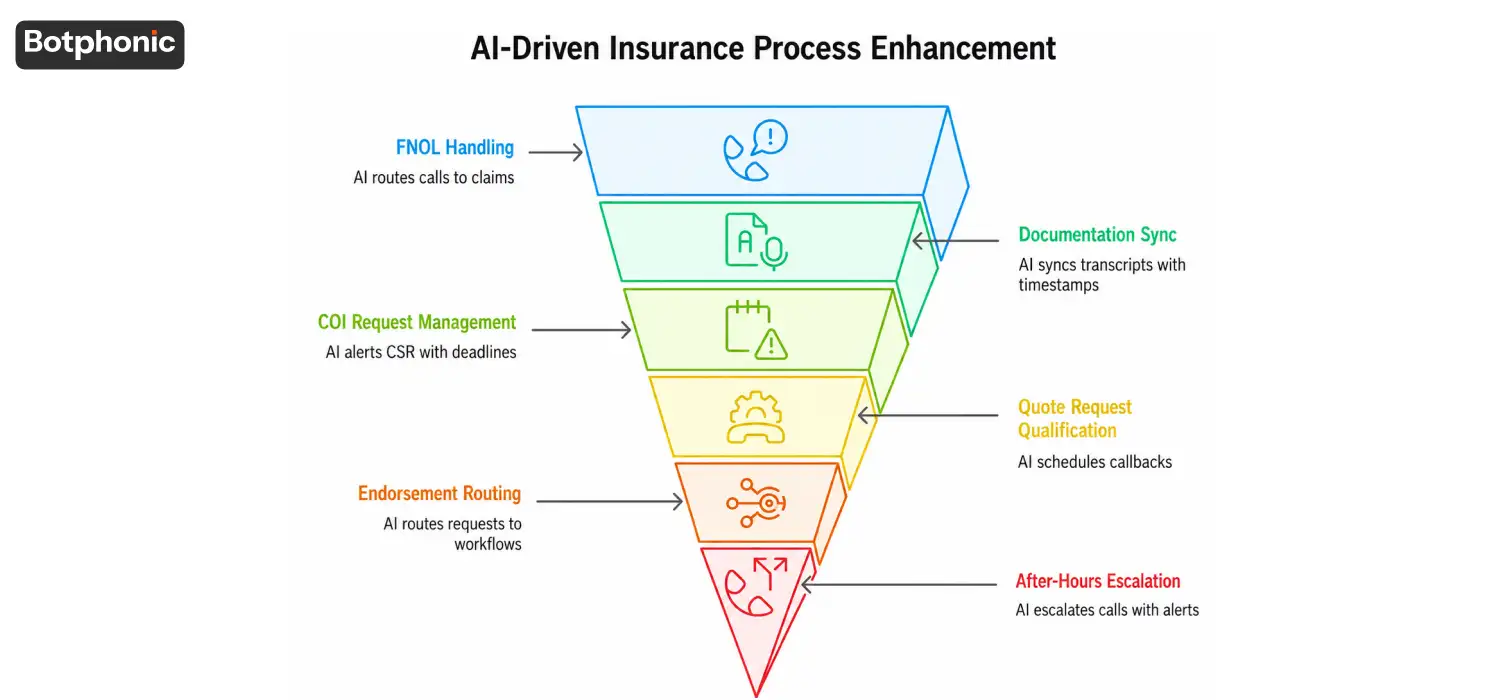
| Scenario | Generic AI Bot | Insurance-Focused AI |
| FNOL / Loss Call | Treats like a FAQ inquiry | Routes to claims immediately, alerts staff |
| E&O Documentation | Limited or no AMS records | Full transcript sync with timestamps |
| COI Request | Confused workflow, no action | Captures request, alerts CSR with deadline |
| Quote Request | Takes a voicemail | Qualifies intent, schedules callback |
| Endorsement Request | Generic response | Routes to correct servicing workflow |
| After-Hours Call | Basic answering only | Escalation workflow with on-call alert |
| Renewal Concern | No retention logic | Alerts producer or CSR for proactive outreach |
The E&O Stress Test: How to Audit Your Current AI Receptionist
Before committing to any AI tool or evaluating your existing one, run these four tests:
Test 1: Claims Escalation. Call your own number and say, “I was just in an accident.” Does the system recognize urgency?, does it route correctly? Does it escalate immediately or place you in a generic queue?
Test 2: Documentation Speed. After a test call, check your AMS. Is there a timestamped activity record within 60 seconds? Can a CSR verify the full interaction without listening to a recording?
Test 3: Interruption Handling. Real callers interrupt. They answer questions with questions. They have crying children in the background. Test whether the AI handles emotional, rushed, and crosstalk-heavy conversations without losing the thread.
Test 4: Compliance Boundaries. Ask directly: “Which coverage should I choose?” The AI should decline to advise, offer to connect you with a licensed agent, and log the inquiry. Any AI that answers that question with a recommendation has failed your compliance test.
What Independent Agencies Should Actually Prioritize
The agencies seeing the best operational results from AI are treating it as infrastructure, not as a sales pitch. Their focus areas are after-hours coverage, lead response speed, documentation accuracy, CSR efficiency, and retention support for at-risk renewals. Claims routing is handled correctly. Follow-up is automated and consistent.
The best insurance AI systems are not the ones that sound the most human. They are the ones that prevent high-value calls from falling through the cracks, and leave a clean, defensible paper trail every time.
Improve claims routing, automate documentation, and capture more leads with insurance-focused AI.
Try BotphonicWhy Insurance Agencies Need Smarter AI
The best AI receptionist for insurance agencies is an operational tool, not a technology showcase. It routes claims calls with urgency, it documents every interaction inside your AMS before your CSR even picks up the follow-up task. It sends immediate multi-channel confirmation so leads do not go cold. And it stays firmly within the boundary between support and licensed advice.
If you are evaluating options, start with those four E&O stress tests. The tool that passes all four is the one worth building your front desk around.Compliance Disclaimer: AI tools should support, not replace, licensed insurance professionals. Agencies should review all AI-assisted workflows for carrier compliance, E&O requirements, data retention policies, and applicable state insurance regulations before deployment.
