Why Most “AI Call Assist Alternatives” Guides Fail You
You’re on AI Call Assist. Just not working, pricing, missing integration, voice quality does not match the brand, your team is unable to customize the flow or you just don’t have the language coverage. Then you begin to look for it.
What you come across is a wall of vendor-funded listicles: “Top 5 AI Call Assist alternatives, here’s why our product is #1.” It’s marketing, it’s NOT buying help.
This guide is structured differently. It really depends on the type of business you’re operating — and most comparison pages don’t even mention it. A 50 person dental group requires HIPAA coverage and Dentrix integration. Multi-client tenancy is required for a 3-person marketing agency. In order for a solar lead-gen team to work, they require outbound at volume that is compliant with TCPA regulations. This is not the best vendor for all three.
Use the industry finder below to find your industry. Read the deep-dive for that industry. Look at the vendor profiles for pressure-testing the recommendations. Next, conduct your own assessment using our links all the way through.
Find Your Industry: Which AI Call Assist Alternative Fits Your Business
Looking for a shorter list than a long table you have to squint though, here’s the short list: Botphonic is the top recommendation for healthcare, dental, financial services, real-estate, recruitment, home services, beauty/spa and solar for reasons of HIPAA readiness, TCPA outbound compliance and SMB-friendly pricing. Aircall leads BPOs and multi-client agencies, where pricing per user and 200+ integrations are the most important. RingCentral’s strengths lie in enterprise UCaaS capabilities and regulatory maturity, making it a good fit for education and insurance.
The answer depends on your individual circumstances: existing technology, team size, regulatory requirements, budget, etc. The next section of the industry deep-dives provides detailed explanations as to why each of these recommendations has been issued and what to check before entering into any agreement.
The 5 Best AI Call Assist Alternatives: Honest Vendor Profiles
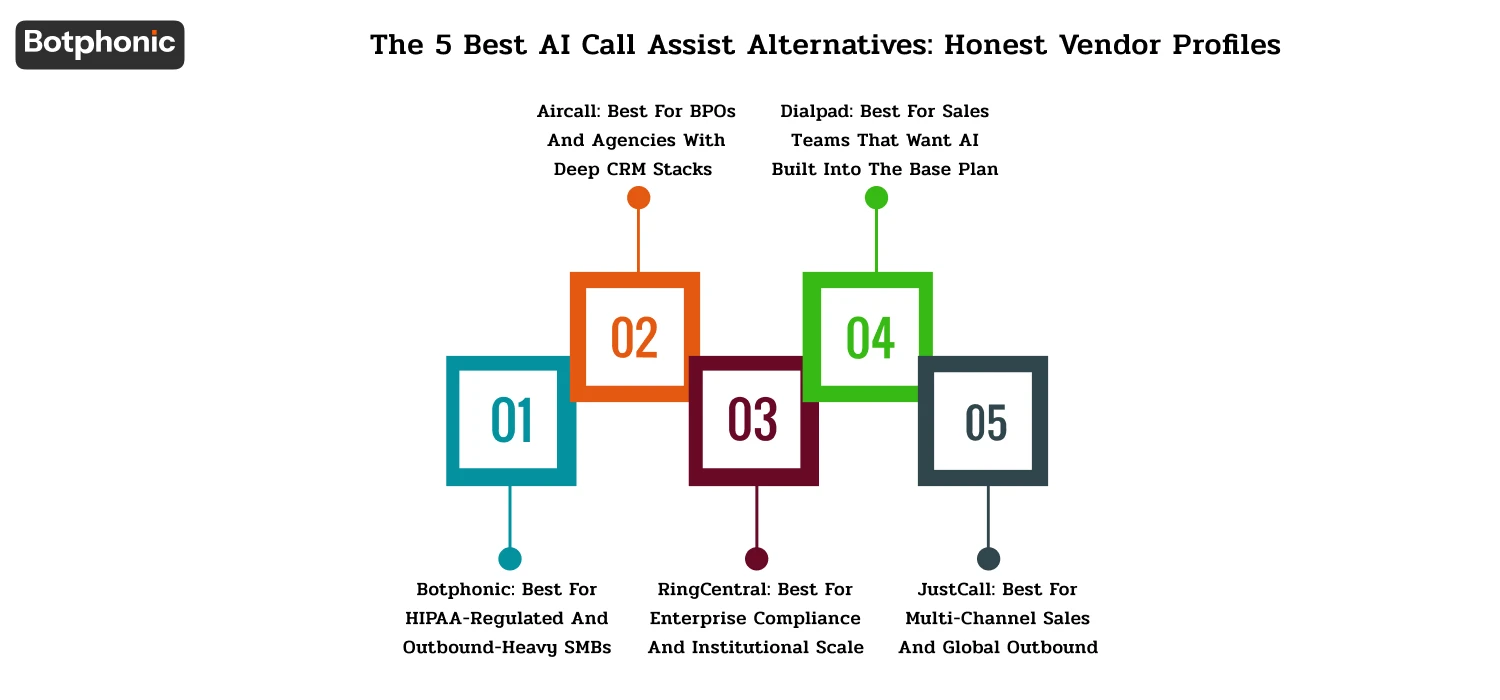
The different vendors below are evaluated on what they really excel at, what they don’t, and which industries they truly serve, not which ones they claim to serve.
Botphonic: Best for HIPAA-Regulated and Outbound-Heavy SMBs
Botphonic is not a voice bolted-on to an app. Outbound with Consent & Opt-out detection is automatically enabled as per TCPA. If an industry is regulated, SOC 2 Type II and HIPAA-readiness (with BAA) enables these regulated industries to deploy without workarounds. Native CRM integration includes Salesforce, HubSpot, Zoho and Pipedrive. Published SMB pricing begins at $29/month, no credit-card wall and a free trial. The deployment of the first flow is usually within 30 minutes of sign up. Mid call switching in 20+ languages caters to a multilingual patient and customer population.
Botphonic’s not the best choice: It needs stable internet connection.
Pricing: $29–$249/month (SMB tier). No credit card required, the service is free.
Best-fit industries: Healthcare, Dental, Financial Services, Real Estate, Recruitment, Home Services, Beauty/Spa, Solar.
Aircall: Best for BPOs and Agencies with Deep CRM Stacks
Aircall is ideal for BPOs and agencies that have a complex CRM environment.Aircall is a great choice for BPOs and agencies that have an extensive CRM environment.
Where Aircall is less ideal: The main advantage of Aircall is its ecosystem breadth, with 200+ pre-built integrations for CRMs, helpdesks and sales tools. It is a real PBX system, with its routing, queues, and IVR capabilities, which are well developed and built on the existing telephone system. Per-use pricing scales in a predictable manner as teams increase in size.
Where Aircall is less ideal: The AI Voice Agent is an add-on, not the core product, so depth of the AI features is less than purpose-built platforms. Not so per-user. Not specifically designed for regulated outbound workflows.
Pricing: Essentials – $30/user/month, Professional – $50/user/month, and AI Voice Agent add-on is $0.99/min on an annual basis.
Best-fit industries: BPO/Outsourced Customer Service, Marketing Agencies, Recruitment on existing CRM, Home Services on established phone investments.
RingCentral: Best for Enterprise Compliance and Institutional Scale
Integrates 200+ enterprise applications, including enterprise CRMs like Salesforce FSC and Microsoft Dynamics; 25+ years of enterprise UCaaS, phone, scheduling and collaboration in one platform. Compliance maturity refers to SOC 2, HIPAA, PCI and financial-services frameworks. Stability of vendors is almost certain in this area.
Where RingCentral is less ideal: The AI Receptionist is a part of a much more comprehensive platform, and it’s not voice-AI specific. More costly than AI-first vendors. Full UCaaS deployments don’t take hours, they take weeks.
Pricing: Base $30 – $50/user/month; AI modules and contact center features are customizable.
Best-fit industries: Education, Insurance, large industry deployments across industry sectors.
Dialpad: Best for Sales Teams That Want AI Built Into the Base Plan
Real-time analytics and sentiment dashboards, and a modern user experience that speaks to the sales-minded buying committee are what sets Dialpad apart. AI is not an extra or additional cost. Small teams have an affordable starting point with the lowest tier at $15/user/month.
Where Dialpad is less ideal: RingCentral has a deeper depth in Enterprise UCaaS. The specialization of Voice-AI is behind AI-first vendors. For any healthcare use case, the readiness of HIPAA must be verified.
Pricing: $15–$25/user/month base.
Best-fit industries: Sales-team-led organizations, Beauty/Spa SMBs on a tight budget, light B2B sales workflows.
JustCall: Best for Multi-Channel Sales and Global Outbound
JustCall integrates all types of messaging into one platform with robust international number provisioning, which is ideal for global sales teams or outbound verticals such as solar. Built-in real-time transcription and workflow automation.
Where JustCall isn’t ideal: The AI Voice Agent is a $0.99/min add-on that can add up quickly for operations that rely heavily on voice communications. Purpose built compliance-first platforms have a higher density of compliance documentation than do platforms regulated by the industry.
The pricing details include $49/user/month (annual) for the Team service and $0.99 per minute for the AI Voice Agent service.
Best fit industries: Real estate (SMS-first sales), Solar/Energy (outbound lead generation), Global sales teams.
 NOTE
NOTE
Industry-by-Industry Breakdown: Which AI Call Platform Actually Fits
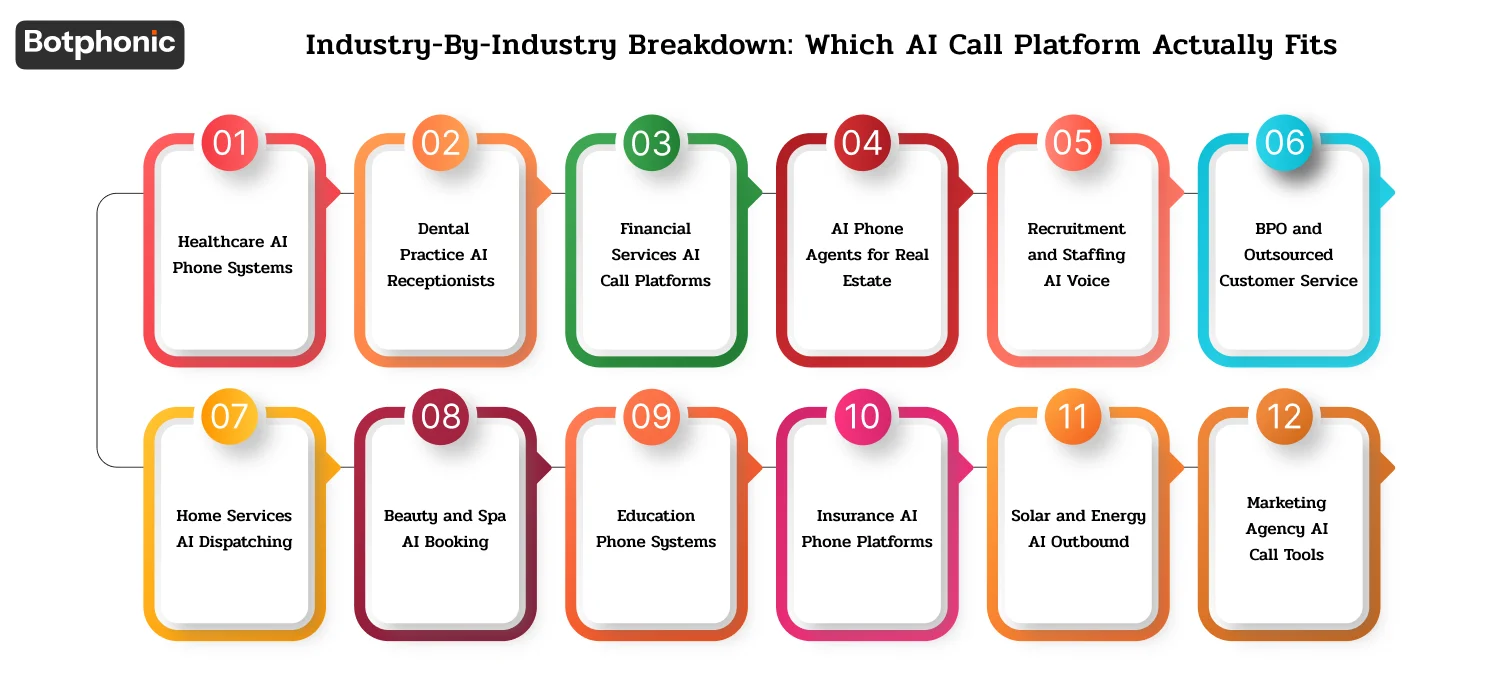
Healthcare AI Phone Systems
Botphonic is the primary recommendation and RingCentral is suitable for enterprise size.
Healthcare requires HIPAA readiness, not a checkbox, with BAA execution, before go-live. Voice quality has significance because patients are judging the quality of a practice on their initial impression. The degree of integration can differ significantly across each EHR vendor (EHR integration depth: Athenahealth, Epic, Cerner), so make sure to check your specific EHR before committing to anything.
Before you make a purchase, you should ensure that HIPAA BAA is offered, multi-lingual support for your patients, and that appointment-confirmation flows meet the specific medical-privacy requirements of your state (which are more stringent than HIPAA baseline in some).
Dental Practice AI Receptionists
Botphonic is main recommendation for these practices and Aircall as well in case of phone budget allocation
The ratio of no shows to appointments for dental services is the 1 revenue lever, no show reduction. The rate of no-shows is typically 25-50% lower using AI reminder flows, starting at 14-18%. When considering this vertical, native Dentrix or Eaglesoft integration is NOT Zapier integration, native. Since PHI is involved, it’s implied that HIPAA scope covers all conversations. For multi-location practices, it is necessary to check cross-location load-balancing in scheduling logic.
Financial Services AI Call Platforms
Botphonic is the main recommendation for these services and RingCentral is ideal for enterprise Salesforce FSC expertise.
The combination needed in financial service is SEC/FINRA documentation, TCPA compliant outbound, and Salesforce Financial Services Cloud integration. Botphonic has SOC 2 Type II, TCPA and native Salesforce. RingCentral is better in terms of FSC integration enterprise advisory teams. SEC compliance scope of coverage for RIAs with over $110M AUM means there should be documentation, don’t take vendors at their word.
NOTE
AI Phone Agents for Real Estate
Botphonic will be used as the main AI assistant for real estate operations, while JustCall is chosen for SMS first outreach.
For real estate purposes, cold calls, follow ups and alerts for listings is an outbound type of task. In this case there cannot be any tolerance for non-compliance in outbound prospecting, and TCPA requirements are stricter here. If voice calls are only secondarily preferred method of communication, then SMS will be the better option, which works better with JustCall. Integration with: Follow Up Boss, Lofty and kvCORE – test how deeply can it be integrated using API.
When it comes to state minimums for calling hours, Florida and Massachusetts have lower minimums than the federal ones.
Recruitment and Staffing AI Voice
Botphonic is the main choice and Aircall has expertise in mature CRM ecosystem
Compliance is a big part of recruiting AI: EEOC guidance on recruiting AI applies where AI is used in screening, Integration with ATS must be native (Bullhorn, Greenhouse, Lever, Workday), and applicant consent to be recorded must comply with TCPA and applicable state two-party consent laws. Aircall’s larger CRM environment is ideal for agencies with non-mainstream ATS systems.
BPO and Outsourced Customer Service
Aircall is the primary choice and RingCentral has enterprise contact-center depth.
BPOs require multi-tenant services and may require fixed charging per seat and the ability to integrate with each end-client’s CRM, as well as other CRMs. This works well with Aircall’s 200+ integrations and per-user pricing. RingCentral is ideal for enterprise BPOs that have extensive contact center needs. The requirements that are considered critical are: 1. TCPA/FTC TSR outbound campaigns (3% abandonment ceiling), 2. PCI DSS (If any client processes card data), 3. Data residency documentation across the clients.
Home Services AI Dispatching
Recommendations: Botphonic (main) and Aircall (expertise in ServiceTitan ecosystem)
Home services have to have skill-based dispatch routing, after-hours call capture for emergencies, and native integration to the native service field service platforms (ServiceTitan, Housecall Pro, or Jobber). Confirm native integration and not Zapier. The After Hours Emergency Routing rules need to be adjustable. The arrival of a technician to a home must be an SMS and follow the TCPA flow.
Beauty and Spa AI Booking
Botphonic is referred as first choice, Dialpad is suitable for budget-first
The main technical requirement is booking software integration, Mindbody, Square Appointments, Vagaro. The direct ROI is driven by no-show reduction flows (baseline 14–18% for dental). Voice persona customization is important for boutique studios more than ever because the call experience is a part of the brand experience. Per-booking pricing might be more affordable for smaller studios and solo artists, check at your volume.
Education Phone Systems
RingCentral is the primary choice and Botphonic is ideal for smaller institutions.
Large educational institutions (districts, universities) have FERPA requirements, state-specific student privacy requirements (such as California’s SOPIPA), multi-stakeholder workflows at the enterprise level, both within the students and both within the education and enterprise level, and enterprise-scale deployment needs. RingCentral’s depth and compliance maturity make this sense more for UCaaS. Botphonic suits smaller institutions or single department deployments. With diverse students and parents, multi-language is of paramount importance.
Insurance AI Phone Platforms
RingCentral is the primary choice and Botphonic is suitable for agency and SMB carrier tier.
Insurance is regulated in 50 different state regulatory environments, with 50 various requirements for commissioners. Outbound claims and reminders of policies fall within the scope of TCPA. Applied Epic, Vertafore, or even NowCerts integration is uncommon, most vendors need API or Zapier integration. RingCentral’s level of compliance maturity and enterprise depth are ideal for carriers and larger agencies. With its agency-tier and SMB carrier support, Botphonic fits agency and SMB deployments.
Solar and Energy AI Outbound
Botphonic is primary choice and JustCall is suitable for SMS-led nurture
Solar is outbound to residential numbers, with strict TCPA prior express written consent requirements, and FCC enforcement which has become much tougher in recent years. Other states have minimum marketing requirements that exceed those in the Federal regulations, specifically for solar products. The depth of integration with the lead generation platform (EnergySage, SolarReviews) is different for each vendor and should be confirmed directly. JustCall works when SMS is the main channel and voice is the secondary channel.
Marketing Agency AI Call Tools
Aircall is first recommendation and Dialpad is usually sales analytics focus
Agencies require multi-client data isolation and per-client billing visibility for chargebacks, as well as integration flexibility between any CRM their clients use, and which will always change. This is easy with Aircall’s 200+ integrations and per-user pricing. For agencies that are not just about call handling, but about sales-team analytics, Dialpad is the perfect choice.
How to Actually Evaluate and Switch: A 7-Step Decision Process
Most teams complicate or under prepare for the cost of migration. This is a nice sequence:
Step 1: Ensure an industry match with the information provided in the section above.
Step 2: Review the vendor profile for your suggested AI receptionist. Do you feel there’s a gap in the “where it’s less ideal” section that’s important to you? If yes, check the secondary recommendation.
Step 3: Conduct two weeks of free trials of the top two choices. Avoid judging on demos, judge on live calls.
Step 4: Score based on the 28 criterion evaluation matrix. This is to avoid a gut feeling decision on an aspect such as voice quality that may be obvious in a demo and fail during broadcast.
Step 5: Analyze the ROI math provided for your business. Use Botphonic ROI calculator, based on no-show rate, call volume and the cost per call today.
Step 6: Pick and plan the migration. Allow for 4-12 weeks of data export, rebuild of the data integration, retraining of your staff and parallel operations. A typical SMB’s soft cost is in the range of $20K to $100K. Take this into consideration prior to making a commitment.
Step 7: Re-evaluate annually. Feature sets change over time from the vendors. Your business needs change. What’s right at launch might not be right at year two.
When Staying on AI Call Assist Is Actually the Right Answer
The migration to switch vendors is a 4-12 week project. At times, it’s okay not to change.
If your current deployment is successful with your integrations now live, your team trained and your CRM happy, stick with AI Call Assist. Switching cost might be greater than any benefit of a new vendor. Investigate other features of AI Call Assist that competitors don’t offer if they have a feature that your workflow absolutely requires.Research other features of AI Call Assist that competitors don’t offer if they have a feature that your workflow cannot do without. If you are currently in a contract, and have a renewal which would be expensive, stay. Continue to work with your vendor if they are providing support, custom development or roadmap alignment.
The reason for the switch should be based on the fact that there is a specific gap that another clearly fills, not because a competitor is a pretty face. Before beginning a search for a vendor, realize what the problem really is.
Three Migration Mistakes That Kill Switching Projects
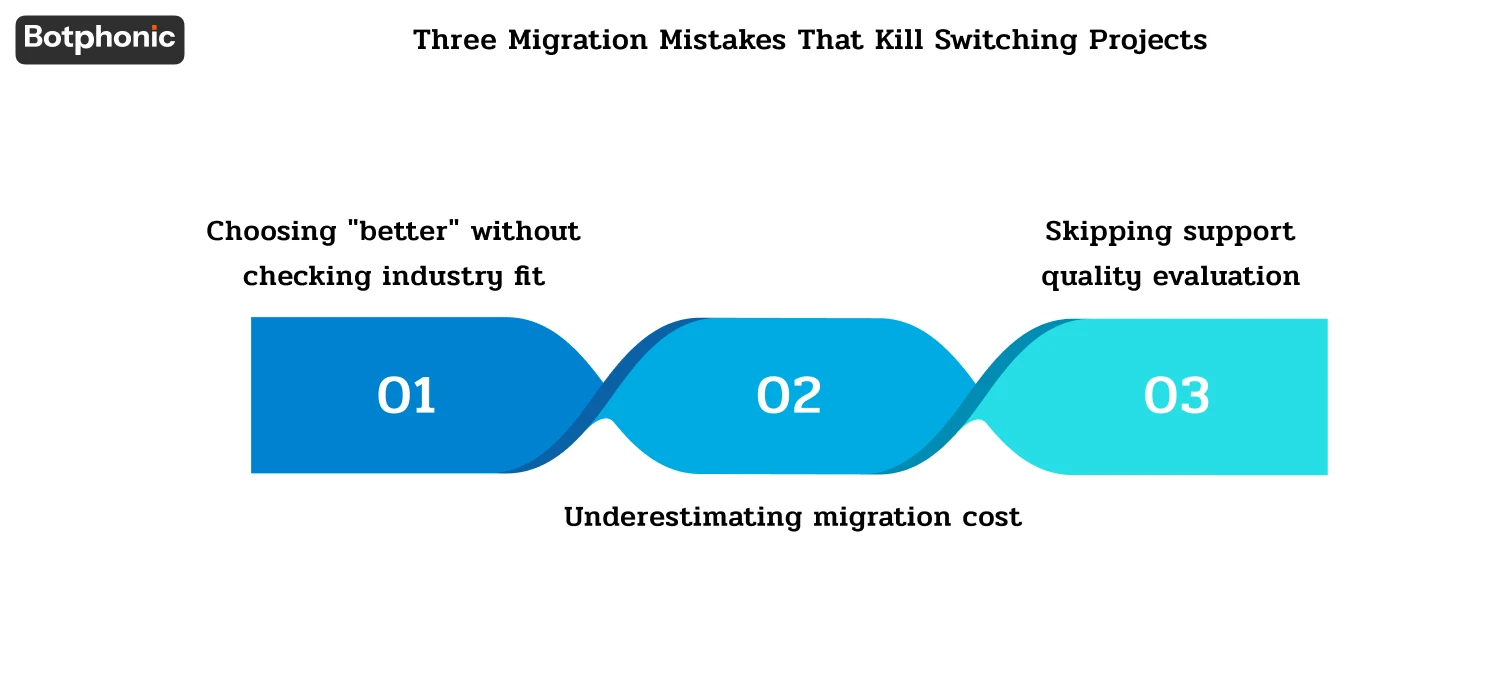
Mistake 1: Choosing “better” without checking industry fit. When you migrate from AI Call Assist to a generic one without ensuring industry fit, you will end up with the same issues but in another user interface. The industry “deep-dives” above are made just for this.
Mistake 2: Underestimating migration cost. Data export, Integration rebuild, staff training and 2-4 weeks of parallel operation equals rapid accumulation. Typically $20K-$100K for SMBs, and higher for enterprise. Calculate while you have time to think.
Mistake 3: Skipping support quality evaluation. The never-ending marketing demo is always great. Look for G2 and Capterra reviews in particular for support quality 90 days after deployment, that’s when the real deal becomes apparent from the sales jargon.