
Summarize Content With:
What You’ll Learn
- Why hotels miss booking calls and how it impacts revenue
- The four-layer front desk setup used by hotels with near-zero missed calls
- How AI voice systems handle after-hours and overflow calls
- Why PMS integration is critical for converting calls into confirmed bookings
- Which call types should always be escalated to a human
- What to evaluate before choosing an AI receptionist platform
Hotels that never miss a booking call are not staffing their front desks around the clock. They have built a layered call-handling setup, combining cloud phone routing, AI voice systems, and clear escalation rules, that catches every inbound call regardless of time, volume, or staffing levels.
Why Do So Many Hotel Front Desks Still Miss Booking Calls?
Missing booking calls is a structural problem, not a staffing failure. Front desk teams face three predictable pressure points simultaneously: peak check-in windows (typically 3 PM–6 PM), after-hours periods when the desk is fully unstaffed, and seasonal volume spikes that outpace any reasonable headcount.
Canary Technologies found that 40% of calls to hotel front desks go unanswered. That figure rises sharply after 9 PM and during the summer surge months when inbound call volume is highest and staffing is already stretched.
The financial cost compounds fast. Research shows that 85% of callers who reach voicemail never call back, and small businesses lose an average of $126,000 per year in revenue from missed calls. For a mid-size hotel with higher average booking values, that figure is considerably larger.
What Does a Guest Do When No One Answers?
The behavior is predictable and happens within seconds. A guest, especially a late-night traveler looking for same-day availability, does not leave a voicemail. Only 20% of callers bother leaving a message, and 67% of people admit they ignore voicemails entirely. They open Google, find the next property on the list, and call there instead.
That third hotel, the one that picks up, wins the booking. The first two never get a second chance.
What Are the Two Peak Windows Hotels Most Often Miss?
Data from aggregated hotel call logs points to two consistent high-miss windows. The first is the afternoon check-in rush, roughly 3 PM to 6 PM on weekdays, when front desk staff are physically occupied with arriving guests. The second is overnight, any call coming in between 10 PM and 8 AM at properties without after-hours coverage.
Hotels have historically missed between 20% and 40% of incoming calls, a challenge that has been significantly worsened by persistent staffing shortages. Both windows are predictable. Both are solvable with the right setup.
 NOTE
NOTE
What Does the Front Desk Setup of a Hotel That Never Misses Calls Actually Look Like?
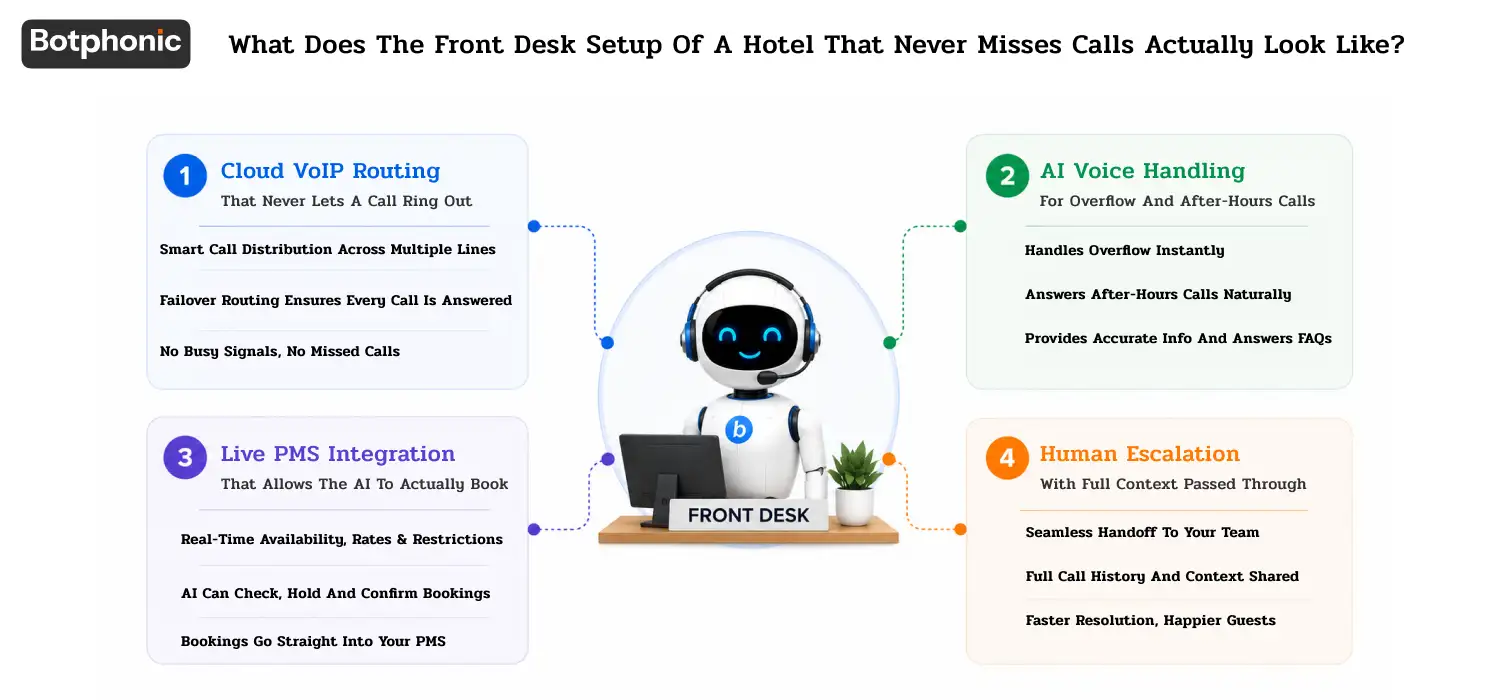
Hotels that maintain near-zero missed-call rates are not running bigger teams. They are running a layered system where every inbound call has a defined next step, even when no human is available to answer it.
The setup has four components working in sequence: a cloud VoIP phone layer that routes calls intelligently, an AI call assistant that handles overflow and after-hours calls, a PMS integration that gives the AI live booking data, and a human escalation path for calls that require judgment.
Layer 1: Cloud VoIP Routing That Never Lets a Call Ring Out
The foundation is a cloud-based VoIP and SIP routing system configured on top of the hotel’s existing phone number. Guests dial the same number they always have. What changes is what happens when the front desk line is busy or unstaffed.
Overflow routing kicks in automatically when the front desk does not answer within a set number of rings. After-hours scheduling routes calls to the AI layer from 10 PM to 8 AM without any manual staff action. Multi-property operations can route calls from any location to centralized handling. No call ever rings out to silence or voicemail.
Layer 2: AI Voice Handling for Overflow and After-Hours Calls
Hotels using AI call handling see 70–82% of routine calls handled automatically, which cuts missed-call rates and captures bookings that would otherwise go to voicemail.
The AI receptionist answers with a natural conversation, not an IVR phone tree with numbered menus. Voice AI handles inbound calls for bookings, modifications, and general inquiries, combining speech-to-text, natural language processing, and text-to-speech to create conversational experiences that feel natural.
It handles the call categories that account for most of a front desk’s inbound volume: room availability inquiries, check-in and check-out time questions, parking, breakfast hours, cancellation policies, and new reservation requests. Sub-200-millisecond response times separate conversational AI from robotic interactions. When voice AI can access real-time availability from the PMS and respond instantly, conversion rates climb. When it stutters or misunderstands, guests hang up.
Botphonic is built specifically for this layer. Its voice handling is designed for the call complexity hospitality operations generate, multi-room inquiries, rate questions, tour and activity add-ons, not repurposed from a general-purpose call-answering tool built for law firms or dental practices. For more on how Botphonic structures inbound call workflows for hotel operations, see our guide to AI phone automation for hospitality businesses.
Layer 3: Live PMS Integration That Allows the AI to Actually Book
This is where most under-built setups fail. A conversational AI for travel & hospitality, that can answer questions but cannot write a confirmed reservation back to the PMS is a sophisticated message-taking service, not a booking recovery tool.
Modern hotel AI receptionists integrate bidirectionally with major PMS platforms, Opera, Mews, Cloudbeds, Apaleo — so the AI reads availability and rates in real time and writes confirmed reservations directly into the property management system. Confirmation emails are sent automatically. No staff action required.
When a caller asks about availability, the AI queries the PMS API in real time, typically receiving a response within 200–500 milliseconds. Without PMS integration, an AI voice agent can only take a message and promise a callback.
The distinction matters enormously at 11 PM. A guest calling about a same-day room does not want a callback in the morning. They want to know if a room is available right now, and they want it confirmed before they hang up.
Layer 4: Human Escalation With Full Context Passed Through
AI receptionists in hotels can’t always handle every call. Emotional complaints, billing disputes, VIP arrivals, group reservation modifications, and accessibility accommodation requests all require human judgment. The difference between a good setup and a damaging one is whether the AI gets stuck, or transfers smoothly.
 PRO TIP
When the AI picks up, it still has the ability to transfer live to the front desk with full call context intact, so the human agent does not ask the guest to repeat their name, room type preference, and dates again from scratch.
How Does This Setup Compare to What Most Hotels Are Still Running?
| Setup Type | After-Hours Coverage | Overflow Handling | PMS Booking Write-Back | Escalation Control | Missed Call Rate |
| Traditional front desk only | None | Voicemail or ring-out | N/A | Full human judgment | 30–40% |
| Basic IVR phone tree | Partial (menu routing only) | Limited | None | Poor, guests get stuck | 25–35% |
| Answering service (human outsourced) | Yes | Yes | None, messages only | Inconsistent | 10–20% |
| AI voice with read-only PMS | Yes | Yes | No, messages only | Configurable | 5–15% |
| AI voice with two-way PMS integration | Yes | Yes | Yes, confirmed in real time | Configurable | Under 5% |
The table shows why a two-way PMS integration is the functional dividing line. Every setup above it answers calls. Only the bottom tier actually closes bookings.
What Do Hotels Actually Experience After Building This Setup?
In practice, results split clearly between properties that deployed gradually and those that went full automation immediately.
Properties that started with a focused pilot, overnight coverage only, 10 PM to 8 AM, while keeping the front desk fully staffed during peak hours, report recovering real booking volume within the first 30 days. The AI handles calls that previously rang out. Staff arrive in the morning to confirmed reservations that would otherwise have been lost or recaptured through Booking.com at a 15–30% commission cost.
One independent hotel reported eliminating after-hours missed bookings entirely, allowing front-desk employees to focus on in-person hospitality rather than juggling phones.
Properties that deployed AI across all hours simultaneously without completing escalation configuration report a different outcome. Guests with complaints get trapped in loops. VIPs who expect recognition get routed through generic flows. The AI handles the wrong calls, and staff spend their time managing fallout rather than being freed from repetitive inquiries.
The operational principle is consistent: the goal is not to remove humans from the front desk. It is to ensure no call rings out to silence when a human is not available to answer it.
For a closer look at avoiding the most common deployment mistakes, see our breakdown of AI receptionist setup for travel and hospitality businesses.
What Should Hotels Verify Before Choosing a Platform for This Setup?
Not every AI receptionist platform is built for hospitality. Hotels using AI voice assistants report 80% fewer missed calls, 25% higher ancillary revenue, and guest satisfaction scores jumping by 27%, but those results come from well-matched deployments, not from any platform deployed without proper configuration.
| Evaluation Criteria | Why It Matters | What to Verify |
| Two-way PMS integration | AI must confirm bookings, not just check availability | Ask which PMS systems have live write-back, not just read access |
| Voice response latency | Pauses over 1.5 seconds cause guests to hang up | Request sub-200ms benchmark data, not just marketing claims |
| Escalation live transfer | Guests must reach a human when needed | Test a real transfer in a demo scenario |
| After-hours scheduling | Overnight routing should be automated, not manual | Confirm scheduling is rule-based, not staff-triggered |
| Multilingual support | International guests need real language handling | Test your actual guest language mix, not a feature list |
| PCI-DSS compliance | Payment-related calls require certification | Request documentation, not a verbal assurance |
| Call analytics | ROI measurement requires attribution data | Ask for call-to-confirmed-booking reporting |
PRO TIP
Final Assessment
Hotels that never miss a booking call are not running a front desk trick. They are running a system, cloud VoIP routing, an AI answering service with live PMS access, and pre-configured escalation rules, that ensures every call has a defined next step, regardless of when it arrives.
Over 70% of hotel executives are now prioritizing AI investment, with voice technology leading the pack. The properties acting on that priority earliest are not the largest chains. They are the independent and boutique hotels that cannot afford to lose even a handful of bookings per week to infrastructure that wasn’t built for modern call volume.
The technology is stable. The PMS integrations are mature. The operational case for after-hours and overflow coverage is clear. What separates the hotels that benefit from those that don’t is the quality of the setup, not the quality of the AI.
Stop Losing Bookings to Missed Calls. See how Botphonic helps hotels answer every call, automate reservations, and provide 24/7 guest support.
Schedule a personalized demo today