
Summarize Content With:
What You’ll Learn in This Blog
- Why school front offices struggle with high call volumes and staffing shortages.
- How AI receptionists automate attendance reporting, call routing, and parent inquiries.
- The benefits of multilingual call handling for diverse school communities.
- A comparison of the top AI receptionist platforms for schools in 2026.
- Which sensitive situations should always be escalated to human staff.
- How schools can evaluate ROI and determine if an AI receptionist fits their budget and operational needs.
An AI receptionist for schools is a voice-based automation system that handles inbound parent calls, attendance reports, routing requests, and general inquiries, without requiring front-desk staff to pick up. It is designed for K–12 administrators dealing with high call volume, thin staffing, and multilingual parent populations. Used correctly, it reduces morning congestion and improves response accuracy.
Why Are School Front Offices So Overwhelmed During Morning Hours?
School front offices are overwhelmed in the mornings because a single desk must handle call floods, physical visitors, internal requests, and emergency escalations simultaneously, with minimal staff.
As of October 2024, 50 percent of public school leaders reported feeling that their school is understaffed at their current staffing level. That shortfall doesn’t stop at classrooms. The shortage extends beyond teachers to paraprofessionals, bus drivers, cafeteria and custodial staff, and front office staff.
The result is structural: too many concurrent inbound calls, not enough people to answer them.
The Morning Call Spike Is Predictable, and Mostly Avoidable
The 7–9 AM window triggers a predictable surge of parent attendance calls. Every parent calling to report a child absent is competing for the same two or three phone lines. Front desk staff answer the same question dozens of times. Voicemails pile up. By 9:15 AM, staff are processing a backlog instead of supporting students.
This is not a staffing problem that hiring solves. It is a call-routing problem that automation solves.
Staff Are Acting as Dispatchers, Not Administrators
In most schools, the front desk operates as a triage hub, routing calls to nurses, counselors, grade coordinators, and administrators while simultaneously logging attendance, greeting walk-ins, and managing urgent messages.
That multi-threading breaks down under volume. During the 2023–2024 school year, nearly 90 percent of U.S. K–12 public schools reported challenges in hiring both teaching and non-teaching positions. When those vacancies go unfilled, front office staff absorb the overflow, further reducing their capacity for high-value tasks.
 NOTE
NOTE
What Does an AI Receptionist Actually Do in a School Setting?
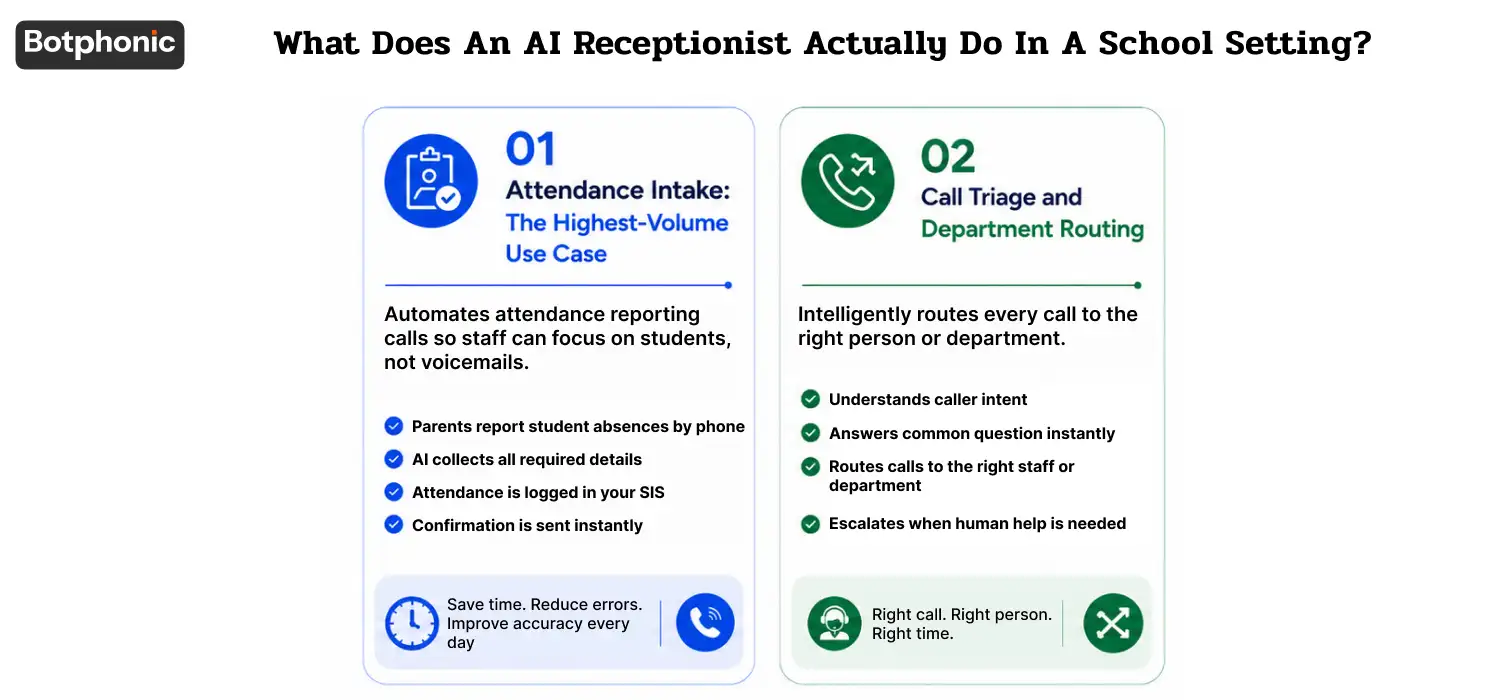
An AI receptionist for schools is a voice agent that answers inbound calls, captures structured information, routes callers to the right department or staff member, and logs data into your systems, without requiring a human to pick up for routine calls.
This is not a phone tree. It is a conversational system that detects intent, handles multilingual callers, and escalates when needed.
Attendance Intake: The Highest-Volume Use Case
The most direct value is automating attendance calls. When a parent calls to report an absence, the AI call assistant captures the student’s name, grade, reason for absence, and relationship context. It confirms spelling, flags ambiguous inputs, and logs the record into your student information system (SIS), or exports it in a format your attendance software accepts.
At Botphonic, our multilingual call handling for schools is built specifically around this workflow, including error tolerance for diverse name pronunciations and accented speech.
Call Triage and Department Routing
Beyond attendance, the system handles routing logic: sending a caller to the nurse’s office, counseling department, transport coordinator, or bilingual staff based on stated need, not a menu selection. If urgency signals appear in the call (specific keywords, distress indicators, or emergency language), the system bypasses standard routing and connects directly to a designated escalation contact.
Crucially, calls involving disciplinary matters, mental health concerns, or custody disputes are not handled by the AI. These escalate to humans immediately, by design.
How Does Multilingual Call Handling Work for Schools?
Multilingual call handling in an AI receptionist means the system detects a caller’s preferred language mid-conversation and responds or routes accordingly, without forcing the parent through a separate language menu.
Many school phone systems still rely on IVR menus where parents must press “2 for Spanish.” That creates friction, delays, and miscommunication. Districts that deployed voice agents in 2024 cut abandoned calls by up to 50 percent and freed clerical staff for student-facing work. A significant portion of abandoned calls are from non-English-speaking parents who disengage after repeated menu loops.
Language Detection vs. Language Menus: What Works in Practice
In practice, a multilingual parent calls and immediately speaks in their preferred language. An AI system with live language detection identifies this within the first few words and either responds in that language or routes to a bilingual staff member, whichever is configured for that school.
Botphonic’s configurable call flows for diverse school populations support this natively, including handling mid-call language shifts where a bilingual parent switches languages during the conversation.
Schools With Mixed-Language Families Need Adaptive Routing
A school in a high-diversity district may serve families speaking Spanish, Cantonese, Vietnamese, Haitian Creole, and Arabic, sometimes in the same morning call queue. Static IVR systems fail here. Adaptive AI routing does not: it identifies language context and distributes calls to the right resource without requiring every front-office staffer to be multilingual.
How Do the Leading AI Receptionist Options for Schools Compare?
Before selecting a platform, administrators should evaluate on-call triage accuracy, SIS integration depth, multilingual handling, and deployment complexity, not demo-day features.
| Platform | Primary Strength | Best School Fit | SIS Integration | Deployment Speed |
| Botphonic | Flexible multilingual routing + configurable call flows | Mixed-language campuses, mid-size districts | Medium (API-configurable) | Moderate, cloud-based setup |
| Ambit Solutions | School-native workflows, academic calendar awareness | Traditional schools, plug-and-play needs | Low complexity | Fast, pre-built flows |
| Retell AI | Low-latency voice infrastructure, API control | Tech-forward districts with IT resources | High (custom build) | Slower, requires telephony mapping |
| AI-Receptionist.com | Structured attendance + admissions automation | Small to mid-size schools | Low complexity | Very fast |
| RingCentral for Education | Enterprise unified communications | Large multi-campus districts | High | Long, full overhaul required |
The right choice is not the most technically advanced option. It is the one that fits your school’s call topology, staffing structure, and language profile.
What Should Schools Never Let AI Handle Alone?
AI receptionists should not handle calls that require human discretion. This is not a limitation, it is a feature.
Even well-configured AI answering service systems must escalate immediately for:
- Student disciplinary incidents with legal implications
- Mental health or safeguarding concerns
- Custody disputes or court-ordered restrictions
- Active medical emergencies requiring EMS coordination
- Bullying investigations or police-involved situations
AI handles structure. Humans handle judgment. Any vendor claiming their system can manage these scenarios without human intervention should be questioned directly during procurement.
 PRO TIP
Is an AI Receptionist Worth the Investment for a School Budget?
An AI receptionist is worth the investment when your school handles high call volume in predictable daily peaks and your front office staff spend more than two hours per day on routine inbound calls.
The virtual receptionist market reached $3.85 billion in 2024 and is projected to hit $9 billion by 2033, at a compound annual growth rate of 9.8 percent. That growth reflects real operational value across sectors, not just marketing momentum.
For schools, the return is measured in staff hours recaptured, not revenue generated.
What Schools Actually Experience After Deployment
In practice, the first change administrators notice is not reduced call volume, it is reduced cognitive load on front desk staff. When attendance calls are handled automatically before 9 AM, the first hour of school shifts from reactive (fielding a backlog) to proactive (student-facing tasks, emergency readiness, in-person coordination).
The second measurable change is parent satisfaction. Parents who call in an absence and reach a clear, quick, multilingual system, rather than a busy signal or voicemail, report the interaction as resolved. That reduces callback volume, which further reduces front-desk pressure.
The Hidden Cost of Not Automating
Unmanaged call queues have downstream costs beyond staff frustration. Missed attendance calls create inaccuracy in daily rosters, which affects safety procedures during drills and real emergencies. A student marked present when absent due to a dropped call is an operational liability, not just an inconvenience.
Schools in high-poverty communities report that 57 percent face ongoing shortages in administrative assistants and support staff that remain unfilled year after year. For those schools, AI call handling isn’t a convenience upgrade, it’s continuity infrastructure.
Whether you’re managing staffing shortages, multilingual parent communities, or high attendance call volumes, the right solution starts with understanding your current call patterns.
Try Botphonic