
Summarize Content With:
What You’ll Learn
- Why IVR surveys remain one of the most effective customer feedback channels in 2026
- The biggest factors that influence IVR Survey Success and survey completion rates
- How to design high-performing call center IVR surveys that customers actually complete
- The key benefits, limitations, and best practices for Automated IVR Surveys
- Advanced IVR Feedback Management strategies that turn feedback into actionable insights
- How AI is transforming surveys for IVR and shaping the future of customer feedback collection
Introduction
Most businesses don’t have a customer feedback problem. They have a customer participation problem.
Every day, organizations invest significant resources into customer service operations, customer experience programs, and feedback collection initiatives. Yet despite these investments, many businesses struggle to collect enough meaningful customer feedback to make informed decisions. Customers frequently ignore surveys, abandon them midway, or provide rushed responses simply to finish the interaction as quickly as possible.
The result is a dangerous gap between the feedback companies want and the feedback they actually receive.
Low participation rates don’t simply reduce the amount of feedback available for analysis. They can create sampling bias, distort customer sentiment, and hide operational issues that require immediate attention. When only a small percentage of customers complete surveys, businesses risk making strategic decisions based on incomplete information.
According to Qualtrics XM Institute, organizations that actively collect and act on customer feedback are more likely to improve customer retention, satisfaction, and loyalty. However, the quality of those outcomes depends heavily on the quality and representativeness of the feedback being collected.
One of the biggest challenges facing customer experience teams today is survey abandonment. Industry research consistently shows that customers are most likely to drop out after the third survey question. This means that many businesses lose valuable insights not because customers are unwilling to provide feedback, but because survey design creates unnecessary friction.
The companies generating the most valuable IVR survey customer feedback are not necessarily asking more questions. They are asking better questions at the right time, in the right sequence, while requiring the least possible customer effort.
In this guide, you’ll learn how to design high-performing call center IVR surveys, improve survey completion rates, implement effective IVR Feedback Management strategies, and leverage Automated IVR Surveys to collect more actionable customer insights.
What Is an IVR Survey?
An IVR survey is an automated voice-based feedback mechanism that allows customers to provide feedback through their telephone following a service interaction.
Instead of speaking with a live representative, customers interact with automated prompts and provide responses using:
- Touch-tone keypad inputs
- Numerical ratings
- Voice responses
- Speech recognition systems
Organizations commonly use IVR surveys for:
- Customer Satisfaction (CSAT)
- Net Promoter Score (NPS)
- Customer Effort Score (CES)
- Agent performance evaluation
- Service quality monitoring
- Complaint analysis
- Resolution verification
Because surveys occur immediately after customer interactions, they often generate more accurate feedback than delayed survey methods.
Why IVR Surveys Still Matter in 2026
Customer feedback channels have expanded dramatically over the last decade. Businesses can now collect feedback through email, SMS, mobile applications, web forms, social media, and live chat. Despite these alternatives, IVR surveys remain one of the most effective methods for capturing authentic customer sentiment.
The primary reason is timing.
Unlike email surveys that may be opened hours or days after a customer interaction, IVR surveys capture feedback immediately after the service experience. The interaction is still fresh in the customer’s mind. Their emotions are current. Important details have not yet been forgotten.
Research from Forrester has consistently shown that 61% of respondents said their companies don’t have a formal process for closing the customer feedback loop. As memory fades, recall accuracy decreases, reducing the reliability of survey responses.
This immediate feedback window makes Automated IVR Surveys particularly valuable for industries such as healthcare, banking, insurance, telecommunications, utilities, and customer support.
Another advantage is scalability.
Organizations can collect feedback from thousands of customer interactions every day without increasing staffing costs. Modern survey platforms can automatically trigger surveys after completed calls, route responses to analytics systems, and generate reports in real time.
Today’s IVR technology is also significantly more sophisticated than traditional touch-tone systems. Modern platforms can integrate speech recognition, sentiment analysis, customer segmentation, and AI-powered decision-making to create more personalized survey experiences.
Rather than asking identical questions to every caller, advanced systems can adapt survey flows based on customer history, interaction type, and service outcomes.
This ability to collect immediate, scalable, and context-rich feedback ensures that AI For Customer Service remains a critical component of customer experience programs.
The Biggest Problem With Most IVR Survey Customer Feedback Programs
Most organizations design surveys around the information they want to collect. Customers evaluate surveys based on how much effort they require.
This difference in priorities creates one of the biggest challenges in customer feedback collection.
Businesses often attempt to gather as much information as possible from every interaction. They ask numerous questions, collect data they may never use, and create survey experiences that feel unnecessarily long.
Common mistakes include:
- Asking too many questions
- Using confusing language
- Repeating information already available elsewhere
- Including questions that do not influence business decisions
- Requiring excessive customer effort
The result is predictable. Participation rates decline. Abandonment rates increase. Response quality deteriorates. The most successful IVR survey customer feedback programs focus on a different objective:
Minimize customer effort while maximizing actionable insight.
This principle serves as the foundation for every high-performing survey strategy.
 NOTE
NOTE
Why Customers Ignore Most Post-Call Surveys
Understanding why customers abandon surveys is essential for improving participation rates.
Survey Fatigue
Customers have already invested time resolving an issue. Additional questions can feel like extra work rather than an opportunity to provide feedback.
SurveyMonkey research has repeatedly demonstrated that aim for a maximum of 10 questions whenever possible, which typically nets an 89% completion rate. Completion rates drop significantly once you exceed 15 questions.
Lack of Perceived Value
Many customers believe their feedback will not lead to meaningful change.
If customers feel their responses disappear into a reporting dashboard without action, motivation to participate declines.
Poor Timing
Not every interaction creates the right environment for a survey.
Customers who experience unresolved issues, lengthy wait times, or frustrating service interactions may be less willing to complete a survey immediately afterward.
Excessive Length
The longer the survey, the greater the likelihood that customers will disconnect before completion.
This is one reason many surveys for IVR struggle to achieve acceptable participation rates.
The Science Behind IVR Survey Success
High-performing organizations follow a simple principle:
Reduce friction.
- Every additional question increases abandonment risk.
- Every unnecessary instruction increases effort.
- Every extra second creates another opportunity for customers to disconnect.
The best-performing survey programs prioritize:
- Simplicity: Questions should be easy to understand and answer.
- Relevance: Every question should have a clear business purpose.
- Speed: Short surveys consistently outperform long surveys.
- Clarity: Customers should immediately understand what is being asked.
Survey Completion Rate Benchmarks
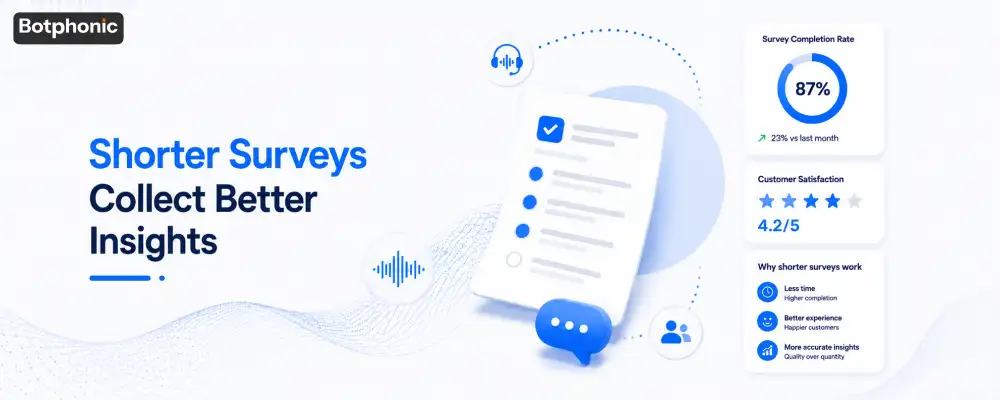
Shorter surveys consistently yield higher completion rates, with platforms like Typeform recommending under 2 minutes for optimal engagement.
| Survey Length | Average Completion Rate | Data Quality Score |
| 1 Question | 72% | High |
| 2 Questions | 61% | High |
| 3 Questions | 48% | High |
| 5 Questions | 31% | Medium |
| 7 Questions | 22% | Medium |
| 10+ Questions | 11% | Low |
The most significant drop-off typically occurs after question three. This means many organizations lose valuable insights by asking too many questions rather than too few.
The 5 Variables That Determine IVR Survey Success
1. Question Count
Question count is the single most important factor influencing survey completion rates. Every additional question increases the likelihood that a customer will abandon the survey before reaching the end.
The highest-performing IVR surveys typically contain between one and three questions and require less than 45 seconds to complete. Shorter surveys reduce customer effort, minimize frustration, and increase the likelihood of receiving complete responses.
Rather than trying to collect every possible data point, focus on gathering the information that will directly influence business decisions.
2. Survey Timing
Survey timing often has a greater impact on participation than the questions themselves.
Customers provide the most accurate feedback when the interaction is still fresh in their minds. Delayed surveys can suffer from memory decay, reducing both response quality and participation rates.
Best practices include:
- Immediately after successful issue resolution
- Within 30 minutes of the interaction
- Within 24 hours for complex customer journeys
Organizations should avoid triggering surveys several days after the interaction whenever possible.
3. Question Type
The structure of survey questions directly affects customer engagement.
High-performing question formats include:
- Rating scales
- Yes-or-no questions
- Single-touch responses
- Simple numerical scores
These formats require minimal effort and can be completed quickly.
Poor-performing question formats include:
- Long open-ended responses
- Technical terminology
- Multi-part questions
- Questions requiring lengthy explanations
The simpler the response process, the higher the completion rate tends to be.
4. Caller Effort
Every additional action required from the customer increases abandonment risk. Survey designers often underestimate the impact of friction. Even small inconveniences can significantly reduce participation.
Common sources of caller effort include:
- Long survey introductions
- Repeated instructions
- Multiple menu layers
- Complex navigation paths
- Unnecessary confirmation prompts
The most successful surveys begin quickly and guide customers through the process with minimal effort.
5. Incentive Design
Customers are more willing to provide feedback when they understand its purpose. Participation rates often improve when organizations explain how feedback will be used to improve future customer experiences.
Simple messages such as, “Your feedback helps us improve our service,” can encourage participation without requiring financial incentives. The goal is to create a sense that customer opinions genuinely matter.
 PRO TIP
The Ideal IVR Survey Structure
The most effective AI Answering Service follows a simple structure designed to maximize completion rates while collecting actionable insights.
A typical high-performing survey includes:
1: How would you rate your overall experience today?
2: Was your issue resolved during this interaction?
3: How likely are you to recommend our service to others?
This three-question approach provides valuable information about satisfaction, resolution effectiveness, and customer loyalty while keeping survey length under one minute.
Automated IVR Surveys vs Live Agent Surveys
Both automated and live agent surveys can help organizations collect customer feedback, but they differ significantly in terms of cost, scalability, consistency, and data quality.
| Metric | Automated IVR Surveys | Live Agent Surveys |
| Cost | Lower operational costs due to automation | Higher costs because agents are required |
| Scalability | Can handle thousands of surveys simultaneously | Limited by agent availability |
| Consistency | Every customer receives the same questions and experience | Survey delivery may vary between agents |
| Response Speed | Feedback is collected immediately after the interaction | Feedback collection can take longer |
| Bias Risk | Lower risk of interviewer influence | Higher risk of interviewer bias |
| Data Collection | Standardized and easy to analyze | May generate more detailed qualitative insights |
| Availability | Available 24/7 without staffing requirements | Restricted by workforce schedules |
| Customer Comfort | Some customers prefer anonymous feedback | Some customers may be more open with a human interviewer |
Which Option Is Better?
For most businesses, AI IVR provides the best combination of affordability, scalability, and consistency. They are ideal for collecting feedback from large customer volumes while maintaining standardized reporting.
Live agent surveys can be valuable when organizations need deeper qualitative insights or detailed conversations, but they are typically more expensive and harder to scale. The most effective customer experience programs often use automated surveys for large-scale feedback collection and reserve live-agent follow-ups for specific customer segments or high-priority cases.
The Pros and Cons of Post Call IVR Surveys
Post-call IVR surveys remain one of the most effective ways to collect customer feedback because they capture customer sentiment immediately after an interaction. However, organizations should understand both the strengths and limitations before implementing them at scale.
| Metric | Pros of Post-Call IVR Surveys | Cons of Post-Call IVR Surveys |
| Feedback Timing | Collects feedback immediately while the experience is fresh. | Negative interactions may result in lower participation rates. |
| Cost Efficiency | Low operational costs due to automation. | Initial setup and optimization may require investment. |
| Scalability | Can survey thousands of customers without additional staff. | High survey volume can contribute to customer fatigue. |
| Consistency | Every customer receives the same survey experience. | Standardized questions may miss unique customer concerns. |
| Data Collection Speed | Real-time feedback enables faster issue identification. | Rapid responses may sometimes lack context. |
| Response Quality | Captures authentic reactions immediately after service. | Emotional responses can occasionally skew feedback. |
| Qualitative Insights | Can collect basic voice comments when enabled. | Typically provides less detailed feedback than live interviews. |
| Customer Effort | Simple surveys require minimal customer effort. | Long surveys significantly increase abandonment rates. |
| Reporting & Analytics | Easy to track trends, CSAT, NPS, and CES metrics. | Overreliance on scores may overlook deeper customer issues. |
| Operational Impact | Helps identify service gaps and coaching opportunities quickly. | Poor survey design can lead to inaccurate or incomplete insights. |
Advanced IVR Feedback Management Techniques
Modern feedback programs go beyond collecting survey responses. Advanced IVR Feedback Management focuses on turning feedback into operational improvements.
Leading organizations use:
- Sentiment analysis
- AI-powered trend detection
- Automated escalation alerts
- Agent coaching workflows
- Customer recovery programs
- Real-time issue monitoring
The goal is to transform feedback into measurable business outcomes.
Metrics That Matter More Than CSAT
Customer Satisfaction (CSAT) is one of the most commonly tracked customer experience metrics, but it only tells part of the story. A customer may report being satisfied with an interaction while still experiencing unresolved issues, high effort, or the need to contact support again.
To gain a more accurate understanding of customer experience performance, organizations should monitor additional metrics alongside CSAT.
| Metric | What It Measures | Why It Matters |
| Resolution Confirmation Rate (RCR) | Whether the customer’s issue was successfully resolved. | Resolution is often a stronger predictor of loyalty than satisfaction alone. |
| Customer Effort Score (CES) | How easy or difficult it was for the customer to get help. | Customers value convenience and are more likely to remain loyal when interactions require less effort. |
| Repeat Contact Rate (RCR) | The percentage of customers who contact support again for the same issue. | High repeat contact rates often indicate unresolved problems or inefficient processes. |
| Survey Completion Rate | The percentage of customers who complete the survey. | Measures survey effectiveness and indicates whether feedback data is representative. |
| First Contact Resolution (FCR) | The percentage of issues resolved during the first interaction. | Strongly correlates with customer satisfaction and operational efficiency. |
| Net Promoter Score (NPS) | The likelihood of customers recommending the company. | Provides insight into long-term customer loyalty and brand advocacy. |
The Future of Automated IVR Surveys
The future of IVR surveys will be driven by intelligence rather than volume.
Organizations are increasingly adopting systems that can:
- Predict customer churn
- Identify dissatisfaction in real time
- Trigger automated recovery actions
- Personalize survey experiences
- Connect feedback directly to business workflows
Future survey systems will focus less on collecting data and more on driving action.
Conclusion
Successful IVR survey programs are built around customer convenience. Organizations that minimize effort, reduce friction, and focus on relevant questions consistently achieve higher completion rates and better-quality insights.
Survey performance is not determined by technology alone. It is shaped by timing, psychology, question design, and the overall customer experience.
Businesses that understand these principles can transform customer feedback from a reporting exercise into a powerful driver of service improvement.
With Botphonic, you can build intelligent IVR surveys, automate feedback collection, leverage AI-powered insights, and transform every customer interaction into a learning opportunity.
Book Free Demo Today