Summarize Content With:
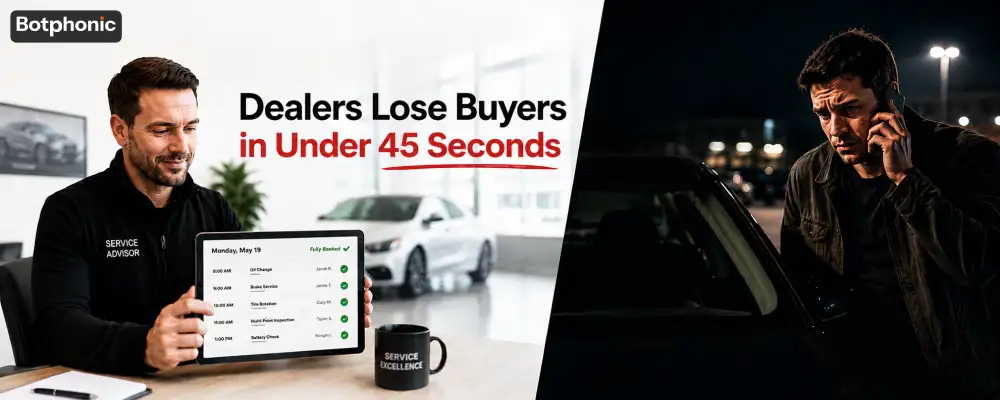
It’s 9:48 PM. A customer who bought from you six weeks ago is sitting in a parking lot, staring at a dashboard warning light. They’re not panicking – but they’re unsettled. So they do exactly what a loyal customer does: they call their dealership.
Five rings. Then voicemail.
That thirty-second moment quietly costs you more than any bad review, pricing dispute, or recall notice. According to CDK Global’s Service Shopper study, an unanswered dealership phone call drops the customer’s NPS to just 26.7 – detractor territory, from someone who was a loyal advocate moments before.
An AI receptionist for auto dealership customer calls fixes this permanently. Here’s how – and why the dealerships moving first are pulling ahead fast.
The 6 PM CX Gap: Where Modern Dealership Customer Experience Breaks Down
The Post-Closing Anxiety of Today’s Vehicle Owner
The post-6 PM window is not dead time in your customer’s mind. It is often the most emotionally active part of their relationship with your dealership. A driver noticing a brake squeal on the highway home, a new parent worried about a tire-pressure warning with a car seat in the back, a recent buyer second-guessing a noise they have heard twice this week – these are high-emotion, high-intent moments. And every single one of them begins with a phone call.
Industry data from Numa’s 2024 automotive analysis, covering over 600 franchise dealership service departments, found that dealerships risk losing an average of $853,000 annually from failing to answer customer calls and schedule service appointments. That is not a rounding error – it is roughly the annual salary of four experienced service advisors, evaporating through a phone line that nobody answered.
The after-hours window is not a niche edge case. Research cited by useflai.com’s dealership benchmark data shows that 56% of dealership leads arrive after business hours – meaning the majority of your highest-intent customer contacts are happening when your team is not there to receive them.
“Customers don’t compare you to your competitors anymore – they compare you to the best service experience they’ve had anywhere. That means you’re competing with Amazon’s response time whether you want to or not.” – Shep Hyken, Customer Service Expert & Author, The Cult of the Customer
 PRO TIP
Inside the 68% Dropped-Call Crisis: Mapping the Invisible Brand Leak
The Post-Closing Anxiety of the Modern Vehicle Owner
The emotional architecture of a late-night dealership call is entirely different from a daytime inquiry. During business hours, a customer calling about a check-engine light is mildly inconvenienced. At 10 PM, that same customer is anxious, isolated, and making fast judgments about whether your dealership actually cares about them after the sale. This is not a service inquiry – it is a trust test.
The high-emotion nature of after-hours calls means that how you respond – or whether you respond – carries outsized weight. A first-ring answer that provides accurate, calm reassurance (“That code is typically non-urgent, and I’ve booked you in for Thursday at 9 AM”) builds more loyalty in 90 seconds than a five-star showroom can build in a two-hour test drive. Conversely, voicemail tells the customer: we were glad to sell you a car, but the relationship ends at closing time.
The CDK Effect: How Silent Ringing Corrodes Your CSI and NPS Scores
The numbers from CDK Global are precise and they are damning. When a dealership’s service phone rings and no one answers, the calling customer’s NPS score lands at 26.7 – the single lowest score in CDK’s entire service experience dataset. For context, the industry average NPS for dealership service departments currently sits at 59, following a 14-point improvement in 2024. An unanswered phone call does not just fail to help – it actively converts a potential promoter into a confirmed detractor in a single interaction.
Customers placed on hold for more than eight minutes (the average hold time at dealerships, per CDK’s data) score an NPS of 39.7 – still significantly below average, and still the result of a phone system that has not been designed with the customer’s experience in mind.
| Phone Experience | Customer NPS Score |
| Answered immediately, no hold | ~70+ (promoter territory) |
| Placed on hold (avg. 8+ min) | 39.7 |
| Navigated phone tree / transferred | 45–50 |
| Phone rang, no one answered | 26.7 (detractor) |
Source: CDK Global Service Shopper 4.0 Study
Each unanswered call is not just a missed appointment – it is a measurable NPS event that compounds over time into lower CSI scores, fewer repeat visits, and negative word-of-mouth in your local market.
Why Your Current After-Hours “Safety Nets” Fail the Modern Customer Experience Test
The Phone-Tree Tollbooth: Why Legacy IVR Menus Trigger Immediate Abandonment
Most dealerships that have tried to solve the after-hours problem have reached for one of three tools: an IVR phone tree, a third-party answering service, or an overflow to voicemail. All three fail the modern customer in different ways – and the data makes this clear.
According to Vonage’s 2019 IVR Research, 61% of consumers believe IVR technology makes for a poor customer experience, and more than half (51%) have abandoned a company altogether because they encountered an automated menu. The psychological friction of “Press 1 for Sales, Press 2 for Service” is not neutral – it triggers immediate frustration in a customer who is already in an elevated emotional state. The IVR does not solve the after-hours gap. It confirms the customer’s fear that your dealership does not actually care about them outside of business hours.
The top reasons customers abandon IVR calls: irrelevant menu options (63%), menus that are too long (46%), inability to reach a live person (54%), and having to repeat themselves (45%). These are not technical failures. They are design failures – and they are costing dealerships $262 per affected customer annually in lost revenue that flows directly to competitors.
The Burnout Cycle: The Hidden Strain of Overflow Calls on Your Daytime Team
Every unanswered after-hours call that converts to a voicemail becomes a morning callback obligation for your daytime service advisors. These callbacks stack on top of an already-pressured peak window: according to Numa’s 2024 dealership call data, the highest volume of missed calls occurs between 8:00 AM and 11:30 AM – the same window when advisors are also managing walk-in customers, opening repair orders, and coordinating with technicians.
The result is a burnout cycle: your best people are splitting attention between the customer standing in front of them and the stack of overnight callbacks on their desk. The face-to-face experience degrades. The callbacks come across as rushed. And neither interaction gets the quality it deserves. This is a hidden operational cost that never appears in a staffing report but shows up clearly in your monthly CSI scores.
The CX Transformation: The Blueprint of an Automotive Conversational AI Voice Assistant
Elevating the Standard: What a Dedicated AI Receptionist for Auto Dealership Customer Calls Looks Like
The category that has matured to close this gap is automotive-specific AI customer service technology – and it is a fundamentally different product from the generic chatbots and IVR upgrades dealerships have experimented with before.
A purpose-built AI receptionist for auto dealership customer calls is a domain-trained voice system that answers on the first ring, identifies caller intent using natural language understanding, and conducts a full service or sales conversation without menus, hold music, or transfers. It knows the difference between an RO status check and a wheel alignment quote. It understands when a caller says “my car’s been pulling to the left on the freeway” and correctly routes that to a suspension or tire concern – not a generic service category.
This is not automation for its own sake. It is the CX transformation that allows your dealership to deliver a premium, white-glove customer experience at every hour of the day, at a fraction of the cost of a human team doing the same job imperfectly.
“The best service experience is one where the customer gets what they need before they have time to get frustrated.” – Chris Sutton, Vice President, Automotive Retail, J.D. Power
 NOTE
NOTE
Natural, Frictionless Conversations That Feel Instant
The quality bar for automotive AI voice has moved significantly in the past two years. Modern generative voice technology does not ask callers to “say or press 1.” It opens with a natural greeting, listens to free-form responses, interprets regional phrases and automotive terminology, and responds conversationally – without the robotic cadence that characterized earlier voice automation.
A caller who says “I just bought a Tahoe from you guys in March and I keep getting a low tire pressure alert even after I’ve added air” will be understood completely – vehicle type identified, concern categorized, and an appointment offered for a TPMS inspection within the same conversational turn. The caller does not feel like they are talking to a machine. They feel like they are talking to someone who knows what they are doing.
This matters because the quality of the first-ring experience is the foundation of the entire CX transformation. An AI that sounds natural and resolves the call effectively creates a higher CSAT score than a human answering service that takes a message and offers a callback.
Eradicating “Hold Time Limbo” During Peak Holiday and Recall Surges
The scalability advantage of an AI receptionist is most visible during the events that break human phone systems: manufacturer recall announcements, holiday Monday service rushes, post-storm weather surges, and the 8–11:30 AM Monday peak that overwhelms nearly every dealership in the country.
Where a human team has a hard ceiling on simultaneous calls, an automotive AI voice system handles unlimited parallel calls without any degradation in response quality. Every caller gets a first-ring answer on Thanksgiving morning, on Christmas Eve, during a five-alarm recall event. No hold music, no transfers to voicemail and no queue. This single capability eliminates the most common and most damaging CX failure point in the dealership phone experience.
Connected Customer Experiences: How AI Works With Dealership Systems
Real-Time, Frictionless Service Booking via Live API Integrations
The version of AI voice technology that actually transforms dealership CX is not a standalone tool – it is a connected layer that reads from and writes to the systems your service department already runs on. When an AI voice assistant for car dealership integrates directly with Xtime, Reynolds & Reynolds, or CDK Global via live API, it can confirm actual service bay availability in real time and book confirmed appointments on the call – not tentative holds, not callback requests, but real calendar entries with the customer’s name, vehicle VIN, stated concern, and confirmed time slot.
Your service manager arrives Monday morning to a populated, organized schedule – not a stack of voicemails and callback obligations. The customer who called at 10:45 PM has a confirmation number. The appointment is real. The relationship is intact.
Intent-Based Hygiene: Pushing Clean, Organized Customer Profiles Directly Into Your CRM
Every conversation handled by an AI receptionist is a data asset – if the system is built to capture it correctly. Best-in-class automotive AI platforms automatically transcribe every call, categorize it by intent (service inquiry, sales inquiry, complaint, recall question, trade-in inquiry), and push a structured customer record update into VinSolutions, Elead, or DealerSocket.
Over time, this creates a granular, accurate picture of your after-hours demand patterns: which service categories drive the most late-night anxiety, which vehicle models generate the most callbacks, and what percentage of after-hours callers are conquest opportunities versus existing customers. This intelligence directly informs staffing decisions, service marketing, and retention strategies – and it accumulates automatically, without requiring anyone to log a call manually.
Real-World Proof: How Top-Tier Rooftops Protect Their Reputation While Their Competitors Sleep
Case Studies in Frictionless After-Hours Bookings
The competitive dynamic created by AI voice adoption is straightforward: two similar dealerships in the same market, serving the same customer base. One answers every after-hours call with a natural, conversational AI that confirms appointments and updates the CRM. The other routes are after-hours calls to voicemail. Within 90 days, the first dealership is capturing the midnight appointment requests, the Sunday-evening service inquiries, and the holiday-weekend leads that used to evaporate.
Botphonic’s AI call center deployment data for car dealerships shows that dealerships implementing AI voice infrastructure report a 30% reduction in missed appointments and measurable improvements in morning schedule density – more confirmed bookings waiting for the service team when they arrive, and fewer reactive callbacks eating into peak-hour productivity.
The market-share implication is significant. Dealerships that capture the after-hours window are not just booking more service ROs – they are building the customer relationship continuity that drives vehicle repurchase loyalty. A customer whose 10 PM call was answered professionally is not just booked for a Thursday appointment. They are more likely to return for their next oil change, their next tire set, and their next vehicle.
What Car Buyers Actually Say: The Surprising Truth About AI Acceptance
The most common objection to AI receptionist adoption – “our customers won’t want to talk to a machine” – is consistently contradicted by post-deployment satisfaction data. Customers do not object to AI. They object to slow, unhelpful, and inaccurate – regardless of whether the source is human or AI.
CDK Global’s dealership satisfaction research confirms that customers now actively prefer AI-powered scheduling tools over being sent to voicemail – a meaningful data point that reflects how normalized and preferred instant digital interactions have become, even for a traditionally high-touch industry like automotive retail.
The one non-negotiable is transparency. Customers who are misled into believing they are speaking to a human react negatively when they discover otherwise. Best-practice AI deployments are upfront and frame it positively: “Hi, this is the [Dealership Name] virtual assistant – I can book service, check your appointment status, or connect you with the team tomorrow morning. What can I help you with?” That framing earns consistently high CSAT scores and builds trust rather than eroding it.
Operational Blueprint: Deploying Your Autonomous Voice Agent for a Smooth Transition
Step 1: Creating a Seamless After-Hours Customer Experience
The first deployment milestone is the simplest and the one that delivers the fastest measurable ROI: configure the AI receptionist to take over all calls that arrive outside of business hours, with business-hours boundaries defined by day of week and time of day. This creates an uninterrupted customer communication layer – the phone never goes to voicemail, the customer always gets a first-ring answer – without changing anything about your daytime operations.
Most vendor deployments reach this state within two to four weeks. The customer experience improvement is immediate: your after-hours answer rate goes from near zero to 100% overnight. Your morning team arrives on a populated schedule instead of a voicemail backlog. And every customer who called after 6 PM has a confirmed response – not a message in a queue.
For a practical overview of what the deployment process looks like end-to-end, Botphonic’s best AI phone call solutions for auto dealerships guide walks through the setup process and integration requirements in plain language.
Step 2: Personalizing Customer Conversations for Every Dealership
The second phase moves from functional to distinctive: configuring the AI to sound like your dealership rather than a generic automotive bot. This means defining the assistant’s name, scripting the greeting language, setting the conversational tone – more formal for a luxury import brand, more approachable and direct for a high-volume domestic rooftop – and specifying which types of information the AI is authorized to confirm versus escalate to a human.
Localization matters in ways that are easy to underestimate. A dealership in rural Georgia has a different conversational register than one in downtown Seattle. Regional phrases, vehicle model nicknames, and even the cadence of a natural greeting vary by market. The AI should reflect your brand and your community – not a national call center’s idea of what automotive customers sound like.
Botphonic’s AI receptionist scripts for car sales guide provides a framework for building brand-consistent, dealership-specific conversation flows that cover the most common call scenarios across service and sales.
Step 3: Using Customer Conversation Insights to Improve Service Experience
The third phase is where the AI voice investment shifts from a phone-answering tool to a strategic intelligence asset. Once 60–90 days of call data have accumulated, patterns emerge that no human-managed phone system would have captured:
What percentage of after-hours calls are service versus sales versus owner concerns? What time of night sees the highest anxiety-driven call volume? Which vehicle makes or model years generate the most after-hours service inquiries? Which service categories are callers most likely to mention unprompted?
This data directly improves service department operations in measurable ways. Staffing decisions become data-informed rather than intuition-based. Marketing messaging can address the specific concerns that are actually driving customer calls. Service advisor training can be calibrated to the real-world concerns customers are expressing – not the ones assumed in training materials.
| Insight Category | Business Impact |
| Peak after-hours call times | Optimize on-call manager schedule |
| Most common service concern at night | Pre-stock parts, adjust advisor training |
| Conquest vs. returning customer split | Adjust marketing spend allocation |
| Call-to-booking conversion rate | Identify script improvement opportunities |
| Vehicle models driving the most anxiety | Flag for manufacturer communication |
Botphonic’s automotive AI voice assistant answers every call, books every appointment, and updates your CRM 24 hours a day, at a cost well below a part-time hire.
Book a Live DemoFinal Verdict: First Ring or Last Chance The Dealership CX Decision That Defines 2025 and Beyond
This is not a technology decision. It is a customer experience philosophy decision – and the phone is where that philosophy becomes visible in the moments that matter most.
Every dealership in your market is making this choice right now, whether they recognize it as a choice or not. The ones deploying AI receptionist infrastructure are quietly capturing every after-hours lead, every late-night service inquiry, every post-recall-announcement call that their competitors are still routing to voicemail. They are building relationship continuity that compounds into repeat service revenue, CSI score improvement, and the kind of local word-of-mouth reputation that no advertising budget can manufacture.
The dealerships still relying on voicemail and legacy IVR systems are not just losing appointments. They are losing the trust of the customers they worked hardest to earn – and doing it silently, one unanswered ring at a time.
The first-mover advantage in conversational AI for automotive retail is real, measurable, and available right now – at a cost well below what most general managers expect, and with an ROI timeline measured in weeks rather than quarters.
Your service lane is open at 9 AM. The question is whether your customer relationship is open at 9 PM. With an AI receptionist for auto dealership customer calls, the answer is always yes.