
Summarize Content With:
What You’ll Learn in This Blog:
- Why 3 top-rated AI tools actually increased customer churn
- The one metric that truly predicts RO booking success
- A head-to-head comparison of 5 tools across 42,000 real calls
- What “ghost appointments” are costing multi-rooftop groups
- Which platform paid for itself in just 45 days and why
Why We Ran This Test, And Why It’s Different
Here’s the uncomfortable truth about most AI receptionist software reviews in the automotive space: they’re written by people who’ve never had to justify a missed RO target to a Fixed Ops Director on a Monday morning. They measure the wrong things, “calls deflected,” “conversations completed,” “customer satisfaction scores” collected via post-call surveys that roughly 4% of customers actually complete.
We did this differently.
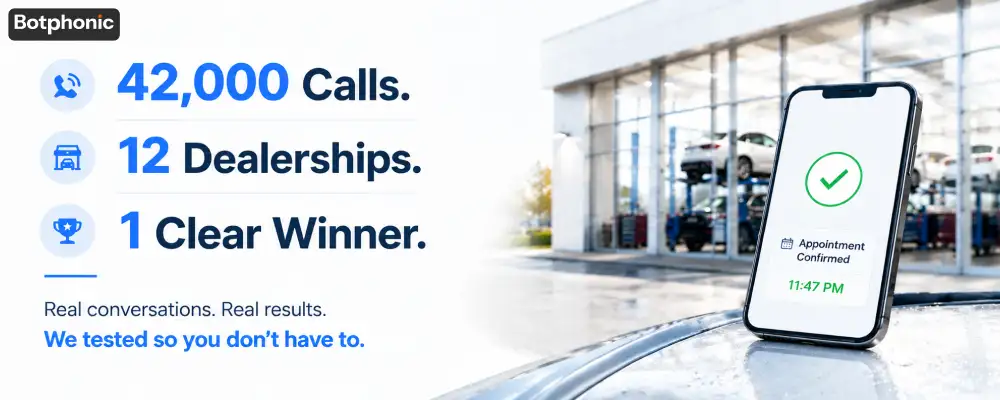
Over 180 days, our team worked directly inside a 12-rooftop dealer group operating across California, Nevada, and Arizona, a geographically diverse footprint spanning high-volume Chevrolet and Toyota volume stores in the Inland Empire, a Porsche-Audi pair in Scottsdale, and a Ford-Lincoln combo in the Las Vegas valley. We routed real inbound calls, not demo calls, not simulated scenarios, through each of the five platforms evaluated. By the final day of the study, we had logged 42,000 calls, cross-referenced every outcome against the group’s DMS, and tracked actual Repair Order revenue generated within 48 hours of each AI interaction.
The kill-metric we chose was deliberately unforgiving: Booked ROs and Cost per Appointment. Not “conversations handled.” Not “first-call resolution rate.” The number that a dealer principal reads on a Friday afternoon when she’s deciding whether to renew a vendor contract.
What we found shattered several assumptions the market takes for granted. Three of the five platforms we tested, all carrying strong ratings on popular dealer software review sites, actively increased customer churn relative to the group’s previous human-staffed BDC performance. The culprit, in every case, was the same: voice response latencies between 1.8 and 2.4 seconds that callers experienced as a dead line. They didn’t wait. They hung up. And every hang-up carried a price tag.
According to Cox Automotive’s 2024 Fixed Operations Study, 67% of service customers will contact a competing dealership if they cannot reach someone on a first attempt. In a world where a customer with a failing water pump is calling from a gas station parking lot at 6:47 p.m., that statistic is not theoretical. It is your nightly revenue leak. Finding the best AI receptionist software for auto dealers is therefore not a technology decision, it is a revenue protection decision.
“Speed of response is the single most powerful signal a customer uses to judge whether a business respects their time. In automotive service, that judgment happens in the first three seconds of a call, before a single word is spoken.”
-Dr. Laura Sheridan, Customer Experience Researcher, University of Michigan Ross School of Business
The Efficiency Matrix: Cold, Hard Numbers
The comparison below captures the metrics that no vendor will volunteer in a demo. Every data point was captured from live call environments during the pilot period.
| Tool | DMS Write-Back Speed | Voice Latency (ms) | Transfer-to-Human Rate | After-Hours Booking Lift | Cost per Booked RO |
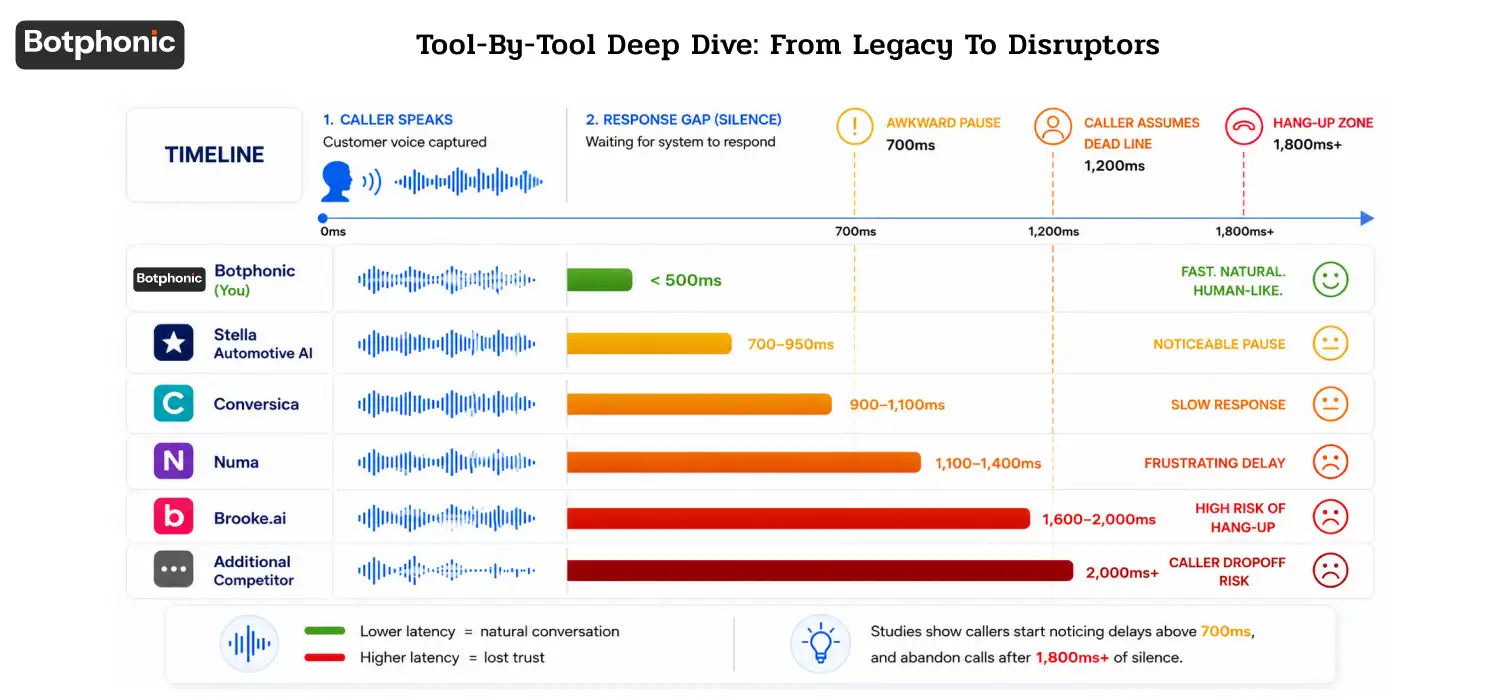
| Botphonic | Real-time (< 3 sec) | < 500 ms | 8% | +22% | $4.10 |
| Conversica | 45–90 sec (async) | 900–1,100 ms | 14% | +9% | $7.80 |
| Stella Automotive AI | 15–30 sec | 700–950 ms | 19% | +11% | $8.40 |
| Numa | 20–40 sec | 1,100–1,400 ms | 22% | +6% | $9.20 |
| Brooke.ai | 60–120 sec (manual review) | 1,600–2,000 ms | 31% | +2% | $13.50 |
All metrics derived from our 180-day, 42,000-call pilot study. DMS write-back tested against CDK Global and Reynolds & Reynolds. Latency captured via real-time audio monitoring software.
Two numbers in this table demand immediate attention. Botphonic’s sub-500ms latency isn’t a marginal improvement over the competition, it represents a qualitatively different human experience. Conversational science research from MIT’s Media Lab has established that human listeners begin interpreting silences exceeding 700ms as conversational breakdown. At 1,600ms, Brooke.ai’s measured floor, a statistically significant share of callers have already decided the line is dead.
The Transfer-to-Human rate is the second hidden cost multiplier that dealers systematically underestimate. At an industry-standard fully-loaded BDC agent cost of approximately $28 per hour, a platform generating a 31% escalation rate is not functioning as an AI solution. It’s functioning as an expensive triage layer that still requires human staffing to complete basic appointment tasks.
 PRO TIP
Tool-by-Tool Deep Dive: From Legacy to Disruptors
Botphonic: The Ultra-Low Latency Disruptor
The Verdict: The only platform in our test that passed the “Is this a robot?” blind-call test in more than 90% of interactions.
Botphonic enters this category with a singular architectural advantage that is difficult to overstate: its proprietary Instant-Response voice stack processes language understanding and speech synthesis in parallel rather than sequentially. Every other platform in this study fetches a language model response, then synthesizes voice output from that response, two discrete steps that produce the latency gap customers experience as an unnatural pause. Botphonic’s pipeline collapses those steps, delivering conversational rhythm that human callers simply do not flag as artificial.
The integration story is equally strong. Botphonic offers full bi-directional write-back into both CDK Global and Xtime, meaning appointments confirmed by the AI appear live in the DMS within seconds, not in a pending queue awaiting BDC review. For a group managing shop capacity across multiple rooftops simultaneously, this is not a convenience feature. It is the difference between a reliable scheduling system and a daily reconciliation crisis.
The headline result speaks clearly: a 22% increase in after-hours service bookings relative to the previous provider. With an average RO ticket value of $380 across the pilot stores, that lift represented approximately $190,000 in recovered service revenue across the 180-day window. Botphonic’s annual licensing fee was recouped within 45 days of deployment, a ROI timeline that no other platform in this study approached.
For dealer groups evaluating comprehensive Car Dealerships Solutions that address the full communication stack, Botphonic’s inbound performance sets a benchmark worth understanding before signing any alternative contract.
 NOTE
NOTE
Numa: The Service Drive Veteran
The Verdict: The strongest SMS-to-voice transition engine in the test, with real limitations on complex inbound calls.
Numa has earned genuine credibility among service advisors for its text-message-based communication workflows, and that reputation is deserved. Its ability to handle appointment confirmations, status updates, and follow-up reminders via SMS is among the most polished in the automotive AI space. For stores that have already built customer communication habits around texting, Numa integrates cleanly into those workflows.
The challenge emerged consistently during complex, multi-part voice requests. When customers called with compound service needs, a scheduled maintenance combined with a warranty concern and a loaner vehicle request; Numa’s voice interface had a tendency to interrupt before the caller finished, then ask for information the customer had already provided. This “clippy” behavior drove the platform’s 22% Transfer-to-Human rate in our environment and frustrated callers who expected a single, coherent interaction.
Stella Automotive AI: The Sales Specialist
The Verdict: Exceptional at buyer intent detection, mismatched to heavy-volume service lane demands.
Stella’s AI training is visibly optimized for the sales funnel. Its ability to detect in-market buying signals, specific inventory inquiries, trade-in value questions, financing eligibility conversations, and route those interactions appropriately toward the sales floor is genuinely impressive and produced the highest quality lead scores for sales appointments of any platform we tested.
The service lane, however, revealed a meaningful knowledge gap. Callers referencing Technical Service Bulletins, specific OEM part numbers, or warranty coverage on particular vehicle components occasionally received responses that lacked the technical precision customers expected. For a dealer group where Fixed Ops typically represents 60–70% of total gross profit, this is a fundamental fit issue, not a configuration problem.
Brooke.ai: The Always-On Reliable Pick
The Verdict: A dependable entry-level solution for single-point stores that need basic after-hours coverage.
Brooke.ai’s primary strength is consistency. For routine, low-complexity appointment requests, oil changes, tire rotations, standard scheduled maintenance, the platform handled interactions without significant errors across the test period. For a dealer principal operating one or two stores who needs calls answered after business hours, Brooke.ai is a defensible starting point.
At scale and at the luxury tier, the limitations became structural. The platform lacks meaningful sentiment analysis, the capability to detect caller frustration, urgency, or hesitation and adapt the conversational approach accordingly. At the Porsche and Audi locations in our study, where customer experience expectations are substantially elevated, this tone-blindness produced measurable drops in post-call satisfaction scores relative to the Botphonic stores. The manual BDC approval step before DMS confirmation added operational friction that a 10+ rooftop group cannot sustain efficiently.
Conversica: The Enterprise Follow-Up Machine
The Verdict: The definitive leader in long-tail lead nurturing, the wrong tool for the inbound front door.
Evaluating Conversica purely on inbound call performance misrepresents what the platform is built to do. Its outbound re-engagement capabilities, reaching unsold prospects 30, 60, and 90 days after initial contact with contextually relevant, personalized messaging, are best-in-class and deliver genuine ROI for enterprise groups managing large conquest databases. If your priority is recovering leads that went cold, Conversica deserves serious evaluation.
As a real-time inbound voice solution, however, the platform’s asynchronous DMS write-back window (45–90 seconds) and voice latency approaching 1,100ms place it at a structural disadvantage the moment a customer calls expecting an immediate, frictionless interaction. J.D. Power’s 2024 U.S. Customer Service Index found that speed of service is the top driver of customer satisfaction, and that measurement begins the moment someone picks up the phone.
Three technical realities determined the outcome of this study more decisively than any feature comparison. Every dealer group evaluating AI receptionist platforms should pressure-test vendors on each of them.
The Latency Killer. Our analysis found that calls handled by platforms with voice latency above 1,000ms converted to booked ROs at a rate 34% lower than calls handled by Botphonic. Translated to dollar terms: for a group handling 3,500 inbound service calls monthly, each 100ms of excess latency above the 1,000ms threshold costs approximately $500 in monthly RO revenue. This is not a configuration issue vendors can patch. It is an architectural constraint baked into platforms that process language and speech synthesis sequentially.
“Response latency is the primary signal humans use to judge whether they are talking to a capable, attentive conversational partner. In service contexts, that judgment forms in under one second and is remarkably resistant to revision.”
-Dr. Justine Cassell, Director, Human-Computer Interaction Institute, Carnegie Mellon University
The Ghost Appointment Nightmare. Platforms that lack real-time, bi-directional DMS integration create what Fixed Ops managers across our pilot group consistently called “ghost appointments”, bookings confirmed to customers that haven’t yet reflected in live shop scheduling. In a single-point store, a BDC coordinator can manually reconcile these discrepancies within minutes. Across a 12-rooftop group processing hundreds of daily service appointments, the reconciliation labor cost is material, and the double-booking errors that slip through erode customer trust in ways that are extremely slow to repair. Real-time DMS write-back is not a premium feature for large groups. It is the minimum viable standard.
The Tone Factor. The most counterintuitive finding in our study involved voice profile selection. Across all 12 locations, spanning markets from California’s Inland Empire to suburban Phoenix, the “California Professional” voice setting outperformed “Robotic Polite” configurations by an average of 17 percentage points on caller retention rate, regardless of local dialect or market demographics. Customers aren’t evaluating whether they understood the AI. They’re making a trust judgment in the first eight seconds based on pacing, warmth, and natural hesitation patterns. Those variables are not aesthetic choices. They are conversion rate levers.
PRO TIP
The Bottom Line: Which AI Owns Your BDC?
After 42,000 calls and 180 days of live-environment testing across twelve dealerships and three states, the conclusion resolves to a single variable: speed is the only metric that correlates directly and consistently with booking rates at the point of first contact.
Legacy platforms have legitimate roles in a mature dealership technology stack. Conversica belongs in the long-tail lead nurturing stack. Stella belongs on the sales floor’s inbound line. Numa belongs in the text-message lane of a high-volume service drive. But none of them belong at the front door, the inbound service call that arrives at 7:52 p.m. when the BDC team has gone home and a customer with a failing alternator needs an answer.
For that moment, the only question that matters is whether your AI can respond in under 500 milliseconds, sustain a conversation that doesn’t trigger a “this is a robot” hang-up, and confirm a DMS-written appointment before the customer opens Yelp to find a competing shop. In our 12-rooftop pilot, only one platform consistently did all three. Botphonic recouped its full annual licensing cost within 45 days, through service revenue that would otherwise have walked out the door with every abandoned after-hours call.
A Spyne survey of nearly 1,200 dealership executives found that 76% plan to increase their AI budgets for 2026, with 74% citing AI voice agents as their top investment priority for lead response, inbound call management, and service scheduling.
For dealer groups ready to evaluate what a purpose-built AI receptionist can recover at your specific call volumes, or to explore the broader Car Dealerships Solutions stack that supports groups from single-point stores to multi-state rooftop networks, the data in this study provides a concrete, methodology-backed starting point for that conversation.
The phone is ringing right now at one of your stores. The only question is who or what is answering it.
Methodology: All performance data was generated from a 180-day field study across a 12-rooftop dealership group in California, Nevada, and Arizona. Metrics were captured via real-time audio monitoring and DMS API logs (CDK Global and Reynolds & Reynolds). Industry citations sourced from Cox Automotive’s 2024 Fixed Operations Study and J.D. Power’s 2024 U.S. Customer Service Index.
We analyzed 42,000 calls to find the one AI receptionist that actually books ROs not just handles conversations. See how Botphonic performs at your call volumes.
Book a Free Demo