
Summarize Content With:
What You’ll Learn
- How to choose the best AI receptionist software for BPO environments
- What to check for scalability, SLA compliance, and failover reliability
- Why concurrency limits and SIP/PSTN integration matter for high-volume call handling
- How white-label multi-tenant AI platforms support BPO resellers
- Which compliance standards enterprise AI receptionist platforms should meet
The best AI receptionist software for BPO handles thousands of concurrent calls, supports white-label multi-tenant deployments, and meets enterprise SLA requirements. This guide is for BPO executives and procurement heads evaluating platforms before committing.
Why Do Most AI Receptionist Platforms Fail Under BPO Traffic Conditions?
Most AI receptionist tools are built for small businesses. They are not architect for the concurrency, redundancy, or compliance demands that BPO environments require.
A platform that handles 50 calls a day for a dental clinic behaves very differently from one managing 5,000 simultaneous sessions across a healthcare outsourcing account.
The Gap Between Demo Performance and Live Traffic
In demos, latency looks clean. Under real load, shared infrastructure shows its limits. Response times stretch. Transcription pipelines lag. Voice quality degrades.
What BPO operations teams actually experience: a vendor scores well in a 20-call pilot, then throttles during month-end spikes when client SLAs are most exposed.
What Happens When AI Downtime Hits a BPO Floor
Even 15 minutes of AI downtime can breach contractual SLAs. Escalation costs spike. Human overflow teams absorb unplanned volume. Client relationships take damage that no post-incident report can fully repair.
What Is BPO-Grade AI Receptionist Infrastructure, and How Is It Different?
BPO-grade AI receptionist infrastructure is a purpose-built voice automation stack designed for high concurrency, telecom-grade failover, and strict data isolation across multiple client accounts. Here’s what that means for outsourcing operations.
Standard AI receptionists run on shared cloud resources. Enterprise platforms run on autoscaling dedicated infrastructure with geographic redundancy and SIP/PSTN-level telecom integration.
The Four Pillars That Separate Enterprise Platforms From SMB Tools
| Capability | Standard AI Receptionist | BPO-Grade AI Platform |
| Concurrent call handling | Dozens | Thousands |
| Infrastructure model | Shared cloud | Autoscaling dedicated |
| Escalation routing | Basic transfer | Complex global workflows |
| Client environments | Single-tenant | Multi-tenant white-label |
| Compliance coverage | Limited | HIPAA, GDPR, SOC 2, ISO 27001 |
| Uptime SLA | Best-effort | 99.99% contractual |
The difference is not cosmetic. A platform without autoscaling architecture will degrade under peak load regardless of how well it performs at baseline.
What Should BPO Buyers Check for Infrastructure Scalability?
Infrastructure scalability is the platform’s ability to expand call-handling capacity automatically without manual intervention or performance degradation. For BPOs, this is non-negotiable.
Buyers should verify three specific numbers before signing: maximum concurrent sessions per deployment, guaranteed response latency under peak load, and server geographic distribution.
Why Concurrency Limits Are the Metric That Actually Matters
A vendor may advertise “unlimited calls.” That claim means nothing without a documented concurrency architecture. Ask for the contractual cap per deployment and what happens when it is reached, does the system queue, fail over, or drop?
Enterprise AI voice systems should maintain sub-second response latency at high concurrency. Anything above 1.5 seconds in live conditions creates audible hesitation that erodes caller confidence and increases abandonment.
SIP and PSTN Integration: Why Telecom Flexibility Matters
BPOs operate across carrier environments. A platform locked to a single telephony provider creates a single point of failure. SIP trunk support and PSTN redundancy allow routing to shift when a carrier degrades, automatically, without agent intervention.
 PRO TIP
How Should BPOs Evaluate SLA Compliance and Failover Reliability?
SLA compliance in AI receptionist platforms means contractually guaranteed uptime, documented failover protocols, and defined escalation paths when AI confidence thresholds are not met. Here’s what that means for operations directors.
A vendor offering 99.9% uptime versus 99.99% uptime may sound similar. In a BPO running 24/7 operations, that difference equals roughly 8.7 hours of downtime per year versus 52 minutes.
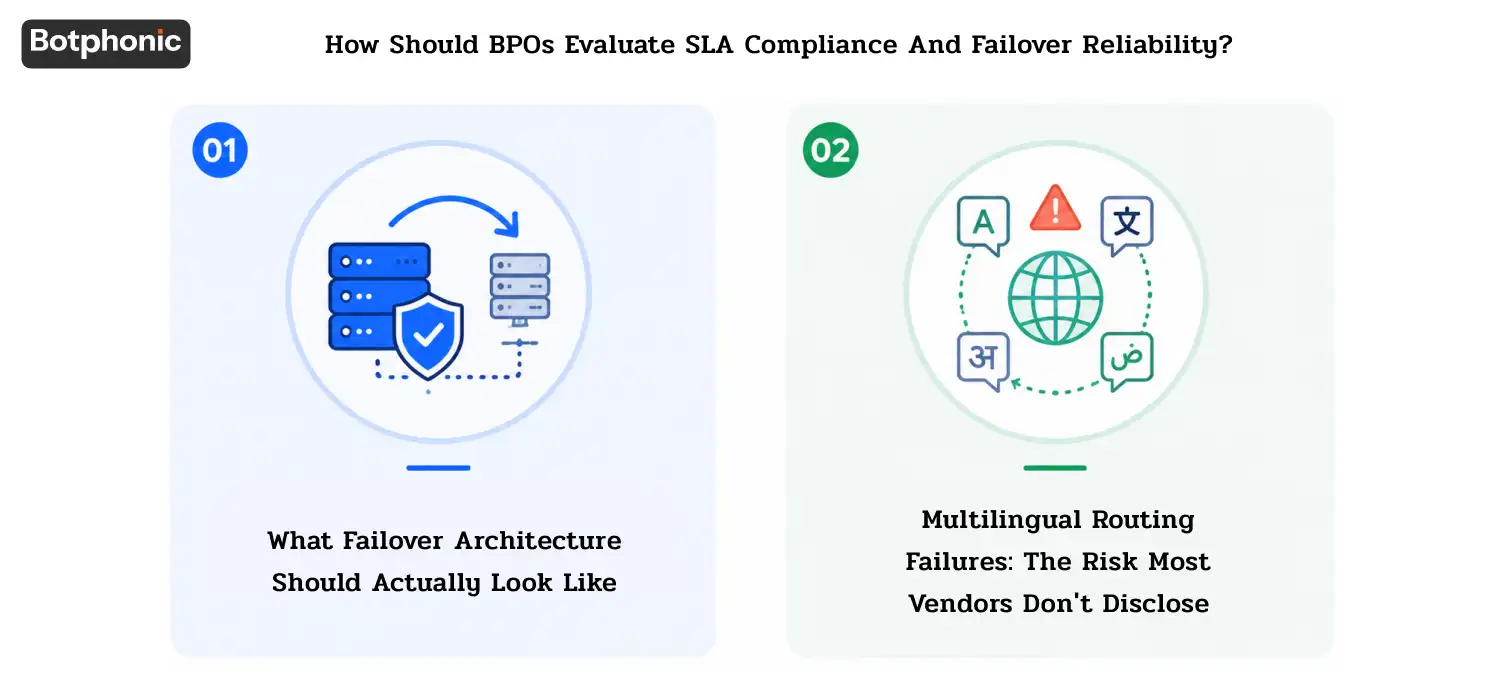
What Failover Architecture Should Actually Look Like
When speech recognition confidence drops below threshold, the platform should automatically escalate to a human agent, not hang, not loop, not hallucinate a resolution. That escalation path must be pre-configured, tested, and contractually defined.
Disaster recovery architecture should include geographic redundancy. If a primary data center fails, call sessions should migrate without audible interruption to the caller.
Multilingual Routing Failures: The Risk Most Vendors Don’t Disclose
Multilingual intent detection is harder than monolingual processing. Confidence scores drop. Misrouting increases. For BPOs serving global client bases, this creates a specific operational risk that vendors rarely surface during sales cycles.
Ask vendors for accuracy benchmarks across the specific languages your accounts require, not aggregate multilingual performance figures.
What White-Label and Multi-Tenant Capabilities Do BPO Resellers Require?
White-label multi-tenant capability means the ability to deploy separate, branded AI environments for each client account, with isolated data, custom voice personas, and independent analytics dashboards. Here’s what that means for BPO resellers.
Without true multi-tenancy, a BPO cannot resell AI receptionist services at scale. Client A’s interaction data must never touch Client B’s environment, model training pipeline, or reporting layer.
What Client Isolation Actually Requires at the Infrastructure Level
Logical separation is not enough. Enterprise BPO deployments require physical or cryptographic data isolation per tenant. Model training opt-out must be available per client. Analytics must be segmented by account with role-based access controls.
Custom voice personas per client, distinct tone, name, and escalation scripting, are a reseller requirement, not a premium feature. Platforms that offer only a single configurable voice across all deployments are not built for white-label operations.
 NOTE
NOTE
Botphonic’s BPO Customer Service Solution is specifically architected for multi-tenant deployments with isolated client environments and custom branded AI agents per account.
What Compliance and Security Requirements Must BPO AI Platforms Meet?
Compliance readiness in enterprise AI voice platforms means documented certification across HIPAA, GDPR, SOC 2, and ISO 27001, with signed BAAs available and clear data residency policies. Here’s what that means for procurement teams.
“Compliance-ready” as a marketing claim is meaningless. Ask for certification documentation, where voice data is store. And, whether call recordings are retained or anonymized post-session.
The PCI-DSS Question Most Buyers Forget to Ask
If any client account involves payment workflows, collections, billing confirmation, card verification, PCI-DSS compliance is mandatory, not optional. Platforms without PCI scope cannot safely process payment-adjacent interactions.
This single compliance gap has disqualified platforms from major BPO procurement decisions. Verify it before the pilot, not after.
What Changes Operationally When a BPO Deploys Enterprise AI Receptionist Software?
When a BPO deploys a purpose-built AI receptionist platform, it reduces human agent exposure to repetitive first-contact interactions, compresses average handle time on routine calls, and creates consistent call experiences across client accounts at scale. And, these AI receptionists handle high-volume BPO calls easily while managing not just the volume but lead conversion.
What operations teams actually experience in the first 90 days: a measurable reduction in overflow escalations during peak windows, faster onboarding of new client accounts using pre-configured templates, and cleaner data flowing into CRM and reporting systems.
Where AI Call Handling Creates the Fastest Measurable ROI
Routine inquiry handling, account status, appointment confirmation, FAQ resolution, basic triage, accounts for a significant share of inbound volume in most BPO environments. Automating these interactions with a well-configured AI call assistant frees human agents for complex, revenue-relevant interactions.
The platforms that deliver fastest ROI are those integrated directly into existing telephony stacks via API and SIP, not those requiring a full infrastructure replacement.
Botphonic’s AI call centre supports direct integration with existing BPO telephony infrastructure, reducing deployment time without disrupting live operations.
Book a BPO-specific demo with Botphonic to see the platform under enterprise conditions.
Request a Free Demo