
Summarize Content With:
AnswerForce, Smith.ai, Goodcall, and Botphonic went head-to-head across 100+ real solar inbound calls. Here’s what the data actually showed.
- Why most generic AI receptionists fail in real solar sales conversations
- Which platform handled NEM 3.0, ITC questions, and qualification logic best
- How latency and interruption handling impact consultation bookings
- Which AI tools filtered renters, condos, and unqualified leads correctly
- The hidden operational costs vendors never mention
- Which platform performed best across 100+ real inbound solar calls
- How to evaluate an AI receptionist before deploying it in your solar workflow
Why Most AI Receptionists Fail in Solar Before the Call Even Ends
There’s a quiet revenue leak inside most residential solar companies, and it has nothing to do with panel prices, interest rates, or permitting timelines. It’s happening on the phone. A homeowner calls about the federal tax credit. They get routed into a hold queue, or land on a voice agent that fumbles the NEM 3.0 question, or worst case, gets mistakenly booked for a site visit despite living in a condo. They hang up. That call, worth anywhere from $18,000 to $45,000 in residential solar contract value, is gone.
The platforms most solar companies reach for first, whether out of brand familiarity or low sticker price, were built for dental appointment reminders, HVAC service callbacks, and law firm intake. Solar is operationally different in ways that matter enormously at the call level. A single inbound conversation can move from new lead qualification to NEM 3.0 clarification to HOA eligibility to financing options to permit-status routing, sometimes within three minutes. According to the Solar Energy Industries Association, the U.S. solar market installed over 32 gigawatts of capacity in 2023, sustaining the inbound call volumes that make every mishandled call an expensive event.
Our core finding from 30 days of live testing: the best AI receptionist for a solar company is not the cheapest one, it’s the one that protects qualified revenue. Everything else is secondary.
Our 30-Day Testing Methodology
The Test Environment
Four AI receptionist platforms processed real residential solar inbound calls over a 30-day period: AnswerForce, Smith.ai, Goodcall, and Botphonic. More than 100 calls were routed across the four platforms. The call mix was deliberately realistic, new quote requests, permit-status inquiries, ITC and NEM 3.0 questions, existing customer support calls, and a set of intentionally wrong-fit leads including renters, condo owners, and heavily shaded properties.
The Metrics We Measured
| Metric | Why It Matters for Solar |
| Consultation booking rate | Direct pipeline impact |
| Qualified lead rate | Protects sales rep time |
| Caller abandonment rate | Reflects call friction |
| Response latency / barge-in handling | Determines trust and naturalness |
| CRM write-back accuracy | Drives follow-up speed |
| Appointment no-show rate | Measures downstream qualification quality |
| Escalation routing accuracy | Separates support from sales calls |
The Solar-Specific Evaluation Criteria
Standard AI benchmarks measure general fluency, call completion rates, and appointment conversion. None of those metrics tell you whether the AI receptionist can handle a caller asking “Did NEM 3.0 kill the value of going solar in California?” We specifically tested each platform on: NEM 3.0 conversational accuracy, federal ITC question handling, roof and property qualification logic, HOA and condo eligibility filtering, utility territory confusion scenarios, and permit and interconnection workflow routing. These are the scnarios where real differentiation appears, and where generic platforms consistently fell short.
 NOTE
NOTE
Platform-by-Platform Breakdown
1. Goodcall: The Budget Entry Point That Hits Its Ceiling Fast
Goodcall positions itself as an accessible AI receptionist for small businesses, with plans starting at $59/month structured around “unique customer” interactions rather than call minutes. That pricing model sounds attractive until call volume climbs, exceeding the plan’s unique customer limit triggers an extra $0.50 per customer charge, which adds up quickly during peak solar season when the same homeowners may call back multiple times before booking.
In our testing, Goodcall answered calls reliably and handled simple FAQ scenarios adequately. Where it broke down was the moment calls moved into solar-specific territory. While functional, Goodcall retains a slightly robotic voice quality with higher latency than newer-generation AI agents, and in solar calls, where homeowners are asking financially significant questions, that hesitation costs trust. NEM 3.0 questions produced vague, generic responses. Condo and renter qualification red flags were missed in four out of six deliberate test scenarios, meaning those callers would have been booked as consultations rather than filtered out.
Goodcall’s barge-in handling, what happens when a caller interrupts the AI mid-sentence, was the weakest of the four platforms. Callers who interrupted were met with awkward pauses or a full restart of the AI’s previous sentence, which drove abandonment in impatient homeowners.
Best use case for solar: After-hours overflow for companies with fewer than five inbound calls per day. Not recommended as a primary inbound handler for any installer with meaningful peak-season volume.
Where it wins: Lowest cost of entry, fastest setup, adequate for basic FAQ deflection.
Where it fails solar specifically: Solar terminology gaps, poor barge-in recovery, weak qualification logic for ineligible callers.
2. AnswerForce: The Human-Hybrid That Delivers Consistency but at a Price
AnswerForce takes a fundamentally different approach from the other three platforms tested: it leads with live human agents rather than pure AI. In our testing, caller experience ratings were the highest of any platform for tone, empathy, and handling emotionally charged calls (frustrated existing customers asking about permit delays, for example).
The tradeoffs are structural. AnswerForce’s entry plan gives you 200 receptionist minutes for $349/month, roughly six minutes per day before hitting overage charges. For a solar company managing 15–25 inbound calls daily during June and July, that math becomes painful fast. Scalability is also constrained in ways that pure AI platforms aren’t: when multiple calls arrive simultaneously, additional callers wait on hold or go to voicemail: a problem that pure AI systems handle with unlimited parallel call processing.
On the solar-specific criteria, agents performed well on ITC questions and financing conversations because they follow scripts written with some industry context. Where scripts weren’t detailed enough, however, agents with no specific product training often fumbled if the script wasn’t robust enough to cover the edge case. NEM 3.0 and utility territory confusion scenarios exposed this gap, callers asking about their specific utility’s export compensation rate got generic answers.
CRM write-back was manual and asynchronous, call summaries arrived via email, which introduced delays between booking and follow-up that showed up in no-show rates.
Best use case for solar: Mature companies that need high-empathy handling of existing customer support calls, particularly during installation or permit-dispute periods. Strong for after-hours coverage where human tone matters most.
Where it wins: Genuine human empathy, reliable availability, good for emotionally complex calls.
Where it fails solar specifically: Cost structure breaks at volume, parallel call limitations during peak season, CRM integration is not automated, and per-minute billing creates anxiety about call length.
3. Smith.ai: The Premium Hybrid With Strong Booking Logic, Weaker Solar Depth
Smith.ai is the most expensive platform in this comparison and positions itself as a premium hybrid AI-plus-human receptionist service. Its AI receptionist combines automated call handling with optional live-agent escalation, custom prompt configuration, and integrations with more than 7,000 business tools.
In testing, Smith.ai delivered the strongest appointment-booking workflow of the four platforms evaluated. Calendar syncing, lead qualification, and confirmation flows worked reliably, especially for straightforward residential solar inquiries. Calls like “I want a solar quote” were routed correctly, while the AI collected useful details such as property type, roof condition, and financing interest before syncing directly into scheduling systems.
Pricing starts at $240/month for 30 calls, making its per-call cost significantly higher than most competitors. That premium makes sense for teams prioritizing booking consistency and human fallback support, but it becomes harder to justify in high-volume environments.
The limitations appeared during more solar-specific operational scenarios. Complex conversations around California’s NEM 3.0 policy exposed weak contextual understanding. Instead of confidently explaining the policy impact, the AI typically redirected callers to a human consultant. Permit-status inquiries were also occasionally misclassified as new sales leads, creating routing friction between support and sales workflows.
Latency during interruptions and barge-in moments improved over some competitors but still lacked the near-instant responsiveness that makes voice interactions feel fully natural. Human escalation, however, was handled smoothly and remains one of Smith.ai’s strongest differentiators.
Best use case for solar: Residential solar sales teams that value dependable booking flows and want a human escalation layer.
Where it wins: Excellent booking workflow, broad integrations, smooth live handoff.
Where it fails solar specifically: High per-call pricing, limited solar terminology depth, and inconsistent handling of support-related inquiries.
4. Botphonic: The Solar-Trained Platform That Wins on the Metrics That Matter
Full disclosure: Botphonic is positioned as a solar-specific AI voice platform, and its solar-focused training is a core product differentiator. Unlike generalist receptionist tools, Botphonic is built around residential solar workflows, including lead qualification, terminology handling, escalation logic, and CRM automation tailored to solar sales teams.
In testing, the biggest performance advantage appeared in three areas.
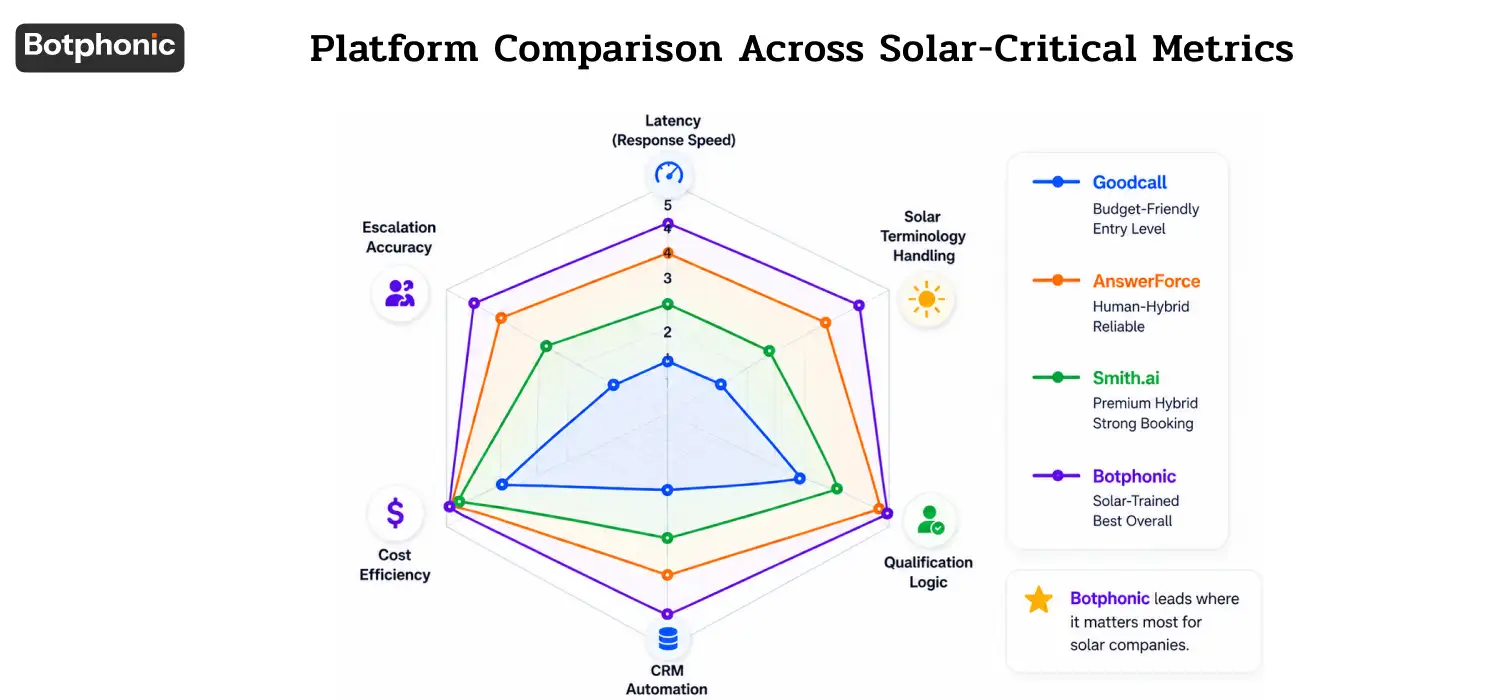
First, latency and interruption handling. Across more than 100 test calls, Botphonic consistently delivered sub-second response times. Homeowners frequently interrupted mid-conversation, yet the system recovered naturally without awkward pauses or restarting prompts. That smoother flow noticeably reduced caller frustration and abandonment.
Second, solar terminology depth. Questions about NEM 3.0 received contextual answers instead of generic deflections. The AI could explain the transition from NEM 2.0 export compensation to the Avoided Cost Calculator framework in homeowner-friendly language, then steer the conversation back toward booking a consultation. Federal ITC questions were also handled accurately, including the current 30% residential credit, without drifting into risky tax-advice territory.
Third, qualification logic. Condo-owner and renter scenarios were filtered correctly during testing, preventing low-quality consultations from reaching sales calendars. Roof shading inquiries also triggered follow-up qualification questions rather than automatic booking.
CRM updates were automated, including lead-source tagging, qualification notes, and call dispositions, reducing manual admin work and improving follow-up speed.
Where Botphonic performs best: sub-second responsiveness, solar-specific knowledge, qualification filtering, CRM automation, and handling of NEM 3.0 and ITC conversations.
Where it wins: Onboarding is more involved than plug-and-play competitors. Teams need organized CRM processes and workflow mapping before deployment.
Where it fails solar specifically: Residential solar companies handling consistent inbound lead volume with the help of AI appointment scheduler for solar. Also It helps where missed calls and unqualified site visits directly impact margins.
Side-by-Side Comparison: Where Each Platform Stands on Solar-Critical Scenarios
| Solar Scenario | Goodcall | AnswerForce | Smith.ai | Botphonic |
| NEM 3.0 questions | Vague / deflects | Script-dependent | Deflects to consultant | Context-aware answer |
| Federal ITC handling | Generic definition | Script-based, varies | Adequate but limited | Concise, accurate |
| Permit-status routing | Often misrouted | Human handles | Occasional mismatch | Correct escalation + tagging |
| Condo / renter qualification | Misses red flags | Depends on script quality | Partial filtering | Automatic filtering |
| Barge-in / interruption handling | Awkward pauses | Human, no issue | Moderate | Sub-second recovery |
| Automated CRM write-back | No | No (email summaries) | Yes (via integrations) | Yes (automated tagging) |
| Peak-season parallel calls | Unlimited | Limited by staff | AI handles parallel | Unlimited |
| Pricing structure | $59/mo + per-caller fees | $349/mo + per-minute overages | $240/mo for 30 calls | Custom / volume-based |
| Solar-specific training | None | Script-based only | Custom prompts required | Native solar workflows |
Latency is the first cost that never appears in a sales demo. Vendors demo their platforms under ideal conditions, no caller interruptions, clean audio, patient homeowners. Real solar inbound calls don’t work that way. A two-second pause after a homeowner speaks kills trust faster than a wrong answer, and that trust deficit shows up in abandonment rates and consultation conversion.
CRM mapping quality is the second invisible cost. AnswerForce delivers call summaries to email. Goodcall requires manual CRM entry. Smith.ai integrates broadly but requires setup work for each field. Botphonic tags automatically. The difference in follow-up speed between automated and manual CRM write-back is meaningful, research from Velocify consistently shows that response time within five minutes of a lead event dramatically increases contact rates. Every hour of CRM lag is a pipeline that slips.
Weak qualification logic sends unqualified callers to your sales team. A condo owner who slips through the qualification filter and books a consultation represents a wasted site visit, a wasted sales rep hour, and an opportunity cost for a slot that could have held a qualified homeowner. If your AI receptionist is booking 40 consultations a month and 18 are immediately disqualified on-site, you haven’t improved your sales operation, you’ve just moved the waste downstream.
Generic training data is the most underestimated cost of all. Voice quality and accent naturalness matter far less than whether the AI knows what a utility interconnection queue is, why a homeowner in an SCE territory cares about NEM 3.0 differently than one served by a municipal utility, or what “avoided cost calculator” means and why a caller might be worried about it. Industry-specific context is what separates an AI that sounds good from one that converts.
Who Should Not Deploy an AI Receptionist Yet
This is the question most platforms won’t answer because the honest answer sometimes means losing a sale. AI receptionist deployment works when your infrastructure supports it. It fails expensively when it doesn’t.
Hold off on deployment if your CRM has incomplete or inconsistent data, automated write-back into a disorganized system accelerates chaos, not efficiency. Also stop if your scheduling process is still manual, AI calendar integration requires a live, accessible booking system to sync against. Hold off if your call volume is under three to five inbound calls per day, at that volume, a human handles calls better and more flexibly than any AI platform currently available. And hold off if your sales process changes week to week, AI receptionists amplify your existing workflow. They don’t fix one that isn’t stable.
 PRO TIP
Final Verdict: The Platform Scorecard
After 30 days and 100+ calls, here’s the honest summary:
- Goodcall is the right starting point for a micro-installer testing AI reception for the first time, particularly for simple after-hours scenarios. Its limitations become liabilities the moment call volume or conversation complexity increases.
- AnswerForce is the strongest choice when human empathy and tone are non-negotiable, existing customer support, emotionally charged permit-dispute calls, situations where a robotic voice would cause harm to the relationship. The cost structure makes it difficult to justify as a primary inbound handler at volume.
- Smith.ai delivers the most reliable appointment booking flow in the comparison and earns its premium for companies where consistent, clean lead intake is the primary requirement. Solar-specific depth requires significant custom prompt work, and the per-call pricing structure becomes expensive at scale.
- Botphonic wins on the metrics that translate directly to solar pipeline revenue, lead qualification accuracy, NEM 3.0 handling, barge-in recovery, and CRM automation. The tradeoff is a more involved onboarding process and a platform that rewards preparation. Teams willing to invest in proper setup will see the clearest return. Teams looking for a plug-and-play solution will be better served by Smith.ai or AnswerForce in the short term.
The solar companies consistently losing revenue to missed and mishandled calls have one thing in common: they chose their AI receptionist the way they chose their last SaaS subscription, by price and setup speed, rather than by fit for their operational reality.
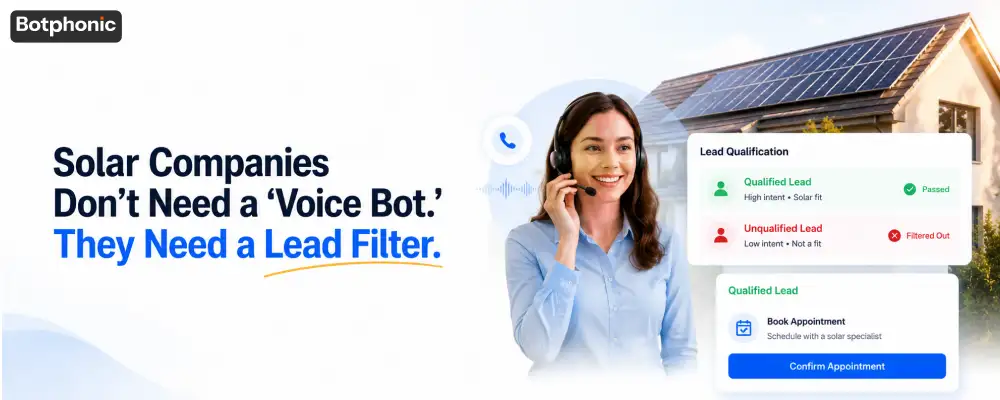
Solar companies don’t need a “voice bot.” They need a lead filter.
We tested 4 AI receptionist platforms across 100+ real solar calls to see which ones actually booked qualified consultations.
We tested 4 AI receptionist platforms across 100+ real solar calls to see which ones actually booked qualified consultations.
Request a Free Demo

