Summarize Content With:
The AI receptionist pricing is between $22/mo on the lowest-priced plans up to $3,000 and above on the highest-priced enterprise models. You already know the issue when you have attempted to compare options, they vary in terms of call volume, features, pricing model and industry needs and it is almost impossible to do a direct apples to apples comparison. This guide slices through that clatter.
It was observed that the global virtual receptionist service market will stand at $4.64 billion in 2026, and is projected to reach $10.85 billion by 2035 at a 9.8% CAGR. You can find a breakdown of AI receptionist cost and each of the factors that drive the cost of an ai receptionist, a comparison of the four main pricing models, a tier-by-tier analysis of how much does an AI receptionist cost, a named provider comparison table, a head-to-head analysis of AI versus human receptionist costs, and a section devoted to the pricing of virtual receptionists across AI, live and hybrid services below. At the end you will be in a position to select the right plan that will suit your business.
What Determines AI Receptionist Pricing?
There is no standard rate at which two businesses will hire an AI receptionist. It would be useful to know what is an AI receptionist and the variables that increase or decrease the price before you compare plans.
Call Volume
The largest cost driver in all the pricing models is volume. Usually, 50-100 calls are allocated in the budget plans. Mid-range plans go up to 500 or more. Business plans have unlimited calls. Overage costs begin to apply at $0.10- $0.50 per additional minute, should your business get more calls than you had planned, so your actual monthly cost could be far above the base price.
Feature Configuration
The simplest AI receptionist answering the phone and taking messages is much cheaper than the one that manages bookings. Including, sending SMS confirmations, call forwarding to designated departments, and operates 24/7 in multiple places. New feature layer added – live call transferring or custom IVR menus – adds complexity to the configuration, and correspondingly, costs per month.
Customization Level
Out-of-the-box setups are cheap. Off-the-shelf solutions are not. To have a branded greeting, proprietary call scripts, multi-language support, or specialized intake workflow, you can expect to pay a higher monthly rate and possibly a setup fee of $250- $5,000 to cover the onboarding and build work.
Industry Requirements
General-purpose virtual receptionist pricing is cheaper than those that are designed to work in controlled industries. Dental offices and healthcare facilities require HIPAA-compliant call service, which increases the base prices by $50- $150/mo. Law firms require recorded interviews and intake forms that are confidential. Businesses providing financial services might need PCI compliance. These compliance layers demand more infrastructure and liability cover on the provider side, and the cost is transferred to you.
Integration Complexity
Integrating your AI receptionist with a CRM, electronic health record (EHR) system, or calendar is an additional expense. Integration will cost between $50 and $200/mo based on the platform and the level of connection. Basic Google Calendar integrations are at the bottom; Salesforce or EHR integrations at the top.
Multilingual Support and Language
Base pricing is done with English-only setups. When your business requires the AI to make calls in Spanish, French, Mandarin or any language other than English, it is nearly always an add-on that costs money. Depending on the provider, multilingual support can increase your base plan by 20-40 percent.
AI Receptionist Pricing Models Explained
You must know the four pricing structures before comparing certain plans. One of the most frequent, and most expensive, business errors that businesses make is to pick the wrong model of call pattern and not understanding actual virtual receptionist pricing.
Monthly Subscription
The most common model. It can also be considered as an AI receptionist cost per month. You pay a fixed amount of money monthly which entails a certain amount of minutes or calls. Prices start as low as $22/mo on the basic and a high of $1,500/mo on the high volume premium plans. Businesses that have a steady and regular flow of calls are better placed on subscriptions. The biggest risk is that you will pay for the capacity that you will not utilize during slow months.
Per-Minute Pricing
Each minute that the AI is on a call is billed. The average rates range between $0.04 and $0.25/minute. This model is appropriate to the business with low or unpredictable call volumes – a seasonal landscaping company, e.g. The danger is that you can get a spike in your bill with no notice because of long calls or months with unexpected high volume.
Per-Call Pricing
The rate that the AI will respond to each call is a fixed rate, usually $2.50-$4.00 per call. This is suitable in businesses that are interested in paying only on the actual call activity as opposed to a fixed monthly rate. The negative aspect is that a per-call model will be costly compared to a subscription plan as the volume of calls increases.
Hybrid Models
Many more providers are offering a low base subscription with overage priced at a price per minute or per call above a specific limit. As an illustration, you could spend $99/mo on up to 200 minutes and then it would be 10 cents/minute after that. Hybrid models are appropriate in expanding businesses since the base cost can remain predictable and the overage structure is capable of managing the volume upsurge, you will have a proper structure of AI receptionist cost per month. The trick is that your overall bill needs to be dealt with month to month.
The table below summarizes each model at a glance:
| Model | Cost range | Best suited for | Risks |
| Subscription | $22–$1,500/mo | Predictable call volume | Overpaying for unused calls |
| Per-minute | $0.04–$0.25/min | Low call volume/variable call volume | Cost can increase with longer calls |
| Per-call | $2.50–$4.00/call | Moderate call volume | Costly at larger scale |
| Hybrid | Depends on circumstances | Growing businesses | More difficult billing process |
How Much Does an AI Receptionist Cost? Pricing by Tier
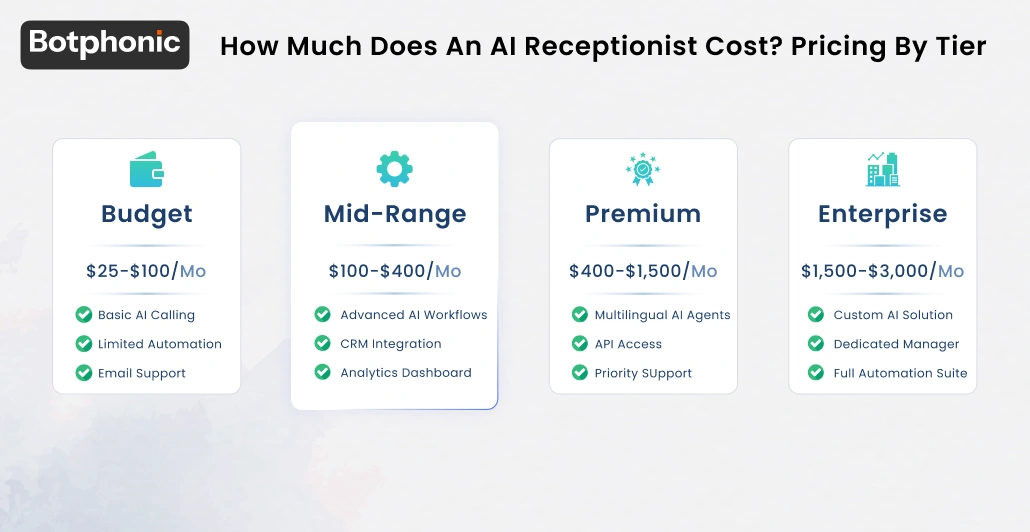
In simple terms, here is what will affect your cost – how many calls you have each month and which features do you need. Below there is a table showing 4 price tiers with possible expenses and a row of one-time setup fees.
| Tier | Average Monthly Cost | Features and Benefits | Best Fit For |
| Budget | $22–$100/mo | Basic phone call handling, voicemail, ~50-100/month | Small business, solopreneur |
| Mid-Range | $100–$400/mo | Integrations, custom recordings, appointment setting, higher volume | Medium-sized businesses, small business |
| Premium | $400–$1,500/mo | Unlimited calls, routing, multi locations, detailed analysis | Businesses with multiple locations, large business |
| Enterprise | $1,500–$3,000+/mo | Tailored solutions, integrations, advanced analytics, API access | Healthcare organizations, law offices |
| Setup Fees | $250–$5,000 (one-time) | Onboarding, integrations, custom workflows | Depends on complexity |
Beyond these subscription options, there are per-minute charges ($0.04 -$0.25/min) and per-call charges ($2.50- $4.00/call) offered separately by some providers. A per-call model can deflate even the low-end budget plan, unless your business receives more than 50 calls each month.
 PRO TIP
Top AI Receptionist Providers Compared (2026)
Lack of a side-by-side named provider comparison is one of the most steadfast gaps in online pricing content. Let’s check out some best AI receptionist software.
The table below discusses eight of the most popular providers in the market, initial price, pricing model, trial option, and the type of business the given provider is most suitable for. The sources of ratings are G2 and Capterra.
| Provider | Starting Price | Pricing Model | Free Trial | Best For |
| Botphonic | $22/mo | Subscription | Yes (14 days) | Small businesses, startups |
| Smith.ai | $300/mo | Per-call + subscription | Yes (14 days) | Law firms, professional services |
| Ruby | $250/mo | Subscription | Yes (14 days) | Premium service, live + AI hybrid |
| My AI Front Desk | $99mo | Subscription | Yes (7 days) | Medical, dental offices |
| Dialzara | $29/mo | Subscription | Yes | Budget-conscious small businesses |
| Rosie AI | $49/mo | Subscription | Yes | Home services, contractors |
| AIRA | $26/mo | Subscription | Yes | Solopreneurs |
| Ringly.io | $69/mo | Subscription | Yes | E-commerce, retail |
The most affordable and full-featured option in this comparison is Botphonic at $22/mo, which makes it a viable entry point of small businesses and startups that do not require an extreme price tag like a Smith.ai or Ruby plan just because they want more than just the basic call answering features.
Smith.ai (starting at $300/mo) and Ruby (starting at $250/mo) are priced higher, aimed at professional service firms (especially law practices) where hybrid live-agency coverage and white-glove services are worth the extra cost.
My AI Front Desk ($99/mo) is designed specifically to fit medical and dental offices, and the scheduling and intake processes are already set up in that context.
The low-end alternatives to Botphonic are Dialzara ($29/mo) and Rosie AI ($49/mo), the latter being exceptionally strong in home services and contractor businesses where emergency routing after hours is a necessity.
AIRA ( $26/mo ) is aimed at solopreneurs who want to have professional call experience but at an enterprise price. Ringly.io (priced at $69/mo) has been popular among e-commerce and retail companies, which require large volumes of calls to be addressed in product inquiry processes.
To further discuss the comparison of Botphonic with each of these providers in terms of features, integrations and call quality, see the complete Botphonic vs competitors breakdown. Want to see how these providers compare beyond pricing? Read our AI receptionist reviews.
 NOTE
NOTE
AI Receptionist vs. Human Receptionist: Comparison of Cost
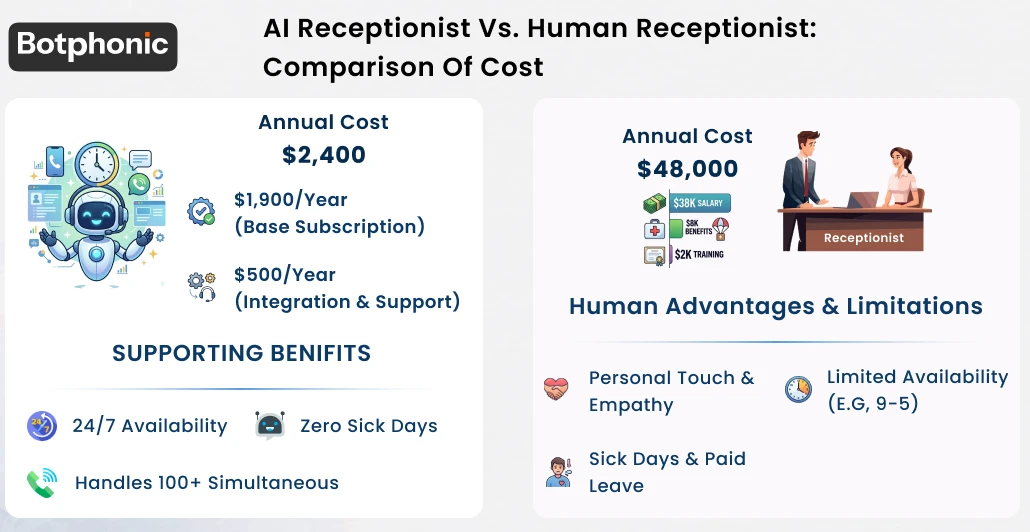
The question where the business case of switching cannot be easily argued is the AI vs human receptionist cost question. The following comparison is based on market data of 2026 and Bureau of Labor statistics receptionist salary data.
The calculations add up to the savings:
- Human receptionist: $38,000 salary + $8,000 benefits + $2,000 training = ~$48,000/year
- AI receptionist (mid-tier): $200/mo x 12 = $2,400/year
- Annual savings: ~$45,600
- 5-year savings: ~$228,000
The difference in costs is in itself convincing, yet it is not the whole story. An AI receptionist never goes sick, never takes holidays and does not resign after six months of training. It supports 100 simultaneous calls at 2 a.m. on Sunday and still provides the same quality as at 10 a.m. on Monday. In the case of expanding companies that a human receptionist has become a bottleneck, that scalability is worth as much as the dollar savings.
| Feature | AI receptionist | Human receptionist |
| Annual cost | $1,200 – $15,000 | $35,000 – $50,000+ |
| Availability | 24/7/365, no overtime cost | Business hours only (~40 hrs/week) |
| Consistency | Same quality on every call | Varies by mood, fatigue, training |
| Personal touch | Limited, improving with AI | Strong |
| Scalability | Instant | Requires hiring and training |
| Sick days / PTO | None | 15 – 25 days per year |
| Setup / training time | Hours (configuration) | Weeks to months |
| Staff turnover | Zero | Every 1 – 2 years on average |
| Multilingual support | Available as add-on (+20–40%) | Depends on hire, extra salary cost |
| HIPAA / compliance | Available on mid/enterprise plans | Requires training and monitoring |
| CRM / calendar integration | Native on most mid-range plans | Manual data entry |
| Complex / sensitive calls | Limited | Handles nuance and judgment |
With that being said, the use of AI receptionists is indeed limited in cases involving human contact, empathy, or subtlety of judgment. A combination between AI and human agents (hybrid model) can be the appropriate solution to those businesses. To compare For a deeper AI vs human receptionist comparison covering ROI and performance metrics, see the full analysis.
Virtual Receptionist Pricing: AI vs Live Service
The range of pricing applied to the virtual receptionist is larger than most purchasers understand, since the term is used to apply to three different types of services with extremely different costing models. When this is your first time researching virtual receptionist pricing, the type of provider you pick is just as important as the type of provider.
AI Virtual Receptionists ($22 – $500/mo)
Computer-assisted and entirely automated. The AI responds to each call without the intervention of humans. Others that come in this category are Botphonic ($22/mo), Dialzara ($29/mo), and AIRA ($26/mo). This is the least expensive solution to the businesses that have typical call handling requirements – booking appointments, call routing, taking messages and responding to frequently asked questions.
Live Virtual Receptionist Services ($200 – $1000/mo)
Human agents that are contacted remotely. Such providers as Ruby ($250/mo) and Smith.ai ($300/mo) occupy this range. It is also more expensive, has a higher personal touch, and without paying extra, the live agents can only work when staffed unlike AI which is all-time. The quality of calls also depends on the turnover of agents, quality of training, and spikes.
Hybrid Services ($150–$800/mo)
The AI is used to process routine calls; in complicated or sensitive cases, a human agent intervenes. This model is increasingly gaining popularity with companies that would like the cost efficiency of AI, but retaining the ability to scale to new levels provided by the human fallback. A version of this model is available in Smith.ai. Pricing is between the two pure-play categories.
To the majority of small businesses that consider the pricing of the virtual receptionist, the AI-only will provide 90% of the service at 10-20th of the cost of the live-service. The math is particularly far more understandable when dealing with businesses that have a large number of calls and calls that are very routine.
In terms of pricing on the AI answering service front, AI-only offers have rendered the traditional answering services who typically charge between $0.75 and $1.25/minute to use live agents more and more of a stretch to justify when it comes to standard types of calls.
The advert price is seldom the actual price. Before you commit to any plan, ask the provider for a complete fee schedule. The charges are most frequently seen in the fine print here:
- Initial and onboarding: $250 – $5,000: depending on your complexity of configuration, integrations, and custom scripting. Basic configurations are on the lower end; multi-location enterprise structures are on the high end.
- Overage fees: Most providers charge an additional amount of $0.10-0.50/extra minute or calls, provided you go over the limits of your plan. One hectic month can contribute to your bill with an amount of $100- $300 without your knowledge.
- Integration charges: To integrate your AI receptionist with a CRM, EHR, or calendar system will usually be $50- $500/mo, in addition to the basic plan. This will be listed as a distinct entry or grouped together as a higher tier.
- Number porting: Transferring your current business phone number to the AI platform typically costs a one-time fee of $22-100. This cost is passed down to some providers; it is not passed down to many.
- Cancellation costs: Some providers, especially those who provide annual agreements request 1-3 months of the outstanding balance of the contract as an early cancellation fee. Cancellation terms should be read prior to signing.
- Add-ons: The HIPAA-compliant call handling will be an extra $50- $150/mo on top of the base plan. The storage of call recording will be an extra cost of $10- $30/mo. Healthcare and legal businesses cannot do without these.
Request each provider to submit a complete fee schedule prior to signing. When they will not give one, it is a red flag that should not be ignored.
AI Receptionist Cost by Industry
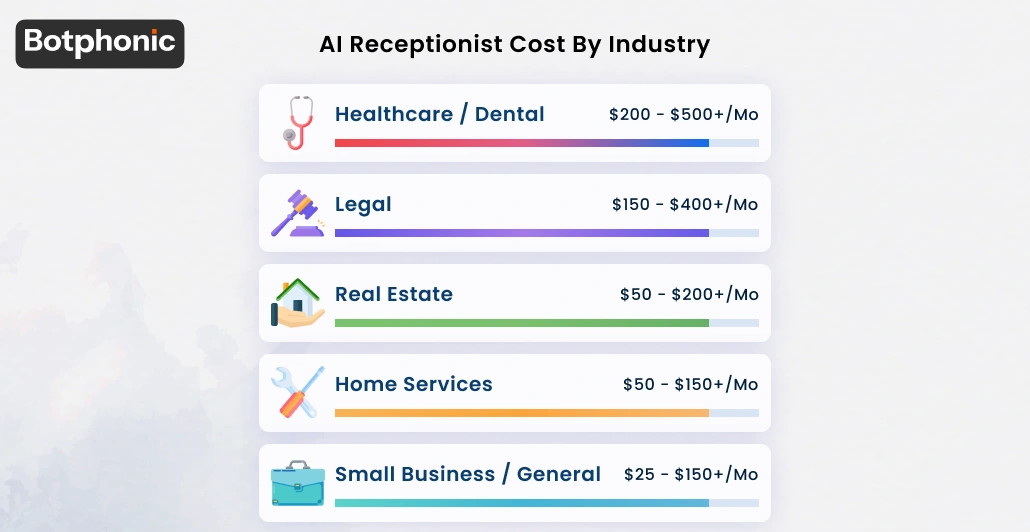
One size does not fit all when it comes to AI receptionist pricing. The industry is what defines what you must have and what you must not have. A quick-reference table of the cost range and
The major cost driver of five key sectors is shown in the table below.
| Industry | Typical Monthly Cost | Why It Costs More/Less |
| Healthcare / Dental | $200–$500+/mo | HIPAA compliance, appointment scheduling, insurance verification add to base cost |
| Legal | $150–$400/mo | Complex call routing, intake forms, confidentiality requirements |
| Real Estate | $50–$200/mo | Appointment scheduling focus, property inquiry handling, CRM integration |
| Home Services | $50–$150/mo | Scheduling, dispatch, after-hours emergency routing |
| Small Business / General | $22–$150/mo | Basic call answering, voicemail, message taking, most affordable AI receptionist tier |
There is no bargain when it comes to healthcare and dental offices since the cost of compliance with HIPAA cannot be compromised. But HIPAA compliance costs vary significantly based on organization type, size, and environment, with compliance infrastructure directly affecting how much businesses pay for services that handle protected health information.
Each call should be treated in a manner that safeguards patient data, and that IT is more expensive to develop and maintain. In case you require AI appointment scheduling and HIPAA-compliant call management, find providers that will provide both options in one plan instead of combining two different tools.
There is a premium on legal practices on secure routing, confidential intake, and call recording with appropriate retention policies. Businesses focused on real estate and home services fall at the lower-cost end since their requirements, such as appointment scheduling, CRM integration, after-hours routing, have a high level of standardization among providers.
The $22-$150/mo price range is affordable and provides a truly capable yet an affordable AI receptionist for appointment scheduling, which is simple to use and operate, and does not include any enterprise-level features that a small business will never require.
How to Choose the Right AI Receptionist Plan
The decision framework below reduces the process to six steps that are feasible with dozens of providers and four pricing models to consider:
1. Determine your monthly call volume: Under 50 calls? You have a budget-level plan or per-call pricing. Between 50 and 500 calls? Those band subscription plans are mid-range packages. Above 500? Consider higher or premium levels with unlimited or high-volume quotas.
2. Name your integrations that are must-haves: CRM sync, calendar booking, access EHR, or process payments? Any integration you require will be an upgrade to a higher level or will incur a monthly integration charge. Compare your price and know your list.
3. Check your compliance requirements:HIPAA, PCI, or call recording laws drive you to a more advanced level and introduce an extra cost of $50-$150/mo in compliance charges. Determine this in e early stages- not all budget providers provide it.
4. Compare three or more providers: It is important to use the comparison table in this guide as a starting point. Ask individual providers to provide a line-item quote, which includes setup, integrations, overage rates and cancellation terms, not the headline monthly price.
5. Get a free trial: A majority of providers have 7-30 day trials. Test your live call traffic on the system prior to commitment. Test the AI with edge cases, not only normal calls. The best indication you can get before purchasing is a free AI receptionist trial.
6. Divide total cost of ownership: Base price and set-up fee and integration fees and estimated overages = your actual monthly cost. A $29/mo package with $150/mo integration charges and periodic overage charges can be more expensive than a $99/mo all-in package.
For a walkthrough of how this evaluation plays out with real call scenarios, the AI receptionist demo covers practical use cases across industries.
AI Receptionist ROI: Is It Worth the Investment?
Computing the payback period of an AI receptionist is simple when you enter your data. The formula is:
| ROI = (Cost of Human Receptionist-cost of AI Receptionist)/ Cost of AI Receptionist x100 |
With market real numbers:
- Human receptionist price: $48,000/per year (salary + benefits + training)
- AI receptionist cost (mid-tier): $3,600/year ($300/mo)
- Annual savings: $44,400
- ROI: ($48,000 − $3,600) ÷ $3,600 × 100 = 1,233% ROI
The calculus is evident, though it is still not the entire value. The calculation of ROI only reflects the immediate salary replacement. It fails to consider the money you retain due to your AI receptionist picking up a call at 11 p.m. that your human receptionist would have missed. It fails to reflect the expense of finding and training a replacement when your receptionist quits, which occurs every 1-2 years on average in the position. McKinsey State of AI 2025 has mentioned, 88% of organizations now report regular AI use in at least one business function, up from 78% the previous year.
Other advantages that are not reflected in the ROI formula: 24/7 operations at zero overtime expense, zero sick days or PTO, no reduction in call quality during peak hours, and can scale to 100 or more simultaneous calls in a few seconds without the need to recruit an individual. According to Gartner research on AI in customer service 85% of customer service leaders planned to explore or pilot conversational generative AI by 2025.
To provide an in-depth AI receptionist ROI model, with industry-specific inputs, the entire ROI analysis subdivides it into business type and call volume.
Finding the Right AI Receptionist Price for Your Business
The range of AI receptionist pricing is between $25/mo to simple call-answering plans and between 3,000 and more/mo to full-scale enterprise deployments. The appropriate number to use in your business will be determined by how many calls you make, how many integration features you need, how your industry must comply with the regulations, and how much of the difference between AI and human receptionist costs you would prefer to receive. Most providers include basic scripts, but you can also start with our free AI receptionist script templates to customize your setup.
In the case of most small businesses, a plan within the $22-$200/mo spectrum will be a substitute to what would otherwise cost $45,000+ per year in terms of human receptionist costs. And, it will also add 24/7 availability and zero-turnover consistency, which a salaried worker can never equal.
The most appropriate thing to do next is Before you buy, test it. See Botphonic pricing plan, and select the tier that matches your volume, or you can get a free trial of an AI receptionist to get the actual call traffic to test the system before you make a commitment.
Still have questions about AI receptionist pricing?
Talk to the Botphonic team or try the platform free for 14 days