
Summarize Content With:
Quick Summary
Conversational AI phone calls are redefining how businesses are interacting with customers by replacing rigid IVR menus and robotic responses with natural and human-like dialogues. Combining advanced technologies like ASR, NLU, and TTS, AI voice agents are now able to conduct seamless and real-time conversations while delivering empathy and efficiency.
It’s no longer about eliminating humans but about how one can scale human experience. From customer support triage to outbound sales, payment reminders, and even HR automation, conversational AI is delivering round-the-clock engagement.
Introduction
These days, markets are getting highly dominated by chatbots and automated emails, and even humble phone calls are now getting initiated by AI. Conversational AI phone call is a technology that’s recollecting the warmth and efficiency in voice interactions while keeping the dial tone to the side. From AI call assistants to voice agents, they are all capable of nuanced conversations anytime.
Whether you are a customer experience leader, an IT architect, or just some executive who is looking to scale the outreach process, in this post, we will explore everything that you should know, how AI phone calls work, what their real-world applications are, and the risks.
What is a Conversational AI Phone Call?
A conversational AI phone call is an interaction process where an AI-powered voice agent communicates over the phone. It effectively converses in a way that simulates human conversation. It’s about some traditional IVR menu or TTS system, but dynamic and contextually-aware dialogues.
Let’s define the terms:
- AI call assistant: A system especially designed to handle voice interactions independently, and often integrates with CRMs and support platforms.
- A voice agent makes a phone call: It’s the final execution of the agent, who initiates, carries, and concludes the conversation with the caller.
- Phone call with AI: It’s a proper outcome of the process, where a call feels as natural and intuitive as a human conversation.
IVR vs. Conversational AI
A traditional IVR system is typically menu-driven and static. It makes the user go through several steps just to clear a simple query. Whereas conversational AI effectively listens, understands, and responds to recognize the intent, emotions, and context of the query.
How Does an AI Phone Call Work?
A conversational AI-powered phone systems work as a pipeline. Let’s explore this:
- Speech-to-text (ASR): Converts the words spoken by the user into text, and accuracy matters the most in this case. For example, no one would like “Can you repeat that?” for the fifth time.
- Natural Language Understanding: Determines the intent behind the query and extracts relevant information from the same.
- Dialogue Manager: Rules out the next step, whether it’s to respond, escalate, or ask for clarification.
- Text-to-Speech (TTS): Converts AI responses into a voice that sounds natural and ensures to complete it with appropriate pauses, emphasis, and tone.
- Telephony Adapter (SIP/WebRTC): Bridges AI with the PSTN or VoIP network.
- Logging and Analytics: Captures the transcripts of the conversations, along with sentiments, and call metrics for proper compliance and insight.
 PRO TIP
How Conversation AI Phone Calls are Making Client Calls Better?
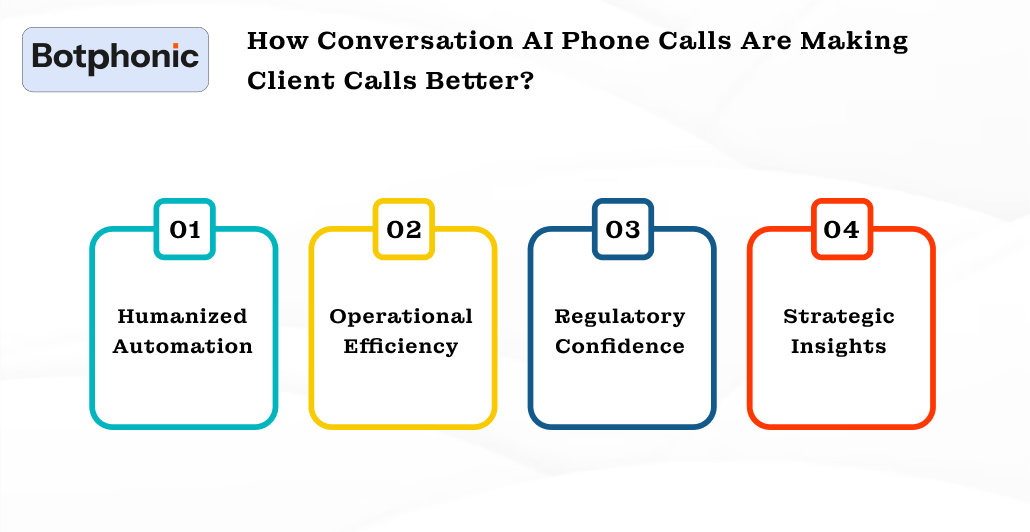
In this day of quick access to info and instant service, it’s obvious no one likes to stay on hold, talking to a monotone IVR, or just having to repeat themselves again and again. Conversational AI is here to fix that; it brings empathy, speed, and intelligence back into the phone experience.
1. Humanized Automation
AI calls are now sounding more and more natural, contextual, and empathetic. Customers are no longer feeling like they are talking to a script, but they feel heard. This aspect becomes the real differential for the same.
2. Operational Efficiency
AI is designed to handle repetitive, tedious work, such as routing, scheduling, and data collection, so human agents can focus on major tasks. Moreover, it also allows agents to manage emotionally nuanced conversations.
3. Regulatory Confidence
AI doesn’t really sleep, call in sick, or go on vacation. It ensures 24/7 availability with a consistent tone and compliance. Moreover, modern AI platforms are compliance-first, with built-in consent capture. By capturing data, such as call recording and securing data handling, companies aren’t just staying compliant but audit-ready.
4. Strategic Insights
Every AI-driven call contains essential data. Transcripts, sentiment analysis, and KPIs offer enhanced customer intelligence that can drive marketing, product design, and service improvement.
Conversational AI is effectively amplifying customer service. With the art of scaling empathy with technology, making every call from a call center into a customer experience has become easier.
Why Conversational AI is Worth Bandwidth
For busy executives, rather than taking up too much of your precious time, let us keep it short and tell you why conversational AI is worth your investment.
- Humanized automation: Customers are now getting answers without experiencing that they are talking to a stiff robot.
- Operational efficiency: Deals with routing calls effectively and allows humans to concentrate on high-value conversations.
- Regulator-ready: Modern AI phone call systems effectively support call recordings, consent, and compliance.
- Actionable analytics: KPIs and other components, such as transcripts and sentiment analysis, make this investment into strategic intelligence.
The conversational AI market is estimated to grow exponentially and reach a value of about $32.62 billion by 2030.
PRO TIP
Use Cases: When AI Phone Calls Feel Human
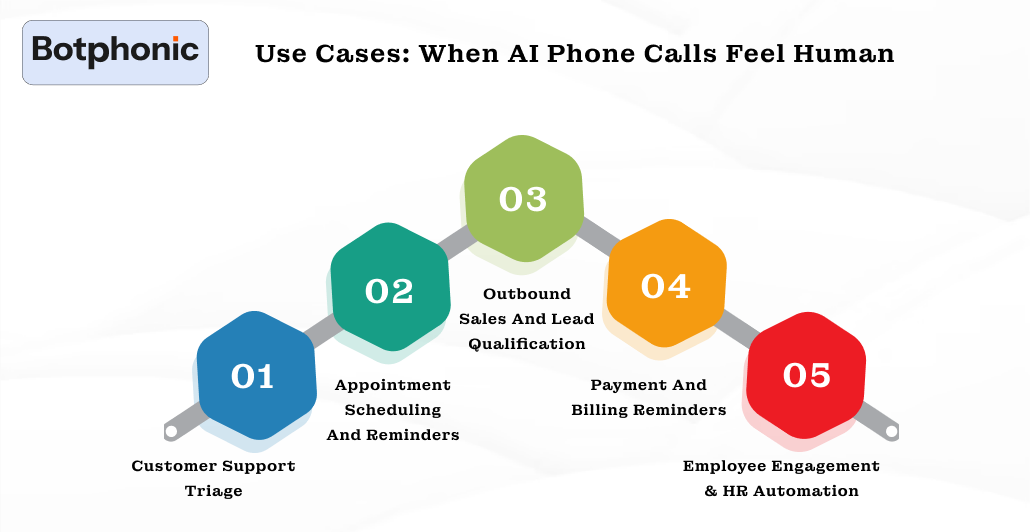
AI phone calls are something that works only when they sound human, not some old robot. Nobody likes to talk to a voicemail or a glorified robot. The winning deployments of conversation AI have something in common, and that’s their respect towards human expectations.
Let’s check out some impactful and real-world scenarios where AI call assistants and AI voice agents are elevating customer experience.
1. Customer Support Triage
Every customer support only dreams of shorter waiting times and happier callers. And here conversational AI proves its worth by handling the front line, collecting customer details, detecting intent, and lastly resolving routine issues. It also helps in transferring complex matters to a human agent.
- Human impact: Offers faster resolutions and less agent burnout.
- AI advantage: Provides 24/7 availability with a consistent tone and enhanced compliance.
2. Appointment Scheduling and Reminders
Healthcare, salons, and service businesses are now able to reduce their repetitive scheduling tasks and just allocate it to an AI voice agent. It can easily make outbound calls, confirm appointments, and send reminders.
3. Outbound Sales and Lead Qualification
AI systems are designed in a way that they easily do heavy lifting, such as identifying interest, gathering qualifying data, and routing only potential leads to sales reps. A conversational AI call nowadays feels like a friendly introduction, not just a cold script.
4. Payment and Billing Reminders
AI phone calls can easily be handled by a polite and offer proactive outreach for overdue bills or payment confirmations. When done appropriately, it removes friction for customers and reduces collection costs for businesses.
5. Employee Engagement & HR Automation
Internal use of conversational AI is not usually appreciated, but it’s one of the quiet powerful moves. Just think of onboarding check-ins, training reminders, or benefits Q&A; all these are automated through natural and conversational calls.
Conversational AI is not about switching real agents but scaling overall human experience. The best implementations of these processes are invisible. Still, they sound so natural that the customer won’t even realize they are speaking to an algorithm rather than a human.
Transform your call experience today.
Try Now!!Conclusion
Conversational AI phone calls are not just a concept of the future; they are the presence of smart engagement. Businesses that have optimized this responsibly are gaining much more than just a simple automation. They are gaining brand trust, operational agility, and competitive foresight as well.
Let’s just get real, even if you deploy a smart voice AI call assistant, if not designed smartly, it can destroy trust faster than just a dropped call. Its winning strategy just lies in its balance to ensure a blend of human oversight, strong compliance, and continuous model training.