
Summarize Content With:
What You’ll Learn
- The 2026 Shift: Why “Agentic AI” is replacing static voice bots.
- Performance Metrics: How to measure p95 latency and integration depth.
- Operational ROI: Hard data on cost savings and payback timelines.
- Compliance Gates: New regulatory requirements beyond GDPR.
- Implementation Strategy: A 3-phase rollout guide to avoid production failures.
By 2026, voice AI has moved beyond simple automation to Agentic Orchestration. Unlike 2025 chatbots that functioned as static interfaces, 2026 voice platforms act as autonomous operators, executing multi-step, API-driven workflows in real time. This guide identifies the three non-negotiable operational shifts, latency thresholds, CRM-integration depth, and human-in-the-loop governance, that separate market leaders from legacy adopters.
Voice AI 2026 Manifesto: Old Way vs. New Way
| Dimension | Old Way (2025 and earlier) | New Way (2026) |
| Core function | Answers questions on a script | Executes tasks across connected systems |
| Data flow | Reads a knowledge base | Reads and writes to CRM/ERP in real time |
| Escalation | Cold transfer, no context passed | Full context and summary handed to the agent |
| Response speed | 1.5–3 seconds, feels scripted | Under 800 milliseconds, feels conversational |
| Channel model | Voice treated as a separate, secondary channel | Voice, text, and visual data share one context layer |
| Compliance posture | Disclosure handled ad hoc, if at all | Disclosure and consent logged per call, audit-ready |
| Success metric | Call volume deflected | Task completed without human rework |
The Rearview Mirror: What We Got Right (and Wrong) in 2025
Looking back at our 2025 forecasts, the industry underwent a significant correction. Here is how our previous predictions measured up against the current 2026 reality:
- What Held True: We accurately predicted the transition from “shiny object” experimentation to ROI-focused AI operations. The enterprise has successfully moved past the phase where voice was a novelty; it is now viewed as core infrastructure.
- The “Text-First” Blind Spot: We (and the broader industry) underestimated the “text-first” bottleneck. In 2025, many organizations treated voice as a secondary channel—a peripheral add-on to chat. We now see that voice is, and always was, the primary interface for complex, high-empathy customer journeys.
- The Shift in Governance: We correctly signaled that “hallucination tolerance” would drop. However, the speed at which regulatory bodies (like the EU and FCC) moved to create procurement gates for AI voice agents caught many off guard. 2026 is officially the year where “compliance by design” is the baseline, not an afterthought.
The Question to Ask: What is Voice AI (Virtual Assistant) in 2026 and How Will it Be Different from 2025?
In 2026, voice AI will be a tool to complete jobs, not input questions. Here are some of the differences this year.
During 2025, most teams looked to voice as an additional channel for chat, which was primarily text-based. The “text-first” constraint—no pun intended—was the biggest blind-spot in last year’s predictions. Voice has become the main way to call in, support and schedule calls.
The one forecast that was right is that there will be a move toward ROI rather than novelty. A Forrester Consulting Total Economic Impact study sponsored by PolyAI found that voice AI can deliver a return on investment for companies of up to 391% over three years and pay off in less than six months. There was a reduction in hallucination tolerance as well. Today’s buyers are looking for answers to every call that are grounded and substantiated.
If you’re still mapping the basics, our beginner’s guide to voice automation covers how an AI phone call actually works end to end.
Multimodal the future of technology in this space too. Three layers of intelligence have been replaced with voice, text and visual data. AI does carry context from one channel to another, so a caller can initiate a request on the chat and complete it on the phone without having to repeat the process.
That includes on-device processing as well. Sensitive data is kept on local hardware, and critical, low-latency reasoning is increasingly running locally, reducing round trip delay. For regulated industries, local-first design is no longer just an added value; it’s a key consideration for vendor selection.
Future of Technology: The Multimodal & Spatial Shift
The future of technology in this space is moving rapidly toward “Spatial Hearing AI.” While 2025 systems were primarily text-processing models wrapped in audio, 2026 systems are evolving into multimodal intelligence layers.
Today, voice, text, and visual data feed a single intelligence layer instead of three separate tools. This allows a caller to initiate a request on chat and finish it on the phone without repeating themselves, as the AI carries context across channels. Furthermore, we are seeing the rise of On-Device Reasoning. To ensure privacy and combat the unavoidable latency of cloud-based round-trips, critical decision-making is increasingly running locally on hardware. For regulated industries like healthcare or finance, this “local-first” design is no longer just an added value; it is a key consideration for vendor selection.
By utilizing acoustic fingerprints to isolate voices in noisy environments—such as busy call centers or drive-thrus—these next-generation systems ensure that the AI remains robust and performant, regardless of the ambient background noise.
What’s Driving The Emergence Of Voice Bots as Agentic AI Systems?
Agentic AI is software that completes a series of actions in your CRM or ERP without any hand-offs. What that implies for operations teams.
A standard voice bot will respond to a question and end. An agentic system calls an account, runs a policy, updates an account and verifies the result, all in one call. By 2029, agentic AI will handle 80% of typical customer service issues without human involvement, reducing operational expenses by 30% (Gartner, 2025).
The fundamental difference that buyers overlook when comparing tools is that they are all designed for a specific purpose. A voice generation AI that is only natural speaking and not able to respond to your systems is not going to be of much service after the initial conversation.
 NOTE
NOTE
What Features Does a Voice AI Platform Offer?
Latency, depth of integration and escalation handling are the key factors in evaluating a voice AI platform, not the quality of the voices. Let’s take a look at a comparison of the two.
The teams landing is the human-AI symbiosis operating model. AI takes care of repetitive, high-volume calls while staff takes care of emotionally complex calls. That split only works if the platform can discern that split mid-call.
| Approach | Typical Latency | System Integration | Escalation Handling |
| Rule-based IVR | 1.5–3 seconds | Limited, static menus | Fixed transfer rules |
| Standard voice bot | 800ms–1.5 seconds | Read-only CRM lookups | Manual handoff, no context passed |
| Agentic voice AI | Under 800 milliseconds | Reads and writes to CRM/ERP in real time | Passes full call context to the next agent |
If you’re interested in learning more about how these systems are constructed, check out our breakdown of AI phone call system architecture.
Buyer’s Scorecard: Questions to Ask Any Vendor
If you aren’t prepared to ask questions of any vendor, take a look at buyer’s scorecard; questions to ask any vendor.
Take this checklist and apply it to the named platforms before you enter into a contract. Give each vendor 1-5 points in each row, and then tally the points.
- Latency proof: Don’t request lab averages, ask for p95 latency during live calls. Benchmarks are published by PolyAI (forrester audited) and sub-600ms claims are being marketed by Retell AI with a request from vendors to reproduce on your own traffic.
- Write back depth: Does the platform have the capability to write back to a Salesforce, HubSpot or Zendesk record throughout the call or does it only log a transcript after the call?
- Escalation context: Is there a structured summary or a cold transfer to the human agent?
- Disclosure logging: Does the platform log machine-readable consent and disclosure, rather than a spoken script, per call?
- Pricing model: How is the pricing model to be determined? Per-minute, per-resolution, flat subscription? Per-resolution pricing encourages vendors to have the ability to resolve the call.
Even though demo latency is the most easily measured number, we recommend that you don’t choose a platform based only on this measure. A vendor that is best geared up for a scripted demo call can still lag significantly when actual tool calls and CRM lookups get into the pipeline.
How Does Voice AI Handle Latency and Emotion in Real Time?
Real-time voice AI means a response of less than 800 milliseconds and sentiment detection that adapts tone while the call is in progress. So what’s the difference between the two?
In natural conversation, callers look for a response in about 500-700 milliseconds time. After 1500 milliseconds, the silence becomes mechanical and people begin to talk over the system (Famulor, 2026). That disparity is what made latency a procurement requirement and not a footnote.
Emotion-aware inference takes that speed one step further. Now the models will give a callers tone a sense of frustration or urgency and alter the pace or provide a human transfer before the call escalates.
There are also some platforms testing spatial hearing techniques, which isolate one voice in a noisy room by using acoustic fingerprints. It’s important for call centres and for drive-thrus and anywhere there is background noise that the AI needs to manage.
 PRO TIP
Why Do Voice AI Deployments Break in Production?
Voice AI deployments typically don’t fail within the model, but rather between systems. Let’s look at some of the common traps teams fall into.
Firstly, there is tool-call latency. If a response is quick in a demo, it will be slower during a real call, when the AI needs to navigate a real CRM or payment system. Each external look-up adds real measurable latency to the model’s response time.
The second trap is “old knowledge.” An AI that is able to answer questions based on a knowledge base that has not been updated in months will be sure to provide incorrect information about the policy. That’s not a model failure; that’s a content hygiene failure; and it’s reflected in an escalation spike.
Silent audio drop is the third trap. The AI may fail to detect a caller’s reply due to background noise, a weak carrier connection, or unhandled interruptions. Barge-in handling and voice activity detection must be configured for real-life call quality, rather than for low noise levels.
PRO TIP
What Changes When You Implement Agentic Voice AI in Your Stack?
Incorporating agentic voice AI involves integrating call handling with your CRM, helpdesk, and billing platforms. That means practically this.
The reality for dealerships and support teams is that there’s a reallocation of staff time. Agents can view the AI-generated summaries and only deal with calls that are marked as complex instead of manually logging call notes into Salesforce or Zendesk. Botphonic’s AI call assistant is designed to continuously feed updates back into these systems, as opposed to just logging a transcript afterward.
The same applies to teams, who begin to see calls as structured data, too. The data of the conversation creates topic tags and sentiment scores, not just a transcript nobody reads, but which are used to inform product and staffing decisions.
The shift is also reflected in our own platform data. Teams that integrated the AI directly into their CRM experienced a 63% first-contact resolution (FCR) rate within 8 weeks (up from a 41% baseline), with no increase in headcount used to support the process of inbound calls.
Want to see how this connects to your own AI phone call setup? A trial run is the fastest way to check fit before a full rollout.
Will Voice AI be a Worthwhile Investment in 2026?
If the number of calls and the cost of each call is high, then it is worth it to invest in voice AI. Let’s do the numbers on that!
Gartner predicts that by 2026, the agent labor attributable to contact centers will fall by $80 billion, thanks to a contact center agent population of approximately 17 million agents globally with up to 95% of the cost attributable to agent labor (Gartner, 2022). At the enterprise level, the Forrester TEI study found a composite organization saved $10.3 million in agent labor costs over three years and cut call abandonment by 50% (Forrester Consulting/PolyAI, 2025).
That same study had a payback period of less than six months. If teams remain considering their pilot budgets, it’s a shorter runway than most software rollouts.
Try out resolution rates for your real call types with a free trial.
Try Botphonic Today!!How Do You Implement A Voice AI Strategy Without Disrupting Support?
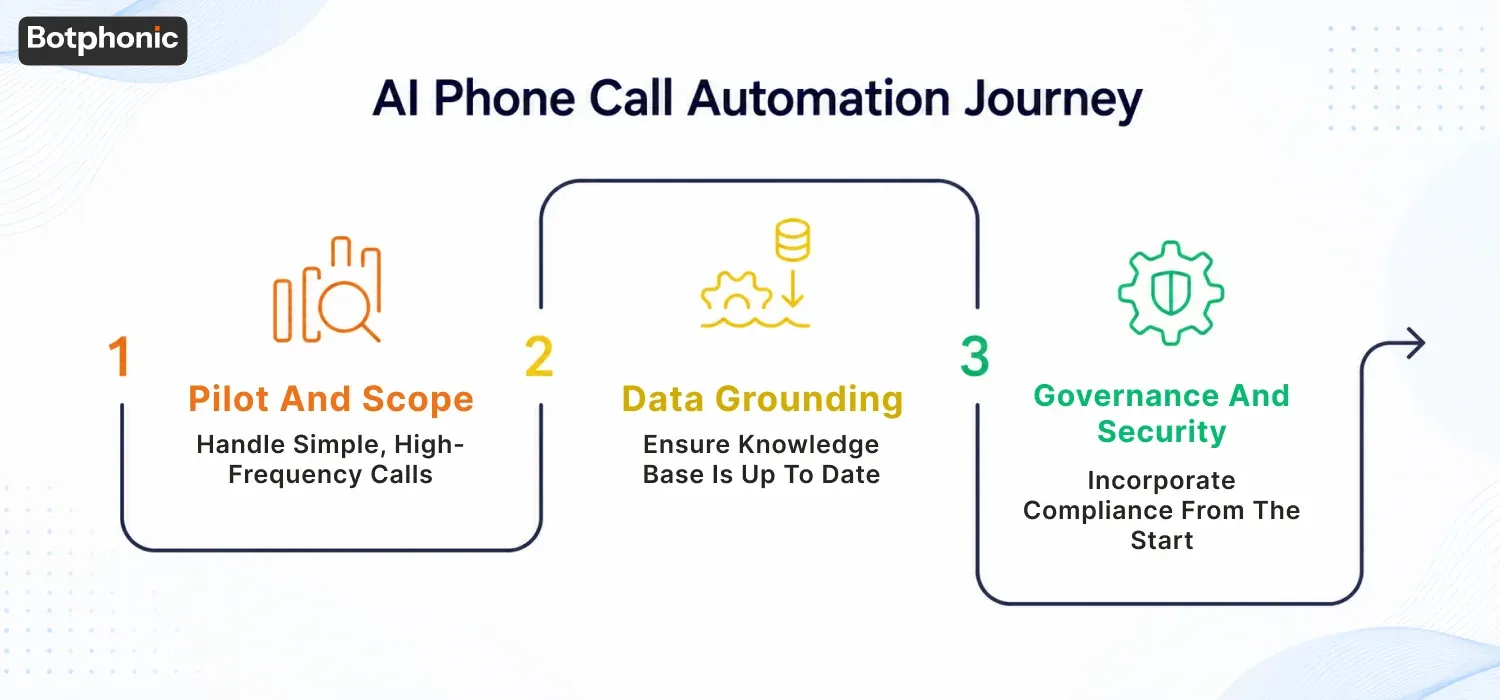
Voice AI can be implemented in three phases: pilot, data grounding and governance. Let’s see how each phase plays out in practice.
Phase 1: Pilot and scope. Handle calls that have a high frequency and don’t require too much effort, such as the order status or the confirm of an appointment. These calls are useful very quickly with little risk of escalation.
Phase 2: Data grounding. Ensure that your knowledge base remains up to date, rather than the AI making up guesses. The number one reason for AI getting answers wrong while on live calls is stale content.
Phase 3: Governance and security. Incorporate compliance right from the start, from SOC 2 to GDPR, such as call recording and data storage. For regulated sectors such as healthcare and finance, this is a must.
Marketing and agency teams are following a similar path. See howagencies are adopting AI phone call automation for client-facing campaigns.
What Regulations Beyond GDPR Is It You Must Plan For?
GDPR is not the only law that applies to voice AI. There are now three further frameworks that are turning into procurement gates for 2026.
Article 50 transparency provisions of the EU AI Act come into effect on 2nd August 2026 to ensure that all AI voice agents clearly identify themselves as AI when it comes to the first interaction with a caller (European Union, Article 50). The Act’s full timeline, including governance rules already in force, is tracked on the European Commission’s regulatory framework page.
In the United States, voiceprints employed for speaker identification are subject to biometric privacy laws, such as Illinois’ BIPA, which mandates clear consent for the capture. In addition, the FCC clarified that calls involve AI-generated voices that must be preceded by a prior written consent under the Telephone Consumer Protection Act.
Tools for planning a Voice-First 2026
One thing is clear about voice AI trends 2026: The phone call is no longer a side channel, it’s infrastructure. The teams that pilot at the moment, ground their data and dive into existing systems is the one that will drive the pace next year.
NOTE
