
Summarize Content With:
What You’ll Learn:
- What AI phone call architecture is and why it’s more than speech recognition
- How audio, intelligence, decision, and integration layers work together
- What separates a production-ready ai system from a fragile prototype
- How natural voice ai handles interruptions, latency, and high call volumes
- What specific protocols like WebSocket, RTP, and gRPC carry data between layers
- What to evaluate before building or buying a voice ai system
AI phone call architecture is the technical blueprint that determines how a voice AI system receives, processes, understands, and responds to a live phone call. It’s built for developers, product teams, and technical buyers evaluating voice AI platforms. Without a sound architecture, even the best AI model will feel slow, unreliable, or brittle.
If you’re new to voice automation, it’s helpful to first understand how an AI phone call works before exploring the technical architecture that powers it. Read our guide on what is an AI phone call to learn the fundamentals of AI-powered conversations.
What is AI Phone Call Architecture?
AI phone call architecture refers to the structured arrangement of layers, services, and data pathways that allow for a live conversation via the use of AI through a telephone connection. AI phone call architecture is not a model or an API – it is a system.
It is like a building. The AI model is merely one of its rooms, while the architecture comprises of the rest of the building, including its structure, plumbing, electrical installation, and exit routes.
The user does not communicate with the language model alone. They have to go through a series of systems, which include telephony protocols, audio streams, speech recognition, language understanding, business logic, external integrations, and voice synthesis all within two seconds.
Why it matters: The failure of any of those layers will result in latency, silence, or dropped calls. None of the AI capabilities can cover up bad architecture.
Voice AI Data Path: End-to-End Flow Diagram
The diagram above shows the entire data flow of one turn of a conversation of a single caller. Each node represents one system component, each arrow represents a transfer between them.
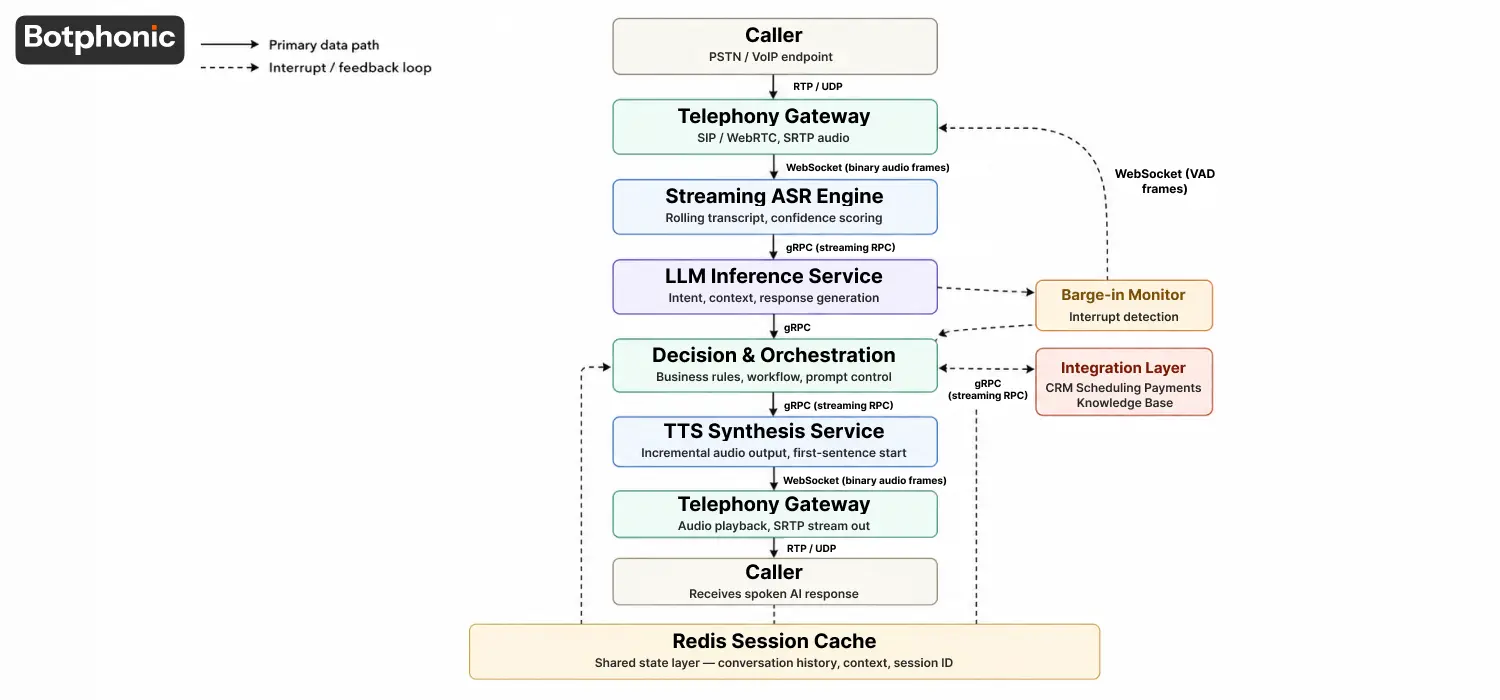
Each and every arrow in this diagram is a decision with its own latency and reliability issues. The following sections describe why each and every one was selected.
What Are the Key Layers of an AI Phone Call System?
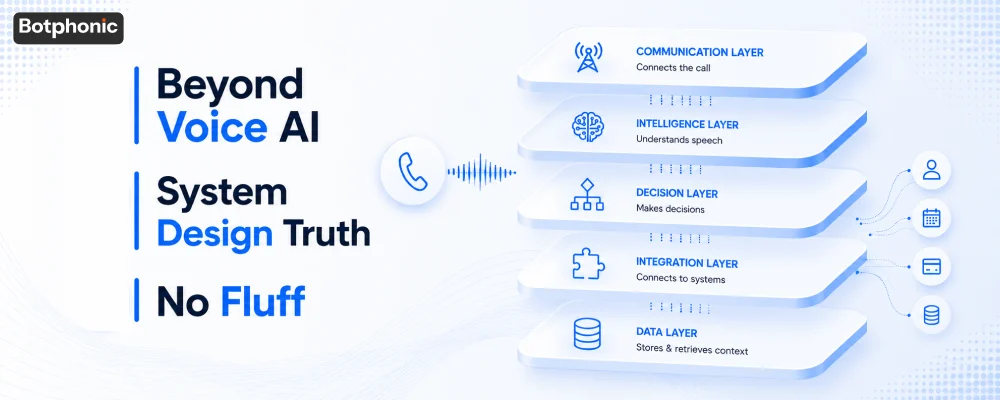
There are five different functional layers in the AI phone call system. There is a particular function associated with each layer, and there are particular impacts of failure on each of them.
Here’s how those layers stack up in practice:
| Layer | Primary Function | Example Components |
| Communication | Receives and routes the call | SIP trunking, WebRTC, PSTN gateways, RTP |
| Intelligence | Converts speech and generates responses | ASR engines, LLMs, TTS providers |
| Decision | Applies business rules and routes intent | Prompt orchestration, workflow engines |
| Integration | Connects to external systems | CRM APIs, scheduling tools, payment gateways |
| Data | Stores and retrieves conversation context | Redis, vector databases, customer records |
These layers need to work in sequence as well as in parallel. There is no waiting from the intelligence layer to the integration layer. The decision layer triggers ahead of the TTS synthesis.
How Is the Audio Sent from Caller to AI Engine?
The audio in the voice AI system is transmitted through streaming rather than batch recording.
Once the user begins speaking, the call audio passes through the PSTN or VoIP as an RTP (Real-time Transport Protocol) stream using UDP transport layer protocol. UDP is used as the transport layer protocol since it prioritizes speed over delivery guarantee – suitable in voice calls as dropping a single packet is preferred over losing 200ms while waiting for retransmission of the packet.
From the telephony gateway, the RTP stream is converted to binary frames of audio and streamed through a WebSocket connection to the ASR engine. WebSocket protocol is employed in this instance since WebSocket protocol is a full-duplex protocol where the telephony gateway is allowed to stream the binary audio frames without having to wait for a request from the client.
ASR engine transcribes the call audio on-the-fly as the caller speaks as opposed to transcribing it after the call has ended. According to a research study conducted by Google Research in 2023, ASR with streaming yields 40% faster time-to-first-token results in real-time dialogue systems.
In reality, what voice AI engineering teams often encounter is that the ASR becomes inaccurate on noisy phone calls with background TV noise, speakerphone distortions, or accents. Those systems that use a single provider of ASRs and do not have a backup often have transcriptions of mistakes leading to errors in the AI call assistant‘s response. Companies such as Botphonic resolve this issue by adding redundancy and confidence scoring in the transcription layer before the text gets to the language model.
How Does the AI Actually Understand What the Caller Wants?
The intelligence layer is where speech becomes structured intent. It is not only about transcription; it is semantic analysis.
Once the ASR converts audio into text, the transcript is sent to the LLM inference service using gRPC protocol. The reason why the gRPC protocol is used rather than REST at the service-to-service boundary includes three points: HTTP/2 allows multiple streams; it is able to use bidirectional streaming of the tokens and Protobuf serialization which takes less space than JSON.
The LLM receives the transcript, the conversation history, instructions for the system, and customer context.
 PRO TIP
Conversation consistency is the harder problem. Multi-turn dialogues demand the ability to keep track of short-term context, what the user has already said, what has been confirmed, and what remains unresolved. Most production systems keep the context in Redis and not just inside the context window of the LLM. Each gRPC request sent to the LLM contains a session identifier which corresponds to the Redis context key.
What Makes Natural Voice AI Feel Natural?
Natural voice ai feels natural due to latency control, and not just the quality of voice. Latency is the main contributor to conversation quality.
There are three approaches that help to decrease latency in ai phone calls architecture:
1. Parallel processing. The decision layer and the integration layer start working simultaneously when responding. The LLM initiates a JSON-RPC request to the integration layer as soon as intent is classified – while the response is still in the process of being constructed. JSON-RPC is chosen as an interface between layers because of its lightweightness, human readability and wide support among the CRM and scheduling APIs.
2. Incremental TTS. The TTS synthesis service starts producing audio frames from the output token stream that arrives from the LLM over gRPC streaming RPC before the full response is ready. The synthesized audio frames are sent back to the telephony gateway via WebSocket connection – the same protocol that was used to receive the inbound audio – but backwards this time. The response latency is reduced by 300-600ms as a result.
3. Barge-in detection. A special Voice Activity Detection (VAD) component receives a separate WebSocket stream of audio frames from the telephony gateway during the AI’s response. If the VAD model detects caller speech, it interrupts the TTS playback and forwards the incoming stream to ASR pipeline over gRPC – without losing Redis session context.
PRO TIP
How Should the Architecture Handle Business Logic and Integrations?
The decision layer is responsible for converting AI-generated output to actual business actions. It applies business rules, routes workflows, and enforces policies before making an integration call.
Such separation is important. Putting the business logic into your LLM prompt makes it fragile. Prompts change. Models change. Hardcoded business rules in prompts stop working quietly. Decision layer should be deterministic and testable code, decoupled from the AI model versioning.In production deployments, this separation becomes even more valuable when integrating voice AI with business platforms. Learn more about integrating AI phone calls with CRM and helpdesk tools to see how architecture supports reliable enterprise workflows.
Integration layer uses JSON-RPC over HTTPS as an interface contract for communicating with external systems. This allows treating all integration calls as stateless and audit-able. Each integration call has session id, intent classification, and any relevant entity extracted (appointment time, customer account number, service type).
What the integration layer talks to in a production setup:
- CRM applications like Salesforce, HubSpot, or VinSolutions for customer context information
- Scheduling tools like Calendly or booking APIs
- Payment providers for transactions during a phone call
- In-house knowledge databases accessed through vector search (embeddings via gRPC)
In a dialogue between an AI and a human being regarding scheduling a call, an AI produces a natural message but the integration layer sends out another request to the calendar API by way of JSON-RPC. These are two different things that have different timeout parameters, retries, and circuit breaker thresholds.
What Happens When Part of the AI Pipeline Fails During a Call?
A resilient ai architecture assumes that failures will happen and makes provision for them, rather than hoping that everything will go smoothly. A production voice AI solution should gracefully cope with partial failures without crashing.
The common resilience techniques are:
- Exponential retry logic for gRPC requests to the LLM and integration services
- Circuit breakers that prevent pounding a downstream service in the case of failures and fall back into a degraded mode of operation — usually done by the gRPC middleware
- Timeouts for each JSON-RPC integration request — an 8-second CRM lookup breaks conversational flow
- Graceful degradation, if knowledge retrieval is unavailable, the AI answers using base model knowledge instead of returning an error to the caller
Single points of failure can be eliminated via redundancy of the underlying services. Load balancers help in distributing gRPC traffic. Stateless services with all sessions managed via Redis instead of application memory enable scalability without session affinity.
Observability is the key to understanding whether your system is running well or not. In production, teams monitor ASR accuracy rates, LLM response latencies (p50, p95, p99), TTS synthesis time, WebSocket connections stability and end-to-end call time. Without observability dashboards reporting on these metrics, failures will not be visible until users complain.
How Do You Protect an AI Phone Call Architecture?
Security for ai phone call architecture works at the data layer, the transmission layer, and the access layer simultaneously. Security is not something that can be added after everything else is done.
- All data must be encrypted in transit. All Web Socket connections are made using WSS (WebSocket Secure, built on TLS 1.2+). All gRPC channels are made using TLS with mTLS (mutual authentication) between the internal services. All JSON-RPC requests made to the external APIs are done using HTTPS and, if possible, certificate pinning. All RTP streams are encrypted using SRTP (Secure Real-time Transport Protocol).
- PII (Personally Identifiable Information) handling is the most sensitive part of the operational aspect. The names of the caller, phone number, account data, and any information about the payment must be masked in the logs and cannot be saved in plaintext in the Redis session cache.
- Audit logging forms the basis of compliance. Each and every gRPC call, each and every integration with JSON-RPC, each and every intent classification, and each and every escalation needs to form the structured audit log, timestamped and including session id and result. This is necessary for HIPAA, TCPA, and PCI compliance depending on your industry.
For people developing applications on top of voice AI services, Botphonic’s approach to voice AI security and compliance is an example of how such controls can be applied to voice AI development without compromising speed of development.
Is It Worthwhile to Invest in Proper AI Phone Call Architecture?
It will pay back through reliability, scalability, and evolution.
How does implementation of a structured AI architecture change things operationally:
- Call-handling capacity becomes scalable horizontally – new gRPC services start automatically, no need to re-architect
- Models can be switched out behind the existing gRPC interface without changing the business logic
- WebSocket and RTP problems become visible in dashboards long before the callers realize them
- Compliance requirements get addressed through configuration and middleware, not through custom code per regulation
However, the alternative of fixing a monolithic voice system whenever the underlying AI model changes leads to increased technical debt. Companies which keep the layers separate for the intelligence and the decision and integration layers have much faster iteration cycles.
