
Summarize Content With:
What You’ll Learn
- Operational Layer Behind AI Phone Calls: RAG, Latency-To-Value Ratios, Intent Drift & Compliance-By-Design
- Top 3 reasons why most AI voice implementations don’t succeed in their first 30 days.
- 2026 Benchmark Table for Containment, Latency, and Escalation Accuracy in 90 days.
- Decision Framework for Whether or Not Your Call Volume Should be Handled by AI Phone Calls
AI phone calls are a conversational AI interface using real-time RAG to run your critical business telephony operations. They are not a software plug-in for your phone line. They are a new operational layer sitting between your business and each caller. When your organization views them as a plug-in, expect a lot of intent drift and poor containment rates. This is our decision framework at Botphonic to get through 80% containment without losing customers.
What Is an AI Phone Call and Why Does Containment Fall Apart So Quickly?
An AI phone call is a live exchange where a voice interface listens, thinks and responds in absence of any human. The problem here isn’t defining what it is. It is about why containment, i.e., percentage of calls resolved by a machine without human help falls apart by week 2.
It doesn’t matter that containment fails due to the weakness of the model. Containment will always fail as you scoped the solution based on the demo and not on your actual distribution of calls. A demo comes with crystal clear audio and single intent per call. Production comes with crosstalk, compound intent, and people changing their mind during a sentence.
 PRO TIP
Tech Stack Behind an AI Phone Call
There are four different components of an AI phone call stacked up into four layers connected over a high-speed, low-latency connection like WebSocket stream (instead of a regular HTTP request/response).
Speech-to-Text (STT) Turns Audio Into Tokens In Real Time
The STT models stream a partial transcription of the conversation in real-time, meaning they don’t wait for the user to finish speaking.
Inference with LLM Decides What to Say and What to Retrieve
Reasoning takes place in a large language model, frequently a multimodal model, which can handle both the text and the audio signals in one go. This is when RAG requests take place: the model asks for some information from your knowledge base or CRM, retrieves the information and provides the answer based on the data retrieval.
Text-to-Speech (TTS) Produces Streaming Speech from Text
Nowadays TTS systems do not generate the whole sentence at once but generate speech piece by piece. And this is what makes it possible to start playback before the whole generation process ends. This reduces the latency-to-value ratio.
CRM Middleware Interacts With Your Internal Business Systems
Middleware is the integration layer which does such things as bookings in HubSpot or Salesforce, checking for availability in the calendar or opening a ticket. Middleware is usually performed via REST API or webhook while a low-latency telephony provider like Twilio transports the call. The stability of middleware, and not the LLM, usually decides if a “successful” call leads to any backend actions.
 NOTE
NOTE
The Four Concepts Vendors Don’t Explain Before You Sign
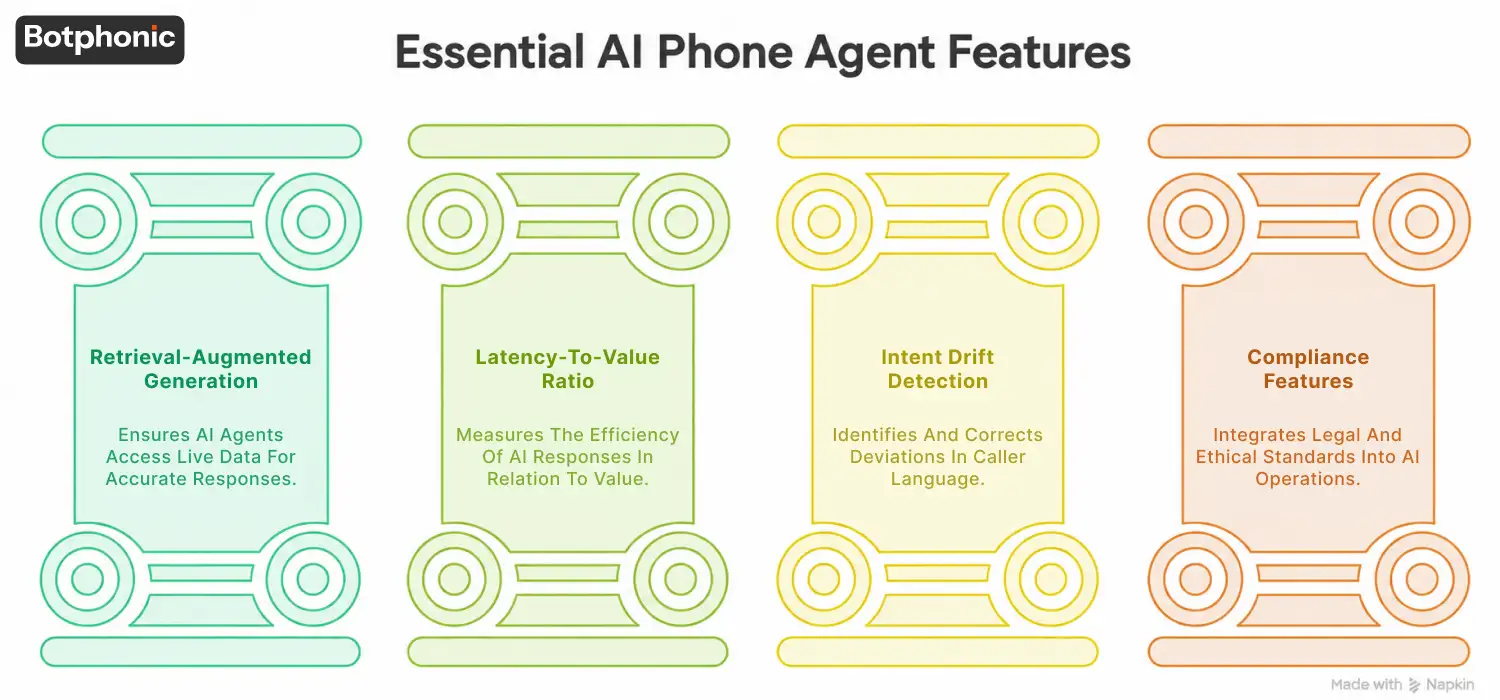
Most sales presentations don’t go into the nitty-gritty of how well your implementation will perform after the first month. Here are the four terms that deserve attention.
Retrieval-Augmented Generation (RAG) Reveals the Real Knowledge Base
RAG is what allows the system to retrieve live information from your knowledge base or CRM before answering the caller, rather than working solely based on its training. The lack of RAG means the AI-powered phone agent answers the questions based on a static view of your business. RAG allows your agent to look at the live inventory, live pricing, or booking availability before responding. The AI call assistant without RAG happily quotes the price of a product whose cost you have recently changed.
Latency-to-Value (LTV) Ratio Is the Metric Vendors Shy Away From
Latency-to-value ratio represents the response delay in relation to the value achieved. Fast and useless or slow and accurate – neither alone will get you anywhere. What matters is the ratio of how many milliseconds of delay are there for each successful task completed, and not the response time by itself. The generally accepted latency limit for turns is under 800 milliseconds, below which the system is considered slow (Bluejay, 2026).
Intent Drift Detection Detects If Callers Deviate from Your Training Data
Intent drift occurs when the language of your callers diverges from what the machine was taught to recognize. Just a price update or a recall could make callers use different wording after several days. Without drift detection, the system will continue directing calls to wrong intents with high confidence while containment metrics drop off without anyone noticing it.
Call Recording Disclosure, Data Retention Limitations, and Consent Logic Are All Built-in Features from Day One
If the system is compliant by design, then disclosure, limitations on data retention, and logic of consent are built-in features from day one. In two-party consent states like California, Florida, and Pennsylvania, the disclosure of consent must happen before the conversation proceeds (Justia, 2024). This is when most compliance debt is created – trying to bolt-on disclosure at the call flow level.
NOTE
The 3 Most Common Deployment Failure Modes for Voice AI in the First 30 Days
These are the most common patterns we encounter in voice AI deployments within the first 30 days, based on industry-wide observation that containment is generally in the 20-40% range for under-scoped solutions (Alhena AI, 2026). [Insert link to the published case study of Botphonic here, remove this line before publishing this post.]
Problem #1: There is no fallback strategy for compound intents. The caller needs both rescheduling of the appointment and a price inquiry. Call flows designed for handling single-intent conversations either respond partially to the customer’s question or go into loops. This consistently becomes the biggest cause of the early escalation of calls.
Problem #2: The knowledge base gets outdated within the first two weeks. Price change, the expansion into a new area, or seasonal changes in the working hours are not available in the AI’s data sources. And while the system responds based on outdated information, it sounds extremely sure of itself. The callers don’t report this issue – they just drop off and call competitors.
Problem #3: Lack of disclosure flow for the two-party consent states. You develop a unified call flow for the country, only to find out that there is an office in the two-party consent state. Fixing this after the deployment takes more time than adding it before deployment.
The 2026 Benchmark: How Your KPIs Should Look After 90 Days
| Metric | Industry Floor | Industry Leader | Botphonic 90-Day Target |
| Containment rate | 20–40% | 70–90% | 80%+ |
| First call resolution | Below 70% | 80%+ | 80%+ |
| Turn-level latency | 1,200ms+ | Under 800ms | Under 700ms |
| Intent recognition accuracy | Below 85% | 90%+ | 92%+ |
| CSAT (post-call survey) | Below 75% | 85%+ | 85%+ |
Containment rates greater than 70% separate successful deployments from unsuccessful deployments (Botpress, 2025; Bluejay, 2026). Turn-level latency rates lower than 800 milliseconds separate delays that do not interfere with conversations from those that do (Bluejay, 2026). By 2029, Gartner estimates agentic AI will solve 80% of common service issues without human intervention, and reduce operating costs associated with them by about 30% (Gartner, 2025)
This benchmark relies on a distinction most dashboards fail to make: Containment does not mean resolution. An issue may be contained while remaining unsolved for the customer. Focus on tracking both measures separately.
PRO TIP
Why Do Businesses Have so Many Missed Calls Anyway?
According to industry research, 62.2% of calls made to small businesses aren’t answered, either due to voicemail or not being answered at all (411 Locals, 2024). The customer patience isn’t adjusted to the mismatch; 83% of customers believe they’ll have an instant conversation with someone on the other line (Salesforce, 2025).
One receptionist or the call forwarding system can take just one customer’s call at once while the IVR menu can understand only button clicks, not the actual words. What makes an AI phone call different is its ability to take several calls at once and solve freeform speech through the RAG and intent recognition mechanisms discussed above.
The reality of what dealerships and clinics face is uneven call volume rather than even volume. Unanswered calls happen mostly during lunch breaks, evenings, and the first couple of weeks of a seasonal rush, not equally throughout the day. If your company is dealing a lot with scheduling, find out about Botphonic’s call routing and escalation mechanism.
Is an AI Phone Call the Solution You Need?
Test your call volume against four questions before the pilot program.
- Are more than one in ten calls directed to voicemail or no-answer?
- Are most calls routine, such as bookings, schedules, or pricing, where RAG could definitively give you an answer?
- Is your call volume seasonally or hourly volatile?
- Does missing a call cost more than the expense of handling it?
If you answered yes to two or more of these questions, then piloting is definitely justified. If your calls are generally complex, emotional, or sensitive in any way, it’s important to keep AI as an auxiliary technology rather than a replacement solution. Home services is one example industry, as spikes occur due to urgent requests and off-hours communication needs.
The same research showed that 95% of the service leaders interviewed in 2025 intend to maintain their human agents in staff (Gartner, 2025). It’s the deployments which are hybrid by nature rather than lack thereof. Check Botphonic’s example of AI receptionist for healthcare clinics to learn how it is done.
Schedule a 15-minute demo call with Botphonic before your next busy season.
Contact Botphonic