Summarize Content With:
Quick Summary
Most sales teams have an idea of what good lead qualification looks like – apply a framework, such as BANT or MEDDIC, score every lead, route the qualified leads to closers, drop the rest. It has never been easy to do it at scale continuously. That gap has now been bridged by AI. Modern AI phone systems qualify conversations with every inbound lead in BANT-style conversations in real time, score responses in real time, push structured data into your CRM, and route hot leads to a human SDR all without an SDR even on the call.
The math: companies using AI to qualify leads report response times as low as 5-10 seconds, capacity recovery as high as 40-60% among sales teams, and per-call costs as low as $0.08/minute compared to $4- $7 per call on outbound that is not handled with AI. According to Gartner, by 2025, 80% of customer service organizations were estimated to be using generative AI by 2025 – that figure already is a baseline, not a prediction, by 2026.
This guide includes the work frameworks of the lead qualification systems that have worked (BANT, CHAMP, ANUM, MEDDIC, AI predictive scoring), the 6-step AI qualification process, 6 industry use cases (marketing agencies, real estate, healthcare, education, recruitment, finance), 10 measurable benefits, and a 7-step playbook on implementation.
The Reasons why Lead Qualification is Broken Without AI
Conventional lead qualification causes structural bottlenecks that cannot be corrected by any amount of headcount:
- Call volume cannot be scaled by sales reps. The average SDR can accommodate 30-50 outbound calls daily. After 50 calls, fatigue affects script consistency. Error rates increase dramatically after 100.
- Missed follow-ups compound. Leads that require 3-4 touches to be qualified are abandoned once the initial “I’m not ready” has been given. Unanimous industry data: 80% of B2B sales require 5 or more follow-ups, yet 44% of salespeople give up after the first.
- Slow responses miss deals. Leads called in 5 minutes are 9x more likely to convert than leads called in an hour. Any SDR team will not strike a 5-minute response on every inbound lead. AI can.
- Inconsistent qualifying data. One of the reps listens to the customer, writes comprehensive CRM notes; another one writes three lines. At the pipeline level level analysis is guesswork as the data was not recorded in the same way.
AI reduces all four bottlenecks and maintains conversational naturalness – modern voice AI can be compared to using a competent SDR, rather than a robocall.
Automated Lead Qualification: What Is It?
Automated lead qualification is the process of qualifying potential customers using AI to determine their potential to become the client without the input of a sales representative during every initial conversation.
This system pulls data across a variety of touchpoints (web forms, CRM history, ad clicks, email engagement) and runs a configurable qualifying conversation with the lead (via phone, chat, or both), scoring their responses against your ICP criteria, and routing qualified leads to the appropriate sales rep with full context. Unqualified leads receive either a polite drop-off or are placed in nurture sequence keeping your closers focused on viable opportunities.
It is not about replacing your sales team, but about letting them get out of the repetitive 60-80 percent of qualifying work so that they can have the freedom to get involved in the conversations which truly require a human.
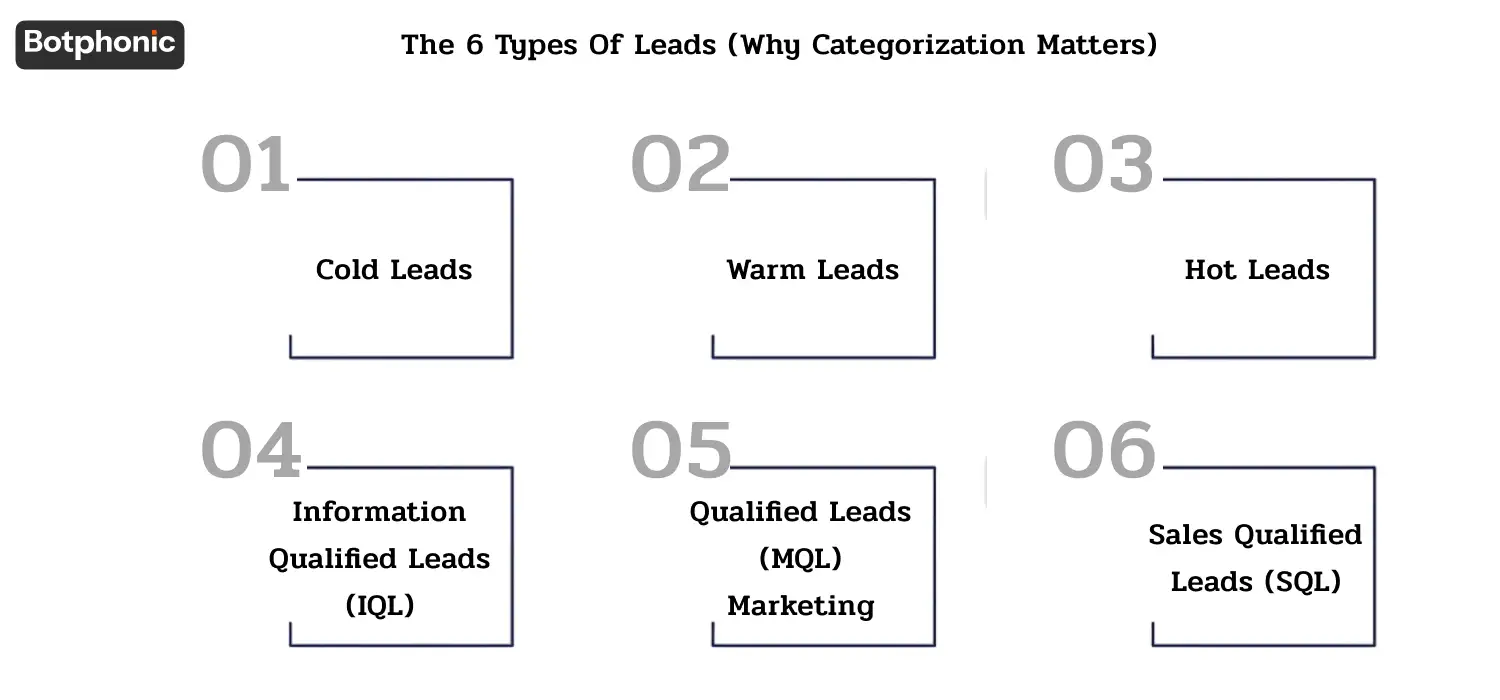
The 6 Types of Leads (Why Categorization Matters)
1. Cold Leads
No previous experience with your business. Discovered during prospecting, bought lists or unsolicited mail. The least probability to convert; must be completely educated before any qualifying questions. Best AI-handled (first-touch) outreach since the cost per call is relevant at large volumes.
2. Warm Leads
Have shown some interest, have visited your pricing page, downloaded a resource, attended a webinar. Better conversion probability than cold; advantage of immediate AI sales assistant is that it takes follow-up, when interest is new.
3. Hot Leads
Active comparison of solutions, high purchase probability, requested a demo, specific pricing questions. These are the leads where speed is the most important factor. The response time of AI of 5-10 seconds captures hot leads that would have otherwise gone to a competitor with a faster response time.
4. Information Qualified Leads (IQL)
Top-of-funnel leads who have already read and consumed educational content, but have not shown purchasing intent. Require nurture sequences prior to hostile qualification.
5. Qualified Leads (MQL) marketing
Interested in marketing various and multiple content touches, repeat visits to websites, demonstrations. Have already expressed interest but are yet to be counterchecked with the sales factors. Most suitable candidates to qualify AI.
6. Sales Qualified Leads (SQL)
Tested in relation to ICP standards, and is ready to engage in direct sales. The main output of AI qualification: each conversation must result in a structured evaluation that eliminates them or advances them to SQL.
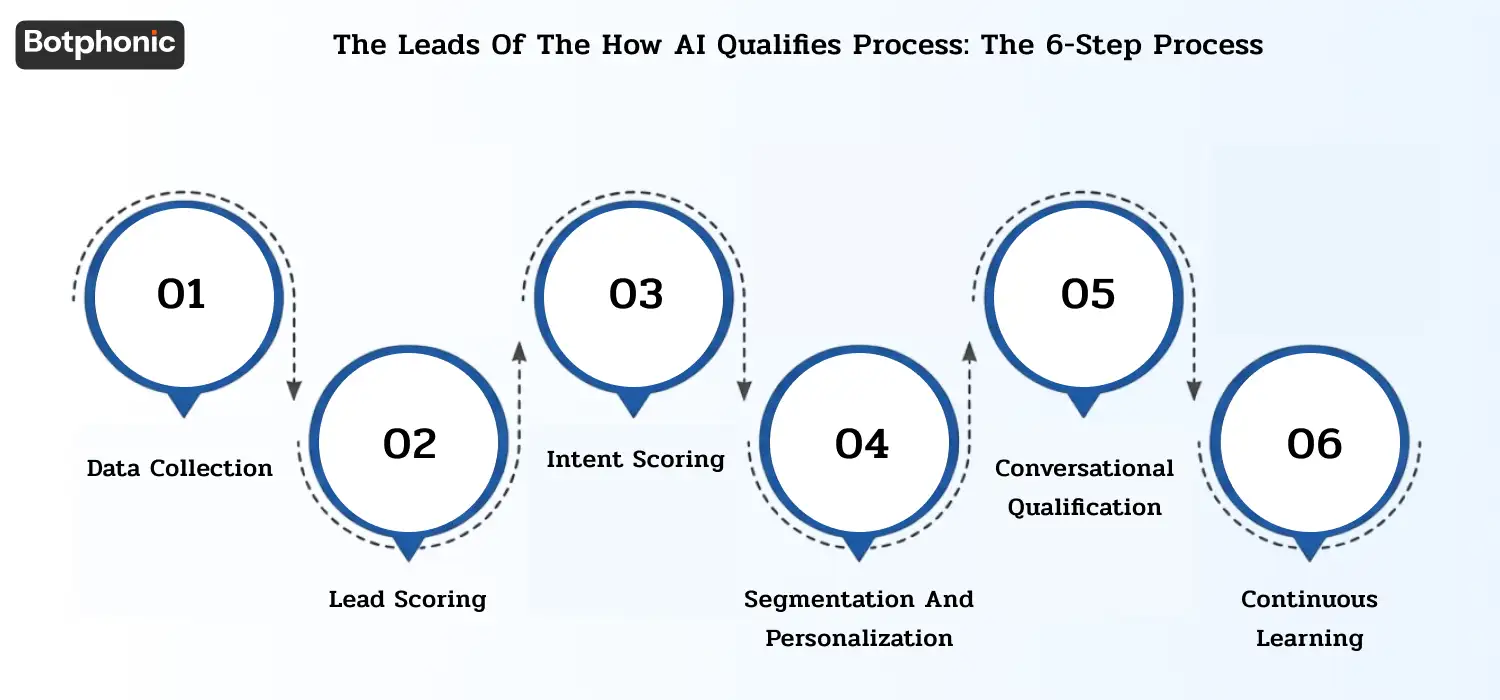
The Leads of the How AI Qualifies Process: The 6-Step Process
1. Data Collection
The AI digests information on your CRM, marketing automation system, web behavioral analytics, email interaction history, and inbound call logs. The more the input data is enriched, the more precise the qualification is.
2. Lead Scoring
Machine learning models score based on the demographic fit (industry, company size, position, geography), behavioral indicators (page visits, content downloads, email opens), and explicit interactions (demo requests, pricing inquiries, support tickets). Scores are constantly updated in real-time when new data is received.
3. Intent Scoring
In addition to the lead, intent scoring recognizes the attempt of what they are trying to accomplish. The combination of key-word search on web behavior, cues of conversation when calling AI, and engagement patterns combine to create an intent score that distinguishes between a researcher and a buyer.
4. Segmentation and Personalization
The AI segments then lead to different treatment plans: hot leads are immediately routed to a human SDR, warm leads are sent through a customized nurture sequence, cold leads get education outreach.
5. Conversational Qualification
The engaged AI engages through phone, chat, or both – operating a configured qualifying conversation that is adapted as a response. Here, programmatically applied frameworks such as BANT and MEDDIC (discussed below) are used.
6. Continuous Learning
Training data is produced every time a particular interaction occurs. These conversions are successful, and the scoring model is informed by this success; conversions that are lost feed back into the scoring model. The system becomes more precise as long as you run it.
5 Lead Qualification Frameworks (And When to Use Each)
BANT: Budget, Authority, Need, Timeline
The traditional framework developed by IBM. Four qualifying questions:
| Criteria | Description |
| Budget | Is the lead able to afford your solution? |
| Authority | Do they make the decision (or anywhere near)? |
| Need | Do they have an issue which your product addresses? |
| Timeline | Within what time frame are they hoping to make a decision? |
Best: Mid-market B2B SaaS that has a shorter sales cycle. Easy to use; familiar and accepted by buyers and sales reps.
CHAMP Challenge, Authority, Money, Prioritization
Another alternative to BANT which is buyer oriented. Tackles the issue of the customer and not your sales needs:
| Criteria | Description |
| Challenge | What is the actual problem of the customer? |
| Power | Who makes the decisions on solutions such as yours? |
| Money | Does it make the investment worth it to solve this? |
| Prioritization | How urgent is to solve it? |
Best: Consultative sales motions where rapport building is of importance prior to qualification of budget.
ANUM: Power, Necessity, Urgency, Money
| Criteria | Description |
| Authority | Speaking to the right person? |
| Need | Problem fit? |
| Urgency | Timeline pressure? |
| Money | Budget allocation? |
Best: Enterprise sales Enterprise sales are best where the key qualification gate is access to the decision-maker.
MEDDIC The Enterprise Framework
| Component | Description |
| Measures | How will success be measured? |
| Economic Buyer | Who is in charge of the budget? |
| Decision Criteria | What are the features/capabilities needed? |
| Decision Process | How is the actual procurement process? |
| Identify Pain | What’s the explicit business pain? |
| Champion | Who is a champion of your solution within? |
Best: Complex enterprise deals are characterized by long sales cycles, many stakeholders, and large contract values. The richness is rewarded in situations where the value of individual transactions is six or seven figures.
 PRO TIP
AI-Based Predictive Scoring
The latest method – applies machine learning on your past conversion history to identify the leads most likely to close. Predictive scoring replaces fixed BANT dimensions with dozens of dynamic signals, weighting each one according to its real-world correlation with your company’s conversions.
Best when: The company has enough historical data (usually 500+ closed deals) and operational maturity to act on probabilistic scoring. Frequently superimposed over one of the structured structures above.
Practically, most teams apply AI to make BANT or MEDDIC programmatic – attaining the consistency benefit of an organized framework with the speed benefit of automation.
Manual vs. AI Head-to-Head Lead Qualification
| Dimension | Manual (SDR) | AI Phone Calls |
| Response time | Minutes to hours | 5-10 seconds |
| Cost per call | $4-$7 | ~$0.08/minute |
| Script consistency | Depends on rep, day, mood. | Identical every call |
| Scalability | Linear – requires additional staff. | Unlimited concurrent calls |
| Conversion rate | Industry baseline | Greater (usually 20-40% lift on speed alone) |
| Data quality | Relies on rep notes. | Organized fields each call. |
| Hours of operation | 9-5 weekday | 24/7 including weekends |
| Multilingual coverage | One language per rep | Auto-detects 20+ languages |
| Compliance audit trail | Inconsistent | All transcribed + recorded calls. |
The framing to which sales teams will provide a buy-in: AI does not displace your SDRs. It does the stuff that your SDRs hate (cold dialing, after-hours coverage, repetitive qualification, status checks) so your humans can do what they are good at -closing.
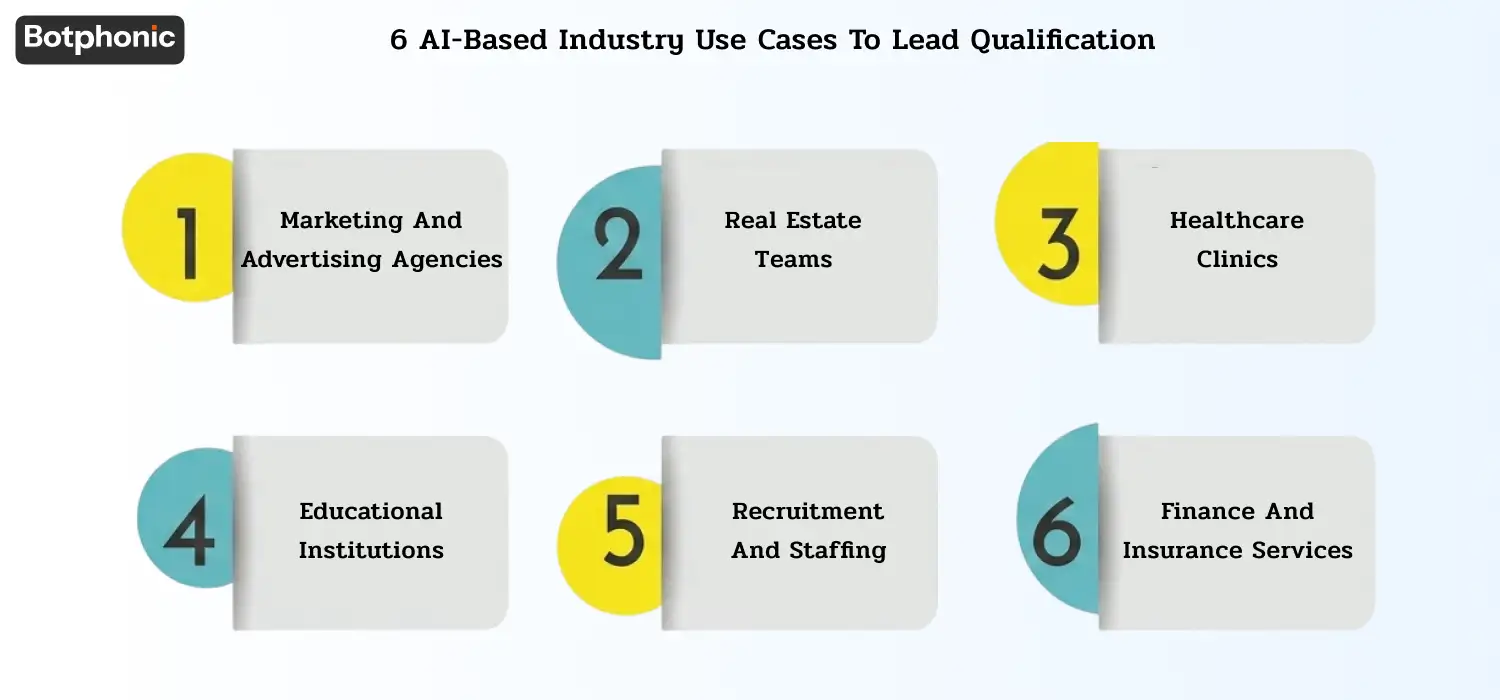
6 AI-based Industry Use Cases to Lead Qualification
1. Marketing and Advertising Agencies
- Inbound lead screening: Screen prospects by budget level, services required, time to route to account executives
- Pitch qualification: Ensures that the decision-maker is current, marketing expenditure is ongoing, growth targets are to be achieved on first contact.
- Re-engagement campaigns: To gauge interest in re-onboarding, call lapsed callers.
2. Real Estate Teams
- Response to property inquiry: Answer Zillow/Realtor.com leads in a few seconds, qualifies on price range and area preferences.
- Demonstrating scheduling: Reserve appointments without delay without having to email back and forth.
- Buyer qualification: Pre-qualify based on financing readiness, timeframe, features that must be present.
3. Healthcare Clinics
- 24/7 appointment screening: Intake calls after business hours.
- Pre-qualification of patients: Collect insurance information, visit purpose, preferred schedules.
- Specialist referral routing: Match patients with the correct provider, based on symptoms and history.
Healthcare deployments need HIPAA-ready vendors. See AI for healthcare →
4. Educational Institutions
- Student interest test: Screen potential students on program fit, financial preparedness, enrollment date
- Enrollment targeting: Determine high-intent applicants and outreach them personally.
- Application status calls: Deal with routine questions about admissions decisions.
5. Recruitment and Staffing
- Candidate pre-screening: Qualify based on availability, experience match, salary expectations, work authorization.
- Interview scheduling: Book without recruiter back and forth.
- Pipeline nurture: Re-engage passive candidates who have been candidates before.
6. Finance and Insurance Services
- Questionnaire management: Qualify requests based on type of service, account size, regulatory requirements.
- Hot lead transfer: Route route transfers a high-intent prospect to licensed representatives in real time.
- Compliance-aware screening: Capture required disclosures, audit-ready conversation logs.
10 Benefits of AI Lead Qualification
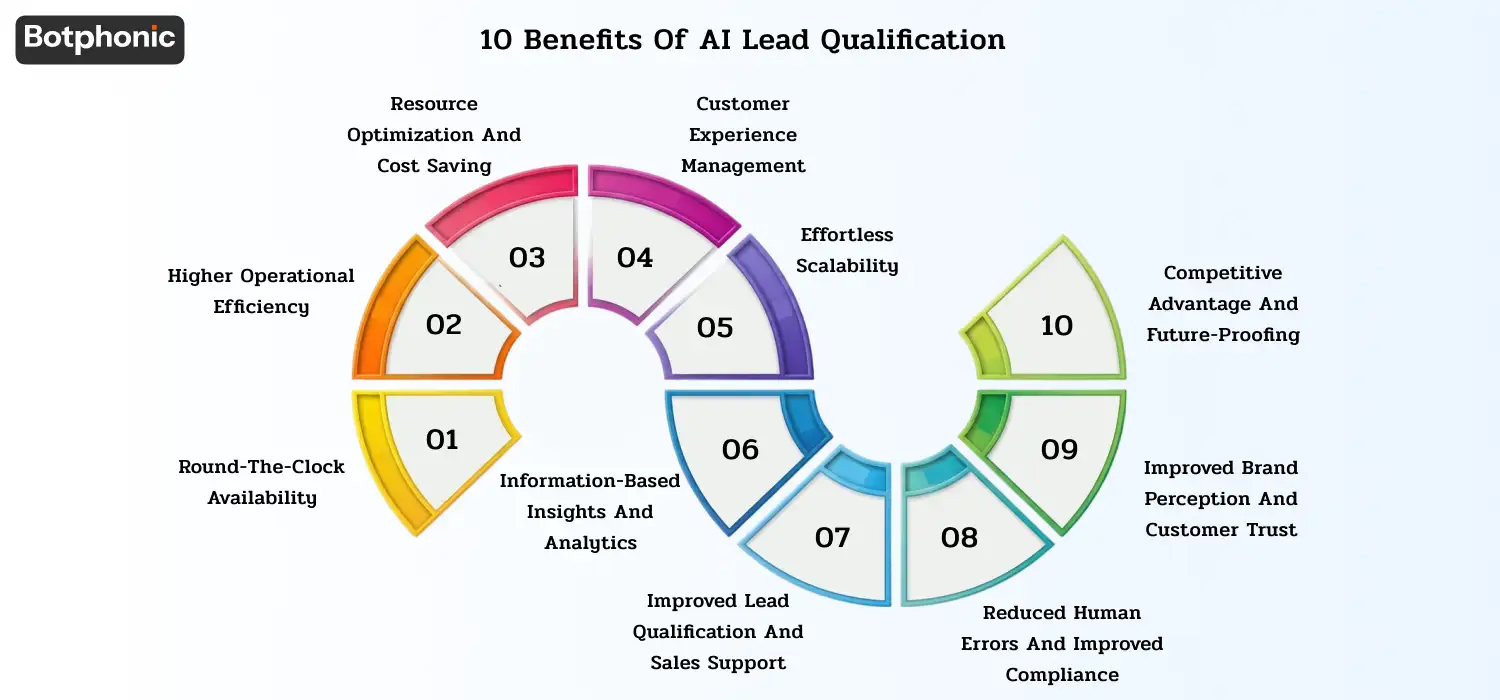
1. Round-the-Clock Availability
Inbound leads do not come 9-5. AI manages all inquiries, whether submitted at 11pm, Saturday morning, or lunchtime, with the same speed and quality as Tuesday-morning calls. To the majority of teams, after-hours capture alone is sufficient to justify the cost of deployment.
2. Higher Operational Efficiency
AI eliminates the monotonous 60-80% of qualification work – the same questions posed to each lead. Your SDRs cease to burn on running their day with script execution and begin burning with high-value conversations.
3. Resource Optimization and Cost Saving
Switching to AI reduces per-minute costs to roughly $0.08. A sales team running 5,000 outbound dials per month would typically see their monthly costs drop by $20K to $35K Run your specific numbers →
4. Customer Experience Management
All the prospects are presented to exactly the same accurate information, questioned by the same qualifying questions in the same order. There is no bad-day variability, no rep-to-rep skills differences. The customers who can know what they can expect when they interact with your brand are the customers who will continue to interact.
5. Effortless Scalability
Demand spikes (post-launch spikes, end-of-quarter spikes, viral moments) do not necessitate emergency hiring. AI peaks every volume without notice and then subsides without periods of layoff.
6. Information-Based Insights and Analytics
Each call yields structured data: intent classification, sentiment path, qualifying answers, top objections raised, next-best action. Analyzing thousands of calls reveals the ultimate truth about your buyers’ desires and their friction points.
7. Improved Lead Qualification and Sales Support
In addition to the conventional structures, AI uses them uniformly. AI delivers every BANT or MEDDIC question consistently, producing scores that are truly comparable across leads and removing the risk of SDR oversight.
8. Reduced Human Errors and Improved Compliance
AI does not type an account number with a typo, forget to record a phone call, or omit a regulatory disclosure. The audit-ready logs are a significant compliance advantage in the case of TCPA, GDPR, HIPAA, and PCI-DSS-governed workflows.
9. Improved Brand Perception and Customer Trust
Organisations who are responsive, professional and all-time project professionalism. When one of the vendors has responded within 5 seconds and the other vendors have responded within 3 days, prospects that consider multiple vendors will notice the time taken. The brand-perception lift enhances along the funnel.
10. Competitive Advantage and Future-Proofing
The use of AI in sales is shifting to the differentiator to the baseline. By 2026, the companies that will deploy will have 12-24 months of experience in operation before their rivals begin their deployment. Compounding advantage: Better data, refined prompts, integrated workflows are difficult to keep pace with.
How to apply AI Lead Qualification: 7-Step Framework
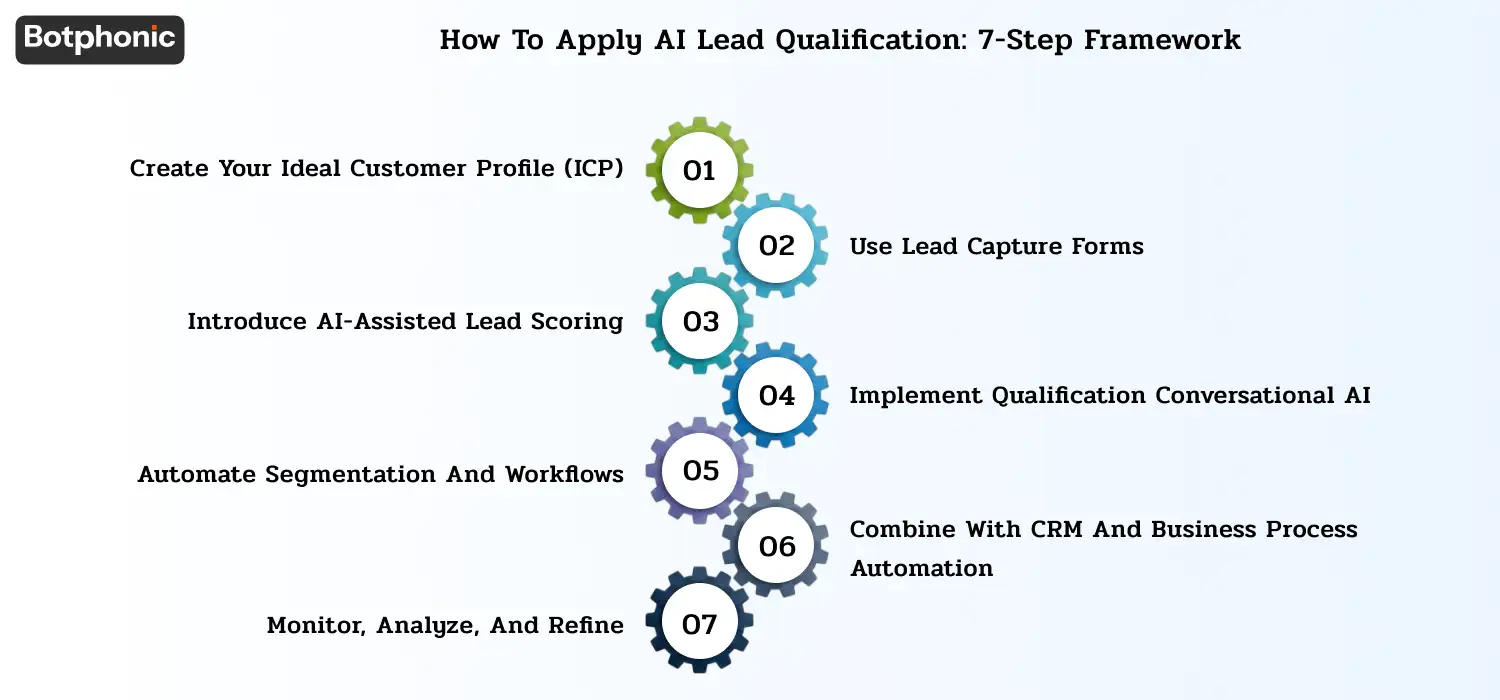
Step 1: Create Your Ideal Customer Profile (ICP)
Specify who you are qualifying. Industry, company size, role, geography, technology stack, growth stage, pain points. The more transparent is the ICP, the more precise is the leading of the AI scores.
Step 2: Use Lead Capture Forms
Most of the B2B leads come through Web forms. Store only the essential fields needed for qualification. While too many fields destroy conversion, too few starve the AI of context.
Step 3: Introduce AI-assisted Lead Scoring
Link your CRM data, history of marketing automation, and output of AI conversations to a single scoring model. First-generation scoring rules may be hand-configured (BANT-style) or trained upon historical conversion data (predictive).
 NOTE
NOTE
Step 4: Implement Qualification Conversational AI
Program your AI phone, or chat agent, to execute the qualifying conversation. Stipulate the flow of questions with each lead segment, the escalation limits, the workflow of handoff. Create a sandbox test and then go live with your Conversational AI.
Step 5: Automate Segmentation and Workflows
After qualifying and scoring leads, the AI routes hot leads to SDRs for instant follow-up, warm leads to nurture sequences, and cold leads to long-cycle drip campaigns
Step 6: Combine with CRM and Business Process Automation
Whether it is Salesforce, HubSpot, Zoho, Pipedrive, or any other platform you are running AI on, AI qualification data should be pumped back into the same pipeline view that your sales department works in. See Botphonic integrations →
Step 7: Monitor, Analyze, and Refine
Weekly metrics to monitor: qualification rate, conversion rate of AI-qualified leads, time-to-first-contact, cost per qualified lead, contribution to pipeline. Adjust scoring weights, prompts, and routing rules, depending on what the data depicts.
The 5 Components of the Effective AI Lead Qualification Strategy
Development of Scripts With Flexibility
Preset qualifying questions that change with responses, not fixed scripts that break when leads go out of pattern.
Voice Tone Selection Consonant with Brand Identity
Warm, consultative to relationship-driven sales, professional, direct to transactional sales.
CRM Synchronization to Real-Time Data
Captures on the right CRM field – all the conversation results are automatically entered in the correct CRM field.
Defined Qualification Criteria on AI Decision-Making
Set definite routing rules for hot, warm, and cold leads so you can explain the AI’s decisions and ensure they remain consistent.
Continuous Testing and Tuning
A/B test triggers variations, optimises scoring weights, retires non-performing flows based on outcome data.
Real Results: Serenity Case Study of Botphonic
An actual Botphonic implementation of a workflow in customer-services:
| Metric | Result |
| Conversion increase | +25% |
| Call handling time | −50% |
| Human errors | −20% |
| Agent satisfaction | +15% |
The first-year ROI is expected to be +150%.
Across deployments, the trend holds: AI manages 60–80% of routine qualifying tasks, leaving humans to tackle the 20–40% requiring human judgment.Productivity and satisfaction increase – the only time automation makes the human work more, not less of it.
Conclusion
Lead qualification does not have to be the choke point it has been the past two decades. At 5-10 seconds response times and costs of approximately 0.08/minute, an AI phone call assistant manages repetitive work – initial outreach, qualifying questions, scheduling, follow-up coordination – at high response times and costs. The 60-80% of the work day previously lost in script execution becomes available to the sales team, which now has the time to do the high-judgment work that makes deals happen.
The 2026 deploying teams have the advantage over the waiting teams of 12-24 months of operational learning advantage. According to Gartner, 80 percent of customer service organizations are expected to adopt generative AI by 2025 – that is now the base and not the forecast. The next question that most sales leaders have to ask is not whether or not they should adopt AI but rather what framework to use, which use case and which vendor.
Select a model that suits your sales motion. Choose a use case to begin with (inbound qualification is the typical non-high-risk entry point). Select a vendor that has the level of integration that your CRM needs. Measure rigorously for 90 days. Expand from there.
Ready to see what AI lead qualification looks like for your sales pipeline?
Try Botphonic free for 14 days