
Summarize Content With:
Introduction
You’re under a hiring freeze and a quota increase. Sales management continues to ask you how you will make it to next quarter with the sales team you have in place. Due to velocity, the pipeline reports indicate that the problems are that the reps spend too much time on admin and not enough time in front of customers and that the length of the pipeline continues to grow.
This is the page where you will find the answer to that problem.
It’s not a “replace the SDRs” narrative for AI sales assistant. This is about a “Give Your Existing Reps Back the Days They Are Spending on Prep, Research, Follow-Up, Qualification Call, Tag and CRM Hygiene” story. When executed properly it can reduce the average B2B sales cycle by 25-30%. If it is done poorly, it’s another tool added to an already overburdened tool box.
This playbook is for the sales leader who is calling: VP Sales, RevOps Director, Head of SDR, CRO. It demonstrates where conversational AI saves time across each stage of the cycle, what the math is for an existing 10-rep team, which integrations are worth considering for sales-stacks, and what failure modes silently kill a sales team’s six months of pilot time.
If you have to read only one, read the stage-by-stage map. That’s how the 30% number got.
What “Cutting the Sales Cycle by 30%” Actually Means
Sales Cycle is the period of time between first touch and closed-won. The industry benchmarks are dependent on the deal size:
| Deal size (ACV) | Typical cycle (days) | Source |
| SMB (<$10K) | 30–45 | HubSpot State of Sales |
| Mid-market ($10K–$100K) | 60–90 | Gartner CSO research |
| Enterprise (>$100K) | 90–180 | SaaStr benchmark studies |
The marketing number is not a 30 percent number! It’s the total of little victories over 6 stages, 3–5% saved this way, 6–8% saved that way. No particular AI solution brings 30% by itself. The 30% is from the compounded gains on the stage.
The actual ceiling is approximately 30%. Beyond that, it’s a matter of sacrificing deal quality, moving deals closer at lower win rates and higher churn. Those sales leaders that focus on pushing through 40–50% cycle deals are the ones who end up paying for them with renewals.
The “No New Hires” Math
Run the headcount-equivalent math before mapping stages. This is the sum that leads to the budget being accepted.
The 10-AE team needs to make the following assumptions:
- Fully loaded AE cost: $250K/year (base + commission + benefits + ramp + tools)
- The National Team will cost $2.5M per annum.
- Housed in multiple sites with a capacity of 100% of 15.00 MW, this is the current capacity of the team.
- Please allow 6 months for a new AE to be added, on average.
- Benefit of adding 2 AEs: $750K/year in cost avoidance + 6 months of better performance
Conversational AI is used throughout the stack:
- By using Per-AE time recovered, we are able to recover 6–9 hours/week.By leveraging Per-AE time recovered we can recover 6–9 hours/week.
- 60–90 hours/week = 1.5-2.25 AE-equivalents released (Across 10 AEs).
- Typical annual AI cost for 10-rep deployment: $30K – $80K based on call volume and integration depth
- Total unit cost of hire: ~15–30% of the total cost of hire
If the math doesn’t work: sub-5-rep teams (overhead does not justify the deal margins), deal sizes of less than $5K ACV (AI assist cost outweighs the deal margin), and industries where the buyer expects a human touch from the first message (some enterprise procurement contexts, regulated healthcare). In those instances, AI can help with internal processes, but not with customer interactions.
The Sales-Cycle Stage Map, Where AI Cuts Time
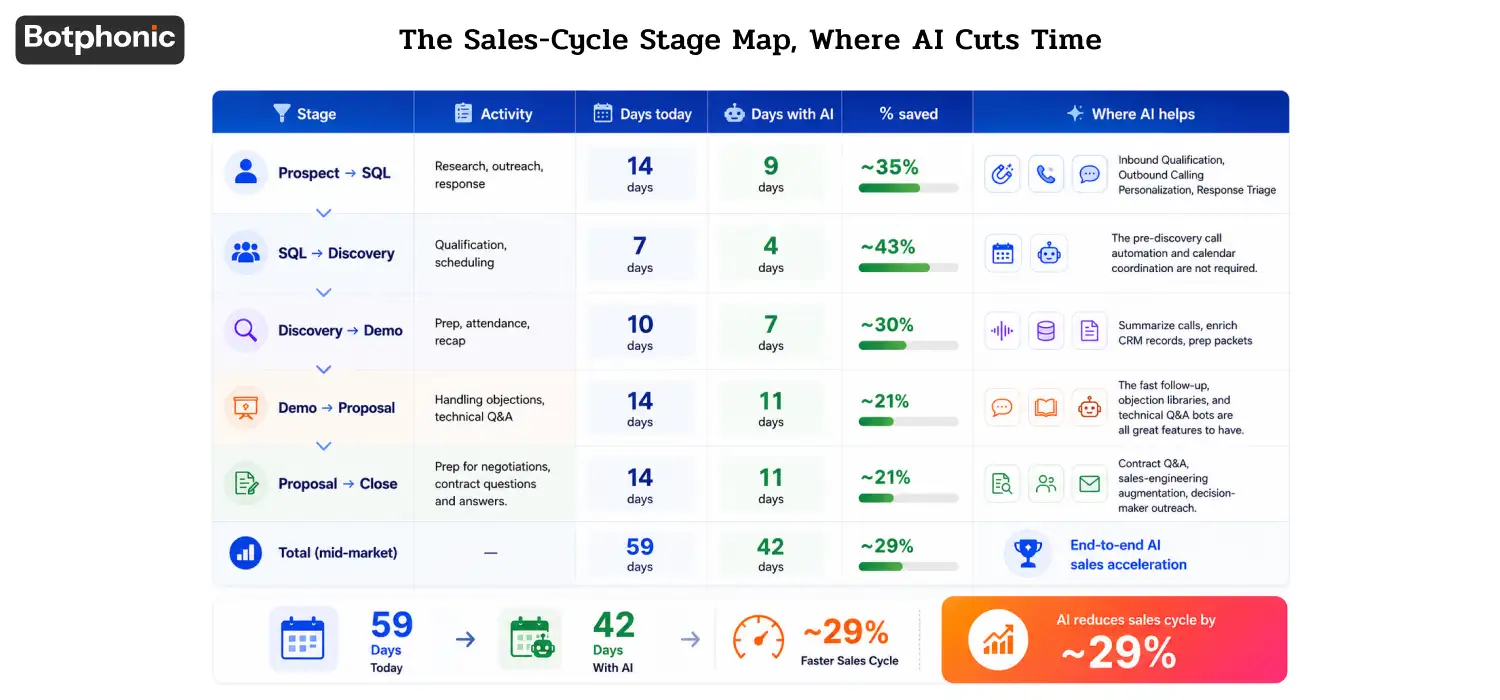
Here is the table that clarifies the 30%.
| Stage | Activity | Days today | Days with AI | % saved | Where AI helps |
| Prospect → SQL | Research, outreach, response | 14 | 9 | ~35% | Inbound Qualification, Outbound Calling Personalization, Response Triage |
| SQL → Discovery | Qualification, scheduling | 7 | 4 | ~43% | The pre-discovery call automation and calendar coordination are not required. |
| Discovery → Demo | Prep, attendance, recap | 10 | 7 | ~30% | Summarize calls, enrich CRM records, prep packets |
| Demo → Proposal | Handling objections, technical Q&A | 14 | 11 | ~21% | The fast follow-up, objection libraries, and technical Q&A bots are all great features to have. |
| Proposal → Close | Prep for negotiations, contract questions and answers. | 14 | 11 | ~21% | Contract Q&A, sales-engineering augmentation, decision-maker outreach. |
| Total (mid-market) | 59 days | 42 days | ~29% |
This page ships with each row having a connected source. The key here is the compound – small increments over time, not a miracle at one time.
Detailed Sales-Cycle Stage Map
The sources of gains are:
- Prospect → SQL compresses, AI with inbound qualification calls 24/7 without business-hour constraint; AI helps with outbound with researched, personalized, openers. HubSpot research reveals that when it comes to the impact on response-time on winning, the difference is 21 times, from under 5 minutes to over 30 minutes.
- SQL → Discovery, the AI handles calendar handoffs and performs a pre-discovery qualification pass, so the AE gets to discovery already knowing the budget range, the decision process and the competitive context.
- Discovery → Demo compresses, as all calls are auto-summarized and CRM-enriched. The AE does not take the time to find his/her notes.
- Demo → Proposal compress, Objection responses are retrieved in real time, Technical Q&A is channeled to the knowledge-base bot at night, and follow-up is automated within 60 minutes of demo’s end.
- Proposal → Close compresses, should be closed as Q&A for contracting does not take place for every trivial point and AI can map the network of decision makers so that an AE doesn’t miss out on a deal due to an unknown stakeholder.
 NOTE
NOTE
Sales-Leader Playbooks by Role
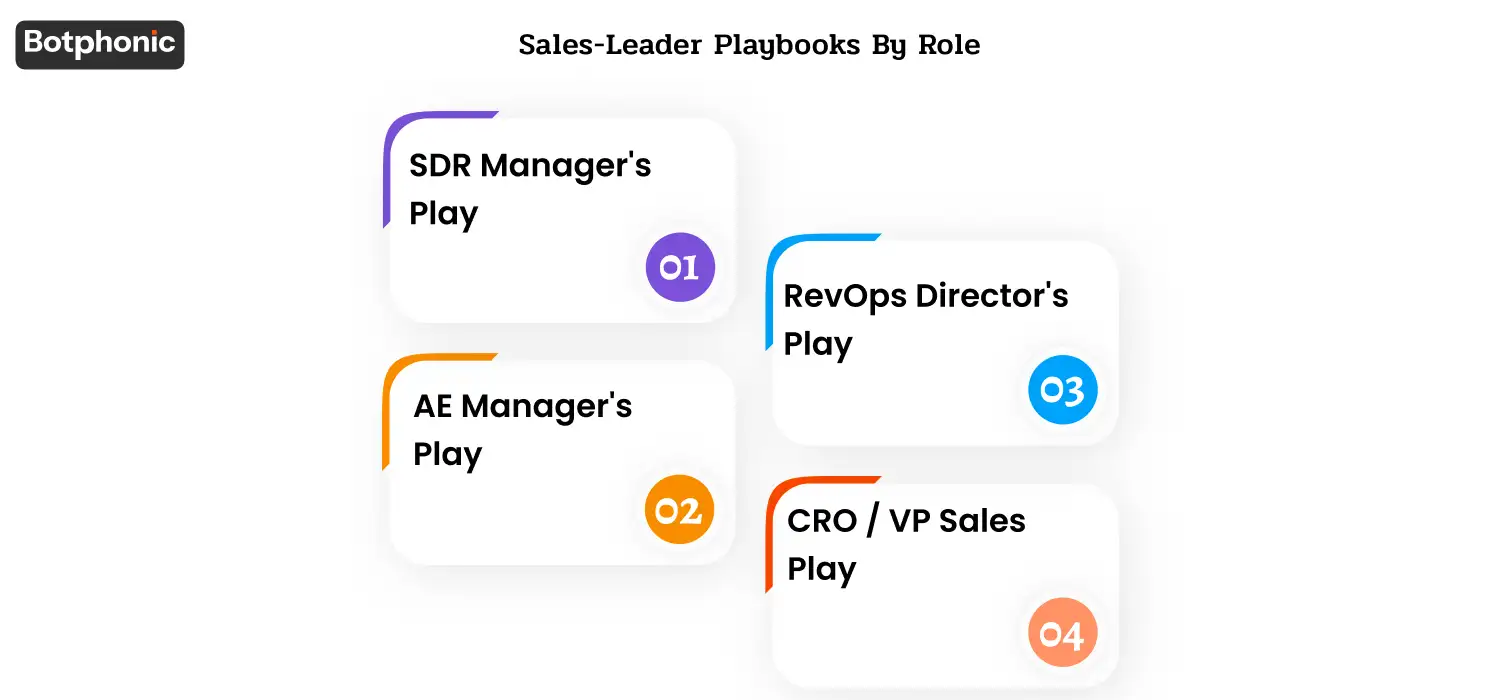
The order of deployment is important. Here are some of the initial websites each person should visit.
1. SDR Manager’s play
Begin from inbound qualification and outbound response processing. In most cases, 30–40% of SDRs’ time is spent on “qualifying” leads that are not qualified. An AI Qualifier filters the first conversation, does lead qualification and only passes SQLs to humans. Before and after SDR-hours-per-SQL.
Deploy: AI Qualifier on Inbound Forms & AI Response on Outbound Messages + Meeting Booking Integration.
Regulatory risk, brand risk, don’t deploy first: AI cold calling.
2. AE Manager’s play
Build call coaching and automation of followups.Create call coaching and follow-up automation. AEs win if they rep good motion. AI plays all the demos and marks the questions it didn’t discover, rates the call’s quality and composes an email to send to the caller, all in one hour. Indicators: time to follow-up after demo, demo to proposal conversion.
Deploy: Gong/Chorus integration, coaching + AI follow-up email drafting + CRM auto-enrichment.
Avoid deployment first: AI enhanced customer conversations (this is AE-augmentation, and not AE-replacement).
3. RevOps Director’s play
To begin, pipeline hygiene and signals of impending trouble. AI listens to call recordings and identifies deals where reps are saying different things in Salesforce as compared to what they say during the call. Measure: accuracy of the forecast, slippage rate, variance during a stage.
Deploy: conversation intelligence + CRM data validation + forecasting model inputs.
Do not deploy first: Lead with AI communication (not the responsibility of RevOps!).
4. CRO / VP Sales play
Start with capacity planning. Apply rep equivalent math (§2) to determine teams to get AI assist and others to get humans. AI is a lever to unlock broken sales motions in teams that aren’t or a lever to improve the sales motions in a well-managed team. Measures: $-Per-AE produced, ramp time for new hires, variation in win rate by rep.
Deploy: capacity dashboard & rollout to top performing teams first.
The bottom-quartile reps will use AI to hide not improve: Don’t deploy first: company-wide rollout.
Sales-Stack Integration, What Actually Works
The vast majority of conversational AI vendors state that they integrate with anything. The truth is more complex. The truthful version.
| Tool | Integration depth | Data flow | What to validate in your demo |
| Salesforce | Native (mature) | Bidirectional | Custom-object support, governor-limit behavior, sandbox support |
| HubSpot | Native (mature) | Bidirectional | Workflow trigger compatibility, contact-vs-lead model fit |
| Outreach | Native or middleware | Mostly write-into | Sequence-pause logic when AI handles a reply |
| Salesloft | Native or middleware | Mostly write-into | Cadence-resume rules after AI conversation |
| Gong | Native | Read-from (AI consumes Gong data) | Call recording permissions, retention policy |
| Chorus | Native | Read-from | Same as Gong, plus speaker-ID accuracy |
| Apollo | API or middleware | Bidirectional | Lead-data freshness, deduplication logic |
| ZoomInfo | API or middleware | Read-from (AI consumes) | License model — per-seat vs per-API call |
There are two integrations that are hardly noticed and they cause trouble:
- Outreach + AI together: Outreach is not always aware to pause cadence when AI responds to a prospect. You receive the AI response and the next scheduled cadence email 2 hours later. Accept sequence-pause behaviour in the demo.
- No, AI is not afraid of dirty data, and if your Salesforce has 40% empty fields, AI is going to shout about it.AI isn’t afraid of dirty data, and if 40% of fields in your Salesforce are empty, AI will shout about it. AI is not a CRM Cleanup Tool. Wash the data model before using it.
How to Roll This Out, A 6-Week Plan
The order matters. The top reason for AI pilots to fail was attempting to implement the entire program in one go.
1st-2nd Week: SDR side
- Integrate AI with form and chat.Link AI to incoming forms and chats.
- Practice on your qualification parameters BANT or MEDDIC or any other that you apply.
- Send SQLs to any existing SDR routing rules.
- Metric: SDR-hours-per-SQL, time taken to respond to inbound leads.
3rd-4th Week: AE side
- Integrate AI Assist with conversation intelligence (Gong/Chorus)
- Enable auto-follow-up for demos
- Organize the knowledge about objections from the top-rep recordings.
- Median: 44 days, 39 days
5th–6th Week: RevOps side
- Verify pipeline hygiene score is turned on.
- Add forecast-signal feeds to your existing forecasting model
- Create CRO dashboard – capacity vs cost
- The measure would be forecast accuracy, variance by stage, dollar per-AE-hour
After week 6, evaluate. The teams who are growing the fastest tell you where to increase your growth. The teams that are not making progress tell you where it is human – not technical.
 PRO TIP
Common Failure Modes (and How to Avoid Them)
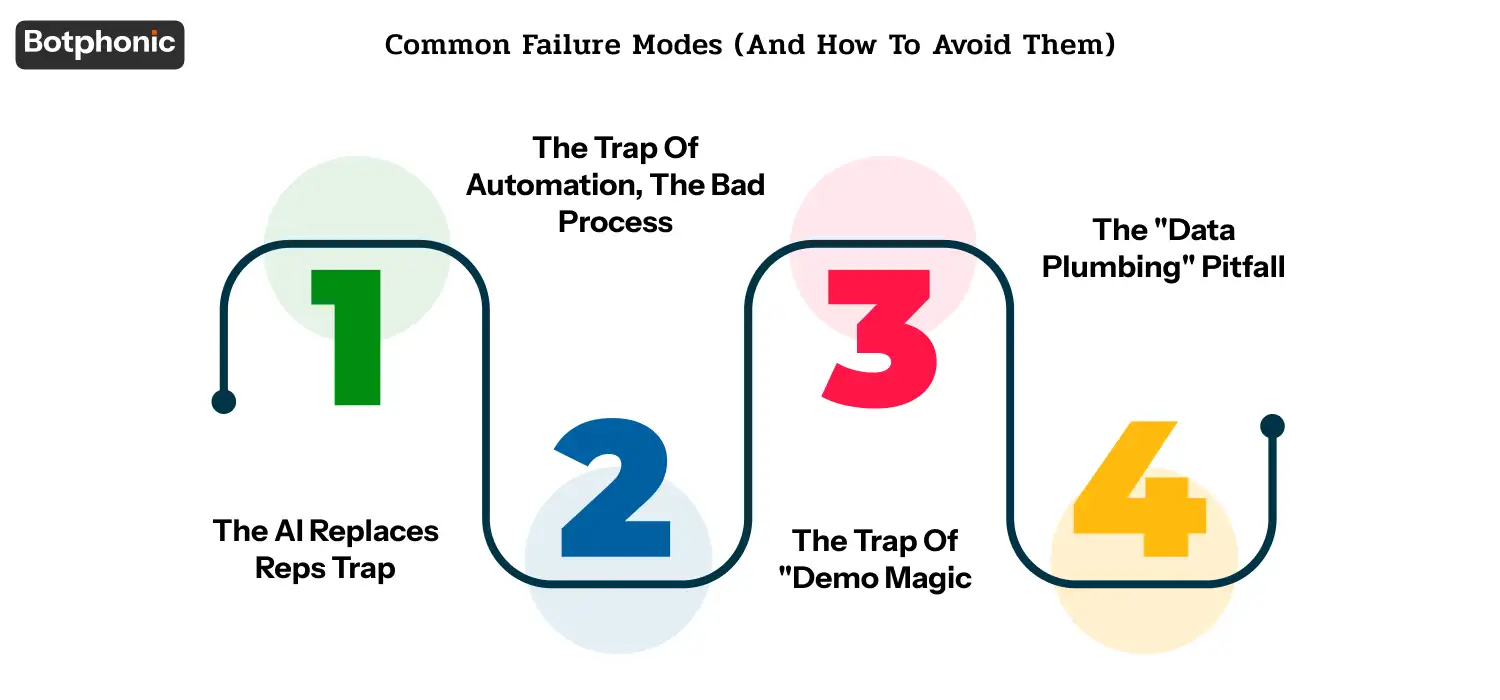
The 4 hidden traps for the death of Sales Org’s conversational AI pilots.
- The AI replaces reps trap. If the reps think that AI can replace them, they don’t feed it data, they don’t train it or they don’t adopt it. If the numbers suggest otherwise, make sure to frame AI as a capability recovery tool, and not a jobs replacement tool. Rewarding the AE with Artificial Intelligence output is the right approach to compensation plans, not marking the use of AI as “cheating.
- The trap of automation, the bad process. AI will help reps skip qualification faster when the discovery process is skipping the qualification phase due to the speed at which reps are demoing. Address the process first. AI turns all the motion into code, whether it be good or bad.
- The trap of “demo magic”. The vendor demos are based on curated data, perfect call examples, and vendor’s best-trained model. Your actual call recordings, Your messy CRM and your real prospects drive your production deployment. Please perform a pilot before signing. Always.
- The “data plumbing” pitfall. The higher the data quality, the more value AI can provide. AI exacerbates the 30 percent of calls that are recorded correctly and the 40 percent of contacts with missing info in Salesforce. Schedule 2–4 weeks of data hygiene sprint in advance of the pilot.
What to Ask Vendors Before You Sign
15 Questions: 5 in each category. If the vendor cannot answer the first five questions, exit!
Cycle-time evidence (5 Qs):
- Provide me with three case studies, not “improved efficiency” statements, that provides stage-by-stage cycle time data.
- How large were the case sizes and what was the industry for these case studies?
- What was the delay between the cycle-time impact and the appearance of that in the pipeline data?
- What was the rep adoption rate at 30 / 60 / 90 days?
- What percentage of your customers do not renew after the first year and why?
Integration depth (5 Qs):
- Please demonstrate to me the Salesforce / HubSpot integration in a customer’s sandbox, NOT in yours!
- What if there is an active Outreach cadence, but your AI is responding to a prospect?
- What are your techniques for dealing with Salesforce governor limits during peak periods?
- Which of the following CRM data hygiene is usually required before a customer goes live?
- What are the native, middleware and custom build integrations?
Rep adoption / change management (5 Qs):
- Sharing the changes customers made to their comp-plans to get them to adopt AI.
- How long does a typical SDR / AE need to work on the tool before he/she can be productive?
- At 90 days, how many of the reps in a typical deployment use the tool weekly?
- What do you do if you get a “AI is replacing me” rep objection?
- What is the usual sequence of onboarding, who has it at our company?
The Decision
When you’ve got a quota bump and no budget for new hires, conversational AI is one of three handles to pull (along with territory management and pricing optimization). Conversational AI provides the quickest time-to-value among the three.
There are four common denominators in the businesses that achieve a 30% reduction in cycle times: clean CRM data upfront, commissions aligned with conversational AI-generated outcomes, phased rollouts beginning with a single team, and CROs seeing conversational AI as a way to recover capacity, not replace headcount.
For a quick tour of where the inefficiencies are in your current cycle and how to roll out a phased approach for your tech stack, schedule a cycle-time assessment with the Botphonic team. Be sure to include your stage-time data from the last quarter.
Benchmark your current sales process, identify stage-specific delays, and understand how conversational AI can help you
Contact Botphonic