

Summarize Content With:
Quick Summary
- Real estate agents miss 48% of leads because after-hours calls are unanswered – AI phone call assistants solve this problem, answering in seconds, 24/7.
- Red Pine Realty grew leads by 34% in 90 days with Botphonic’s AI phone call assistant.
- AI phone call assistants qualify leads with programmed criterion questions, schedule property viewings while avoiding double bookings, and connect calls with all call details.
- Call predictions increase answer rates by up to 30% with no more calls.
- Do-Not-Calls, state laws and Fair Housing Act-compliant calls are configured day one this is a guide to all three.
A Zillow Lead Comes Through At 9:47 Pm On Friday
By Saturday morning, your agent will have missed the phone call – and the buyer will have scheduled an appointment with another brokerage.
This isn’t a staffing problem. It’s a response-time problem. Research indicates 78% of potential buyers choose the first brokerage that contacts them. But the median agent’s response time to a new lead is 47 hours – more than enough time to lose the lead.
AI phone call assistants eliminate this gap by answering in seconds, asking qualifying questions from a script and scheduling the showing, without requiring any work from the agent. This article will show how, using the actual data from real estate brokerages that have installed the system.
Why AI Phone Calls Are Reshaping Real Estate Lead Capture
It’s a numbers-versus-time game. You have to reach every lead quickly, weed out the window shoppers from the serious buyers, and get the serious buyers’ appointments. People are inherently poor at all three tasks because they sleep, get distracted and have different abilities.
AI phone call systems don’t. They pick up every call within a few seconds, ask the same questions to qualify every lead, and never miss a possible lead because they were on another call. In a 2025 report, The Business Research Company reported that AI-based call automation leads to a 34% increase in lead generation for real estate agencies using it for multi-channel lead generation.
Morgan Stanley quantifies the revenue benefit differently: A 37% increase in agent productivity in real estate agencies that embrace AI assistance – not because they eliminate agents, but because they free them from the clerical tasks that keep them from talking to real buyers.
The 5 Problems Realtors Keep Facing
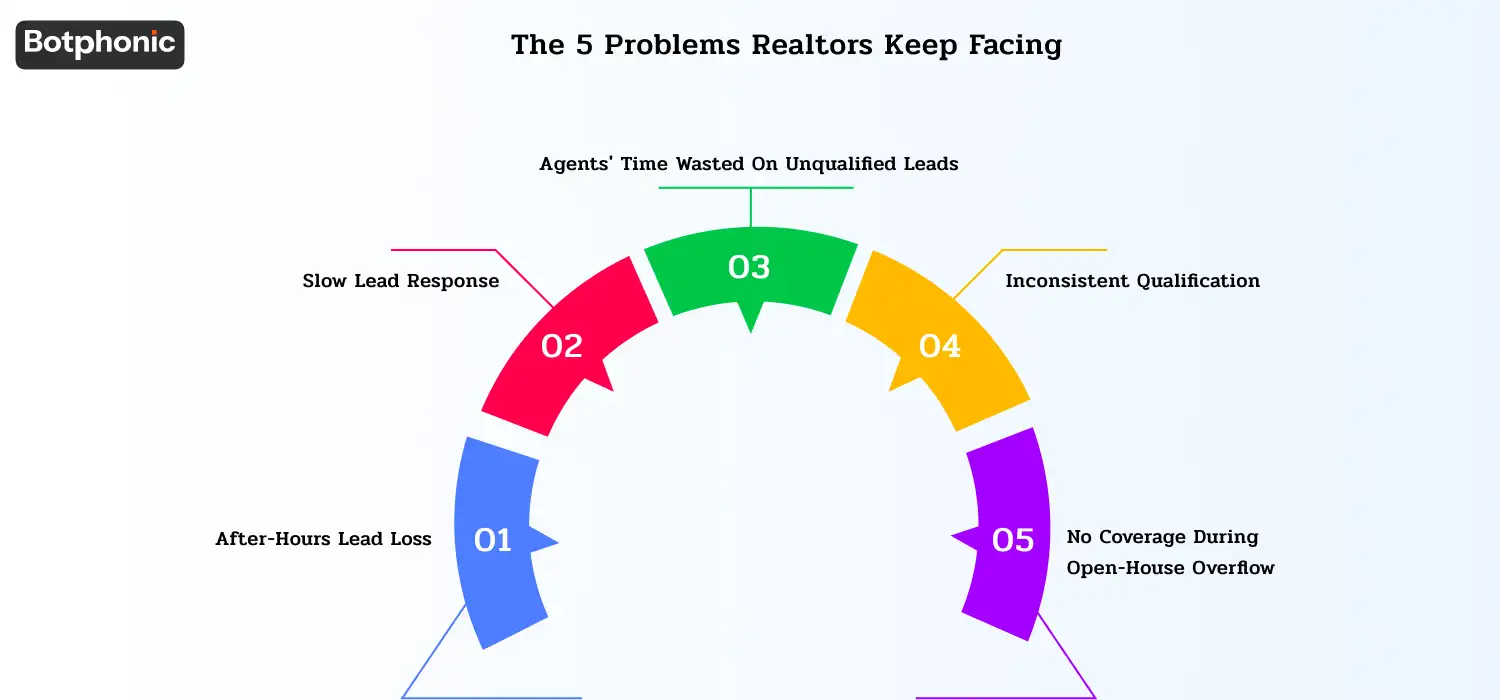
To choose a solution, let’s identify problems first. Here are the top five most common among brokerages of all sizes:
1. After-Hours Lead Loss
About 40% of all real estate leads occur after hours. If you can’t respond right away, leads go to voicemail and voicemail goes to a competitor. You can’t hire more people to answer the phone at 10 pm.
2. Slow Lead Response
The average response time industry wide is 47 hours. A study by MIT calculated the likelihood of converting a lead declines 21 times if you wait longer than 5 minutes to respond to a lead. Response time is the best predictor of conversion to a showing.
3. Agents Time Wasted On Unqualified Leads
On average, 60-70% of the time agents spend on the phone with a lead doesn’t result in a lead – “is this property still for sale?” from someone who won’t be buying in the next six months. Time wasted on unqualified leads is time lost with qualified leads.
4. Inconsistent Qualification
When qualification is left up to the agent who answers the phone, the type of questions asked, information collected, and tone changes. Some agents ask for budget and time frame. Others ask if the property is available. AI calls ask all the questions, in the proper sequence, and update your CRM.
5. No Coverage During Open-House Overflow
Open weekends are the busiest calling times, when all agents are out of the office. Calls go to voicemail. Leads go cold. AI automatically answers the overflow, qualifying and scheduling during the times humans are least likely to answer.
 NOTE
NOTE
What An AI Phone Call Really Is
An AI phone call helper is not an IVR and it is not a chatbot with a voice interface. It’s a real-time speech processing system using five technologies:
| Technology | What it does |
| Automatic Speech Recognition (ASR) | Transcribes caller speech to text in real time – including accents, umms, ahs, and even background noise from an open house |
| Natural Language Processing (NLP) | Understands the caller’s intention (what they want), information (time frame, budget, address) and sentiment |
| Conversational AI | Handles multi-turn conversations so the system can ask questions and keep track of the conversation for a 5-minute call |
| Intent Detection & Lead Routing | Determines that the caller is a buyer, seller or investor – then routes to the correct script and agent |
| Decision Engine | Enforces your business rules and compliance policies, and then connects to your CRM, MLS, or calendar |
Predictive Call Timing
But in addition to handling incoming calls, Botphonic’s AI phone call assistant examines prospect activity data (when they opened your emails, when they responded to previous calls, when they viewed real estate listings on your website) to determine the optimal time to call prospects back. Super AGI (2025) reports a 30% boost in engagement with no change in the number of calls made when prospecting timing is optimised by AI.
What Happens In The Six Seconds After “I’m Calling About The 3-Bed On Maple Street”
- Call intake & audio processing – VoIP/PSTN provides audio; noise reduction kicks in as soon as the call starts, to reduce street noise or office chatter
- Speech-to-text – streaming ASR translates the request to text, while the caller is still speaking
- Intent detection – NLP figures out what they want (showing request) and how they feel (excited, in a hurry, hesitant)
- Decision-making – the engine checks your business rules, pull the caller’s CRM record, check the listing availability and the agent’s calendar
- Response generation – natural text-to-speech responds to the caller in a human-like voice, tone and tempo that fits the caller’s mood
- Book the tour or escalate to a human – the AI books the tour and sends an email confirmation, or connects to a human agent and provides the transcript and sentiment analysis
 PRO TIP
How AI Phone Calls Help Realtors Capture Leads
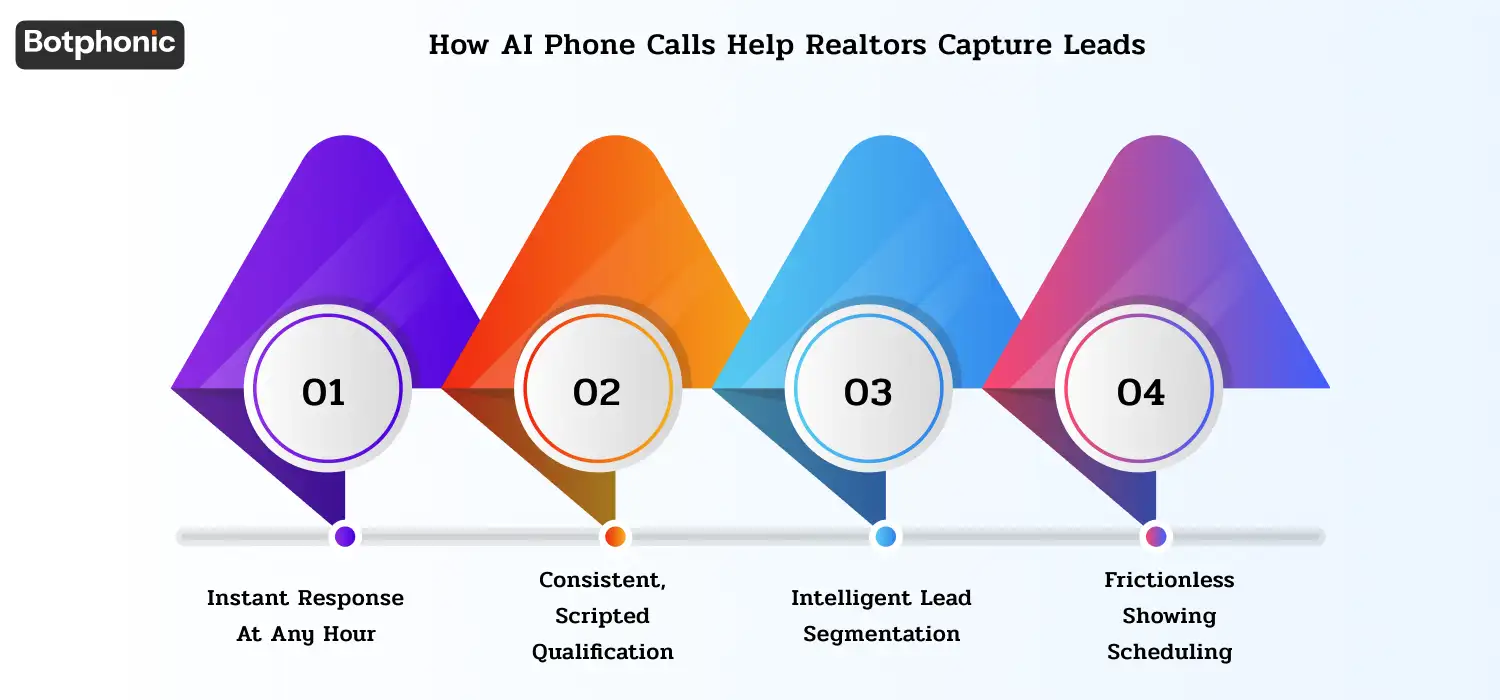
1. Instant Response At Any Hour
AI provides sub-second response to every inbound lead – phone, web form, Zillow lead, text message, WhatsApp. It doesn’t get “busy” after hours or on the weekend or during the open-house rush. The 11:30 pm inquiry is treated the same as a Monday morning at 10 am inquiry.
2. Consistent, Scripted Qualification
This AI asks your qualification questions – timeframe, budget, financing, key features, flexibility in location – about every call, in the same sequence, and records your responses in your CRM. Your agents can pick up the call, knowing exactly where the lead is in the process.
3. Intelligent Lead Segmentation
Voice AI segments leads as they speak to your agents, based on what they say. Buyers ask about availability and showings. Sellers ask about valuations and listing timelines. Investors ask about cap rates and yield. The AI knows which segment to put on which script and agent – no sorting necessary.
4. Frictionless Showing Scheduling
Once a lead matches a property, AI looks at the agent’s availability, the listing’s availability rules and showings scheduled to that listing – then recommends two or three time slots, books the showing and sends the lead a reminder. The agent knows what the lead is looking for.
5. Long-Term Nurture With No Manual Work
Not-ready-now leads don’t go into a spreadsheet and get lost. AI can move leads through automated nurture campaigns – market news, new property listings, mortgage tips – at a pace that matches the lead’s interest. Once they’re ready again, the AI puts them back in the active qualification process.
Core Use Cases
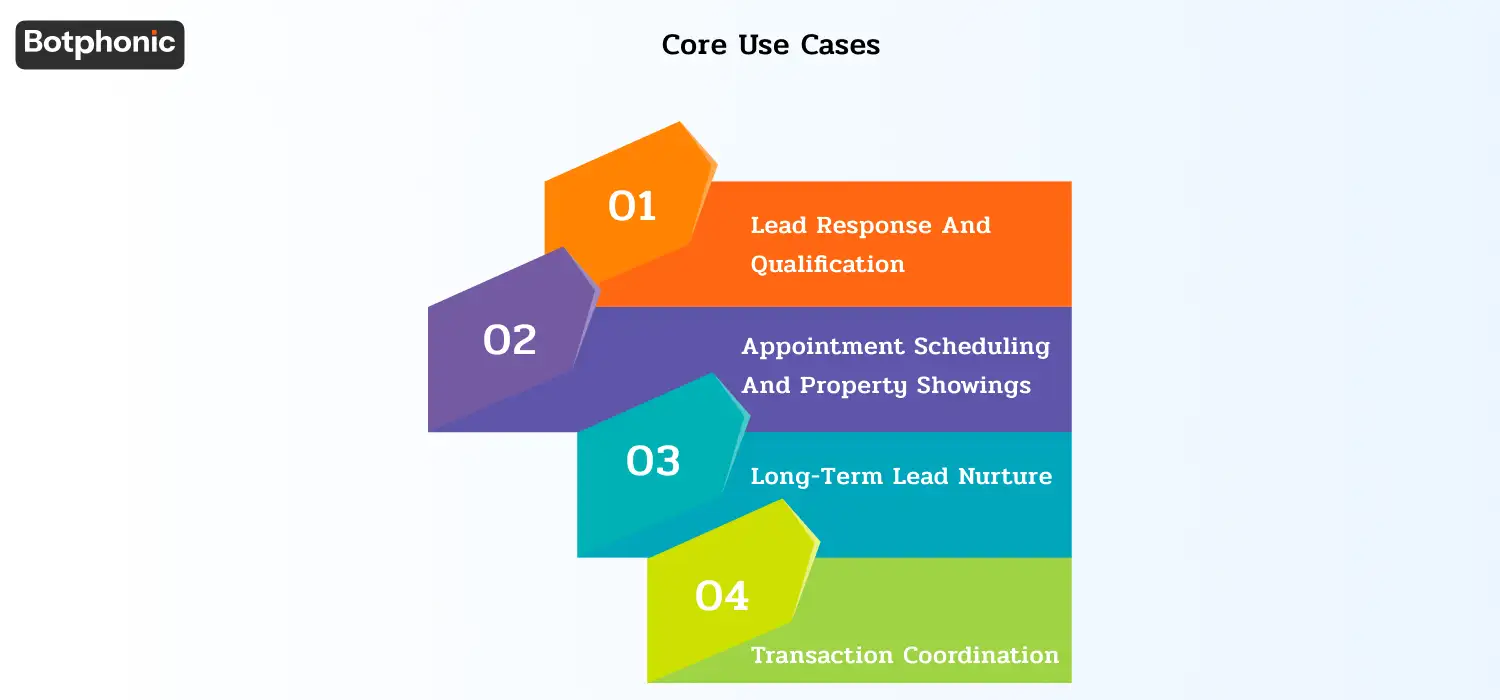
1. Lead Response And Qualification
Real-time response to all channels. Qualification script to capture the 5-7 key data points required in order for your agents to follow up: time frame, budget, financing, property type, location, and motivation. Real-time data to your CRM. Leads scored and routed as hot, warm or long term leads.
2. Appointment Scheduling And Property Showings
Integration with Google Calendar, Outlook and Calendly. Instant checks for availability between agents and properties. Instant SMS and email confirmation with listing information. Reminders 24 hours later with rescheduling. Follow up and feedback request with comparable property, mortgage assistance and other resources.
3. Long-Term Lead Nurture
Drip campaigns for leads with 3-12 month time frame. Market update calls based on price changes in their area of focus. Listing notifications based on their targeting rules. Re-engagement routing based on a lead’s reactivation.
4. Transaction Coordination
Progress report calls to buyers and sellers. Call when documents are required for signatures. Closing date confirmation and logistics. Automated post-closing survey and referrals.
You can look for the best AI receptionist tools for realtors that can help you in selecting relevant tools for your business.
Real Estate In Action: Case Studies
Case Study 1: Red Pine Realty: 34% More Lead Conversions In 3 Months
A mid-sized firm, Red Pine Realty, was missing leads on out-of-hours inquiries, and wasting agent time on non-serious browsers. Following the introduction of Botphonic’s AI receptionist in early 2025:
- +34% Leads captured in 90 days
- 24/7 Includes nights and weekends
- 0 double-bookings after deployment
- Day 1 Time to go live
The AI responded to incoming calls, web inquiries and text – screening each lead with a series of criterion questions. Appointments automatically scheduled for multiple properties. Open-house overflow, nights and weekends captured leads for the first time.
Case Study 2 – Serenity (Real Estate Operations Team): Year On Year
Serenity is a mid-sized real estate operations team processing over 400 inbound calls per week, which replaced its 3-person phone support team for standard questions with Botphonic. Results after 12 months:
- 25% Increased conversion on inbound inquiries
- 50% Decreased call handling time
- 20% Decreased Manual scheduling and data processing errors
- 15% Increased Agent satisfaction score
- 150% ROI in year one
The Real Estate Showing Workflow – Start To Finish
If the lead doesn’t get scheduled, the capture and qualification is pointless. This is the end-to-end workflow Botphonic handles:
- Lead Comes In: Web form, Zillow, phone call, SMS, WhatsApp – AI gets back to the lead in seconds
- Qualification: AI poses qualification questions: timeframe, price, financing, must-have features
- Scheduling Check: AI verifies agent’s calendar date, listing’s showing rules, and current showings at the property
- Conflict Check: AI prevents conflicting appointment of the agent or listing, in real time
- Propose Times: AI suggests 2-3 times, taking into account listing’s location and time to get between back-to-back showings
- Confirmation + Reminder: confirmation SMS/email, 24-hour reminder
- Rescheduling: If rescheduling requested, AI checks availability and reschedules automatically
- Follow-Up After Showing Properties: Automated follow-up: request feedback, show similar properties, provide mortgage advice
This process works with the tools real estate agents already have: MLS (multiple listing service) to check property availability, CRM (Salesforce, HubSpot, Zoho, Follow Up Boss) to route leads, calendar (Google Calendar, Outlook, Calendly) to check agent availability, and property management systems to check rental listings.
PRO TIP
Myths About AI Calls For Realtors
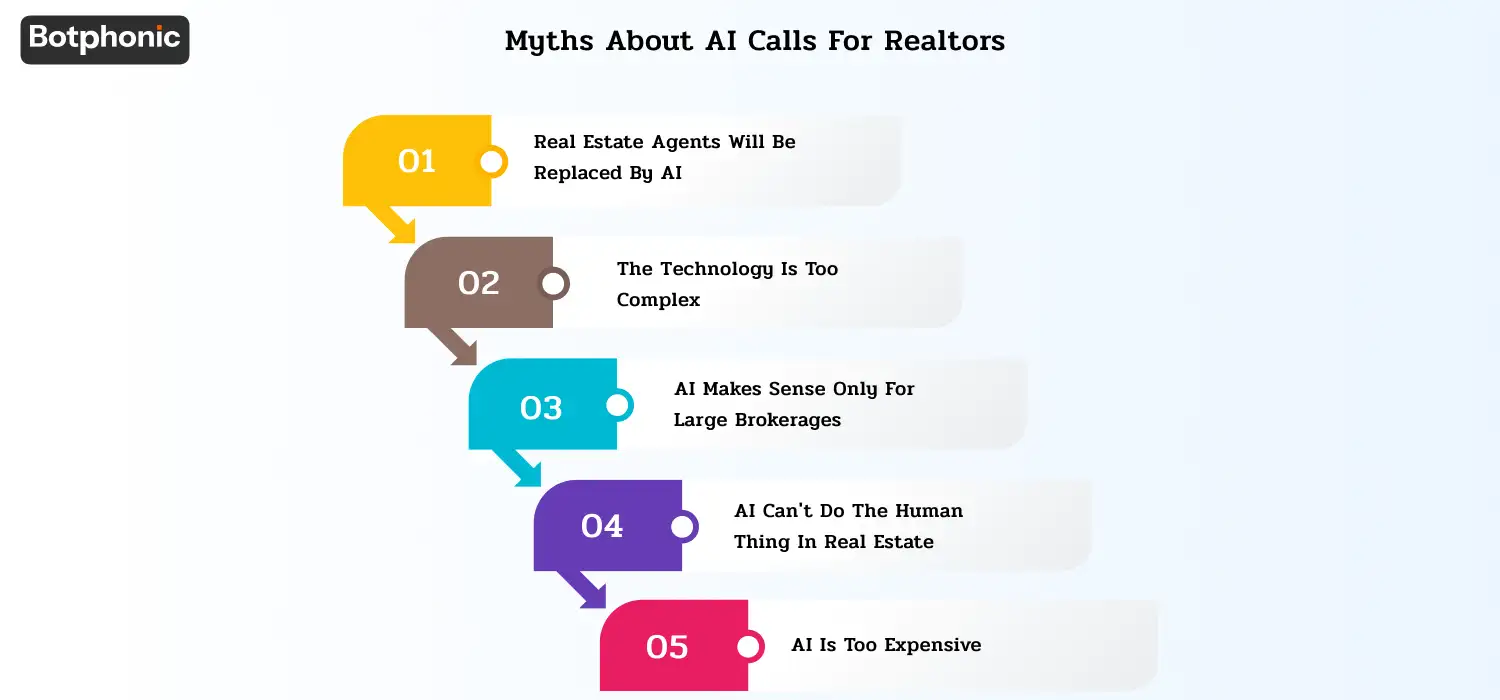
1. Real Estate Agents Will Be Replaced By AI
Real estate is about relationships and trust – and selling property requires a human. AI takes over the unpaid labour that consumes your time: responding to “Is it still available?” forty times, trying to return calls, copying and pasting answers to the same questions. That means you can focus on listing appointments, contract management and showing prospects. You turn your time from doing to creating value by using an AI receptionist.
2. The Technology Is Too Complex
Voice AI is no longer programmed. A typical installation of Botphonic for a small brokerage is up and running in one day: plug in your CRM, plug in a phone number, plug in your scripts, plug in the routing. No engineers required. Typically live by lunch.
3. AI Makes Sense Only For Large Brokerages
The opposite is true. The greatest benefits are for solo agents and small teams. You can’t afford to miss calls when you’re the only person on the phone. Pay-as-you-go pricing means you only pay for the seats you need – there’s no minimum, no enterprise agreement.
4. AI Can’t Do The Human Thing In Real Estate
Newer voice AI can use sentiment analysis to pick up on stutters, tone and urgency – and respond accordingly. It won’t take the place of a human agent’s empathy in a negotiation. But it will detect “this person is worried about time” or “this caller is frustrated” and prioritise, meaning the agent who takes the call will be better prepared.
5. AI Is Too Expensive
With call costs of $4-$7 for human staffed calls vs less than $1 for AI, the economics turn quickly. A small real estate brokerage receiving 200 inbound calls per month breaks even after the first month; that’s before including the business retained from calls to the brokerage’s phone lines after hours, when no one was there. For details, see Botphonic pricing plans.
The Laws: TCPA, State, And Fair Housing
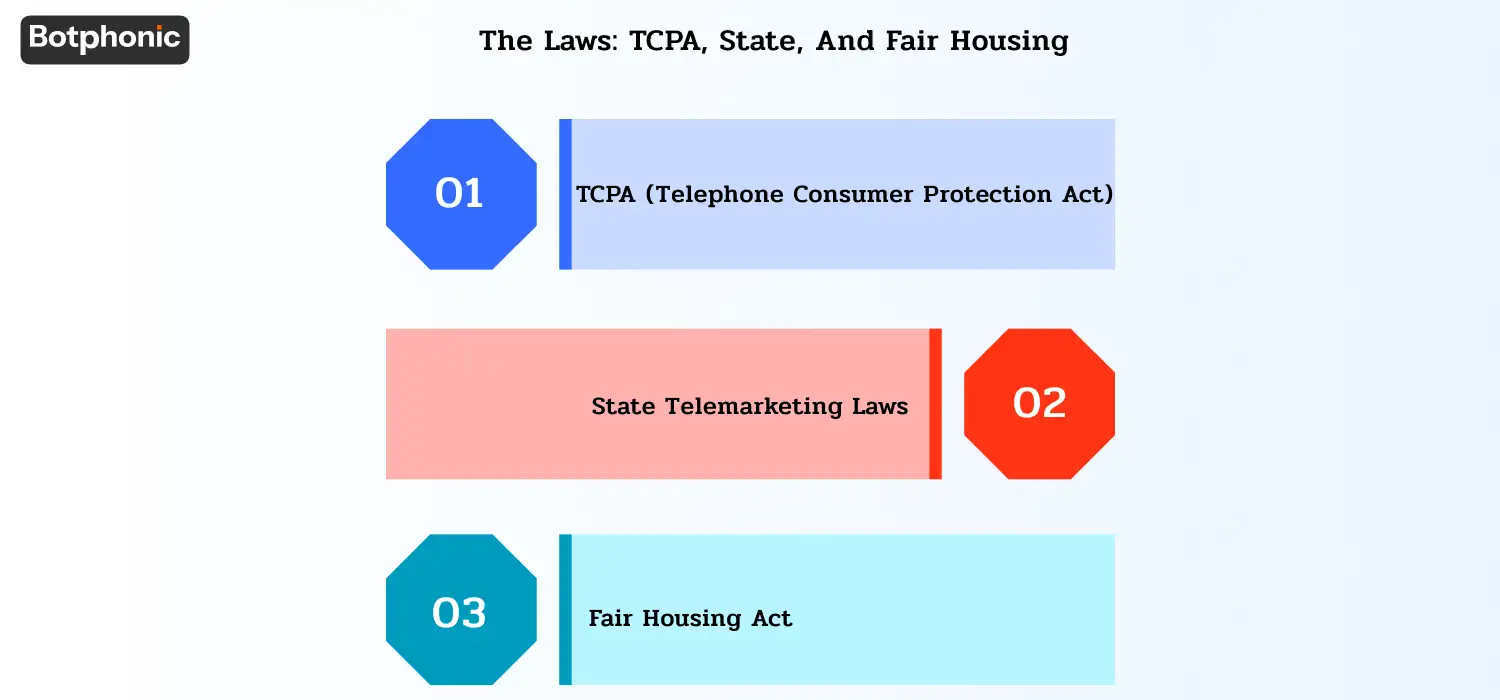
Real estate AI phone systems are regulated. Three areas for brokerage set-up:
This section provides an overview of compliance issues. It is not legal advice. Ask your firm’s compliance officer and/or counsel to review your AI scripts and routing logic prior to deployment.
1. TCPA (Telephone Consumer Protection Act)
AI calls must be placed with consumers’ express written consent. Your AI system should automatically respect Do Not Call lists, provide the ability to detect opt-out statements in mid-call (“take me off your list” and record that) and keep track of consent per individual. Botphonic does all this automatically.
2. State Telemarketing Laws
A number of states have additional laws on top of TCPA. The “mini-TCPA” of Florida, Oklahoma, Washington and Maryland all have more restrictive consent laws and narrower calling windows. Your AI’s calling schedule should be state-specific – not a national rule that puts you at risk of state-specific liability.
3. Fair Housing Act
AI for tenant screening, rental rates, or buyer routing should not have a disparate impact. This is the biggest compliance gotcha for real estate teams. Review your AI’s scripts & routing to ensure it’s not relying on proxies for race, national origin, family status or disability to prioritise leads. The FTC has made it clear it is cracking down on algorithmic discrimination in real estate.
Botphonic comes with TCPA-compliant calling, encrypted call recording and audit logs. If you are a brokerage managing a rental or property management business, ensure you include a Fair Housing review in your script approval before going live.
What Realtors Should Do Now
Review your lead response time. Review your CRM for the past 90 days. What’s your median response time? If it’s longer than 5 minutes for any source, you have revenue leak to address. You can look for the best AI phone call software for real estate agents that can help you in decision making.
1. Find Your Top 5 Most Common Call Types
Analyse your calls for a week. These are the top 5 AI calls – “Is this property still on the market?”, “Can I book a viewing?”, “What does the HOA cover?”. Work with those first. Grow once you know if you can solve it.
2. Map Your Qualification Criteria
Document the 5-7 questions your top agents ask all prospective clients. Time, price, mortgage, must-have, open to location – these are your AI qualification questions. The simpler the better, for effective CRM data collection.
3. Look For A Platform With An Integrated CRM And Calendar
Stacked calendar widgets are like looking through a keyhole. You want to read your agent’s calendar, the listing calendar and the CRM at the same time. Look at AI phone call systems for realtors to find the level of integration.
4. Test With A 90-Day Pilot And Baseline
Measure lead call rate, displaying booking rate, after-hours conversion and total calls before and after installation. If the pilot is set up properly, you should see a lift (such as the 34% Red Pine Realty saw) within 90 days. If not, it’s likely due to a poor script or integration issues, which can be addressed.
Compare AI phone call tools for real estate agents with Botphonic’s ROI calculator
Botphonic is a 24-hour deploy, with plans from $29/month and a dedicated real estate AI receptionist. See how much you can save.
See pricing plan