
Summarize Content With:
Quick Summary
There is a structural issue of patient communication in the US healthcare practices. Doctors spend between 15-18 minutes with each patient consulted but use up to approximately half of their clinic day on documentation and non-clinical work. The front-desk personnel receive hundreds of calls a day – appointment requests, prescription refill questions, lab result questions, insurance verification – most of them based on the templates. Patients are becoming more and more demanding of the sort of instant response (Amazon-style) and throwing their toys out of the window when they are not provided.
That gap is bridged by AI phone systems. They make inbound calls within seconds, end-to-end (including reschedules and cancellations) in appointment scheduling, multi-channel reminders in order to reduce no-shows, integration with EHR and practice management systems, and HIPAA-compliance throughout. The healthcare AI market is projected to reach $120 billion by 2028 (Blue Prism), with appointment scheduling being one of the fastest-adopted use cases.
The technology, the 5-step appointment scheduling workflow, healthcare-specific functionality, named integrations with EHR systems, HIPAA compliance, the no-show reduction playbook, real ROI numbers on Botphonic deployments, and a 2026-2028 forecast are all covered in this guide.
Try Botphonic free for 14 days → · Book a 20-minute demo →
Patient Communication: Why it is High Time to Change
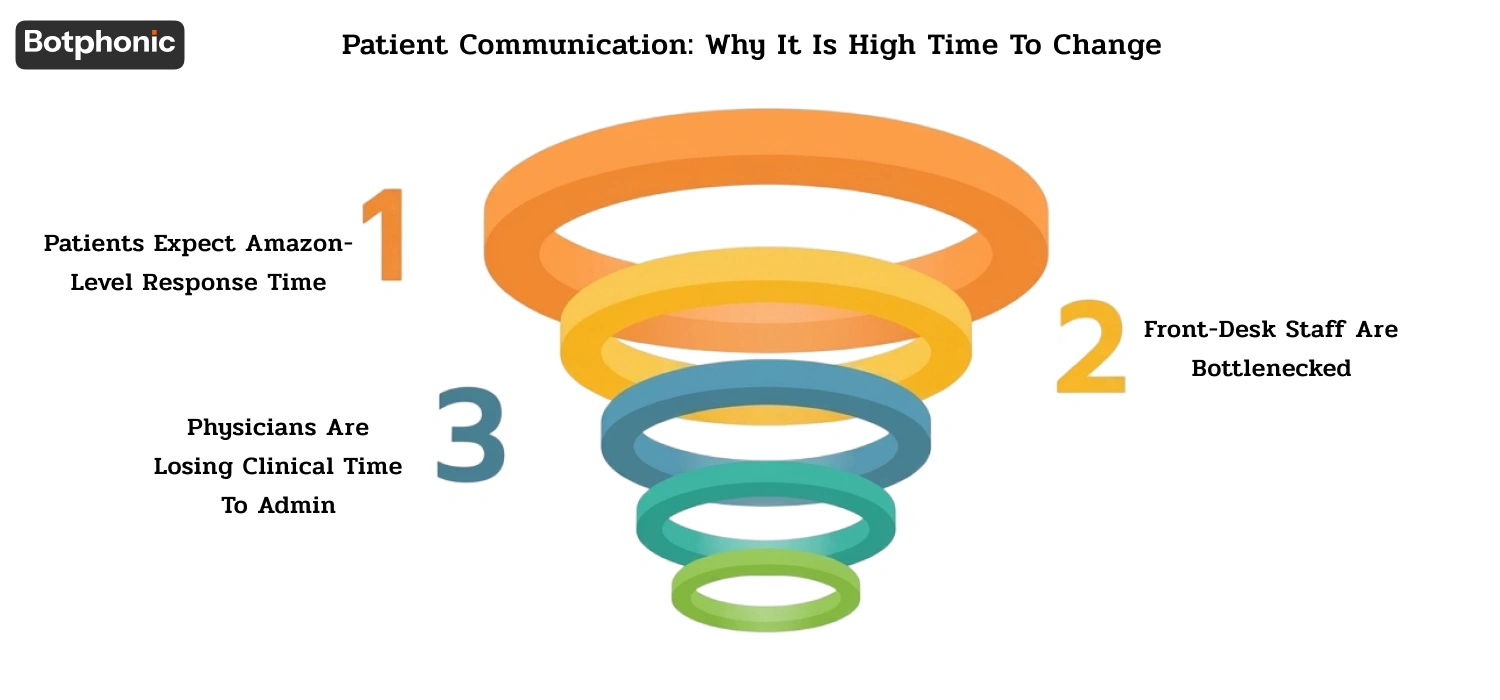
Three forces can be seen as acting on the healthcare front-desk operations:
Patients expect Amazon-level response time
When people can get groceries, book flights, and transfer money in a matter of seconds, the long wait times to access basic health information are no longer acceptable, particularly when health is on the line. Healow
Patients who call at 7pm Friday, after visiting the doctor, do not want to get a call back on Monday morning. They desire answers immediately. Those that fail to get responses proceed to the next provider on the first page of Google.
Front-desk staff are bottlenecked
An average mid-sized clinic has hundreds of inbound calls per day in appointment requests, refill requests, lab result requests, billing requests, and triage. The math does not work call volume is proportional to patient volume, but staff is not. Holding time increases, no-shows become more problematic, and the senior staff is burning out faster than they can be replaced.
Physicians are losing clinical time to admin
According to industry statistics, physicians spend 15-18 minutes per patient visit but spend almost half of their day in the clinic on documentation and non-clinical work. Each minute of waiting to check a question of an insurance or calling a patient back to reschedule is a minute that is not spent working with the patient.
AI phone systems are a combination of the three: response time to patients is instant, repetitive phones off of front-desk staff, and physicians are relieved of documentation burdens.
 NOTE
NOTE
What an AI Phone Call for Patient Communication Looks Like
The technology stack
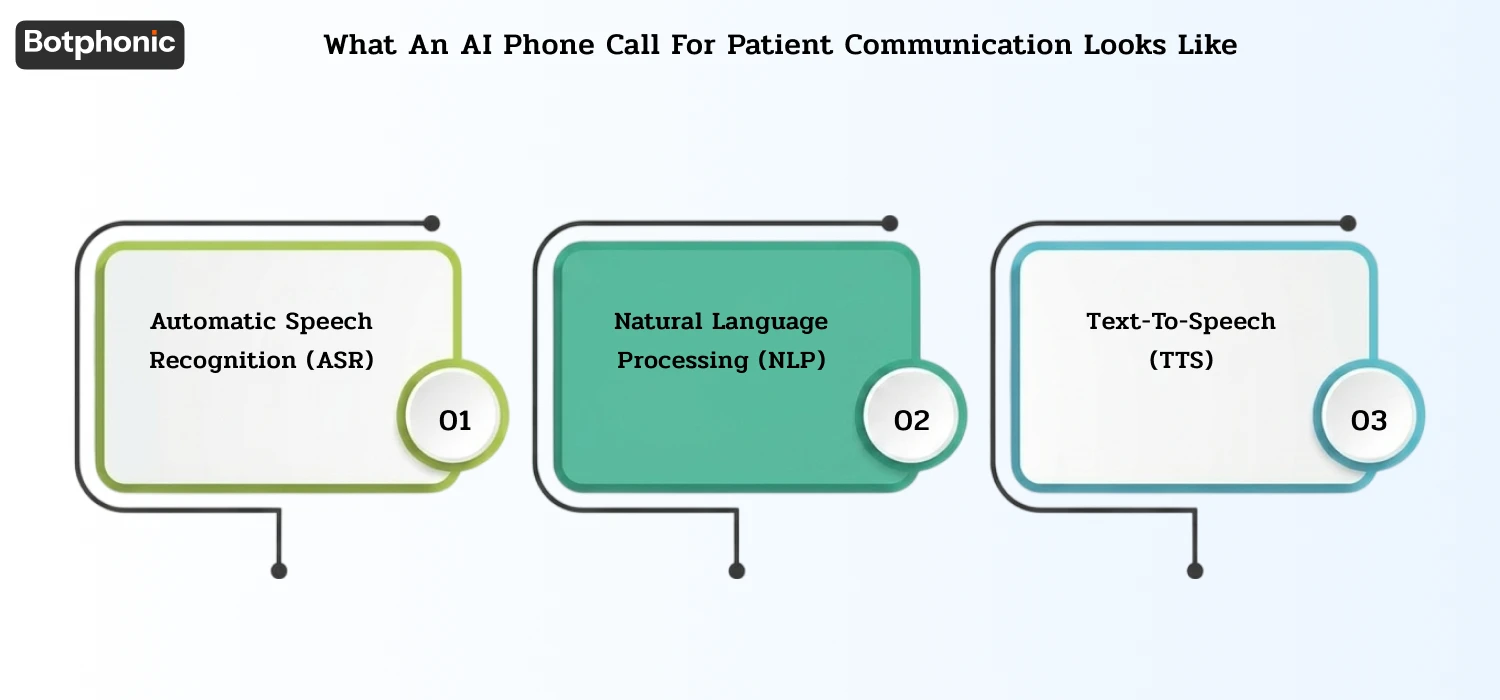
A current AI phone call system is end-to-end running on three layers:
- Automatic Speech Recognition (ASR): translates the voice of patients into real-time text, including accents, background noise, hesitation.
- Natural Language Processing (NLP): understands the intent of the caller (appointment request, prescription refill, billing question, urgent triage)
- Text-to-Speech (TTS): produces natural-sounding voice responses with the proper pacing and tone.
These three are linked to your EHR, scheduling system, and practice management software through API. The outcome: a caller dialing with the message I need to reschedule my appointment on Thursday gets the AI looking up his/her record, locating his/her appointment, checking the availability of the doctor, and offering a user 2-3 alternative slots, all in 60-90 seconds, without the involvement of the front-desk.
Healthcare-specific Features
In addition to generic call automation, healthcare AI must have certain characteristics:
- Virtual triage, sending urgent symptom reports to relevant clinical personnel, less urgent problems to scheduling.
- Medication reminders, Outbound calls, scheduled to prescription refill periods.
- Check-ins, Automated follow-ups, Surgical and acute-care patients.
- Notifications of lab results, secure, HIPAA-compliant delivery of routine lab results.
- Multilingual patient care, Spanish, Mandarin, Vietnamese, Tagalog (most-used non-English languages in US healthcare)
- Sentiment analysis, identifying frustrated callers and transferring to a human empathy-first agent.
Real-time Escalation
The AI does not attempt to answer all the questions. In cases where it is unable to (caller posing complex clinical questions, signs of medical emergency, technical problem outside its training), it acts as a human agent, and the transcript of the conversation and the patient context are attached so the human agent can pick up at minute 3, not minute 1.
The 5-Step AI Appointment Scheduling Workflow

This use case has the highest ROI in healthcare AI. The flow.
Step 1: Patient initiates contact (call, chat, or web form)
Patient calls the phone, chats on the practice web site, or completes a contact form. AI responds instantly, no moving through a menu, no hold.
Step 2: AI matches patient to provider availability
The system pulls real-time availability out of the calendar/scheduling tool of the practice. Factors:
Type of appointment (new patient intake, follow-up, lab review, telehealth)
Preference and specialty of the providers.
Acceptance of insurances by providers.
Time-of-day patient preferences
The AI provides 2-3 time slots, “I have Thursday at 2:30 PM with Dr. Patel, or Friday at 10:00 AM with Dr. Chen which works with you?
Step 3: AI handles confirmation, notifications, and intake
After the patient has chosen a slot:
- AI appointment booking verifies the appointment verbally.
- Immediately sends SMS + email confirmation.
- Intake form delivery (insurance verification, medical history, consent forms) is initiated through secure link.
- Books calendar invitations to patient and provider.
Step 4: Practice management software syncs in real time
The appointment writes back to the EHR (Epic, Cerner, Athenahealth, eClinicalWorks, NextGen, athenaOne) and practice management system. No manual data input. No double-booking risk.
Step 5: HIPAA-compliant data storage + audit trail
All end-to-end encrypted recording of all calls, transcripts, and interactions between the patient are stored with role-based access controls and audit logs available to compliance teams. Data retention is in accordance with HIPAA.
The entire process, which includes: patient call to confirmed appointment with intake form assessments, takes less than 3 minutes. See the flow of the traditional (call, voicemail, callback, schedule, email confirmation, mail intake forms) that can extend up to 3 days or more.
Quick Reference: Healthcare AI Receptionist Features
| Feature | What It Does |
| Human-like Conversation | Behaviors and noises such as a trained front desk employee. |
| Sentiment Analysis | Identifies patient mood/emotion to be served in a friendlier, empathy conscious way. |
| 24/7 Availability | Always makes a booking, even when the clinic is not in operation. |
| Multilingual Support | Provides access to healthcare in more than 20 languages such as Spanish, Mandarin, Vietnamese. |
| Secure Data | Secures patient data and meets the requirements of HIPAA. |
| Real-time Analytics | Lets clinics monitor trends, high call times and patient requirements. |
| EHR Integration | Notifies practice management software about appointments, intake information and call history. |
| Multi-channel Reminders | SMS, email, and voice reminders series to avert no-shows. |
See AI for healthcare in production →
How AI Cuts No-Shows: The Multi-Channel Reminder Playbook
One of the most expensive issues in healthcare in terms of cost-per-incident is no-shows. The industry average no-show rates are 15-30% based on specialty, and the missed appointment costs the industry an average of 150-400 dollars in lost revenue not to mention the ripple effect on patient care.
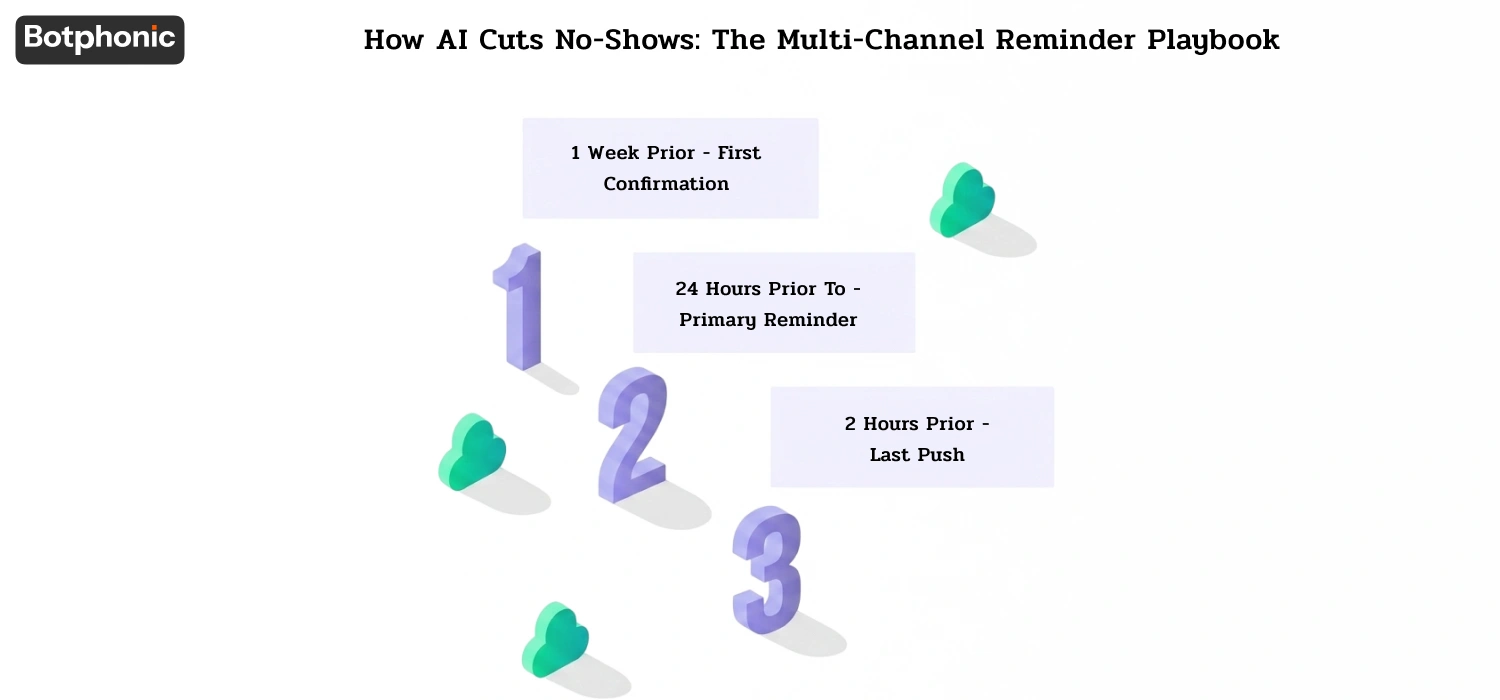
The AI phone system involves no-shows by sending three synchronized notifications:
1 week prior – first confirmation
Confirmation of appointment and prep instructions by SMS or email with one-tap reschedule button. At this stage, patients who are unable to make it rebook at this stage — making the slot available to a patient on the waitlist.
24 hours prior to – primary reminder
Voice call (or SMS at the choice of the patient) containing the appointment time, location, and reschedule. Voice prompts are always more effective than text only since voice conveys a sense of reality.
2 hours prior – last push
SMS reminder with directions, parking information, completion of intake form check, and what to bring (insurance card, ID, list of medications).
In the case of patients who do not respond to any reminder, AI notifies the appointment of front-desk follow-up, before the no-show occurs. Combined impact: there is a reduction in the rate of no-shows by 30-50% in 90 days of deployment.
 PRO TIP
Key Benefits of AI Phone Calls in Healthcare
| Benefit | Healthcare Relevance |
| Better access (24/7) | Patient support anytime — including evenings and weekends when most after-hours questions arise |
| Reduced no-shows | Multi-channel reminder sequences reduced no-show rates by 30-50% |
| Staff efficiency | Front-desk staff freed from repetitive calls; refocus on patient relationship work |
| Scalability | Manages highest volume (flu season, post-holiday rush) without recruiting temporary employees. |
| Analytics & integration | Operational details (busiest call periods, most frequent inquiry types, drop-off rates) and EHR/practice-management workflow continuity. |
| Multilingual reach | Attend Spanish-, Mandarin-, Vietnamese-speaking patients without having personnel to ensure specific staffing bilingual receptionists. |
EHR Integration: Plug Into Your Existing Stack
The usefulness of healthcare AI only goes as far as the extent to which it is integrated with your existing EHR and practice management software. Botphonic is compatible with the big systems:
- Epic – hospital system standard (large).
- Cerner (Oracle Health) – enterprise health system.
- Athenahealth / athenaOne – famous with ambulatory practices.
- eClinicalWorks – typically used in both primary care and specialty practices.
- NextGen – multi-specialty practice management.
- Practice Fusion Practice Cloud EHR small practice.
Custom integrations through Zapier, webhooks and custom API where proprietary systems are used.
Installation is usually done within 24-48 hours of normal integrations. Custom integrations Custom EHR integrations require 1-2 weeks through direct API.
The integration is a two-way process: AI pulls patient demographics, insurance status, appointment history, and provider availability; AI writes back appointment confirmations, intake form completion status, call summaries, and triage routing decisions.
See all 50+ Botphonic integrations →
HIPAA Compliance & Healthcare Data Security
The implementation of AI in healthcare must meet HIPAA compliance on the first day of implementation. The framework requires:
- Business Associate Agreement (BAA): Botphonic signs a BAA as a HIPAA-compliant Business Associate, assuming the same data-handling requirements as covered entities.
- End-to-end encryption: All recordings of calls are encrypted on the way and at the destination.
- Role-based access controls: Only authorized clinical and administrative personnel can see patient data.
- Audit logs: All the interactions with patients recorded and available to the compliance teams.
- Data retention: Configurable to meet HHS HIPAA Security Rule requirements.
- Breach notification: Automatic notifications and incident response according to the timing of Notification Rule.
Along with the wider compliance stack: – SOC 2 Type II certified – GDPR compliant of any EU patients – PCI DSS of payment processing in patient billing flows
For more on HIPAA-specific AI deployment patterns, see Why HIPAA-compliant AI phone call assistants are the future of healthcare.
Real Results: Botphonic’s Serenity Case Study
An actual Botphonic application to a customer-services workflow demonstrates what one can expect of a tuned healthcare application:
- +25% uplift in conversion on inbound inquiries.
- −50% call handling time
- −20% Human error in scheduling and data entry.
- +15% agent satisfaction (through offloading repeat task)
- +150% ROI in the first year
In the case of healthcare, typical deployments are found to yield: – 30-50% no-show reduction within 90 days – 40-60% front-desk capacity recovery on higher value patient relationship work – 20-40% improvement in patient experience scores within 6 months.
Pricing: How Healthcare AI Pricing Works
AI phone systems used in healthcare start at $50-500/month based on the number of calls, complexity of integration, and feature set:
- Small practice (1-5 providers): $50-150/month, basic AI receptionist, standard EHR integration.
- Mid-sized clinic (5-20 providers): $150-300/month, multilingual support, custom workflow, advanced analytics.
- Hospital/health system – $300-500+/month, enterprise SLAs, complex multi-EHR integration, dedicated customer success.
Botphonic plans begins with SMB plans at $22/month; healthcare-specific plans include HIPAA compliance and EHR integration.
In the majority of clinics, the deployment math will pay back within 90 days the no-show reduction alone (300-1000 missed appointments per year × $200 average revenue lost) is typically 5-10× higher than the annual cost of the platform.
You can see nmeorus AI phone solutions for hospitals and compare how they actually help you.
The 5-Step Rollout on How to Implement AI Phone Calls in Healthcare
1: High volume routine call Pilot
Don’t try to automate everything at once. Choose one category of highest-volume call categories (typically appointment-scheduling or prescription-refill questions) and direct those to AI first. Run for 30 days.
2: Monitor key metrics
Track weekly:
- Answer Rate, Percentage of inbound calls AI answers and does not escalate.
- Average call length, ought to decline compared to human-only benchmark.
- Reduction in no-show, measure pre/post-deployment.
- Patient satisfaction, NPS or post-call survey.
3: Grow to the surrounding workflows
Once the Use Case #1 has been operating steadily over the next 30 days, expand to the next category outbound appointment reminders, lab result notifications, post discharge check-in.
4: Optimize via analytics
Weekly assess intent recognition accuracy, escalation trends, and trends in patient sentiment. Tune prompts, insert training data, tune routing rules.
5: Interdepartmental and interlocation scaling
When one department or location is functioning well, duplicate the setup to other departments or sister plants. The majority of multi-location practices take 6-12 weeks to fully roll-out.
What’s Next: 2026-2028 Healthcare AI Trends
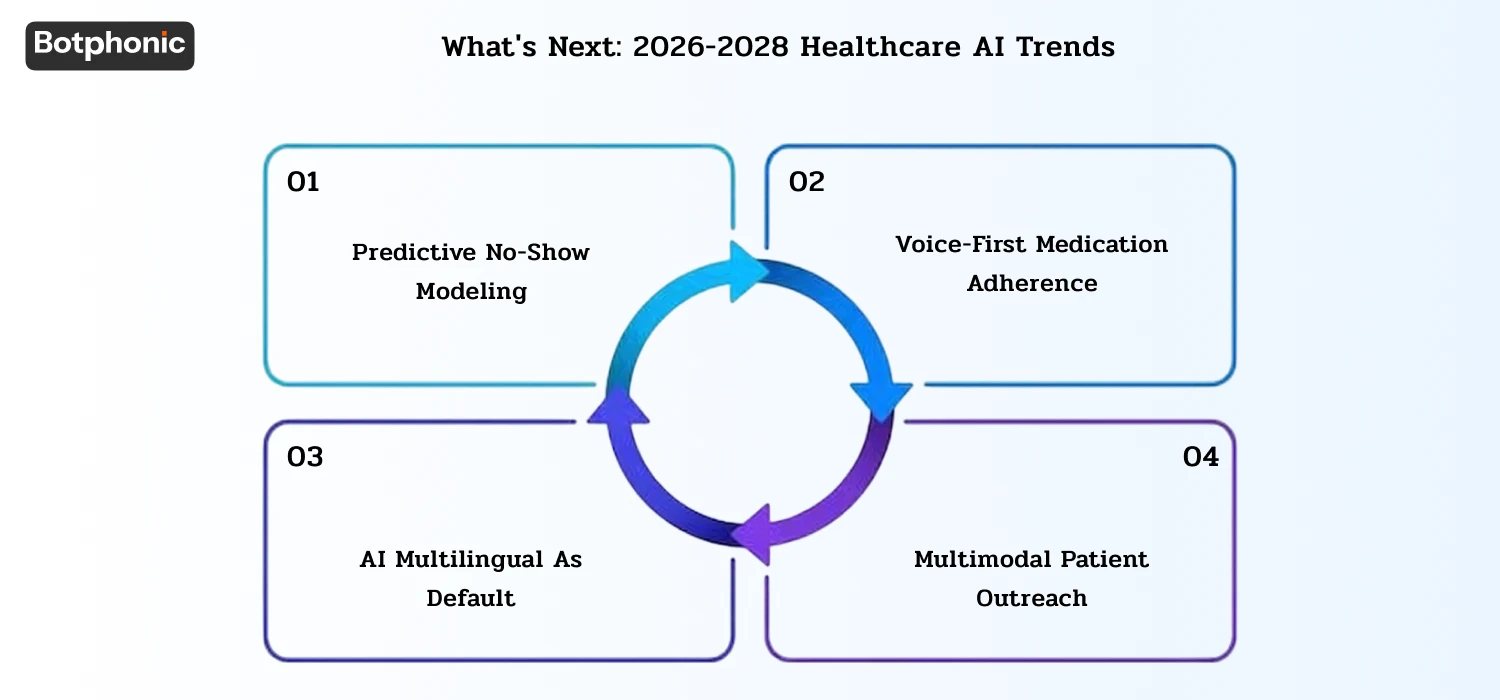
The AI market in the global healthcare sector is expected to reach USD 120 billion by 2028 (Blue Prism, 2025), with appointment booking being one of the fastest-growing groups. The next 24-36 months are characterized by three trends:
Predictive no-show modeling
In addition to the reactive reminders, AI will forecast what appointments have the highest probability of no-show (based on patient history, weather, distance, prior cancellation patterns) and proactively activate interventions overbooking with awareness, alternative time offers, telehealth conversion suggestions.
Voice-first medication adherence
AI calls at a schedule based on prescription refill cycles, with compliance check-ins (Did you take the new medication?). Side effects to report on any side?”). Together with automated submission of refill order to pharmacy systems.
AI Multilingual as default
Spanish + Mandarin + Vietnamese + Tagalog support will not be premium but standard. The patient population in the US includes 350+ languages; voice AI bridges the gap that traditional staffing is unable to bridge.
Multimodal patient outreach
Voice + SMS + email + patient portal orchestrated by a single AI system, with a shared context across channels. The voice-initiating patient can change to SMS without re-establishing a context.
Conclusion
The point of friction in healthcare since the first phone-based scheduling system has been patient communication. AI alters the economic landscape: real-time response, 24/7 service, workflows linked to EHRs, HIPAA compliance – at a cost that can be absorbed by any practice.
The most valued teams select a clear use case (booking an appointment is the usual starting point), pilot it over 30 days with intense measurements, and then scale based on what the data tell them. Firms which implement in 2026 develop the workflows and patient comfort with AI which competitors who start implementation in 2027 will spend 12+ months to catch up to.
Unlock 24/7 Agent Power and Overcome Challenges
Request a Free Demo