
Summarize Content With:
What You’ll Learn
- How an AI voice agent automates common customer support tasks without human intervention.
- The most valuable customer support use cases, including refunds, rescheduling, order tracking, and troubleshooting.
- Real-world examples of how businesses use AI voice agents to improve customer experiences.
- Which support workflows deliver the fastest ROI when automated with voice AI.
- Best practices for combining AI voice agents with human support teams for maximum efficiency.
Customer support teams face a common challenge: customers expect immediate answers, but hiring and scaling support staff is expensive.
That’s why businesses are increasingly adopting an AI voice agent to handle repetitive customer interactions over the phone. Unlike traditional IVR systems that force callers through endless menu options, modern AI voice agents can understand natural language, answer questions, complete tasks, and escalate complex issues when necessary.
The real value of AI isn’t replacing support teams, it’s automating repetitive conversations so human agents can focus on complex customer issues.
Customer support teams are under pressure to deliver faster service without increasing costs. As a result, businesses are increasingly turning to an AI voice agent to automate repetitive customer conversations and provide 24/7 assistance. The shift is already underway: more than 80% of customer care leaders are investing in generative AI, 51% of consumers prefer bots for immediate service, and 70% of CX leaders are redesigning customer journeys around AI-powered experiences. At the same time 19 million support tickets and 37 million customer conversations and found that AI-powered self-service and conversational support significantly improve response and resolution times. These trends are making AI voice agents a practical solution for handling common customer support use cases such as refunds, appointment changes, order tracking, and basic troubleshooting.
What Is an AI Voice Agent?
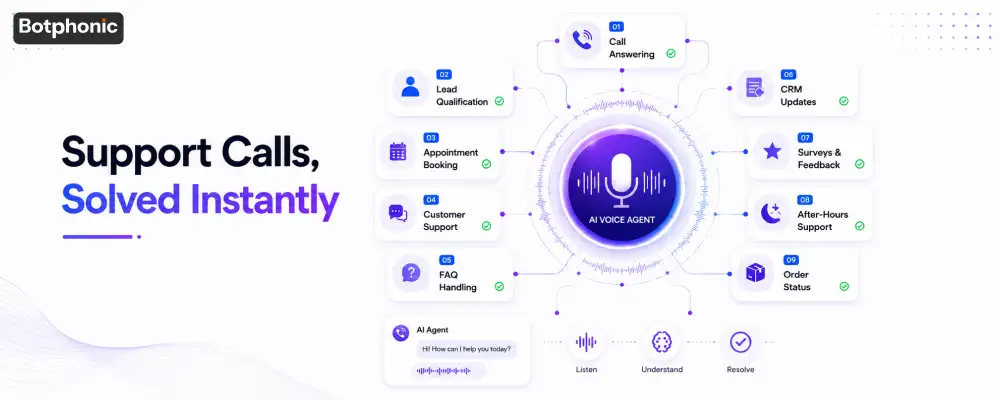
An AI voice agent is a conversational AI system that answers phone calls, understands spoken language, and performs customer service tasks without requiring a human representative.
Modern voice agents can:
- Answer incoming calls
- Authenticate customers
- Check order status
- Process appointment requests
- Handle refund inquiries
- Troubleshoot common issues
- Route calls intelligently
- Escalate complex cases
Instead of forcing customers through scripted menus, the AI understands intent and responds naturally.
Why Businesses Are Using AI Voice Agents for Customer Support
Customer expectations continue to rise.
Customers want:
- Instant support
- 24/7 availability
- Faster resolutions
- Less time on hold
- Personalized interactions
Meanwhile, support teams struggle with:
- High call volumes
- Staffing shortages
- Rising operational costs
- After-hours inquiries
An AI Customer Service helps bridge this gap by automating repetitive support conversations.
Common benefits include:
- Reduced call wait times
- Lower support costs
- 24/7 customer assistance
- Improved first-contact resolution
- Consistent customer experience
Real Customer Support Use Cases
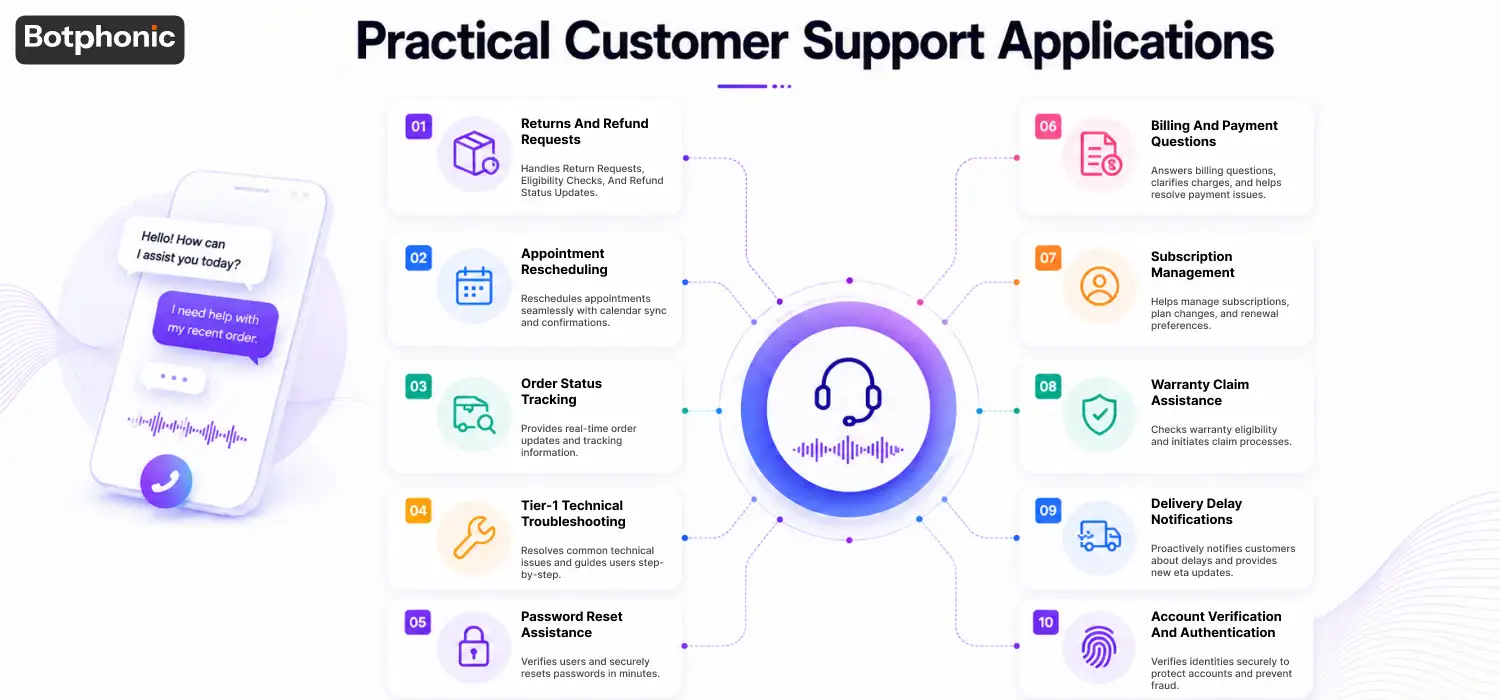
Case #1: Returns and Refund Requests
Returns and refund inquiries are among the most common support calls.
Instead of waiting for a live agent, customers can speak directly with an AI Answering Service.
Example
Customer:
“I want to return an order.”
AI Voice Agent:
“I’d be happy to help. Can you provide your order number?”
The AI can:
- Verify the order
- Check return eligibility
- Explain return policies
- Generate return instructions
- Create support tickets
Case #2: Appointment Rescheduling
Healthcare providers, salons, automotive services, and home service businesses frequently receive appointment-related calls.
Example
Customer:
“I need to move my appointment from Thursday to Friday.”
AI Voice Agent:
“I found your appointment. Friday at 2 PM is available. Would you like me to reschedule it?”
The AI can:
- Check calendar availability
- Update bookings
- Send confirmations
- Handle cancellations
Learn more: Why Enterprises Are Investing In AI For Customer Service Before Scaling Support Teams
Case #3: Order Status Tracking
Customers frequently call simply to ask:
“Where is my order?”
This is one of the easiest support tasks to automate.
Example
Customer:
“Can you track my shipment?”
AI Voice Agent:
“Your package was shipped yesterday and is expected to arrive on Friday.”
The system can pull information from:
- Shopify
- WooCommerce
- Amazon integrations
- Shipping providers
Case #4: Tier-1 Technical Troubleshooting
Many support calls involve basic troubleshooting steps.
An AI voice agent can guide customers through solutions before escalating.
Example
Customer:
“My internet isn’t working.”
AI Voice Agent:
“Let’s try a quick reset. Please unplug your router for 30 seconds.”
The AI can assist with:
- Internet issues
- Software login problems
- Device setup
- Password resets
- Connectivity troubleshooting
Case #5: Password Reset Assistance
Password reset calls consume significant support resources.
Example
Customer:
“I can’t log into my account.”
AI Voice Agent:
“I can help reset your password. I’ll send a verification code to your registered email.”
Benefits include:
- Faster account recovery
- Reduced ticket volume
- Improved customer convenience
Case #6: Billing and Payment Questions
Billing inquiries often follow predictable workflows.
Example
Customer:
“Why was I charged twice?”
AI Voice Agent:
“I can review your recent transactions. Let me verify your account first.”
The AI can:
- Explain invoices
- Verify payments
- Check subscription status
- Identify billing errors
Case #7: Subscription Management
Subscription-based businesses receive frequent requests related to plan changes.
Example
Customer:
“I’d like to upgrade my plan.”
AI Voice Agent:
“You’re currently on the Standard Plan. The Premium Plan includes additional features and costs $20 more per month.”
The AI can:
- Upgrade plans
- Downgrade plans
- Pause subscriptions
- Process cancellations
 NOTE
NOTE
Case #8: Warranty Claim Assistance
Warranty-related support often involves gathering information and validating purchases.
Example
Customer:
“My product stopped working.”
AI Voice Agent:
“Can you provide the purchase date or serial number?”
The AI can:
- Collect documentation
- Verify eligibility
- Create warranty claims
- Schedule follow-up actions
Case #9: Delivery Delay Notifications
Instead of waiting for customers to call, AI can proactively contact them.
Example
AI Voice Agent:
“We’re calling to let you know your delivery has been delayed by one day due to weather conditions.”
This reduces:
- Incoming support volume
- Customer frustration
- Repeated status inquiries
Case #10: Account Verification and Authentication
Security is critical in customer support.
AI Call Assistant can verify callers before providing account information.
Methods include:
- OTP verification
- Phone number validation
- Security questions
- Account matching
This protects customer data while maintaining convenience.
How to Prioritize AI Voice Agent Customer Support Use Cases
Not every workflow should be automated immediately.
Start with high-volume, repetitive support requests:
- Order status inquiries
- Appointment scheduling
- Refund requests
- Password resets
- Billing questions
These use cases often produce the fastest ROI. As confidence grows, businesses can expand automation into more advanced support workflows.
 PRO TIP
Top AI Voice Agents for Customer Support in 2026
| Platform | Best Use Case | Setup Experience |
| Botphonic AI | End-to-end AI customer support calls | Very Easy |
| Signity Solutions | Enterprise customer support & voice automation | Easy |
| Synthflow AI | Workflow-based voice automation | Easy |
| Retell AI | Developer-built voice agents | Moderate |
| Vapi | Custom AI voice logic | Moderate |
| CloudTalk AI | Call center operations | Easy |
| NL Pearl | Enterprise voice automation | Complex |
| Yellow AI | Omnichannel customer support | Moderate |
1. Botphonic AI
Botphonic AI is designed for businesses that want to automate customer support calls without dealing with complex technical setups. The platform enables companies to build AI voice agents that can answer incoming calls, qualify requests, schedule appointments, provide order updates, handle FAQs, and transfer conversations to human agents when needed.
Its biggest advantage is ease of deployment. Businesses can create customer support workflows, customize call scripts, and launch AI-powered phone support quickly, making it particularly attractive for small and mid-sized businesses looking to reduce support costs while maintaining 24/7 availability.
2. Signity Solutions
Signity Solutions helps businesses build custom AI voice agents for customer support and enterprise call automation. Its solutions can handle inbound and outbound calls, customer inquiries, lead qualification, appointment scheduling, follow-ups, and routine support interactions.
For customer support teams, Signity can integrate voice AI agents with CRMs, APIs, and existing business applications while supporting intelligent call routing and workflow automation. Its custom approach makes it suitable for enterprises with complex workflows, industry-specific requirements, and a need for secure, scalable voice automation.
3. Synthflow AI
Synthflow AI focuses on workflow-driven voice automation. It allows businesses to create AI voice agents using visual workflow builders rather than extensive coding, making it accessible for operations teams and non-technical users.
For customer support teams, Synthflow can automate appointment scheduling, customer inquiries, lead qualification, and routine support requests. Its workflow-centric approach gives organizations flexibility to design structured support journeys while maintaining conversational interactions.
4. Retell AI
Retell AI is a popular choice among developers building highly customized AI voice experiences. The platform provides extensive APIs and infrastructure that allow businesses to create voice agents tailored to specific support processes and business requirements.
Customer support teams can use Retell AI to build advanced call automation systems, integrate with CRMs, and connect voice agents to internal databases. While it requires more technical expertise than no-code platforms, it offers significant flexibility and customization capabilities.
5. Vapi AI
Vapi AI is built for organizations that want complete control over their AI voice logic and conversational architecture. It provides a developer-friendly environment for creating sophisticated voice agents capable of handling dynamic customer interactions.
Businesses often choose Vapi when they need custom workflows, advanced integrations, and highly personalized support experiences. The platform’s flexibility makes it suitable for startups and technology teams building unique customer support solutions.
6. CloudTalk AI
CloudTalk AI combines traditional business phone system capabilities with AI-powered automation. It is particularly well-suited for customer support centers and teams managing large call volumes across multiple channels.
Its AI features help automate call routing, call summaries, analytics, and agent assistance, allowing support teams to improve productivity and reduce response times. Organizations already using contact center software often find CloudTalk AI easy to integrate into existing operations.
7. NLPearl.ai
NLPearl.ai focuses on enterprise-grade voice automation for organizations with complex support requirements. The platform is designed to handle large-scale deployments, advanced compliance needs, and highly customized customer service workflows.
Enterprises use NLPearl.ai to automate repetitive support interactions while maintaining strict operational controls and integration standards. Because of its extensive capabilities, implementation is typically more complex than many SMB-focused AI voice solutions.
8. Yellow AI
Yellow AI is known for its omnichannel AI customer support platform that combines voice, chat, email, and messaging automation into a unified customer experience. Businesses can deploy AI agents across multiple channels while maintaining consistent support workflows.
For customer service teams, Yellow AI helps automate common inquiries, ticket creation, account assistance, and customer engagement tasks. Its omnichannel approach makes it particularly valuable for enterprises looking to provide seamless support across voice and digital communication channels.
Conclusion
The best AI voice agent deployments focus on solving specific customer support use cases rather than trying to automate everything at once.
Whether it’s handling returns, rescheduling appointments, checking order status, or guiding customers through basic troubleshooting, AI voice agents help businesses deliver faster support while reducing operational costs.
Organizations that begin with high-volume support workflows often see the quickest gains in efficiency, customer satisfaction, and scalability. As AI capabilities continue to improve, voice agents will become an increasingly important part of the modern customer support experience.
With Botphonic’s AI voice agents, you can automate support requests, appointment scheduling, lead qualification, and follow-ups without sacrificing customer experience.
Explore Botphonic and start saving on every call