
Summarize Content With:
When you have dozens of open jobs to manage, the process of screening potential candidates turns into a time-consuming task in itself.
Your day would include the following activities:
- Hundreds of applications coming for different roles
- Emails from candidates for follow-up and interviews
- A calendar overloaded with screening calls and scheduling
- Spending hours calling applicants who are not picking up
- Voicemails that don’t get any response
- Repetition of the same qualifying questions
Many recruiters struggle not with finding candidates but with finding enough time to talk to them. As the number of applications increases, the process of manual phone screening becomes the most time-wasting part of the entire hiring process. The solution lies in modern recruiting technology: AI in recruitment, which helps recruiters hire smarter candidates with minimal effort.
This blog talks about that problem and how it can be fixed.
We’ll cover:
- Why phone tag is secretly killing recruiter productivity
- How artificial intelligence in recruitment phone calls will transform screening
- Why every article you read focuses on the candidates but misses the real story
- The client communication problem that everyone ignores
Why Recruiters Are Drowning in Screening Calls
To give some numbers to this,
A medium-sized staffing company with 30 active job orders can get 200-400 applications per position per week. Even if recruiters call only 10% of the most qualified candidates, that still amounts to 600–1,200 calls per week from a single company.
Moreover, taking into account that candidates rarely answer recruiters’ calls during the first attempt, these figures add up quickly.
An average recruiter typically spends 20% to 40% of their workweek making phone calls, much of that time being spent on hold, leaving voicemail messages and speaking with those candidates who are not in the labor market anymore.
This phenomenon leads to the appearance of so-called productivity debt; the larger amount of job orders managed by the team the more time goes for low-value tasks and the less is available for valuable actions like client relations, candidate preparation, and faster positions filling. With the AI phone call, the situation is much more improved.
The Real Cost of Phone Tag in Recruiting
The phone tag is the silent tax on any recruitment effort, and few companies recognize its impact.
Let’s look at the truth behind it:
A recruiter sends an application to the candidate by 10 AM. The candidate calls back at 2 PM, but the recruiter is occupied with another conversation. The recruiter calls back at 4 PM no answer from the candidate. The following day they make another attempt. And on the third day, both sides move away or the candidate accepts another offer.
This situation is not uncommon; this is Tuesday for most recruiting agencies.
Take a closer look at numbers: 90 minutes a day from 5 recruiters results in 37.5 hours of effort per week a whole employee working time dedicated to phone tag.
The issue isn’t only about wasting company resources. Inconsistent communication drives away candidates. They accept offers somewhere else, they leave negative feedback on Glassdoor and they advise their network not to consider this recruiting agency due to poor communication skills. The hiring manager from the client side becomes reluctant due to inefficient pipeline.
Phone tag isn’t just a waste of time; it’s an expense of placements.
 PRO TIP
What AI Phone Call Software for Recruiters Actually Does
AI phone call software for recruiters works by automating the initial contact and screening phase of the recruiting process. In other words, instead of having the recruiter call each applicant themselves, the system calls the applicant using an AI voice agent who will conduct the screening interview, document the answers, score them, and pass the information back to the recruiter.
The best AI phone call systems for phone screening are capable of doing all of the following:
- Outbound calls to newly submitted applicants minutes after submitting an application
- Inbound calls from applicants wanting to check their status or ask basic questions
- Multi-turn conversations which depend on the candidate’s input
- Knockout question logic to automatically screen out candidates
- Interview scheduling that happens automatically without any human interaction
- Summary report that the recruiter can instantly access
It’s important to note that this is not robocall technology. The most up-to-date AI voice agents use natural language processing to converse in a real dialogue format with applicants.
Recruiters’ time will be spent on candidates who have cleared the preliminary screen since the difference between these two models lies in the very fact that AI acts as the first point of contact rather than the recruiter himself/herself.
As per studies conducted by SHRM on recruiting automation, companies using automation during their early stage screening processes have experienced significant decreases in their time-to-fill ratios to even a matter of hours.
Designing Effective Knockout Questions
This is where the real power lies, but most articles that talk about AI for recruiting fail to mention it.
Knockout questions are the screening criteria that determine who advances and who is not worth pursuing. These are the criteria every recruiter uses on each call but most AI solutions are poorly designed around them.
Healthcare recruiting:
- Do you have a current nursing license in this state?
- Are you currently CPR certified?
- Do you have availability for night shifts including weekends?
Logistics and transport:
- Do you have a current Class A CDL?
- Have you been issued any tickets in the last three years?
- Are you okay with driving overnight routes?
General office and admin:
- Do you have legal authorization to work in this country without sponsorship?
- What is your expected salary for this position?
- Do you have availability to begin in two weeks?
Call center and retail:
- Do you have availability to work on-site, five days a week?
- Are you experienced with inbound customer service calls?
- Do you have availability to work nights and weekends?
If done right, the AI can make the qualifying decision on its own without any human review of the candidate’s profile. This changes the recruiter’s job for the better.
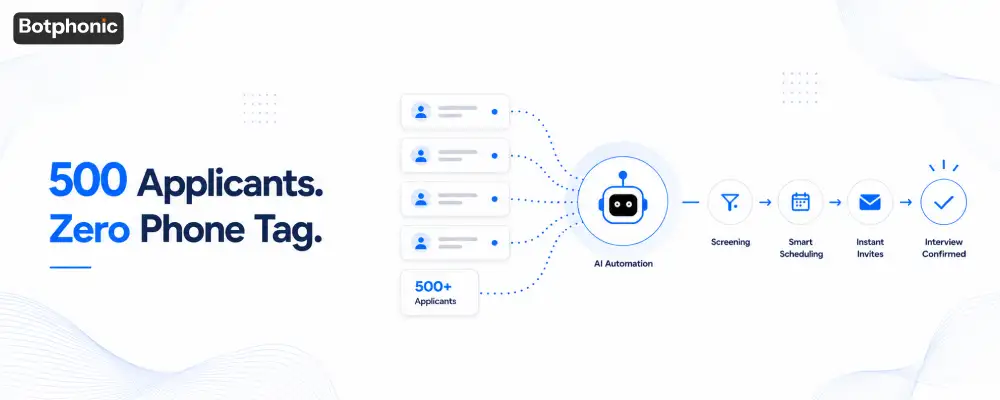
A recruiter no longer needs to contact 500 people. Instead, the recruiter evaluates 80 already qualified profiles and works with 20 of the best ones while submitting 5 profiles to the client. This screening process, which took 3 days to complete, is now completed in 3 hours.
 NOTE
NOTE
The Two-Sided Communication Problem Nobody Talks About
And here’s the key point that most of the literature on AI in recruiting doesn’t mention at all.
The recruiters aren’t only communicating with the candidates. They’re communicating with their clients at the same time. The hiring managers want updates. The department heads want to know where things stand with their pipeline. The account managers want to know which positions are getting filled and which aren’t moving forward.
Which means that recruiters have what you might call a “two-sided” communication challenge. The recruiter needs to coordinate:
- Hundreds of different candidates in various states in their pipeline
- Multiple client contacts who all demand up-to-date information
The vast majority of recruitment assistants are designed only for the candidate end. They facilitate outreach, screening, and scheduling. But they don’t address the other side of the coin.
A much smarter recruitment assistant solution and the one that actually addresses the recruiter’s whole problem is the use of voice AI that works on the other end too. Status update calls to hiring managers. Automated check-in calls to account contacts. Notifications about stalled pipelines or great candidates that have been screened.
When both sides of the communication loop are supported, recruiting agencies stop being the bottleneck. Information flows without someone having to manually relay it.
Example Workflow: 500 Applicants, One Recruiter
For concreteness, here is an example of how this might work in practice for a busy hire:
Day 1 – Applications come in
500 people applied for the job of warehouse supervisor. The AI call assistant instantly starts its work. Outbound calls are made throughout the day in different time zones at best moments.
Day 1-2 – Screening occurs automatically
The AI makes calls to those applicants who answered them. It asks some knockout questions such as having forklift certification, shift availability, years of supervisory experience, required hourly rate. Those applicants who do not have the basic requirements are thanked and informed about that. Those who meet all criteria are informed that the recruiter will contact them soon.
Day 2 – Recruiter analyzes the results
Instead of starting from scratch, the recruiter sees 110 pre-qualified applicants with their call records, scoring, and marked down notes. He spends 2 hours analyzing and shortlisting to 25 candidates.
Day 2-3 – Interviews are scheduled
The interviews are scheduled for the selected candidates by the AI without sending even one email exchange.
Day 3 – Update from client
A robot call or text is made to the hiring manager: strong pipeline; first interviews set; expected submission within the week.
Day 4–5 – Candidates presented by the recruiter
The recruiter makes five most suitable candidates available to the client complete with their interview details and screening.
The process described above, from 500 applications to five suitable submissions in four to five days, is achievable if appropriate phone call software for recruiting is utilized. Otherwise, it normally takes two to three weeks.
Where Human Recruiters Still Add More Value Than AI
It is important to be blunt about this point: AI does not replace recruiters. It eliminates the functions of the profession that should not require a person’s involvement.
There are certain things that AI is not able to do effectively:
Building connections with passive candidates: Getting in touch with someone who is not currently seeking a position and making them consider an opportunity is a job for intuition and interpersonal skills.
Detecting subtleties: Seasoned recruiters can sense subtleties in a conversation that cannot be assessed through qualification points: energy of a candidate, his or her hesitation or doubts about the job position.
Handling complicated clients: In cases when a client is dissatisfied or the process of recruiting is becoming tricky, recruiters should use their strategic mind and interpersonal skills – it is not an AI voice agent’s task.
Offer negotiations: The negotiation process in general, and offer negotiation in particular, is a craft that involves handling expectations of both sides and building the connection with candidates.
The purpose of the AI telephone calls software is not the elimination of recruiters. It is making sure that recruiters are doing their job.
Industries Seeing the Biggest Impact
However, not all industries can reap the same benefits from using AI calling in recruiting. In general, those industries that benefit from the technology most are characterized by high application volumes and clear qualification criteria that can be considered as yes/no.
Healthcare: The need in license verification, shift availability, and particular specialties makes AI knockout screening applicable here. The lack of healthcare personnel and huge volume of applications make recruiting in this sphere one of the leaders in the AI recruiter solutions.
Logistics and transport: Having CDL certificate, safety certificates, and geographical availability is a binary decision for AI. High turnover rates in the sphere imply the need to screen applicants on a continuous basis.
Retail and hospitality: Seasonal employment peaks provide a huge volume of applications. With AI calling it is possible to process hundreds of applications within several days.
Call centers: Availability, language skills and experience criteria make AI knockout screening an effective tool here. Some BPO companies already implement AI into their initial screening process.
Light industrial and manufacturing: Shift flexibility, physical requirements, and certificates required in a particular location make screening repetitive and time-consuming.
To get an overview of how AI technology is transforming talent acquisition practices within these industries, the LinkedIn Global Talent Trends Report gives us some benchmarks for changes in the way recruiters operate.
Cut Screening Time from Days to Hours
Stop spending valuable recruiter hours on voicemail, missed calls, and repetitive screening questions. Let AI handle first-round conversations while your team focuses on hiring top talent.
