AI Phone Call Assistant for Recruitment Agencies: 2026 Guide

November 26, 2025 16 Min Read
AI recruitment system handling automated candidate screening calls, interview scheduling, and hiring workflow optimization for recruiters in 2026.

Quick Summary

Manual phone screens- calling applicants, asking the same qualifying questions, scheduling interviews, taking notes and updating the ATS consume 20-40% of each week by recruiters. To recover that time, 99 percent of talent acquisition teams have turned to AI or automation tools to recover that time. Leading deployments manage the entire screening process end-to-end: AI makes calls to candidates minutes after they apply, runs a natural conversation, scores responses, automatically updates the ATS, and books interviews on the schedule of the recruiter – not a recruiter touching the call.

The agency and in-house TA team outcome: 40-60% greater engagement with candidates, more time-to-hire, and recruiters who, finally, have time to do the high-judgment work that makes them effective.

It includes how AI phone calls work in recruitment, what ATS systems they integrate with (Greenhouse, Lever, Workday, Bullhorn, iCIMS), the screening workflow and scoring framework, what real benefits of this approach are, a 7-step implementation playbook, and what comes in 2026-2027.

Try Botphonic free for 14 days → · Book a 20-minute demo →

The Bottlenecks Holding Most Recruitment Teams Back

Recruiters overwhelmed by applications, repetitive screening calls, inconsistent data, and slow hiring outcomes

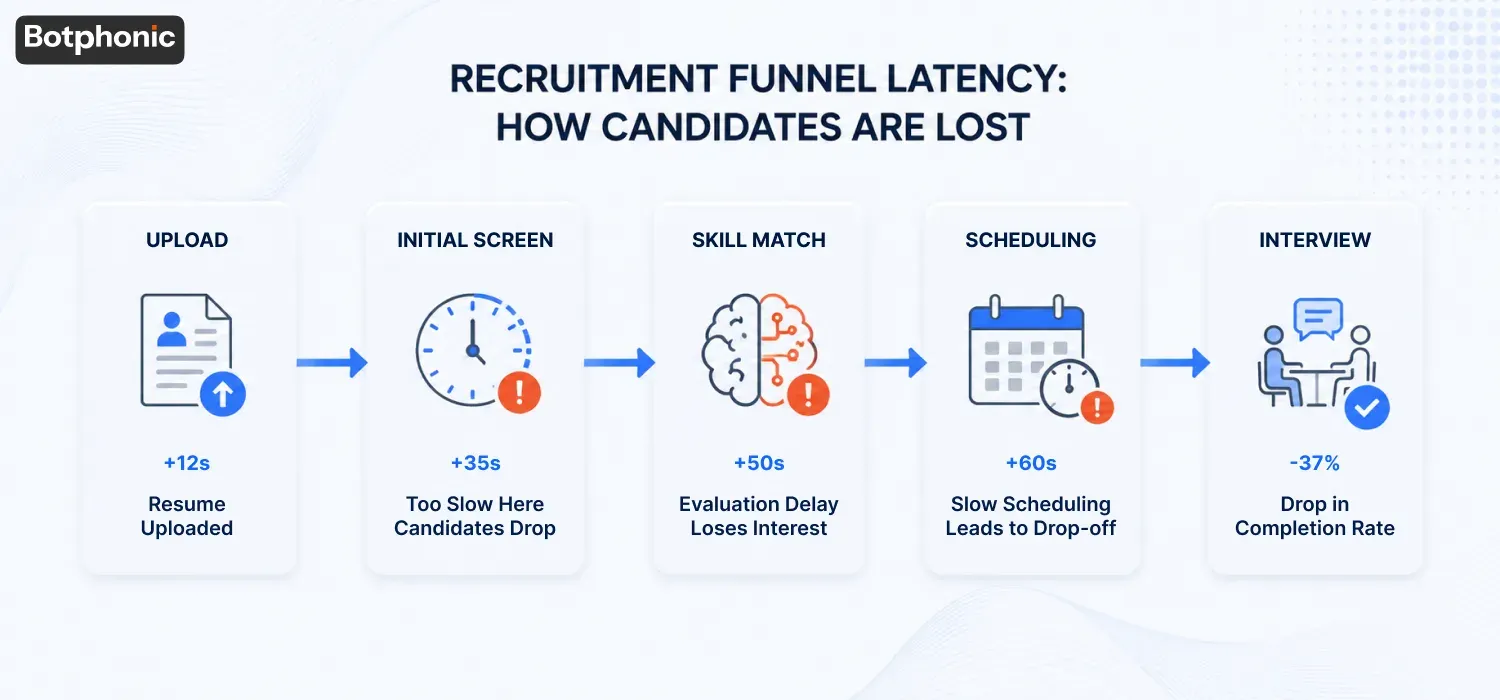
There has always been a math problem in talent acquisition. Each vacant position attracts dozens or hundreds of applications. Every application requires a first-screen. A recruiter needs 15-30 minutes to complete each screen. Divide by the vacant positions, divide by the amount of recruiting agencies, and the line stretches out by Wednesday.

The problem is complicated by three particular bottlenecks:

The Slow Grind of Manual Phone Screening

Initial screening calls take up 20-40% of the week of most recruiters – and even the actual work is extremely repetitive. All applicants are asked the same qualifying questions (right to work, salary expectations, notice period, role-specific experience). The responses are different but the queries are not. It is precisely this type of work that does not scale with the number of heads since the bottleneck is calendar time, rather than capacity.

Data Quality Falls Apart

The screening of phones by humans is not a consistent source of data. One recruiter takes comprehensive notes; another writes down three lines. One is the ATS template; the other is the personal spreadsheet where they log in. Comparing candidates side-by-side turns out to be a guesswork since the data was not recorded in the same manner.

The Consequences That No One Wants to Own

The trickle down impact: the best applicants take up other opportunities as they wait to be called upon, recruiters are getting burnt by the grind, hiring managers are losing faith in the pipeline data, time-to-hire is creeping up, and the cost-per-hire is climbing without anyone noticing exactly when it went up.

The Real Process Behind Recruitment Phone Calls (No Marketing Spin)

The 8-Step AI Screening Workflow

  1. The candidate applies via your job board or career site.
  2. An AI receptionist makes the call (or SMS opt-in) within several minutes – usually less than 5 minutes after submission.
  3. Natural voice conversation – the AI welcomes the candidate, informs them about the position and asks them job-specific qualifying questions which change depending on the responses.
  4. Live text and purpose recognition – each utterance is deconstructed into content, purpose and cue.
  5. Automated generation of scorecards – the AI compares the candidate to role requirements (match in experience, availability, salary fit, behavioral signals)
  6. Transcript, scorecard, and qualification status update automatically into Greenhouse / Lever / Workday / your ATS.
  7. The links to the next stage (recruiter call, technical interview, hiring manager call) are offered to qualified candidates.
  8. Recruiter dashboard There is no manual note taking recruiter can see everything in their regular workflow.

The entire procedure takes between 15-20 minutes on average per candidate, and zero time on the recruiter side of routine cases. Recruiter only intervenes when the candidates who are successful have been screened – and comes with a complete transcript, scorecard, and history already loaded.

Why It Feels Seamless to Candidates

In voice agents (Botphonic and similar) of modern AI, the sound is sufficiently natural-sounding that most candidates will not notice that they do not talk to a human on regular calls. Contributing factors include sub-300ms latency, natural pauses, several voice options per language, and dynamic question adjustment. When candidates do inquire whether they are talking to AI, the system comes clean, which fosters trust and not a loss of it.

Candidate experience tends to be better than human-only screening: response time is instant (no waiting days to get a callback), the interview is more natural and relaxed (no agent who is bored and in a hurry), and follow-up is consistent (no calendar dropouts).

See Botphonic’s AI phone call assistant →

What AI Offers to Recruitment Agencies: Five Fundamental Features

AI automating screening calls, scheduling interviews, centralizing data, enabling 24/7 hiring, and ensuring secure communication

1. Personalized Screening Outbound Calls

The AI calls all applicants in minutes, performs a programmable screening process with role-specific qualifying questions, and uses NLP and sentiment analysis to understand responses (not merely transcribe them). Applicants believe that they are already in a real life conversation but not on a phone-based application.

2. Interview Scheduling Without the Back-and-Forth

Upon candidate qualification, the AI appointment booking system will check the calendar of the recruiter (or hiring manager) in real time, suggest 2-3 time options, book an interview, and provide confirmation via SMS and email. The what time works for you? An email loop that may easily waste 2-3 days is completely eliminated.

3. Candidate Data and Analytics Dashboard

Each call results in structured information full transcript, sentiment trajectory, qualification scorecard, top concerns raised, next-best action. This pulls up into a recruiter dashboard with searchable history and pipeline-wide metrics (time-to-screen, qualification rate by source, common disqualifiers).

4. 24/7 Call Coverage and Scalability

Applications don’t arrive 9-5. Applications are received at 11 pm post work, on weekends, when the candidate researches the company during lunch time. AI can do all of them as quickly and as well as Tuesday-morning calls. In the case of agencies whose applicants are international, the time-zone coverage is the difference between first contact with the applicant and the applicant being lost to a competing firm that responded first.

5. Secure and Compliant Communication

Recruitment information is confidential – salary negotiations, work permit status, personal contacts, in some cases diversity information. Out of the box Botphonic’s security and compliance ships are SOC 2 Type II, GDPR, HIPAA-ready and PCI DSS compliant. All recordings of calls are encrypted during transit and rest, access is managed by role and audit logs can be accessed by compliance teams.

Major ATS Systems Botphonic Combines With

ATS SystemsIntegration Offers
GreenhouseTwo-way full sync (incoming applications, screening data and scorecards outbound)
LeverTranscript and qualification status added to profile of candidate.
WorkdayField-level mapped enterprise integration.
Bullhornstaffing-agency standard
iCIMSATS with extensive integration capabilities that are enterprise-wide.
TelloSupport of emerging platforms.
JobAdderAustralian and international agencies.

Plus 50+ other platforms via API and webhook integration. In case your ATS is not on the standard list, Botphonic can be used to integrate with it through Zapier or direct API.

What Good Integration Actually Looks Like

ComponentDescription
Field mappingAI fetches salary expectation, notice period, work auth status; and puts each in the respective ATS field, not merely in a free-text notes block.
Webhooks and triggersAs a candidate qualifies, the ATS sends an event to the next-stage workflow (interview slot booking, hiring manager notification, technical assessment send).
Validation rulesWhen the AI records conflicting information (e.g., candidate claims to be available immediately but ATS indicates that they are already employed), it flags and does not overwrite.
Error processingPushes that fail are retried: repeated failures are logged to IT.

Without the four pieces, the integration of ATS is turned into a glorified data dump – transcripts are placed in a notes field where no one reads it. The recruiter pipeline, alongside them, operates on organised data which accumulates in value.

Why ATS Integration Matters: A Stat

According to GetApp Recruitment Strategies Report, 72% of recruiters who used ATS said that they had improved the quality of the people they recruited. Introducing into that ATS workflow multiplies the effect – not only is there better data per candidate but also faster screening means recruiters spend their time on better-qualified candidates.

Note Icon NOTE
If your AI is only making transcripts into notes, you have just bought a machine not a smart system that can help you.

The Candidates Screening Framework: Type of Questions, Scoring And Logic

AI-led screening with role-based questions, experience checks, salary inputs, behavioral probes, and follow-up clarifications

Types Of Questions That The AI Can Answer

  • Role-specific qualifying questions, based on each open requirement (technical skills required in engineering jobs, sales experience required in SDR jobs, certifications required in healthcare jobs)
  • Experience walk-through questions include, “Describe your last job” with interactive follow-ups depending on the response that the applicant gives.
  • Salary and availability expectations, not hidden in the notes, but directly entered in structured fields.
  • Start-date confirmation, gracefully deals with notice periods and gardening leave.
    Behavioral signal probes, Tell me of a time you dealt with a tough stakeholder.
  • Clarification follow-ups, where an answer is ambiguous, the AI inquires further about details, as opposed to proceeding.

The Scoring Framework

Signal TypeWhat’s Measured
Conversational signalsPatterns of hesitation, confidence, enthusiasm indicators.
Speech pattern analysisCertainty/ ambiguity in responses.
Response consistencyConsistency within the dialogue.
Behavioral cuesThe way the candidate will deal with interruptions, make clarifying questions, get back on track after making a mistake.
Pro Tips PRO TIP
Don’t aim for perfection. Instead, concentrate on quickly identifying and eliminating the clear mismatches.

This score enables recruiters to set priorities for follow-up interviews. A person who scored 85 in technical skills and 45 in cultural fit will be followed up differently from someone who scored 70 in all categories. Without such a tool, recruiters will be overly dependent on resumes or waste precious time on people they would have ignored had they used this approach.

Qualification Criteria Tracked

  • Relevance that is experienced to the open role.
  • Availability alignment (date of start, period of notice)
  • Estimates vs. budget on compensation.
  • Job-specific competencies
  • Behavioral fit signals
  • Red flags (with predictive scoring becoming standard in 2026 – Trends section) Red flags are inconsistency or fraud flags (with predictive scoring becoming standard in 2026 – Trends section).

Actual Recruitment Team Advantages

Faster hiring, lower costs, better candidate experience, more strategic recruiter work, and data-driven decisions

1. Faster Time-to-Hire

Industry statistics are aligned: when organizations employ AI in the recruitment process, time-to-hire decreases by half when AI is used to filter through applications first. The system: AI simplifies the multi-day callback loop (apply → wait for callback → screen → wait for next step booked) to one hour (apply → AI screens → next step booked).

2. Reduced Recruitment Cost

The time spent every day by recruiters handling initial screening is typically freed up by 40-60% using AI to perform initial screening. That capacity either lowers the number of headcount required, or allows the current team to work on 2 times the number of open requisitions. This directly enhances margin per placement in the case of staffing agencies; it enhances cost-per-hire in the case of in-house teams.

Per-call price also decreases: outbound automated to humans costs $4-$7 per dial whereas automated to AI costs less than a dollar a dial.

3. Improved Candidate Experience

The candidates receive immediate response (no 3-day response wait), consistent treatment (no recruiter who has a bad day), and quicker decisions (no waiting weeks to know whether he/she advanced). The candidate experience surveys following the implementation of AI in an NPS-style typically indicate that the satisfaction scores are 15-30% higher.

4. Higher-Value Recruiter Work

The recruiters no longer spend their day on the first qualifying questions and instead spend their day on the activities that humans are better at: rapport building with passive candidates, offer negotiations, advice to hiring managers, sourcing event attendance. Satisfaction among recruiters is an unintended consequence – the job becomes more engaging.

5. Data-Driven Decisions

All calls generate structured data. When aggregated over thousands of screens, this will become the single best source of truth, which sourcing channels produce the best candidates, which hiring managers have the longest screening cycles, and which jobs lose candidates at the offer stage. This sort of pipeline-wide visibility has never been experienced by most recruitment teams before.

How Recruitment AI Integrates With Your Workflow: 7-Step Best-Practices Framework

7-step AI adoption process covering system review, goal setting, vendor choice, rollout, integration, training, and optimization

Step 1: Understand Your Existing System

Prior to selecting an AI vendor, review your existing ATS to identify particular gaps. Common ones:

  • Manual screening of resumes that is done by the recruiters on all applications.
  • The poor match between candidates and skills (keywords and no context)
  • Simple reporting that does not inform you of the reason candidates drop out.
  • Less developed scheduling tools that have to be coordinated manually.

Define the 3-5 specific gaps that you are addressing. AI is most useful when it solves named problems, rather than when it turns out to be a general sort of play of modernization.

Step 2: Determine Objectives to Integrate

Be clear on the measurement you are making. Common objectives:

  • Minimize the time-to-hire of X days to Y days.
  • Enhance the quality of candidates (based on hire-to-applicant ratio)
  • Improve candidate experience (NPS or satisfaction survey)
  • Automate top-N repetitive jobs (first screening, interview scheduling, follow-up)

ROI assessment is simple with goals related to the current baseline measures. It is impossible by goals in the form of transform recruiting.

Step 3: Choose the AI Partner

Five evaluation criteria:

  • ATS compatibility – does it already have an out of the box integration with your particular ATS, or will it require custom development?
  • API and webhook support – does it have the capability of pushing data into the fields you need, or is it limited to a generic notes field?
  • Customization – Does it support configuring question flows to support different types of roles, or is it one-size-fits-all?
  • Compliance SOC 2, GDPR, where applicable, and HIPAA, as well as EEOC testing fairness and audit logs.
  • Vendor support – Implementation support, continued technical support, response time SLAs.

Step 4: Select Your First Use Case (Quick Wins First)

In week 1, don’t attempt to automate everything. Sequence the rollout:

  • Resume screening + first qualifying (lowest-risk, highest-volume)
  • Candidate matching (AI scores candidates according to role requirements)
  • Interview scheduling (excludes back and forward email)
  • AI pre-screening interviews (whole conversation screening prior to recruiter intervention)

The majority of teams choose step 1 during the initial 60 days, and then extend. Efforts to deploy the four at once tend to give one a half-baked implementation that no one believes in.

Step 5: Prepare Data Synchronization with Due Care

ComponentDescription
Field mappingall of the collected data will fall in the correct field in the ATS.
Webhooks and triggersthe next step in your work process will fire automatically when AI has finished screening.
Validation rulesconflicting or impossible data, is marked, not overridden.
Error processingunsuccessful pushes re-try; constant failures warn IT.

This is the boring infrastructure article that makes the difference between whether the integration is actually working at scale.

Step 6: Educate Recruiters and Hiring Managers

The AI does not displace recruiters, it alters what they devote their time to. Train the team on:

  • How to interpret AI-generated scorecards (which aspect of the matter matters, which aspect of the matter should be weighted)
  • Interpretation of sentiment scores (when to call back to ask about it)
  • The workflow of handoff (where AI leaves off, where human beings start)
  • The fairness aspects (how AI scoring works, what is audited)

When done properly, this instills confidence in the recruiter regarding the AI. Skipped, recruiters either disregard the AI output (wasted investment) or over rely on it (compliance risk).

Step 7: Monitor and Optimize

Measures to monitor each week:

MetricPurpose
Time-to-fill per roleEfficiency tracking
Cost per hireROI measurement
Satisfaction of candidates (NPS or post-screen survey)Experience quality
Recruiter productivity (open reqs / recruiter / month)Output efficiency
Accuracy of AI (intent recognition rate, false-positive screen rate)Model performance

Modify prompts, scoring weights and routing policies according to what the data tells them. With these adjustments, most deployments are getting much better in the first 90 days.

Practical Performance: Serenity Case Study at Botphonic

MetricResult
Conversion increase+25%
Call handling time−50%
Human error−20%
Satisfaction+15 percent

First year ROI of +150%.

In the case of recruitment, in particular, such deployments are expected to yield: 50% reduction in time-to-hire, 40-60% capacity recovery by the recruiter, and 20-40% increase in the scores of the candidate experience within 90 days after full deployment Run your own ROI projection →

Future hiring powered by predictive scoring, voice reference checks, fraud detection, workforce planning, and multi-channel communication

1. Predictive Scoring: Candidate Success

In addition to the question of whether this candidate met the qualifications on the basics, AI will be able to predict more and more the likelihood of succeeding in the job based on historical data (who have been successful and who have failed in the job) combined with role benchmarks and real-time conversation signals. This shifts recruiting to a more proactive (find the candidates with the best chance of staying and performing) approach.

2. Voice-Driven Reference Checks

The current state of the reference-check process is largely email-based and slow – references can take days to respond, conversations are stilted and the information captured is unstructured. Voice-based reference checks allow AI to make calls to references at a convenient time, conduct a structured discussion, and generate a scored summary in the same format as candidate screening. The cycle squeezes out days to hours.

3. Fraud Detection in Real time During calls to Candidates

Resume fraud does exist (usually 20-30 percent of resumes have some type of inaccuracy). During a screening call, AI can uncover discrepancies in candidate experience with a tool: a candidate may claim 5 years of experience with a specific tool, but fail to answer a simple question about it; a stated employment history does not match LinkedIn; a requested salary is 3 times higher than what is normal at the claimed seniority. These are flagged so that recruiter can follow-up on them instead of learning about them after the offer has been made.

4. An AI Overhaul of Workforce Planning

Looking out 24-36 months, AI will be increasingly concerned with the workforce planning itself – predicting which roles will have to be backfilled, which teams are at flight risk, which skills the company will need in the next year, and which sourcing channels to invest in. This transforms recruitment as a service activity to a strategic activity.

5. Multi-Modal Communication Integration

The current AI is voice-first, the future is multi-modal, voice to get first outreach, SMS to confirm, email to document, video to final-round interview, all of this synchronized by one system with shared context. The channel’s experience is a smooth one; everything is rolled up in the recruiter dashboard.

Level Up Your Service Quality With Botphonic

Ready to see what AI looks like for your recruitment workflow?

Book a 20-minute demo

Conclusion

The 2026 recruitment is a far different picture than it was in 2023. Now 99% of talent acquisition teams are in some way using AI. Time-to-hire is down. The scores on candidate experience are increased. Recruiters are doing better-value work – building relationships, negotiating offers, advising hiring managers – than running the same qualifying script 30 times a week.

The agencies and in-house teams with the highest value will select a vendor whose activities are deeply integrated with ATS (Greenhouse, Lever, Workday, Bullhorn, iCIMS), deploy to a single use case first (initial screening is the standard starting point), measure rigorously over 90 days, and expand. The ones that attempt to automate all at once, end up with a half-complete deployment which recruiters work around.

The competitive frame is getting apparent: agencies deploying in 2026 will outcompete those deploying in 2027 – they will fill open positions more quickly, win more applicants, and have a recruiter team that will want to stay.

F.A.Q.s

An AI call assistant for recruiters is software that dials candidates automatically, conducts a conversation in natural language to qualify them, assesses their answers, schedules interviews on the recruiter’s calendar, and updates the ATS all without a recruiter participating in the call. It manages the mundane 60-80% of qualifying conversations so recruiters can concentrate on relationship-building and complex judgment calls.

There are three main ways: (1) it makes initial qualifying calls around-the-clock, ensuring no callbacks are delayed; (2) it records structured data about each candidate so your pipeline operates by signal, not notes; and (3) it plugs into popular ATSs (such as Greenhouse, Lever, Workday, Bullhorn, and iCIMS), allowing recruiters to operate in their preferred ATS with improved data. Expected result: 50% reduction in time to hire and 40-60% increase in recruiter productivity within 90 days.

Yes. AI looks at the calendar of the recruiter (or hiring manager) in real-time, gives 2-3 scheduling options to candidates who fit the criteria, schedules the interview, and sends out an SMS and e-mail notification. “What time works for you?” e-mail back-and-forth usually taking 2-3 days is completely eliminated. Rescheduling and cancellation are handled the same way.

Yes both. Inbound calls when candidates call in to learn about available opportunities, they are instantly qualified and routed accordingly. Outbound calls AI dials candidates after their application, screens them, and contacts candidates from nurture pipelines. All leading agencies use both. The platform processes those types of calls through identical settings.

If asked, AI answers truthfully. “Yes, you’re speaking to an AI assistant now — would you like to talk to a human recruiter?” This not only ensures TCPA compliance in most cases but is simply a good thing to do. Candidates rarely ask the question since the voice sounds very natural.

Yes. Modern AI voice technologies are capable of processing all kinds of accents and dialects in English-language variants (American, British, Australian, Indian, Caribbean) and more than 20 other languages. The Botphonic platform automatically recognizes the candidate’s native language and adjusts to it automatically. Multilingual implementations do not require setting up each language separately once is enough for the entire world.

Yes, of course. You will be able to set up qualifying questions for each position you need (for technical specialists, managers, executives), weight them, determine when it is necessary to escalate the candidate, select the voice persona and the text of the greeting, etc. The most advanced systems allow business users to configure everything themselves without code.

Yes. Botphonic connects to Greenhouse, Lever, Workday, Bullhorn, iCIMS, Tello, JobAdder, as well as other recruiting software like SmartRecruiters and Recruitee via an API and a webhook. In case your ATS platform is not on our official list, Botphonic supports custom integration via Zapier and an API.

Today’s AI phone call assistants are primarily targeted at the call layer, such as resume screening, scheduling, and follow-ups. Resume screening is usually done by the ATS or a specialized screening solution. Both of them complement each other: the ATS filters out resumes and provides candidates worth calling; AI makes a call and decides who moves forward.

The implementation period for an AI recruitment assistant depends on whether you require just the basic setup, including using pre-configured call scripts and integrating with the existing ATS system (1 week). In the case of a full implementation requiring custom training of intents, multilingual capabilities, and routing logic, it will be 4-6 weeks.

Responsible AI recruiting systems come with built-in bias detectors, which monitor score variance by demographic groups, alert on variances above thresholds, store audit logs of each score made by the system, and enable decision trail when there’s a need for an accountability check. Guidelines from the EEOC on AI-powered recruiting tools are still evolving. Make sure you understand your vendor’s approach to testing for bias before using AI in recruiting.

AI cannot and will not be a replacement for the role of recruiters. The right way to do this is for AI to take care of the repetitive part – up to 60-80% of recruitment volume (making qualification calls, coordinating interviews, following up, entering information into the applicant tracking system), while recruiters focus on the other part (that requires judgment and relationships: finding top candidates, negotiation offers, advising managers). Satisfactions levels of recruiters increase by 15-20% in the first six months.

Absolutely, with the right provider. Legitimate AI software includes built-in end-to-end call encryption, role-based access permissions, complete audit trails, GDPR-safe handling of personal data for EU candidates, and for health care recruiting, HIPAA-compliant architecture. It is imperative to check whether your selected service provider complies with all these requirements before implementation.

Monitor five metrics over a minimum of 90-day baseline period, then re-assess after deployment: average time taken to fill open position, cost-per-hire, recruiters’ productivity (open requisitions/active recruiters), candidate experience (Net Promoter Score/NPS or candidate screening feedback survey), and acceptance ratio. Almost all implementations will show improvement in at least 3 out of these 5 metrics within 90 days. Use the Botphonic ROI calculator for an ROI estimate customized for you.

AI voice assistants from Botphonic cost $22/month, starting with their usage in SMBs. Volume packages are designed according to the number of calls and will work for staffing companies and enterprises. It takes only three months before the ROI appears since one recruiter saved from the implementation equals to $50K-$80K in annual recruiting capacity.