
Summarize Content With:
What You’ll Learn
- What an AI phone agent for financial advisors is and who it’s built for
- Why the fiduciary “no advice on a call” boundary changes how AI must be built
- How SEC and FINRA recordkeeping rules apply to AI-handled phone calls
- What an AI governance framework for voice interactions actually looks like
- What RIAs should check before signing with any AI vendor
- Whether an AI phone agent is worth the switch for a financial planning practice
An AI phone agent for financial advisors is software that answers, routes, and logs client calls without giving investment advice. It’s built for RIAs, wealth managers, and financial planners. It matters because every missed or mishandled call carries fiduciary and regulatory weight, not just a lost lead.
What Is an AI Phone Agent for Financial Advisors?
Executive Summary: The AI phone call agent for financial advisors receives, validates, and routes clients’ calls, not providing investment advice. Created specifically for RIAs and wealth managers, it fills the void between missed calls and potential fiduciary or regulatory risk — something call automation systems were never meant to do.
The AI phone agent for financial advisors is a voice platform that answers incoming calls, validates client identity, and routes them where they need to be. This is how it works in practice for the advisory firm: a frontline product, but not a substitute for the advisory relationship.
Advisors miss calls for perfectly legitimate reasons. They are busy meeting with clients, their team may not be available, and out-of-hours calls go straight into voicemail. According to the 2024 study, 73% of AI agent implementations in Europe detected compliance issues during the review, illustrating how simple it is to neglect the regulatory aspect altogether (Botphonic, 2025).
The problem with an RIA not answering the call is much more complicated than missing out on an opportunity. It may be a client trying to notify about the life event, reporting fraud, or requesting something which requires a timestamped response. Generic call automation, developed for retail or restaurants, has never been designed to withstand an SEC examination.
If your firm deals with inbound client calls and doesn’t have a policy on using AI in place, then that is your priority before you consider any vendor.
Why Doesn’t Generic Phone Automation Suit RIAs and Financial Planners?
Summary: Generic phone automation fails RIAs because of its lack of logic and compliance with the advice-detection and archiving of client communications, which are required by SEC Rule 204-2 and FINRA.
Generic phone automation wasn’t made for the regulated advice, and here is what that means: the same artificial intelligence, which can make a reservation in the restaurant, can give an answer to the portfolio-related question that AI hasn’t got the license to answer.
Why Cannot an AI Phone Agent Provide Investment Advice?
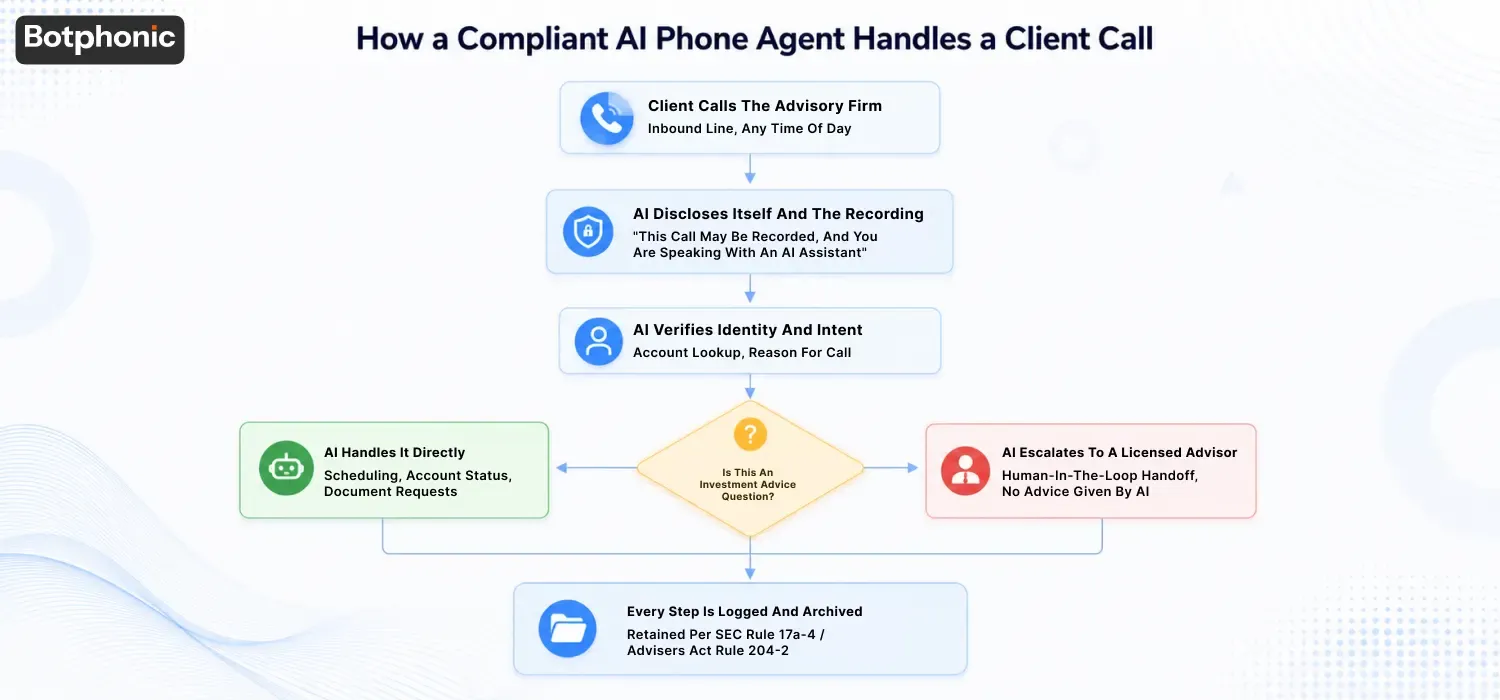
The reason why an AI phone agent cannot provide investment advice is that investment advice is a licensed and fiduciary activity and thus should go hand in hand with an advisor and his or her Form ADV. All AI-based systems should be developed in such a way as to detect advisory language in customer calls and divert the call to a human advisor.
There is no choice here since the rule that prevents a junior associate who picks up the phone from making any recommendations should be the limit in call handling by an AI phone agent as well.
Does SEC and FINRA Record Keeping Rules Apply to AI Handled Calls?
The rules of SEC and FINRA regarding record keeping should be applied to AI-handled calls in the same way as to emails or texts. According to Rule 204-2 of the Investment Advisers Act, all communications of RIAs should be kept for at least five years with the first two being readily retrievable (Cornell Legal Information Institute, 17 CFR § 275.204-2).
A similar standard exists for broker-dealers according to SEC Rule 17a-4, which mandates preservation of communication records in a tamper-proof and auditable manner (SEC.gov, Electronic Storage of Broker-Dealer Records). An automatically generated call transcript becomes a business record the instant it touches your clients’ business, even if a person did not type it out.
Enforcement by the SEC has not waned on this front either. In August 2024, 26 companies were assessed collective fines of more than $390 million for record-keeping violations associated with non-archived communications (SEC.gov, Press Release 2024-98). The January 2025 sweep added another 12 firms and $63 million worth of fines for this category of violation (SEC.gov, Press Release 2025-6). Firms should also understand the broader requirements surrounding AI phone call security and compliance before implementing any voice AI solution.
 NOTE
NOTE
What Are the Risks of Unauthorized “Shadow AI” Tools?
The risks associated with unauthorized “shadow AI” tools involve creating client records not being archived. Chatbots for consumers or a personal voice assistant that is used for writing a call summary may contain discoverable business communications not covered by compliance systems.
FINRA Regulatory Notice 24-09, published on June 27, 2024, reminds member firms that existing rules will apply entirely to the use of generative AI and large language models, including the requirements concerning recordkeeping and supervision (FINRA.org, Regulatory Notice 24-09). No exceptions exist in the rulebook.
How Can I Create an AI Governance Framework for Voice Interactions?
Executive Summary: The AI governance framework for voice interactions is a description of what an AI can say, log, and escalate. The framework combines NIST AI RMF approach to risk assessment and AI self-disclosure during the call along with guardrails which route advice-seeking language to a licensed advisor. These guardrails are to be updated quarterly.
An AI governance framework for voice interactions is a documentation of control measures concerning what the AI says, what it logs, and whom it reports. Here are the items included in such a framework for a financial planning practice.
What Is AI Risk Management for Phone Calls?
The process of AI risk management for phone calls includes auditing the reasoning of the AI prior to engaging in communication with the client and not only after the complaint has been raised. FINRA recommended advisory firms to use the NIST AI Risk Management Framework as the reference for such an audit process (FINRA.org, GenAI: Continuing and Emerging Trends).
NIST AI RMF, published in January 2023, divides AI governance into four functions: govern, map, measure, and manage (NIST.gov, AI Risk Management Framework). With regards to voice AI, this means testing call scripts, noting any edge case scenarios, and examining the transcript of the phone calls at regular intervals.
Why Should AI Disclose its Automation at the Beginning of a Call?
AI call assistants should disclose themselves at the beginning of a call because otherwise it will lack informed consent and might face regulatory actions. The compliant script clearly states that the client is being contacted by the AI assistant and that the call will be recorded.
This one-liner can serve as a double duty for SEO because it directly addresses the query put through Google. Consider it a mandatory part of the call flow process rather than a greeting that could be skipped.
How Do You Design Guardrails Against Prohibited Advice?
You design guardrails against prohibited advice by capturing every possible phrase pattern that indicates a request for a recommendation and putting a strict routing to a live advisor as the only possible course of action. “Should I sell”, “what would you buy”, and “is this a good time to” are the examples of phrases that should be included into such a list.
The reality in practice is that guardrails will have to be updated every three months since client language evolves, new products become available, and rules set becomes outdated after a few review cycles.
What Should RIAs Look for When Evaluating an AI Phone Agent?
Executive Summary: RIAs should check AI phone service providers for data residence, training of their models, and audit readiness, not for how slick the demo sounds. A purpose-built technology platform includes advice detection and call logging features required for Rule 204-2 and 17a-4 review out of the box.
The RIA will want to ensure that there is vendor due diligence for data management, model training, and audit readiness before entering into any AI phone agent agreement. The sales demonstration gives an indication of the capabilities of the solution; the due diligence checklist gives an indication of the consequences of those capabilities going sideways.
Data residency: Where are call records stored? Is the vendor using the data provided by the customer to train its models? Documentation: Can the vendor provide a call log, disclosure script, and change history for all updates? These are the same standards of audit readiness required for any system of record.
Purpose built solutions have a meaningful advantage over general purpose solutions on this criteria. Botphonic’s AI phone call automation is built from the ground up around logging and escalation rules. Many of the same evaluation criteria used when selecting AI phone software for banks and fintech companies also apply to advisory firms that operate under strict regulatory oversight.
| Vetting Approach | How It Handles Advice Boundaries | Recordkeeping Fit for RIAs |
| Consumer chatbot or generic voice assistant | No built-in advice detection; will attempt to answer anything asked | Poor — no archiving, no audit trail by default |
| General-purpose AI voice platform (unconfigured) | Guardrails possible but must be custom-built by the firm | Inconsistent — depends entirely on manual setup |
| Purpose-built financial AI phone agent (e.g., Botphonic) | Advice-detection routing built into the call logic | Strong — calls logged and exportable for Rule 204-2 / 17a-4 review |
 PRO TIP
How Will the RIA’s Advisor Role Change When It Uses an AI Phone Agent?
Executive Summary: Using an AI phone agent helps ensure better call coverage and consistency and does not affect the role of the advisor itself. Routine intake tasks are done through AI, while judgment calls are left to the licensed advisors, creating an easily reviewable timestamped record.
What will change is coverage and consistency, but not the role of the advisor itself. Calls are answered after business hours, the intake data collection occurs consistently every single time, and all conversations go into the archive rather than sticky notes.
Similar workflows are already used across regulated financial institutions, where AI phone calls in banking help automate routine service requests while escalating complex issues to human professionals.
Another unexpected benefit for the company would be having the data on what customers ask about. This information will contribute to compliance reviews and, with the appropriate level of privacy settings, will help to understand how AI phone calls are improving customer support at banking organizations dealing with similar issues.
PRO TIP
Is an AI Phone Agent Worth It for Financial Advisors?
Executive Summary: An AI phone agent is worth it if the compliance aspects are load-bearing rather than purely cosmetic. The value lies in having a defendable call transcript each and every time, against the backdrop of SEC recordkeeping fines totaling $390 million in a single 2024 enforcement round-up—a figure far beyond the usual cost of AI implementation.
An AI phone agent is worth it for financial advisors when the compliance aspects are load-bearing rather than purely cosmetic. It’s not just the speed of the response time, but the defendable transcript each time a call touches the client’s business.
The cost of ignoring the above-mentioned step is well-documented and growing. Regulators have levied more than $390 million in a single 2024 enforcement round-up (SEC.gov, Press Release 2024-98), a figure that puts to shame the cost of conducting intake automation properly from the get-go.
Cost of Non-Compliance vs. Investment in a Compliant AI Phone Agent (Annual, USD)
| Category | Annual Cost (USD) | Relative Scale |
| SEC recordkeeping fines — Aug. 2024 sweep, 26 firms (avg. ~$15M/firm) | $390,000,000 | ████████████████████████████████████████ |
| SEC recordkeeping fines — Jan. 2025 sweep, 12 firms (avg. ~$5.25M/firm) | $63,000,000 | ██████ |
| Enterprise-grade compliant AI phone agent (SOC 2, full audit trail, high call volume) | $42,000 – $120,000 | ▏ |
| SMB / mid-size RIA compliant AI phone agent (basic tier, moderate call volume) | $4,000 – $20,000 | ▏ |
Fine totals reflect combined penalties across all named firms in each SEC sweep, not a single firm’s exposure (SEC.gov, Press Release 2024-98; SEC.gov, Press Release 2025-6). Even measured per firm, the average penalty in the 2024 sweep — roughly $15 million — is over 100 times the high end of a typical annual compliant AI phone agent budget for a mid-size advisory practice (Callsphere, 2026; Retell AI, 2026).
Those making the decision must evaluate this as they would any other compliance solution; the vendor’s approach to the AI phone call security and compliance should be evaluated with the same due diligence as any custodian or portfolio management system. Technology should enhance the fiduciary nature of the advisor-client relationship; it should not cloud or complicate the issue, nor ever put a firm at risk of enforcement proceedings.
“Compliant by design” means the archiving and advice routing function is integrated into the product itself, as opposed to being an available configuration that a busy operations group may overlook.
