
Summarize Content With:
What You’ll Learn
- How AI receptionist call routing uses SIP trunking, STT engines, and LLM orchestration to classify calls
- What semantic routers and vector embeddings do, and how they differ from keyword fallbacks
- How per-intent confidence thresholds protect against misroutes and churn
- Where AI call routing fails: compound intents, context switching, and phoneme mapping errors
- What a real auto group gained by tuning confidence thresholds per intent category
Who this guide is for: Telecom Managers evaluating AI phone infrastructure, Customer Experience Directors responsible for first-call resolution rates, and Contact Center Operations leads configuring routing logic in platforms like Twilio Flex or Telnyx. If you own the decision on where calls go, this is for you.
AI receptionist call routing is the decision logic that determines where an incoming call goes, to sales, support, a specific agent, or no transfer at all. It’s built for businesses that handle high call volume. It matters because a wrong routing decision costs time, money, and the caller’s trust.
The routing architecture diagram above shows the full six-stage decision sequence from SIP ingress through LLM orchestration to final routing outcome. Each stage is covered in detail below.
What Is AI Receptionist Call Routing and How Is It Different From a Phone Tree?
AI receptionist call routing is a real-time decision engine. It replaces static menu trees with natural language understanding and dynamic routing logic.
Traditional phone trees (“press 1 for billing”) rely on the caller selecting the correct option. The caller does the classification work. If they guess wrong, they get misrouted, and they usually hang up.
AI IVR systems built on modern routing logic flip that. The system listens to natural speech, extracts meaning, and decides the destination. The caller says what they want. The system figures out where it goes.
The distinction matters because it changes who carries the burden of accuracy. With traditional IVR, the caller does. With AI routing, the system does.
 NOTE
NOTE
How Does the Technical Stack Behind AI Call Routing Actually Work?
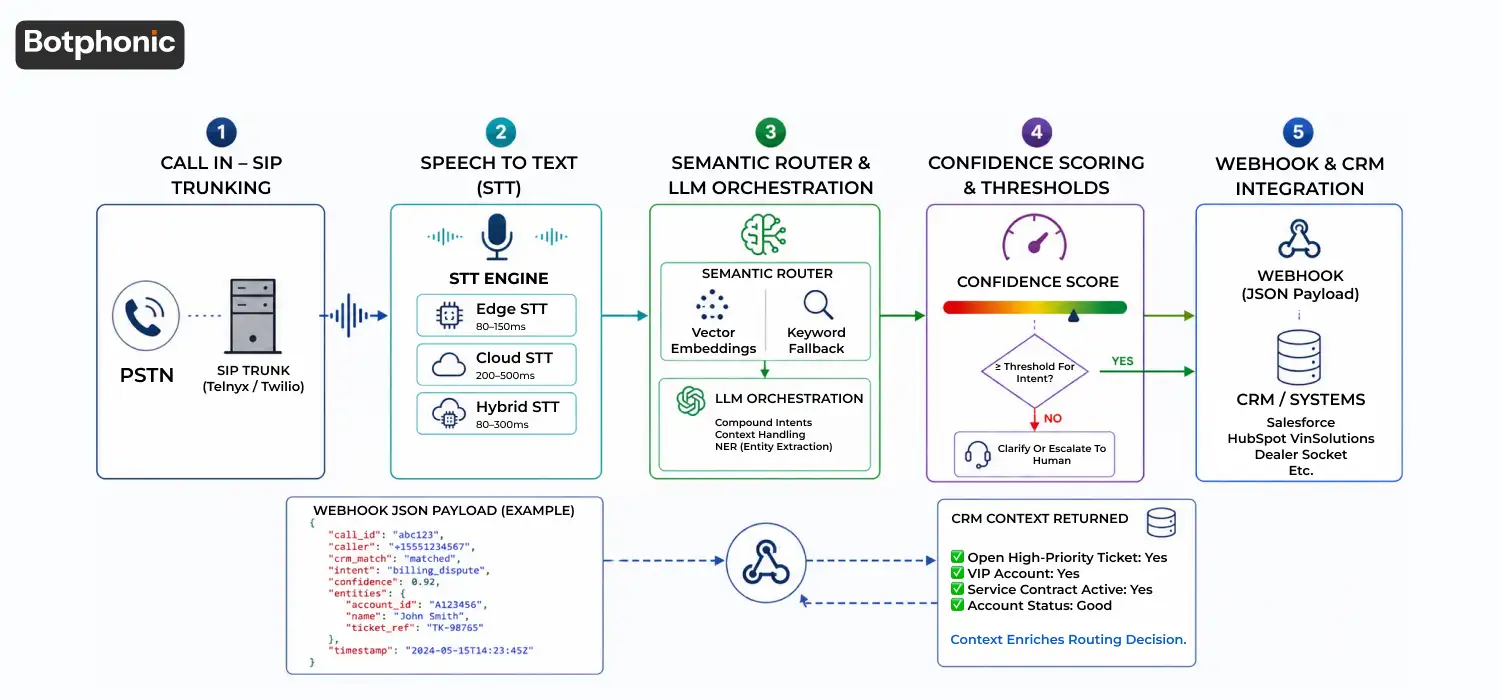
AI receptionist call routing runs on a layered technical stack. Each layer processes the call before passing output to the next.
Stage 1: SIP Trunking Brings the Call Into the System
SIP (Session Initiation Protocol) trunking is the connection layer that carries voice calls from the public telephone network (PSTN) into your AI routing system. Platforms like Telnyx and Twilio Flex handle SIP trunking natively, translating the incoming audio stream into a format the speech recognition engine can process.
Latency at this stage matters. A poorly configured SIP trunk adds 200–400ms before the AI even hears the caller, which compounds with STT and LLM processing time.
Stage 2: Edge vs. Cloud STT Engines and Their Impact on Routing Latency
Speech-to-text (STT) is where audio becomes text. Two deployment architectures exist, and they have meaningfully different performance profiles:
| STT Architecture | Typical Latency | Best For | Trade-off |
| Edge STT (on-premise / local) | 80–150ms | High-volume, latency-sensitive deployments | Higher infrastructure cost, less model flexibility |
| Cloud STT (Google, AWS, Azure) | 200–500ms | Rapid deployment, broad language support | Network-dependent, variable under load |
| Hybrid (edge primary, cloud fallback) | 80–300ms | Enterprise with redundancy requirements | Complexity of maintaining two pipelines |
Edge STT reduces the round-trip to the LLM orchestration layer by 100–350ms. For routing decisions that determine customer experience in the first 2–3 seconds, this is not trivial.
Phoneme mapping is the process STT engines use to convert acoustic sound units into text characters. Errors in phoneme mapping, especially on regional accents or industry terminology, produce transcription mistakes before the intent model ever runs. A caller saying “DEF fluid” may transcribe as “deaf fluid” in a general-purpose model without domain vocabulary tuning.
Stage 3: How Semantic Routers, Vector Embeddings, and Keyword Fallbacks Differ
The Semantic Router Principle: Intent routing should match meaning, not keywords, because callers never phrase things the way your routing rules expect.
Three approaches exist for mapping caller speech to a routing destination:
Deterministic keyword matching is the simplest approach. If the transcript contains “billing” or “invoice,” route to billing. Fast, auditable, brittle. Fails the moment a caller says “my card was charged twice”, a billing issue with no billing keyword.
Vector embeddings convert the caller’s utterance into a high-dimensional numerical representation (a vector). The routing engine then measures the cosine similarity between that vector and a library of known intents. “My card was charged twice” sits close to billing_dispute in vector space, even without the word “billing.” This is how modern AI phone call systems handle natural variation in caller language.
Semantic routers combine both: vector similarity for broad intent matching, keyword rules as a fallback when similarity scores are ambiguous. A well-configured semantic router uses vector embeddings as the primary mechanism and keyword matching as a confidence booster or tiebreaker.
Large Language Model (LLM) orchestration sits above the semantic router. The LLM handles compound intents, context-switching conversations, and edge cases the router can’t classify cleanly. It also runs Named Entity Recognition (NER), extracting customer names, account numbers, addresses, and dates from the transcript that travels with the call as structured data.
Stage 4: What Confidence Scoring Does (and Why Thresholds Are Set Per Intent)
Every intent classification produces a confidence score, a probability that the model’s prediction is correct. The routing system compares that score against a threshold. Below threshold: clarify or escalate. Above threshold: route.
The Operational Threshold Principle: Higher confidence thresholds protect customer experience by escalating to humans, but increase operational overhead. Lower thresholds reduce immediate overhead at the cost of higher misroute rates. The right threshold is different for every intent category, and must be tuned individually, not globally.
A single global threshold (e.g., “escalate anything below 70%”) is one of the most common misconfiguration errors in AI routing deployments. A schedule_appointment misroute is recoverable. An account_cancellation misroute is not.
Stage 5: Webhook Payloads and CRM Context Complete the Routing Decision
Before the routing decision executes, the system fires a webhook, an HTTP call carrying a JSON array of structured data about the call. That JSON payload typically includes:
- Caller phone number and CRM match status
- Detected intent and confidence score
- Extracted entities (account ID, service address, ticket reference)
- Timestamp and call session ID
This webhook payload can trigger actions in VinSolutions, Salesforce, HubSpot, DealerSocket, or any CRM with an API endpoint. It can also pull data back, checking whether this caller has an open high-priority ticket, is flagged as a VIP account, or is within a service contract window.
The JSON array structure allows multiple intents to be passed simultaneously, enabling multi-intent routing logic without a second API call.
Learn more: To know why we need AI call routing, click here.
Case Study: How a Mid-Sized Auto Group Reduced Misroutes by 34% via Per-Intent Confidence Tuning
A regional auto group operating six franchised dealerships deployed Botphonic’s AI receptionist across all locations. Initial routing used a single confidence threshold of 68% across all intent categories.
Baseline performance (Month 1):
- First-transfer success rate: 61%
- Misroute rate: 22%
- Escalation rate: 17%
- Average time to resolution: 6.4 minutes
The operations team identified that 71% of misroutes clustered in three intents: service_appointment, parts_inquiry, and account_cancellation. The general-purpose LLM handled common phrases well but failed on dealership-specific terminology, service advisors, VIN lookups, trade-in appraisals.
What they changed:
They switched from a general-purpose LLM to a domain-specific model fine-tuned on automotive service call transcripts. It also set per-intent thresholds rather than a global threshold:
| Intent | Baseline Threshold | Tuned Threshold | Rationale |
| schedule_service | 68% | 72% | High volume, low stakes if misrouted |
| parts_inquiry | 68% | 75% | Frequent jargon misclassification |
| account_cancellation | 68% | 88% | High churn risk if misrouted |
| trade_in_inquiry | 68% | 80% | Often confused with sales intent |
| general_inquiry | 68% | 60% | Low stakes, broad catch-all |
They also added phoneme mapping for 140 automotive terms (OBD codes, trim levels, manufacturer names) to the STT vocabulary layer.
Results after 90 days:
- First-transfer success rate: 83% (+22 points)
- Misroute rate: 14.5% (–34% relative reduction)
- Escalation rate: 12% (–5 points, counter-intuitively lower despite higher thresholds, because more calls resolved without transfer)
- Average time to resolution: 4.1 minutes (–2.3 minutes)
The operations director noted: “Our testing found that setting an account cancellation threshold below 82% consistently led to preventable churn. The customer got transferred to service when they were trying to cancel, and just gave up.”
The key variable was not the AI model. It was the per-intent threshold configuration and domain vocabulary, two changes that require operational knowledge, not engineering resources.
How Does AI Routing Compare to Traditional Automated Call Distribution?
AI routing is a classification-first system. Traditional ACD is a queue-management system. They solve different problems, and the best deployments use both.
| Feature | Traditional ACD | AI Routing (e.g., Botphonic) |
| Input method | Keypad selection | Natural language speech |
| Routing logic | Queue rules, skill groups | Semantic router + LLM orchestration |
| Customer data use | Limited | CRM lookup, webhook JSON payload |
| Compound request handling | No | Partial (model-dependent) |
| Fallback behavior | Queue overflow | Confidence-based escalation |
| STT dependency | None | Edge or cloud STT engine |
| Latency to decision | ~0ms (keypad) | 300–800ms (STT + LLM) |
| Routing adaptability | Static rules | Dynamic, tunable thresholds |
Traditional ACD still handles queue depth, agent availability, and workforce balancing well. The gap is in how the initial destination is determined, and how gracefully the system recovers when the caller’s request doesn’t fit a menu option.
What Metrics Tell You Whether Your AI Call Routing Is Actually Working?
Routing quality is measurable. These five metrics are the operational standard.
- First-Transfer Success Rate: the percentage of callers routed correctly on the first attempt. Industry benchmarks for well-tuned AI routing systems sit above 80%.
- Misroute Rate: calls sent to the wrong team or agent. Even a 10% misroute rate compounds into significant agent time and caller frustration.
- Containment Rate: calls resolved without any transfer. High containment indicates the AI phone call handled the request end-to-end.
- Escalation Rate: the percentage of calls that required human intervention due to low confidence. Too high means your intent library needs work.
- Confusion Matrix Audit Score: a model evaluation metric showing which intents are being misclassified as which other intents. A monthly confusion matrix review reveals systematic errors (e.g., billing_inquiry consistently misclassified as technical_support) before they become misroute patterns in production.
Making these systems work efficiently determines the future of customer support.
 PRO TIP
Where Does an AI Receptionist Call Routing Get It Wrong?
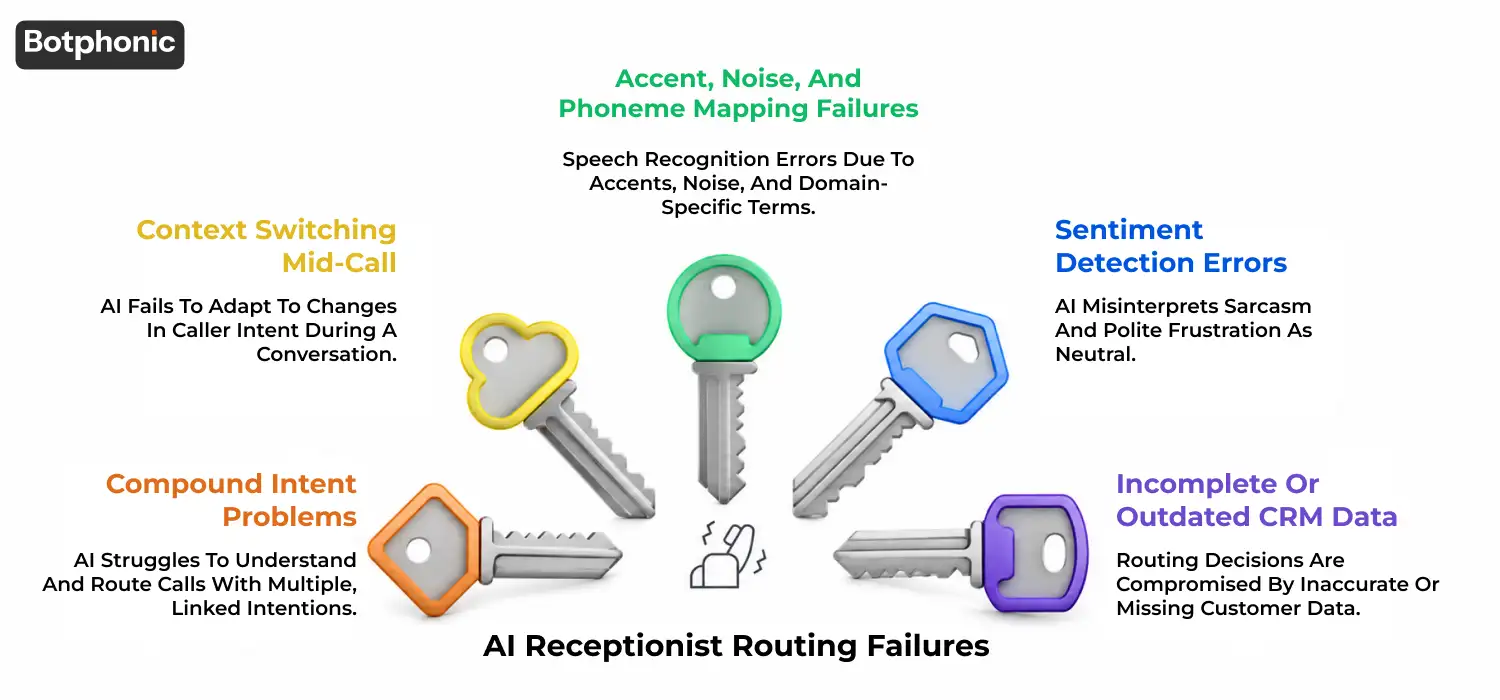
AI call routing fails in predictable patterns. Here are the five most common failure modes.
Compound Intent Problems
“I want to cancel unless you can lower my bill” contains three possible intentions: retention, billing_negotiation, and cancellation. Most routing models classify the dominant intent. They pick one. They’re often wrong.
The Compound Intent Principle: When a caller’s utterance contains logically linked but operationally separate intents, single-label classification will misroute, and the caller who reaches the wrong team is less likely to be retained than one who reaches no team at all.
Systems that handle compound intents require multi-intent JSON arrays passed through the webhook payload, a more advanced model configuration that not all vendors support out of the box.
Context Switching Mid-Call
A caller opens with “I need technical support” and then says, “Actually, can I get a refund instead?” Many routing systems track the first classified intent and stop listening. The call routes to tech support. The caller needs billing.
LLM orchestration at the semantic router level can handle context switching, but only if the conversation history is maintained in the context window and the routing logic evaluates the most recent utterance, not the first.
Accent, Noise, and Phoneme Mapping Failures
Speech recognition accuracy degrades with regional accents, background noise (workshop floors, call centers, vehicle interiors), and domain-specific terminology. Phoneme mapping errors at the STT layer produce transcription mistakes that no intent model can recover from downstream.
The fix is upstream: domain vocabulary expansion in the STT engine, not prompt engineering in the LLM.
Sentiment Detection Errors
Sarcasm and polite frustration read as neutral to most sentiment classifiers. “Oh, that’s just great” scores positive. A caller who is clearly upset but speaks calmly may not trigger the escalation flag, and gets routed through a standard flow while seething.
Incomplete or Outdated CRM Data
The routing decision is only as good as the data behind the webhook payload. A duplicate CRM profile, a missing account number, or an outdated service record causes the system to treat a returning customer as a new contact. They bypass priority routing, they get a generic intake flow. They call back.
In practice, what dealerships and multi-location service businesses actually experience is that 60–70% of their routing failures trace back to data quality issues in VinSolutions, DealerSocket, or their CRM of record, not to the AI model itself.
What Should You Do to Improve AI Call Routing Accuracy?
These five practices directly reduce misroute rates.
Set confidence thresholds by intent category. A threshold of 72% works for schedule_appointment. Use 85–90% for account_cancellation. The stakes of the misroute determine the threshold.
Apply a two-strike escalation rule. If the system asks one clarification question and the caller’s response still produces low confidence, escalate immediately. A second failed clarification destroys caller trust faster than direct escalation would have.
Run a monthly confusion matrix audit. Identify which intents are being confused with which others. That data tells you whether to adjust the threshold, add training examples, or refactor the intent definition.
Stress-test compound intent scenarios before launch. Run real-world conversation scripts through the system. Not “I need support”,but “I got a bill I don’t recognize and I also can’t log into my account.”
Keep your CRM data clean. The AI call assistant fires a webhook payload at the moment of routing. Duplicate profiles and stale records produce routing errors that have nothing to do with your AI model.
See how AI routing decisions happen in real time.
Book a personalized demo.