
Summarize Content With:
Introduction
A single brand can have three different experiences by calling three different places. Each performs with two rings, provides you a brand welcome and books you the same time. One leaves you on hold, and then takes a message that is never called back. One heads for a voicemail box which has been overflowing since spring.
The customer doesn’t say to himself, “That was a bad franchisee.” The customer says “That was a bad brand.”
This is the problem of multi-location consistency, it is the problem of the franchisor, not of anyone else. Each franchise is built on a commitment: it’s the same experience at the store in Tucson as it is at the store in Tampa. That is true for the storefront, the menu, the store signage, the uniform, and then fizzles at the one place the franchisor has the least visibility and control: the phone.
Today, forward-thinking networks are closing that gap with AI receptionists, purpose-built to deliver a brand-consistent call experience at every location, automatically, around the clock.
This guide is all about bridging that divide. It is written for the owners of brand consistency and capture across a network: the Franchisor CMO, the Franchise Operations Director, the Multi-unit Franchisee or Area Developer, the Single-unit Owner who’s going to live with the system and the Field Business Consultant who’s auditing compliance, one location at a time. These personas appear in §6 with what they are looking for.
On the page, you’ll find the following: what the consistency problem is and what it costs, who owns it, who pays to fix it (the franchisor/franchisee tension that breaks most networks), the call-routing architecture that makes a network sound like one brand, the franchise economics and FDD implications of a system-wide deployment, and a vertical-by-vertical and persona-by-persona breakdown.
The Multi-Location Communication Challenge
By definition, a franchise network is a system of independently owned businesses that share a common brand. That is the best part of the franchise model, and where this arises from the consistency issue.
Each location:
- Hires own Front Desk personnel (Turnovers vary, Training varies)
- Programs its own answer machine during rush hours (some put it in voice mail; some make it ring)
- Has its own after-hours handling (a few have a service; most have a voicemail box)
- Creates own informal telephone ‘script’ which over time deviates from the brand standard
- Has a follow-up discipline for missed calls (immediate call back to never)
 PRO TIP
The franchisor does not see the above in real time. The brand standards manual details the in store experience in great depth, and the phone experience, little. This is because there was historically no way for the franchisor to enforce or measure it, though AI-powered call handling now makes real-time monitoring and enforcement across hundreds of locations genuinely achievable
The outcome is inevitable: brand experience variance focused at the touch point where new customers and high intent leads are connecting with the brand for the first time.
The Cost of Inconsistent Customer Communication
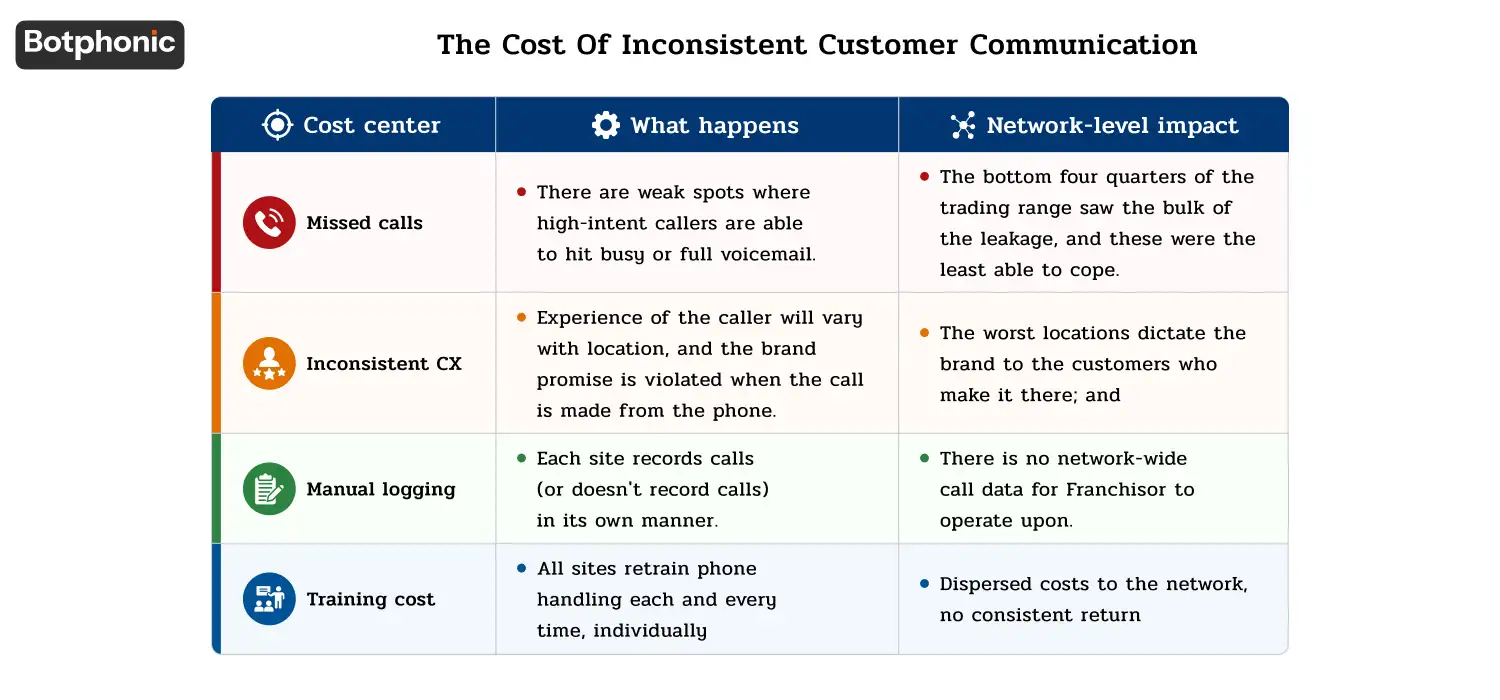
The cost can be seen in four locations. The table is preserved and framed as illustrative only; actual numbers will change depending on network size and vertical and baseline.
For a broader picture of what’s at stake across the industry, see our and growth data
| Cost center | What happens | Network-level impact |
| Missed calls | There are weak spots where high-intent callers are able to hit busy or full voicemail. | The bottom four quarters of the trading range saw the bulk of the leakage, and these were the least able to cope. |
| Inconsistent CX | Experience of the caller will vary with location, and the brand promise is violated when the call is made from the phone. | The worst locations dictate the brand to the customers who make it there; and |
| Manual logging | Each site records calls (or doesn’t record calls) in its own manner. | There is no network-wide call data for Franchisor to operate upon. |
| Training cost | All sites retrain phone handling each and every time, individually | Dispersed costs to the network, no consistent return. |
In most franchise systems, the poorest 20–25% of systems by call-handling quality have a disproportionate impact on brand perception: customers who have a bad experience blame the brand, not the operator. The weakest franchisee’s phone is the brand cost to the franchisor. how one network recovered 40% more responses by fixing this leakage.
Who Actually Has the Consistency Problem (and Who Pays to Fix It)
It’s the part most franchise-technology content skips and always the deciding part in a network rollout where the franchise advisory council meeting goes to make or break.
The franchisor’s view. The brand is the property of the franchisor, along with the brand NPS. They experience network level leakages, lack in consistency of experience and no visibility into how 200 locations answer the phone. They want one “standard” that is called by every brand, and has to be enforced and measured throughout the network.
The franchisee’s view. A P&L is in the hands of the franchisee. This is not the first time they have heard ‘HQ has a new mandatory tool’. Their gut is: “Another expense on my bill, another thing they control, and “is this going to replace my front desk and mix up my regulars?” The majority of rollouts for network call standardization die because of franchisee resistance and not technology.
 NOTE
NOTE
The Resolution that Actually Works
The system actually works with just three moves:
- See the system as a brand asset, rather than a tool. No different than signage, uniforms, the franchisor’s responsibility is to ensure consistency at the phone. The call standard is a choice of the brand and not a choice of the franchisee.
- Fund it correctly. A network-wide call system is funded by the brand/national marketing fund instead of billed to the P&L of the franchisee where possible. The benefit of the marketing fund isn’t that you’re going to receive a line item of brand consistent lead capture, it is that you will receive it. A rollout that has to go on the franchisee’s P&L requires the franchisee to be able to see a return on their investment, (ROI) in their own numbers (Missed call revenue > cost). See our pricing page to model that ROI before your advisory council meeting.
- Provide the franchisee with something that they desire. The franchisee receives after hours coverage, after hours overflow handling and missed call recapture that brings cash in their pocket. It is not brand compliance, it is pitch to the franchisee.
Lead and data ownership. This is a real franchise legal minefield. Who owns the call data and leads in a network deployment: Franchisor or Franchisee? Both parties must agree upon the answer in a contractual agreement beforehand because every franchisee will certainly ask this question. You must explicitly specify these terms in the franchise agreement and the system’s data-handling terms: “The franchise agreement and the system’s data-handling terms must clearly define data ownership and data leadership between the franchisor and the franchisee.” Consult your franchise counsel and avoid making any presumptions about defaults.
The Franchise Economics and FDD Implications
A franchise-wide customer-call network requirement directly impacts your Franchise Disclosure Document. You cannot choose whether to include this information; you must place it on the page because every franchise buyer’s counsel will raise questions about it.
Franchisor requirements or legal mandates for a call system involve multiple FDD items.
- Item 6 (Fees) any fee that a franchisee has to pay the system on a regular basis
- Unit opening requires a setup cost; enter the estimated cost in the field below. If unit opening requires a setup cost, enter the estimated cost in the following field (Item 7 – Estimated Initial Investment).
- Franchisors must justify forcing franchisees to use a specific provider for a product or service. If you oblige a franchisee to use a specific source for a product or service, you must justify using that provider.
- Number 11 (Franchisor’s Assistance, Advertising, Computer Systems): the franchisor’s responsibilities for the system and any needed technology
This also holds true with funding pathway. A system utilising the national/brand marketing fund is subject to the marketing-fund rules of the franchise agreement (usually Item 11 and the ad-fund accounting). A direct-to-franchisee system is a fee charged directly to the franchisees. The disclosure/franchisee-consent dynamic varies with the two.
We preface all of this with the following statement: “This guide does not constitute legal counsel; a franchisor’s counsel must review these factors before you issue any network-wide mandate. Don’t reach any legal conclusions on page.
The Call-Routing Architecture That Makes a Network Sound Like One Brand
It’s a routing-architecture issue, not a script issue. The routing layer is what makes a network sound like one brand. Today’s AI receptionist implementations add an intelligence layer on top of this architecture, handling qualification, booking, and after-hours intake without staffing each location differently.
| Routing layer | What it does | Why it matters for consistency |
| National number + geo-route | One brand number; caller routed by area code / ZIP / IVR selection to the correct location | Customer always reaches the right local unit through one brand-consistent front door |
| Local-number capture | Calls to the franchisee’s existing local number also flow through the brand standard | Consistency holds whether the customer dials national or local |
| Overflow pooling | When a location is slammed, calls pool instead of dropping | The busiest locations stop leaking their highest-intent calls |
| After-hours central | One brand-consistent after-hours experience network-wide | Replaces 200 different voicemail boxes with one standard |
| Abandoned-call recapture | Calls that drop before connecting are identified and called back | The franchisor-level play that recovers the leakage concentrated at weak locations |
| Territory / lead-ownership routing | A lead from an overlapping or undefined territory is routed by the network’s designated-territory rules | Prevents franchisee disputes over who owns a national-number lead |
| Master-franchisee / area-developer tiering | Multi-tier routing for networks with regional developers or master franchisees | Respects the franchise structure’s contractual hierarchy |
The script layer is built on top of this: a single brand approved call standard, managed by the franchisor as a brand asset, which all locations’ routed calls follow. The control is what makes the system and the franchisee can’t change the brand-approved script to suit themselves just as they cannot repaint the brand logo if they wish.
PRO TIP
Persona Playbooks and Vertical Quick Reference
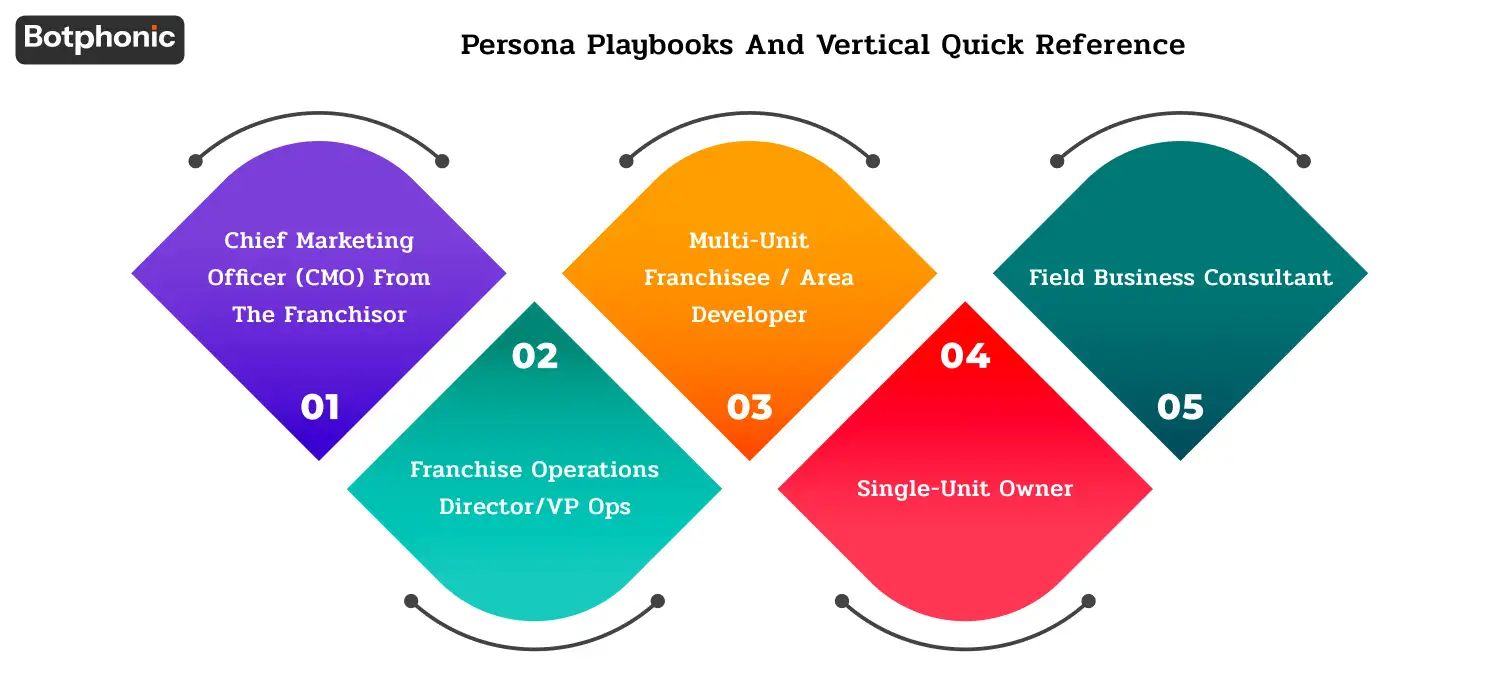
Personas
- Chief Marketing Officer (CMO) from the Franchisor. Monitors brand NPS, ROI on leads, and ROI on marketing funds. Deploy priority: abandoned call recapture – network-level lead recovery, network QA scorecard – consistency measurement by location.
- Franchise Operations Director/VP Ops. Has brand-appropriate enforcement and field consulting. Priority deployment: the brand-approved call standard, which the field consultants can act on, with per-location compliance scoring.
- Multi-unit Franchisee / Area Developer. Has a PL with multiple units. Priority deployment with overflow pooling + after-hours central, across all owned units (labor savings + recovered revenue at scale).
- Single-unit Owner. Has one facility, will reside in the system every day. Revenue that they personally feel is priority: missed call recapture, reassuring the system is not replacing their front desk.
- Field Business Consultant. Compliance Auditing – Location Wise. The per-location consistency dashboard is the priority-deploy, which replaces mystery call audits with continuous measurement.
Vertical quick reference
| Franchise vertical | Top consistency issue | Top routing requirement |
| QSR / food | Call abandonment during rush hours; variability in order accuracy | Pooling & routing for overflow |
| Fitness | Loss of leads for membership inquiries at underperforming clubs | Recapturing abandoned calls & booking tours |
| Beauty / salon | Variability in booking; variability in no-shows | Geo-routing & appointment booking |
| Home services (HVAC/plumbing) | Wildly inconsistent handling of after-hours emergencies | After-hours routing & dispatch routing |
| Automotive | Handling of service appointment & parts calls varies | Geo-routing & department routing |
| Healthcare / dental DSO | Variability in handling compliance-sensitive intakes | Brand standards & compliance escalation |
| Real estate brokerage | Disputes over lead ownership on inbound calls | Territory/lead ownership routing |
| Education / tutoring | Handling variability for enrollment inquiries | Recapture & enrollment bookings |
| Pet care | Handling variability for appointments & after-hours emergencies | After-hours routing & appointment bookings |
| Senior care | Sensitive-inquiry handling variance | Brand standard + human escalation |
Franchise Compliance and Data Security
A franchise system has numerous locations in multiple states. This means it is not a location problem, it’s a network problem.
- Collecting consent for multi-state TCPA. Federal TCPA is network wide, applies to outbound (missed-call recapture, follow up). The laws governing recording consent vary from state to state; some states are two-party (California, Florida, Illinois, and others). When deploying a network, the strictest state in the footprint applies throughout the deployment. One network policy (highest) is beating 200 location-specific policies.
- This system eliminates waste at every turn of the screw. Locations cannot perform Do Not Call scrubbing individually; if they do, the brand assumes the liability.
- Control of the call standard by brand and trademark. The call script that has been approved by the brand is a brand asset. Franchisees cannot change it without consulting with the franchisor. It is a consistency mechanism as well as a trademark-control mechanism: the franchisor is controlling the way the brand speaks.
- FTC Franchise Rule + FDD linkage. Covered in §4, a required network call system entices FDD disclosure. Be sure to cross-reference and reinforce: a franchisor’s franchise counsel should review before a network-wide mandate.
- Data residency. Ownership of data (as defined in §3) of a U.S. data storage provided to a U.S. franchise network with a contractual definition of the ownership of data between the franchisor and the franchisees.
Final Verdict
The multi-site consistency challenge is an unavoidable reality: a federation of independent owners operating under a single brand will introduce variability at the point of least supervision, which is the phone call. The franchisor bears the burden of brand costs associated with the poorest-performing franchisee’s phone handling.
Addressing this gap is not about technology but rather franchising governance: set the phone call standard as a brand asset; fund it via the proper pathway; sort out data rights in the agreement; gain support from the advisory council; and launch it in stages, with the lowest quartile being the priority. Read our step-by-step AI receptionist implementation guide for the full rollout playbook
Would you like a 30-minute consultation on how to build a franchise-wide phone network? It’ll cover your network topology for your network organization, the available funding pathways, the FDD questions you should ask your franchise lawyer, and pilot plans for your advisory council. Schedule a consult below.
Bring your Operations Director; we’ll bring the network roll-out strategy.
Schedule a 30-minute franchise network consultation.
Book a Demo